Explore professionally built ETF model portfolios. Discover now →



The Low Volatility Anomaly
Low volatility investing allows investors to minimize market volatility, while also remaining invested through varying market cycles.


Keep up with what matters in ETFs
Get timely ETF insights, market trends, and top ideas straight to your inbox.
Your newsletter subscriptions with us are subject to ETF Central's Privacy Policy and Terms and Conditions.
During periods of high market volatility, the natural inclination of investors is to pivot towards asset classes, such as cash, for safety. But there is an alternative course of action, Low Volatility investing, a proven factor-based investing style that investors can utilize during periods of market uncertainty and for achieving their long-term investment objectives.
Like what you're reading?
Stay in the loop — get the latest ETF insights: trends, analysis, and expert picks.
What is the low volatility anomaly?
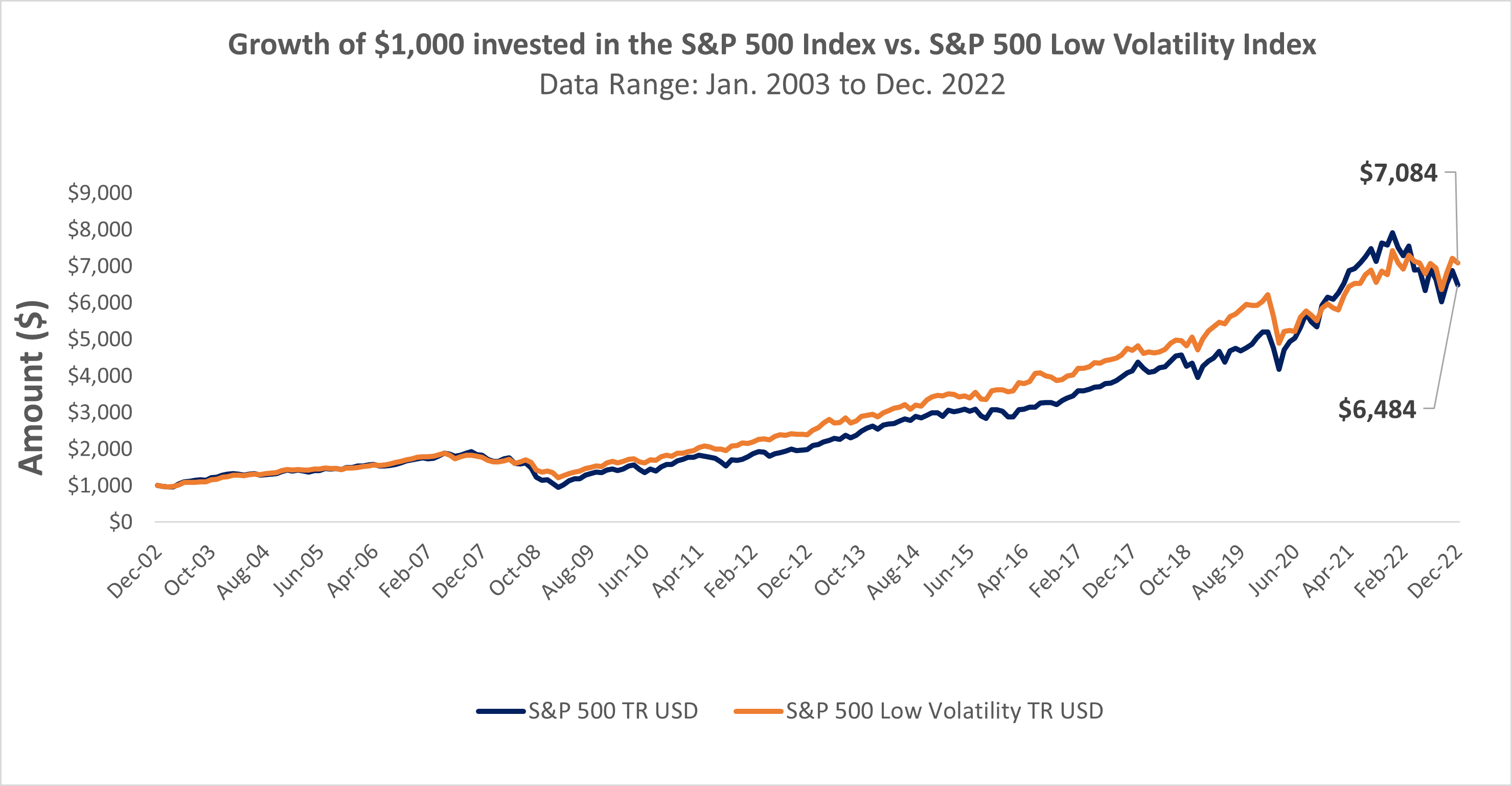
The low volatility anomaly refers to the phenomenon where stocks with lower volatility tend to outperform stocks with higher volatility over the long term. This anomalous behavior is mystifying, as it goes against the central premise of financial markets – taking higher risk, must be compensated with higher return. In viewing the long-term performance of the S&P 500 Low Volatility Index over the past two decades, it has outperformed its parent index, the S&P 500 index.
Understanding the basis for performance
Low volatility portfolios are comprised of stocks that are less volatile than their peers, which means that on a risk-adjusted basis, they should exhibit superior performance and provide exceptional returns relative to other portfolios. Low volatility can be measured in two ways. The first is the standard deviation, which measures the volatility of each stock on a standalone basis, and the second is beta, which measures a stock's volatility and correlation relative to the overall market. The market has a beta of 1.0, so a stock with a beta below one is considered less volatile than the market and vice versa for a stock with a beta above 1.0.
Low volatility portfolios are not impervious to market drawdowns, as over the last two decades, equity markets have faced numerous shocks to the system. When those situations have occurred, low volatility portfolios have generally managed to outperform (i.e. lose less) than the broader market.

Why consider a low volatility portfolio?
Financial markets and the macroeconomic environment are currently in a precarious position. For investors with a low risk tolerance or individuals that believe they can ‘time the market’ – low volatility investing is an approach that they should consider adopting. As observed from the market environment of 2022, all asset classes can be adversely impacted during a market downturn and engaging in ‘market timing’ as a risk management approach does not result in long-term success. Low volatility investing allows investors to benefit from a proven investment strategy that provides them with innate risk-mitigation and a selection of equities best suited to thrive during the ups and downs of an economic cycle.
For investors seeking to access low volatility solutions, Invesco offers a broad suite of low volatility ETFs focusing on different segments of the equity market. Fidelity also has a low volatility ETF, but its focus is purely on the broad US equity market.
- SPLV: Invesco S&P 500 Low Volatility ETF |E/R: 0.25%
- XMLV: Invesco S&P MidCap Low Volatility ETF | E/R: 0.25%
- XSLV: Invesco S&P SmallCap Low Volatility ETF | E/R: 0.25%
- EELV: Invesco S&P Emerging Markets Low Volatility ETF | E/R: 0.29%
- IDLV: Invesco S&P International Developed Low Volatility ETF | E/R: 0.25%
- FDLO: Fidelity Low Volatility Factor ETF | E/R: 0.29%
Please note this article is for information purposes only and does not in any way constitute investment advice. It is essential that you seek advice from a registered financial professional prior to making any investment decision.
Latest ETF News
See all ETF newsWhich Fixed-Income ETFs Benefit from Rising Interest Rates?


MoneyShow Chart of the Day 9/4/26: Don't Just Watch Oil. Watch THESE.


Chart of the Day 8/14/26: The Great "Hot Money" Migration

MoneyShow Chart of the Day 7/29/26: Now, THAT's What I Call Market Rotation!




 Advantages of ETFs over Mutual Funds1/6
Lower Costs
In this guide, we'll explore the advantages of ETFs over mutual funds, giving you valuable insights into why ETFs have gained significant popularity among investors like yourself.
Leveraged ETFs: Unlocking the Potential for Amplified Returns1/6
Understanding Leveraged ETFs
Explore leveraged ETFs: potential for amplified returns & risks. 5 ETFs to consider across equities, commodities & fixed income.
What is a Leveraged ETF?1/6
Introducing Leveraged and Inverse ETFs
In this guide, we'll dive into the world of leveraged ETFs, exploring their definition, mechanics, potential risks, and rewards.
Recent educational content

ETF Trends
ETF Industry KPIs September 14, 2026
This week’s KPI data overview highlights key metrics and trends shaping the ETF landscape.

ETF Trends
ETF Industry KPIs September 8, 2026
This week’s KPI data overview highlights key metrics and trends shaping the ETF landscape.
ETF Trends
ETF Industry KPIs August 31, 2026
This week’s KPI data overview highlights key metrics and trends shaping the ETF landscape.
ETF Trends
ETF Industry KPIs August 24, 2026
This week’s KPI data overview highlights key metrics and trends shaping the ETF landscape.
Browse all educational columns



Build and Analyze Your ETF Portfolio Like a Pro
Create your own ETF portfolio in minutes and instantly see allocations, exposures, performance, and risk. Visualize diversification across asset classes, regions, and sectors. Stress-test ideas, compare benchmarks, and refine your strategy with professional-grade analytics.