Open Now: The Global ETF Survey Take the Survey →



We Talk Careers - Portfolio Managers
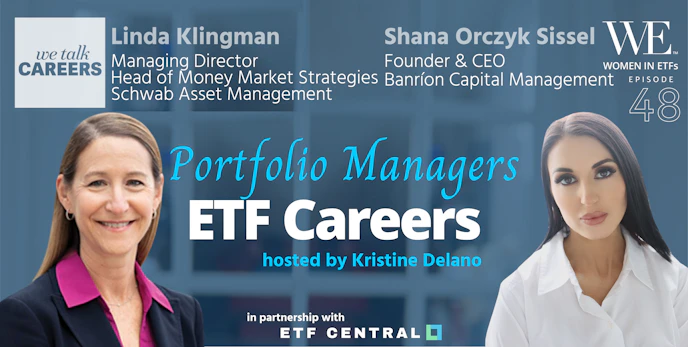
Linda Klingman and Shana Orczyk Sissel join We Talk Careers Podcast to discuss the position of portfolio manager and how to be successful in this role.

Keep up with what matters in ETFs
Get timely ETF insights, market trends, and top ideas straight to your inbox.
Your newsletter subscriptions with us are subject to ETF Central's Privacy Policy and Terms and Conditions.
On today’s episode, we are talking about the quintessential role of Portfolio Manager. They oversee the management and performance of a fund. What does it take to be successful and how do you get tapped for the role? Today we have Linda Klingman and Shana Sissel joining us.
Linda Klingman is a Managing Director and Head of Money Market Strategies for Schwab Asset Management. She leads the portfolio management teams for Schwab Money Funds and has overall responsibility for all aspects of the management of the funds. Linda earned a Bachelor of Business Administration from Stephen F. Austin State University. Linda lives in the San Francisco Bay Area and is an avid gardener, growing many types of fruits and vegetables to share with family and friends throughout the year. When she’s not managing money funds or in the garden, she is traveling to places far and wide or spending time in Key West, Florida.
Like what you're reading?
Stay in the loop — get the latest ETF insights: trends, analysis, and expert picks.
As CEO of Banríon Capital Management Shana Orczyk Sissel helps independent advisors navigate the complex world of alternative investing, bridging the gap between public and private alternative investment opportunities. Shana earned her nickname as “Queen of Alternatives” from her industry peers and wears the “crown” with great pride. Shana earned a Bachelor of Science Degree in Sport Management from the University of Massachusetts at Amherst before receiving her MBA from Bentley University’s McCallum School of Business. She is a proud holder of the Chartered Alternative Investment Analyst (CAIA) designation. In her spare time, Shana enjoys horseback riding, traveling, and spending time at the beach, regardless of the season.
Kristine Delano guides the conversation about the importance of making connections with clients, managing goals, and having mentors.
Listen here
Listen on your favorite podcast platform. We Talk Careers Podcast.
Follow on Instagram kristine.delano.writer
Visit www.womeninetfs.com to find additional support in the ETF industry.
Go to www.kristinedelano.com for your Thrive Guide: a compilation of the most requested and insightful advice from our guests on Leadership and Advancement.
In partnership with https://www.etfcentral.com/
Book recommendations:
- Risk: The Science and Politics of Fear by Daniel Gardner
- Who Moved My Cheese by Spencer Johnson, M.D.
WE Talk Careers Podcast Episode Links:
Your Personal Brand with Sue Thompson
Transcript
Kristine (00:01):
Welcome to the We Talk Careers podcast, brought to you by Women in ETFs. This is Kristine Delano, and I'm thrilled you've joined me. If you're pursuing excellence in your own career, or intrigued by the hustle required for a career on Wall Street, this podcast is for you. We've made all this advice accessible. Grab your own Thrive Guide with a workbook on leadership skills at kristinedelano.com. So put aside that massive to-do list and let's get inspired. Today we're talking about the quintessential role of Portfolio Manager. Among many responsibilities they oversee the management and performance of a fund. What does it take to be successful and how do you get tapped for this role? We have Linda Klingman and Shana Sisel with us. Welcome to the We Talk Careers podcast.
Linda (00:56):
Thank you. Thanks for having me. It's a pleasure to be here.
Kristine (00:59):
Thank you. Awesome. Well, it's so great to have you both, but Linda, let's start with you. Please introduce yourself to our listeners.
Linda (01:08):
Hi everyone. My name is Linda Klingman. I'm managing director and head of Money Market Strategies for Schwab Asset Management. I have been in the industry close to 40 years, 32, almost 33 of those with Schwab. I joined upon the launch of the firm's investment management business back in 1990. I lead a team of 10 portfolio managers who are responsible for the investment activities of the Schwab money market funds across several different sectors. So it's been a fantastic close to 40 years in the industry.
Kristine (01:47):
Wonderful. And what about passions outside of work? Tell us a little bit about yourself.
Linda (01:53):
Oh, yeah. Well, when I am not managing money market funds, I'm actually, I would say a little bit of a farmer. I love to garden. I have quite an extensive vegetable garden which I supply my family and friends with fresh vegetables throughout the year, some fruits and citrus and such as well. And then also along with gardening, I love to travel. So a little more off the beaten path is generally where I try to go. But I've hit many of the continents and I think I'm up to 46 countries maybe. So travel, gardening and I would say, portfolio management, those are kind of my three passions and hobbies, I guess I would say.
Kristine (02:37):
Oh, that's fantastic. I started vegetable gardening a few years ago and realized that traveling was like a big issue with actually having a garden. I felt like I had to like line it up like I had a pet, you know, someone needed to water, someone needed to weed, someone needed to do something with my garden. So I didn't really find a great balance with that. So it sounds like you have, which is great.
Linda (02:57):
Well, I don't know. I agree. You have to really plan for it, and I find the same issues that you've had, but, it's fun.
Kristine (03:07):
Wonderful. And Shana, how about you? Can you tell us about yourself?
Shana (03:11):
Sure. As you introduced myself, my name's Shana Sissel. I'm the founder and chief Executive Officer for Banrion Capital Management, a firm that I started a little over a year ago. We help financial advisors manage alternative investment portfolios, which is a little different than Linda's background with money market funds. We are manager of manager approach, and that is what I've been doing for the last 15 plus years of my career. 23 years in the industry. I actually started my career as a financial advisor. So I have a pretty deep understanding of the day-to-day experience of what it means to be a financial advisor, which I think has really suited me and served me well in my career as I've worked in portfolio management because half the battle is being able to connect with the folks who are gonna be your investors, answer their questions.
Shana (04:18):
And because I work in a fairly complex area of alternative investments, it's even more critical. I started doing portfolio management at Russell Investments where I supported a broader team in the hedge fund group and have been managing money ever since. One time, managed a billion dollar plus sleeve over at Fidelity, and also managed, um, a billion dollar plus fund with Mercer Global Investments as an assistant PM on the international side. So, I've been doing this for quite a long time. Not as long as Linda, but I'd like to think that with every market cycle and every new opportunity you learn something new. That's what makes this industry so interesting and compelling and why I love what I do.
Kristine (05:14):
Oh, I love that. And congratulations on this firm. I know you've been successful and I've loved all of your appearances, so thank you so much for spending some time with us today. Can you tell us about outside of work, some of the passions you have?
Shana (05:30):
Yes. So I too love to travel. I have not been able to do it nearly as much as I would like, especially international travel in the last few years, just for a variety of reasons. But when you are a founder of a startup, it's a pretty time consuming job. So, you know, from that perspective, I need to get back. There's a whole bunch of countries on my bucket list that I need to catch up to Linda. Yes <laugh>. Other than that, I enjoy horseback riding. That is something that I love doing and don't get to do enough these days. And I'm a big, big, big lover of the beach, and it doesn't need to be during warm weather. The beach in general is a place that I find, you know, solace. I do travel to Cape Cod quite a bit. I grew up in Massachusetts. My family lives in central Massachusetts, but I will always travel to Massachusetts and they will always come to Cape Cod. Because no one in my family dislikes the beach again, doesn't matter the time of year, <laugh>. So anytime I can get an Airbnb on the beach in that area, I'm in my happy place. I absolutely just love being by the ocean. And Chicago doesn't, you know, the lake is a good proxy, but it's not the same.
Kristine (06:56):
No, I've lived on a lake for the last 20 years or so. Now, we live kind of downtown, but still have the house. And I always just thought it was about the water, but I grew up on an island, and so now I'm a lot more about being in the ocean. We just got back from Roatan not too long ago, and the snorkeling and the scuba diving, and it just calls to me now. And it's just been odd that as I've grown older, the more and more it is the passion of my youth that comes back to me. So I share the love of the beach, but I tend to like to get quite off the sand, quite <laugh> quite quickly and, and get right into the water.
Shana (07:35):
I do love the water. Cape Cod has the shark thing though. That makes it a little more interesting. I have downloaded the Shark Finder app, which actually tells you where the sharks are. And it's actually something I've become quite obsessed with this idea of the great whites returning to Cape Cod and understanding their habitat and where they like to be. And to your point, I actually love getting in the ocean and kind of knowing that, like I'm in another species world there. And there's something really interesting and almost humbling about knowing that you're somewhere that is not your native habitat. And understanding and getting to know the world of other species and the great whites on the Cape have become a bit of an obsession. I will watch every Shark week documentary that is related to that. And it does not freak me out in the least bit. It's actually something I find quite beautiful.
Kristine (08:42):
I think it is. We were just snorkeling in Roatan across a reef, so we were about a hundred yards or so out, from the shore. And we were above a reef in about two feet of water and a reef shark, which is pretty large. It came like swimming right in front of us, sort of perpendicular to the way we were going. And my daughter was behind me and so I lifted my head up because we were just snorkeling at that point. And I said, do you wanna follow? And she's like, uh, no <laugh>. And I'm like, yeah, probably good idea. <laugh>. And so we sort of held back, because sometimes they, you know, they travel a few of them together and we didn't see any others. And to me, they're just so beautiful. And, you know, I've run into a number of sharks, scuba diving and snorkeling and have never had any issues.
Kristine (09:27):
But it is just this appreciation of being in someone else's world, which frankly, kind of getting back to our podcast on portfolio management is the reason I do this. It’s opening up a world that for some people is just sort of a very different world with almost a different species of people that occupy it. And what does it take to thrive in the world of Wall Street and high finance? So thinking through portfolio management and how, you know, essential this is to a firm. Can you tell us, Linda, a little bit about your role and how it fits with the overall trajectory of your firm?
Linda (10:10):
Yeah, so I am responsible for the investment of about 450 billion in clients' assets. And it's a responsibility I take extremely seriously. You know, really recognizing the trust that our shareholders are placing in me and my team to effectively manage and safeguard their assets. You know, we really treat our clients' assets as our own. And again, it's a very big responsibility to make sure that we're managing markets, that we are helping our investors with their financial fitness and essentially owning their tomorrow, which is something that is really important and the way that we view through clients' eyes, our investment approach.
Kristine (10:54):
Thank you. And, Shana, how do you see portfolio management and how does it integrate with what you are doing for your clients at your firm?
Shana (11:03):
Well, it's the foundation on which the firm is built. Everything that we do at Banrion is about helping advisors and their clients understand and build portfolios that they can stick with and sleep well at night. It's a thing I like to say all the time is, having a plan is great, but advisors' entire reason for being is to help their clients meet their goals. And you'll never get fired because your performance wasn't stellar. As a manager of managers, I've never fired someone for under performance, but I have fired folks and advisors will get fired if you're unable to meet the goals of which you've set out to achieve. And so at Banrion, the focus is to provide portfolios that help clients meet their goals and also help clients stick with how they have chosen to invest so they have the best shot to meet their goals and just being really realistic about it. So I view portfolio management as not really about managing assets. It's about managing goals, and it's about educating to make sure that clients can get to where they want to go. And the performance is secondary. No one is going to give you extra fees or anything to that extent. Although in the hedge fund world, you know, that's a little different because you outperformed by, you know, 2000 basis points, but you will a hundred percent get fired if they aren't able to send their kid to college like they plan.
Kristine (12:40):
Right. So let's dive into that a little bit because I think most people who have an outside view of portfolio management would say it would be all about the assets. So I love that you're provocatively kind of thinking through this. It's a management of the goal. So give me an example of what one of those goals might be, or maybe a client that came to you with something that was interesting to what it is that you needed to manage.
Shana (13:06):
Well, I can't say that there's been unusual goals. You know, most people have the same goals. I wanna retire and be able to live my retirement comfortably. I want to send my child to college, I want to buy a house. All those are the typical goals that people put in place for themselves. It's about achieving a lifestyle more than anything else. And so I can't say that there's been something. I'd love to have like a super unusual story, but I don't. The goals of most people are pretty similar and really it's about managing those expectations. And at Banrion, our focus is to help advisors use alternative investments to do that because we believe that lowering the volatility, making it easier for these clients to ride through the difficult times with these portfolios is important. And it's even more important when you're focusing on goals because goals have an end date, and the last thing that you want to happen is to have a difficult market condition on the end date. And all of a sudden you aren't meeting your goal because there was a 20% drawdown in the market and your portfolio's down 20% and now you can't retire when you wanted to, or you're not able to send your child to school. So we really focus on building portfolios and educating our clients to be able to understand the importance of this goals-based approach, because 99% of investors are investing for that reason to grow their wealth to meet some goal. So we like to focus everything we do around that approach.
Kristine (14:53):
What I find intriguing about the way we've sort of structured these podcast episodes is finding people from very different sort of walks of life in terms of the approaches that they have to these careers. So, you know, very different companies, very different backgrounds. So Linda, in thinking through what Shana just explained as to the role of portfolio management being managing goals, are there pieces of that that resonate with you? And is there anything that you find different in your day-to-day of managing portfolio managers?
Linda (15:27):
Yeah, no, it absolutely resonates. I do totally agree that people are managing for goals for a specific reason. You know, I manage portfolios on the short end of the market. It's kind of investors cash portion of their portfolio, if you will. And so we're all about making sure that we maintain strong liquidity in the funds. So investors, you know, people are using money market funds for, you know, again, expenses, short-term needs and some long-term needs. So we are, again, making sure that, you know, we can meet investors' goals by providing liquidity, stability of capital, and just a stable investment for them. And so that is something that we are focused on. Myself and my portfolio management team as we're watching the markets, we follow the Federal Reserve very closely, very direct impact on the short-term markets. And so we are really cognizant of making sure that we're safeguarding clients' assets so that they can meet their goals, and investment objectives.
Kristine (16:40):
Thank you. So I have a junior in high school. So he is really looking at colleges right now, like, he actually calls it a bit of an obsession, which I find rather refreshing as to other things he could be obsessed with. And so we've been going through lots of different types of careers. My husband, who's an architect, and I, we just kind of always kind of talk through the types of things that my son loves, sociology and social justice and what really motivates people as well as sort of civilizations. And I find myself, when we're talking about careers being very task oriented with how I lay it out, right. So I'm like, well, this type of person does this, this and this on sort of a daily basis. But when I look back at my own career, I think, wow, it's a lot more about relationship management, it's a lot more about collaboration, it's much more people driven, but I'm not sure quite how to do that from the outside. You know, how I could look at a role in say, urban planning and figure out what are all the nuances of the people driven side of it. So maybe take us into your worlds. Shana, I'll start with you a little bit with what parts of your job are task oriented and what parts really are about sort of relationship and collaboration?
Shana (18:01):
Well, honestly, the benefit of running my own firm is I get to delegate a lot of the tasks. Those are things like creating fact sheets and making sure we have regular updates on our performance, our educational content. We have several podcasts we do as well as some web series, but a lot of the task related part of my job, I am able to delegate my job. Really, I don't view it as a job. My job is to understand what's going on in the news and in the markets at all times. And I enjoy that. I enjoy going on Twitter and seeing interesting threads on the market or interesting observations. I enjoy having CNBC on basically from the moment I wake up in the morning until I go to bed at night or until it switches to Shark Tank and it's no longer market programming and I don't view that as a job.
Shana (19:07):
I view that as being intellectually curious as a person and wanting to keep up with what's going on. And that also helps in the relationship management aspect of what we do, which is where I can focus the majority of my time. Building a business and helping people feel comfortable in trusting you with their life savings is something I take seriously. And I think the best way in which to connect with people is to provide them insights like we're doing right now into the job, but also to myself as a person. I think the best advice I ever received was from a former boss who told me that it was really important that I build a personal brand because that was what was going to make me successful in this career. And he wasn't wrong. At the end of the day, people need to want to invest with you and to have you manage their money.
Shana (20:03):
And they do that because they feel a connection with you. Whether it be because they think you're really smart or because they relate to you in the things you enjoy or how you grew up or your personal life circumstance that is inspiring to them. They wanna invest with a woman. They are inspired by the fact that I run my own firm, they see me on TV and think, wow, she knows her stuff, or she speaks in a manner that connects with me. I can understand her and I think if I invested with her, she would be able to communicate well with me. All of those things matter. So in my day-to-day work, it's not work and the tasks, which really are the mundane part of the job, thankfully, as you get to the level of portfolio manager, there is usually folks below you as I've been one of those people that support you and do a lot of the task-oriented businesses. Most portfolio managers are not doing their own research. They are reading the analysts' research, who support them. They're not creating the fact sheets. They have marketing people who do that. Their job is to know their portfolio and know the markets and communicate to their investors.
Kristine (21:16):
Fantastic. Linda, do you agree? How do you see both task and people in your career?
Linda (21:23):
Yeah, so I would say my role is a little bit of both. I absolutely have responsibilities on an ongoing daily basis. Of course, monitoring markets and the performance of our funds. I wouldn't say that's really a task, but that's oversight. Reviewing fund data for accuracy, preparing preparation decks for internal committees and boards, and things like that. So there are deliverables that I have on an ongoing basis, but I would say really primarily my role is centered around managing people. And I absolutely agree with the importance of building relationships, the importance of having a personal brand that really resonates with me and it's really for me about, again, connecting with people. But for my team specifically, trying to keep them empowered, engaged, energized, I view myself kind of as either a train conductor or maybe a musical conductor.
Linda (22:28):
Just on a daily basis making sure that the wheels are well oiled, they're turning, they're staying on the track. If I think of it from a musical sense, just making sure, and again, thinking about my team and how they're working together, ensuring that everything is in harmony, that again, they're playing the tune accurately, the notes as prescribed and just keeping things smooth without interruption and just kind of moving forward. So I do that by really connecting with people and it's my team, but it's also the external teams that I'm partnering with. And again, just building those relationships and partnering with them. I really view all my business colleagues really as partners. So again, my role is really a bit of both on a daily basis.
Kristine (23:20):
I think that makes a lot of sense. And as I've been thinking, Linda, about what you've been saying about this role of having so many responsibilities, but at the same time also really assuring this train is running on track with so many relationships that you have. Have you had good mentors that have gotten you to a place where you can think about your role like this?
Linda (23:43):
Yes. So as I mentioned, I've been in the business and also at Schwab for a very long time. And as far as a mentor goes, I would say my first real mentor <laugh> was my current boss who joined 12 years ago. And I've had people that have helped me kind of direct and kind of work with me over the years, but I've never had anyone who has really, I think been a true, true mentor. And my boss plays that role and, you know, he encourages me. He's pushed me out of my comfort zone. He's made me believe I can do things that I didn't think I could. And I don't know that I would've had the degree of success that I've had if it hadn't been for him. And so while I had people I could turn to ask questions to, I never had anyone who really gave me that extra, I guess that extra support that a mentor or a sponsor really does.
Linda (24:46):
You know, along with all those things, he has given me opportunity. He's connected me with other leaders. He's taught me to have empathy, humility, humanity, kind of always display a sense of humor, let people know who you are. And those are all real important characteristics that speaks back a little bit to building your brand. But I think it really highlighted to me the absolute importance and benefits of having a true mentor. I don't even think I knew I was missing it until I had it and really understood what that was. So I absolutely feel like over the past years because he's played that role for me, it's really propelled me, I think, into taking on greater responsibility and other people's confidence in me and my own confidence in myself.
Kristine (25:43):
And I hope it's encouraging to our listeners to think about that, what a mentor can do in the life of your career. And you know, if they're on the fence right now with like, oh, I really should reach out and just make that ask, would this person be a mentor to me based on what you've been able to learn? And probably, how it's really changed the way in which you've been able to connect with people at the firm. You know, I hope that's encouragement to our listeners. Shana, what about you? Is there a mentor or a sponsor in your career that's made a difference?
Shana (26:18):
I've had several. I've done more of a traditional mentor route early on in my career when I knew I wanted to be in portfolio management, but didn't have the fancy degree from the fancy school and struggled to really get my opportunities. I was fortunate enough to connect with my first mentor, Tom Allen, who is a portfolio manager over at Fidelity. Tom was gracious, allowed me to pester him with questions at a conference and then offered to have coffee with me. He could see that I was needing a mentor, and he offered himself up. And I would say early on in my career, Tom was the most influential person. We would have regular coffee and discuss what I wanted to do, the trajectory I was on, stumbling blocks that I had come across and how to address them. And he would put himself out there for me.
Shana (27:11):
I've always said that mentorship is a little bit of a reputational risk for the person who chooses to be your mentor because a good mentor will put themselves out there for you and help you make connections and allow themselves to be a vessel to help you in your career. And I've always taken that very seriously because in a way any person who chooses to mentor you is taking reputational risk because they're putting themselves out there for you. And so I've always really taken that seriously and behaved accordingly. So Tom was definitely my first mentor, and Tom and I still talk to this day. We've had a lot of Zoom calls because I don't get out to Boston as much as I'd like these days. But if I'm in Boston, we also grab coffee, but it's less of that mentor mentee relationship and more of a peer relationship.
Shana (28:03):
Now, I would say currently, as somebody I really consider a mentor as a woman who's been successful, who I just relate to on a personal level is Sue Thompson at State Street. I had never had a female mentor before. Ironically enough, like Linda, men are dominant in this industry so oftentimes your mentors end up being the folks who can help you get to where you wanna go and are willing to help you get there. But Sue and I just, I immediately connected with Sue on a personal level. We both love fashion and you know, our Instagram feeds are a lot about fashion and makeup and enjoying the feminine side of who we are, but she's also one of the baddest women in this industry who has herself faced challenges. And I am very inspired by Sue. And when I struggle, Sue is someone that I have been able to talk to candidly and get candid advice from someone who I think values the same things and enjoys the same things I do, but also has been able to really chart an amazing career where she's one of the most influential people in this business.
Shana (29:19):
And I'm very fortunate that she takes my phone calls, I still pinch myself to have somebody of her stature to advise me. So I've been really fortunate in that respect. But I've always sought out mentors and I actually take being a mentor seriously. I do it in a number of ways. I volunteer for Invest in Girls, which mentors high school students, but I'm always willing to have a call or meet for coffee with young women in this industry because I don't think there are enough female role models out there that are willing to connect with the next generation and help them grow in this industry. Thankfully many of us have been able to blaze a trail. I know Sue is certainly somebody who's done that and that's what inspires me to make it a little bit easier for the next generation and the next generation. And so I feel like I need to pay it forward since I've had such wonderful mentors to offer that same support and leadership, if you will, to the next generation.
Kristine (30:20):
Well, I think it's fantastic that you mentioned that it was about a personal brand was the advice that you got. And then you have Sue Thompson as a mentor and she came on this podcast, you know, early on in the first season to talk about building your brand and it is a fabulous episode. So I'm gonna put a link in the show notes because anyone who doesn't have this opportunity to know Sue like we do, and to be able to really sit at the feet of kind of a legend in this industry, I think that podcast does a really good job of breaking down some of the, the most important pieces as you think about your own brand in this industry and sort of in your life in a way that helps people connect with you and know how to approach you. So thanks for that. That was fantastic. Linda, did you have something to add?
Linda (31:10):
Yeah, I was just gonna say that I think you'd be surprised if you reach out to people and ask them to mentor you, the reception that you'll receive. I actually, uh, there's a, a couple women here at Schwab that I mentor and they always tell me how appreciative they are that I'm taking the time and I think that they almost feel like it's an imposition, but I'm just so appreciative for them coming to me and actually feeling like I have something to offer them. And so we have wonderful conversations and so I guess my messaging here is don't be afraid to ask because I think you'll really be pleasantly surprised how much support and help you'll receive. I mean, we all wanna help grow women in this industry, men and women. So I think sometimes there's a hesitancy to reach out and ask, but I would say absolutely place that ask and I think that you really benefit from it and I think the mentors benefit from connecting with mentees.
Kristine (32:19):
Absolutely. And you know, just as a help to our listeners again, is that we do have another episode on what does it take be a mentor and what does it take to be mentored and what are some of the steps to go about in asking and how to be a good mentee. And so I'll put a link to that because sometimes it's like, yes, I should reach out, but I'm not sure what's the first question I should ask or you know, how often should I follow up or what do they need to know about me? And we broke that down. So I will put a link to that. Thank you both so much for sharing your insights on that. I think that we have found over the course of many conversations on this podcast is knowing that it doesn't take only yourself to get into the roles that you are.
Kristine (33:02):
There are people and support structures and teams and mentors and all of that that really aid people in being successful. So thank you for reminding us all of that. We have miraculously gotten to the last question time has sort of flown by with so much that we've had to say about the role of portfolio management, but larger, the role of being successful in this industry. So the last question I have for you real quick is just what are you currently reading and what you might recommend to our listeners. Shana a thought on a book?
Shana (33:35):
Yes. So I reread every year the same book because it is that important and that influential to who I am and just my ability to do my job well. So I highly recommend the book. The international version of this book is my preferred version. It's called Risk: The Science and Politics of Fear by Daniel Gardner. There is a US version, which is just called the Science of Fear. The difference is that the international version has like three more chapters in it. Because it was written later because, in essence, the book is a great way to center perspective. It really offers you a way to look at how information is presented to you and how it is presented to you in an effort to elicit an emotional response. And that emotional response really, really shapes decision making. And so the nature of this book is a way to center my emotional behavioral finance mind.
Shana (34:35):
But this book is broader than that. Like it's not really a finance book, it's just an important book that I think helps me always check my gut. So what I mean by that is if I read some information or see some information or watch on TV information and I have an absolute initial very emotional response, this book has taught me to check that because there's a reason I'm having that response and it's meant to cause that, which means I need to step back and really look at the information and how it's being presented. So a very simple way of doing this.
Kristine (35:15):
So a really simple way of making sure you're not manipulated, right?
Shana (35:20):
Yes. One way the book does it is if you put one in a hundred chance, that seems like a pretty common thing, right? If somebody just says there's a one in one hundred chance it's gonna happen to you because we think of far odds as one in a million. But when you think one in a hundred is a 1% chance, if it was presented to you as a 1% chance, you probably wouldn't have an emotional response of fear or nervousness. But that's a very simplified version of how the book does it. But again, it's such an important book that I reread every single year and anytime anybody asks me for a book recommendation, I always tell them, if you can't find it, I have extra copies, I will give you one.
Kristine (36:01):
Thank you, Shana. What about you, Linda? Do you have a book that you can recommend to us?
Linda (36:06):
Yeah, a book that I just read is called Who Moved My Cheese. And my boss actually shared it with his leadership team. And it's a real simple story, but it's a real powerful perspective about change and it applies to all aspects of life, whether it's personal or professional. And it just gives you a way to look at, consider and kind of process change in our lives. And it's a super quick read. I feel it's well worth your time and I think it's one that all probably when something comes about that is changing that maybe I'm uncomfortable with, I'm gonna break that book back out, read it again because I, again, I think it just makes you look at things differently and evaluate a little bit differently. And I found it extremely helpful. So that was the book I just read that I would recommend everybody take a few minutes to check out and read.
Kristine (37:10):
Both those books are new to us. Certainly I've heard of Who Moved My Cheese, but we haven't had anyone recommend it yet. So we will add both of those to our virtual bookshelf. Thank you both for your time today. Thank you for being transparent and candid and I just really appreciate you diving into the world of portfolio management.
Linda (37:29):
Thanks for having me. It was really fun and great to chat with you.
Shana (37:34):
Great to be here.
Kristine (37:35):
Thanks Shana. Thanks Linda. And thank you, our listeners, for spending your time with us. I hope this is not just information, but you let it be transformational in how you think about your career. I'm rooting for you. If you're an Apple user, I'd really appreciate it if you took a few seconds to leave a rating and a review. Your ratings and reviews tell Apple that this is a podcast worth listening to. And in turn your reviews will help WE Talk Careers, get in front of more listeners looking to succeed just like you. And while you're there, go ahead and hit that follow button because there's gonna be another brand new episode and you don't wanna miss it. Until then, keep thriving. Thank you for listening.

Latest ETF News
See all ETF newsThis is How Calamos Turned Wall Street’s $100 Billion Secret Into an ETF


From Dot-Com to ETFs: How One Entrepreneur Helped Spark an Investment Revolution
How Blossom Social Is Revolutionizing Retail Investing and ETF Marketing
Is 2025 the Year for Financing Food Fast?


 Advantages of ETFs over Mutual Funds1/6
Lower Costs
In this guide, we'll explore the advantages of ETFs over mutual funds, giving you valuable insights into why ETFs have gained significant popularity among investors like yourself.
Leveraged ETFs: Unlocking the Potential for Amplified Returns1/6
Understanding Leveraged ETFs
Explore leveraged ETFs: potential for amplified returns & risks. 5 ETFs to consider across equities, commodities & fixed income.
What is a Leveraged ETF?1/6
Introducing Leveraged and Inverse ETFs
In this guide, we'll dive into the world of leveraged ETFs, exploring their definition, mechanics, potential risks, and rewards.
Recent educational content

ETF Trends
ETF Industry KPIs July 20, 2026
This week’s KPI data overview highlights key metrics and trends shaping the ETF landscape.

ETF Trends
ETF Industry KPIs July 13, 2026
This week’s KPI data overview highlights key metrics and trends shaping the ETF landscape.
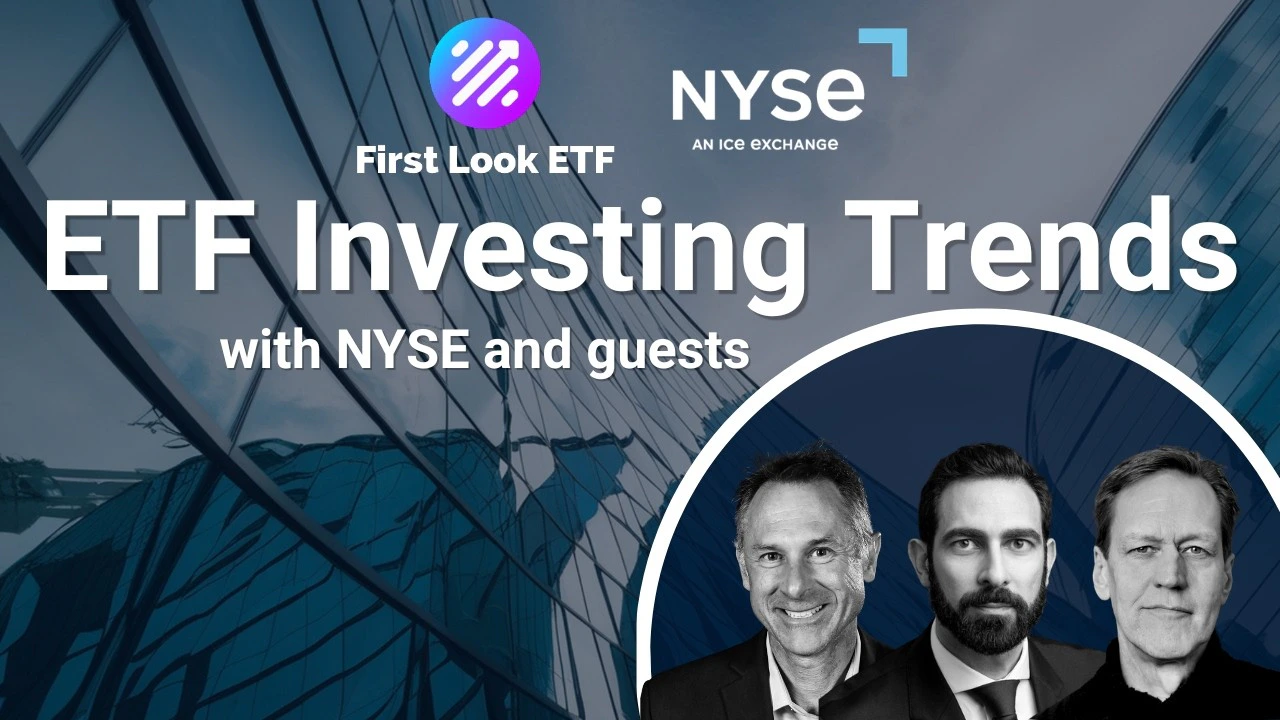
First Look ETF
First Look ETF: Cash Deployment, Bond, and Hedged ETFs
In this season 6 episode of First Look ETF, Stephanie Stanton examines the latest ETF marketplace trends with NYSE and guests.

ETF Trends
ETF Industry KPIs July 6, 2026
This week’s KPI data overview highlights key metrics and trends shaping the ETF landscape.
Browse all educational columns



Expert-Built ETF Portfolios, All in One Place
Don’t start from scratch. Discover ready-made ETF portfolios built by professionals to match different goals, timelines, and market views. Use them as inspiration or as a starting point for your own allocation.