Open Now: The Global ETF Survey Take the Survey →



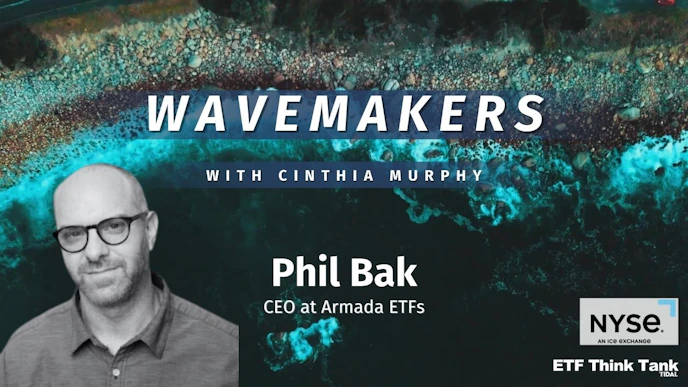
Wavemakers: Phil Bak On ETF Success, Failures & Opportunities
ETF Think Tank’s Head of Research Cinthia Murphy hosts a series about innovation, disruption and entrepreneurship in the ETF industry told first-hand by those who are leading the effort: ETF providers.

Keep up with what matters in ETFs
Get timely ETF insights, market trends, and top ideas straight to your inbox.
Your newsletter subscriptions with us are subject to ETF Central's Privacy Policy and Terms and Conditions.
The ETF industry has been in the business of disrupting and improving investor outcomes for 30 years. ETF issuers sit on the frontline of this innovation. Here they share the choices, the pivotal moments, the lessons and the battle scars that make up their journey into an industry that has democratized and revolutionized market access for investors everywhere.
Our guest this week is Phil Bak, CEO of Armada ETF Advisors, a firm redefining what it means to invest in real estate.
Get data on 14,000+ ETFs
Access Trackinsight's reliable and comprehensive data with 500M+ points on 14,000+ ETFs.
In this episode, Phil tells us the ETF business isn’t easy but it’s oh-so-worth it:
- ETF entrepreneurship isn’t about guarantees, but about probabilities. The chance of success is rewarding but it’s not for everyone. This is an industry where successes – and failures – are very public.
- In an industry where transparency also means no IP protections, authenticity is a key to success is. Be someone a bigger competitor can’t copy or replicate.
- Years of strong market performance have turned many investors complacent. The importance of fundamentals and the value of pursuing alpha is about to be very apparent as active management takes off.
Watch the episode here:
Cinthia Murphy: Hi Phil. This series is about ETF wavemakers. You have to be the poster child for that. In all the years we've run into each other, my question is always: ‘What are you up to now?’ It’s always something new, innovative, and sometimes even a little bit crazy. There’s an element of surprise when it comes to you and the ETF space. What drives you? Are just a disruptor at heart, a visionary, or are you an Olympic level risk taker?
Phil Bak: I don't think I'm a risk taker at heart. Everyone who grows up in finance, everyone who starts their career and thinks critically about risk and portfolio - any side of the business you spend a lot of time in – you know that there are no certainties in this business.
In investing, you know what you can do and what you must do for yourself on behalf of your clients. In any trading strategy and allocations, you have to tilt the odds in your favor. But at the end of the day, the market does its thing. So much of what we do is about probabilities and possibilities, not guarantees, and not certainties.
I view the entrepreneurial side of the business very similarly to the way I view the market side of the business where, if you can tilt the odds in your favor even slightly – even a 51% chance of a positive return – then risks are worth taking.
The problem is that when you do these things on a portfolio level, you do it over a long enough time, the sample size is big enough for you to see that you have some bad luck, some good luck, and things work out in the end. As an entrepreneur, your sample size is one. It's only your career, it's only your life. I've been fortunate. I've had more than one opportunity, and who knows what will happen in the future. But it's very hard. If you have a 60% chance of a positive outcome, that means a 40% chance of failure. And how many of us can survive a 40% chance of failure in a major career?
I'm no better off than anyone else when it comes to that. It's really a question of saying, are the odds in my favor, or am I still willing to have the courage of conviction to say the odds are on my side, even though there are no guarantees? Am I willing to take those odds and see things through? So far I’ve lost a lot of hair in the process.
Entrepreneurship is not for the faint of heart. It is hard. It's harder than I expected. It's not always fun. But the rewards are tremendous.
Murphy: So, if ETF entrepreneurship is rewarding, is it all about conviction? Or about being comfortable with the odds?
Bak: That's a very good question and probably one that I'll be thinking about now for a few days. I think the ETF industry rewards success. The rich tend to get richer; the bigger funds tend to get bigger. It's very hard to break through. There's a lot of noise, there's a lot of saturation. And the ETF industry tends to work at scale – it’s easier to scale a product than it is to get a new product. And it's not just on the on the fund side. So, the ETF industry is not really built for someone like me. The ETF industry is wonderful for a firm like BlackRock or Vanguard. Once you have a market leader position in a category or an asset class to drive that story and scale, it’s a lot easier than trying to break through. But, while it's difficult, it is also achievable. It doesn’t happen often enough, but when it does, the rewards are tremendous. This is a phenomenal business post critical mass. It's easier to retain assets than it is to bring them in, which means that you can have a recurring income that is significant.
There’s a lot of saturation, there's a lot of competition, there's not a lot of protection for intellectual properties. The odds are very tilted in favor of the bigger corporations, so it's hard. But this is the game that I've signed up for, and these are the rules of the road. You have to be ready for a very tough fight. I was willing to potentially fail publicly. Everyone can see your assets. A lot of people you would think would be rooting for you end up saying ‘oh, we only work with a certain size company.’ These different things hurt and are difficult to process and to understand when you believe you have a product that’s better for the investor, and the investor agrees but still wants to work with a bigger company. But that's the game.
Murphy: One of the biggest challenges in the ETF space is distribution. Assets beget assets, but we often see smaller, new firms breaking new ground with some really interesting stuff, and then a ‘BlackRock’ comes in, takes that IP and launches a cheaper fund that grows quickly thanks to their scale. You can't protect that IP, so how do you protect yourself? Are strong partnerships, collaborations key to having a chance at reaching scale?
Bak: It's very disappointing that there are people who will say that we don't want to do business with China or we're going to sanction other governments because they don't respect IP laws there's copyright infringement in patents. And then when it happens right here in front of everybody out in the open, people forgive it. I think it's uncool – to take somebody else's fund idea and replicating it because you're a bigger company and you can. For me, that's not how I want to make my money. I just don't find that to be intellectually challenging. I don't think that's rewarding. There are firms that do it, and you’d think that some of their clients, some of the allocators, some of the gatekeepers would punish that behavior and not reward it. But they don't care. Again, this is the game that we've chosen to compete in. You have to find those pockets of the market that are protectable somehow with active management, thought leadership, that kind of thing. Nobody can replicate a personality. Nobody can replicate the ideas that are coming out of a company or person. There are things that that you can do as an independent that that can't ever be copied.
Murphy: BlackRock might try to create another Phil, but I don't think they can.
Bak: No one can. Should they ever decide that's something they want, that's not something they can do. And that's one of the reasons why I've chosen my whole career as a behind the scenes guy. Nobody knew who I was except for the people I work directly with. It was two years into Exponential and my first ETF startup when I realized that I needed to be authentic, I needed to connect with people. I don't need everyone in the industry to think I'm okay, I just need a small percentage to say ‘I like him, I want to do business with him.’ And in order to find those people, I have to be transparent, authentic, do all the things that I've come to do and it's all new to me. I had never posted on social media until 2018. I was just following baseball writers and comedians, checking in once in a while. Now, it's the other end of the spectrum where you might say, I'm addicted to it. It's terrible. But this was deliberate from my point of view. I’d ask myself, ‘Why would an allocator work with us when it can work with BlackRock? What can I do that Blackrock can’t?’ Well, here's what I could do: I could say I think the Fed is making a huge mistake with their current policy. I can share my opinions on the market. I could say, ‘Hey, I think we're due for a pullback here.’ I couldn't say that if I worked for a large asset manager. I can speak freely. I talk about some of the disadvantages, but there are advantages, too, and that's one of them. I focus on the things that I can do better and faster – things they can’t replicate.
Murphy: To your point earlier, this is a noisy marketplace with lots of players and lots of funds. You have to stand out somehow, and what’s really special about the way you've tackled this beast is that you're just as quick to share the success stories as you are the failures. Whether you're looking to enter the ETF space, whether you ‘re a provider, whether you're an ETF investor or an advisor, whoever you are, there are so many lessons in that. When you look back, what were some of these lessons that were pivotal in helping you determine where you go next?
Bak: The best lessons come from failure. There's no question when you fail, you learn. I think there are two kinds of people: those that fail and get gun shy. And those that keep fighting, keep pushing. Most startups go through a period where they struggle. They've got to find product market fit. And in this industry, there is a compounding effect where when things are working, they work well, but when they're not, it's difficult to get things to go. It’s like starting a fire. It's hard to get it going, but once it is, you can scale it and keep going.
There's a concept going on now in business startups of building in public. It sounds great in the beginning. The idea that we're going to build in public, so we're going to show our clients and our customers and our VCs and everyone else what we're doing, taking them behind the curtain. They're going to be invested in our success. That’s a way to build more of a connection between the company and the people that they're trying to reach. But what often happens is when those companies don’t have success, they don't want to build it anymore. All of a sudden it's ‘let's keep things a little bit at arm's length.’ I just don't believe in that. It’s not about ego. It is what it is. I've taken these risks and I've taken these ideas and I've put them out there. If they work, they work. And if they don't, hopefully our clients know that everything we've done has been best practices, best interest because we believe in them.
We would never launch a fund that we ourselves wouldn't invest in, that I wouldn't put my mother in or my grandmother. That’s just not what we do. When we launched Exponential and the reverse cap fund, that was probably the one that I spent the most effort in, the one I was most determined to distribute. And the market didn't take. It just didn't happen.
We talk about probabilities, and equal weight tends to outperform market cap weighting historically. Going back as far back as we had data, it was about a two-thirds batting rate -- 65% of the time – and it happened to be the first three years of reverse. When equal weight outperforms market cap, reverse cap also outperforms equal weight. That’s what I was trying to do -- extrapolate the equal weight premium a little more. Our luck, though, we underperformed for a while on the big technology run. We couldn't really get the product distributed and there was no hiding it. Anyone could see the assets. It was a huge blow for me. I'm still recovering from it because I really thought that I could single handedly push that product through and I couldn't. But we find a way to push through. We did a lot of sub advisory work and we had a really great portfolio management team and we could manage your taxes more efficiently, manage your rebalances. We used what we had to keep the company going.
It's the same thing now with our model. We're looking at different things. We've got some new technology. Most of the time we launch a fund, it doesn't immediately rocket up to billions. You don't have revenue for a long time. And this is a very, very expensive game to play. So, you’ve got to find ways to bring in revenue.
Murphy: We typically estimate that you need to be able to support your fund for at least two years, assuming zero organic growth. If can't do that you should think carefully about what you do next. When you launch a fund, it can be the coolest idea, but the time is not right for it, or the market environment. I remember when the reverse cap fund came out, it was cool. No one had ever done anything like it. But the time wasn’t great. Is it ever worth revisiting an old idea that maybe was just ahead of its time? Or do you never revisit an idea that didn't work out initially?
Bak: The product development cycle is pretty long. Usually you have a period where you're back-testing or refining, working on the strategy, and depending on your organization, there might be a long process of committee approvals or a board approval or to gather the resources or whatever it is. Then you file for the fund. It's about three months, give or take. Some funds could be longer, like bitcoin – it could take a decade. It's a long process and you're trying to project what the market cycle is. At the time that you start the fund, there are people that are always trying to catch the current trend, and some are very good at it. But it's not really what I do.
When we launched reverse cap, it had a strong value bias because we were coming out of a cycle and reverse is always countercyclical to mean reversion play. I said this is back when we started in 2017, ‘We don't want to play for the growth tech cycle. We want to play for the next cycle.’ It had already been eight, nine years at the time of this kind of growth cycle. What happened was five straight years where the tech momentum cycle just continued to outperform. We're completely wrong about that. We're just five years ahead of our time. You just don't know. Sometimes you get lucky, sometimes you don't. What we're doing now with rates is very timely because a lot of people are very bearish on real estate given where we are in the rate cycle. What a lot of people have missed is that within rates, the subsector correlations are very low and there are certain subcategories that are significantly better positioned than others.
The definition of REITs is expanding beyond pure real estate and VNQ is a market cap weighted fund of anything that elected for the right tax structure. Most people that I talk to that own VNQ don't understand it. They think that they own real estate. They're all fungible. It's all real estate exposure. But in reality, increasingly, they don't. They own something a little bit different that's got a little bit different factor exposure. There’s dispersion of returns in every scenario we see re: markets, geographies, subsectors, of all these different elements that make up the real estate market, which means if there's an opportunity to give people a better, smarter exposure, better way to access REITs, that's what we're trying to do. So, it's not necessarily timing it and saying, ‘we think everyone should pile into real estate at this moment in time.’ It’s about offering something, differentiated; planting seeds that bear fruit years later.
Murphy: I love this idea that you can innovate on many fronts. It’s not always about finding a space that hasn't been explored. It can be about delivering access in a different way to something that may be well trodden, like real estate. When it comes to innovation, what are some of the ETF trends you think are exciting or that you think are completely cringe worthy?
Bak: I go back to first principles, and I think people have really discounted this idea that asset management is commoditized, and people discount the promise of alpha. Market cap weighting has worked for so long, but I don't think that's a permanent condition. There's a point at which the market opens up for opportunities for alpha that people are going to miss because so much of the money is now passive based. I think there are real opportunities on the value side.
On the active side, that's where we're focused, but not in the way that a lot of ETF issuers are. In a very quantitative way. We've got very complex models in our algo to understand what is driving reevaluations, trading, and what signals the market is responding to in different environments, and what is the derivative of those signals that we can pull forward looking indicators from.
We haven't launched those models in an ETF. We may, we'll see. But we're trying to understand how to use the new computing power that's now available to everybody to find edge in our world, which is REITs. What's important is fundamentals, understanding what's driving the market, the companies, how to price them, and what the market's currently responding to as well as what the market may respond to in the future. I think people are being a little too complacent, a little too dismissive of active management, of risk management, of the need for alpha.
That conversation is going to change. We’re planting seeds today that are going to yield fruit a couple of years from now. Now is the time to plant seeds for products that are designed to do better risk management. That's what we're focused on and that's where the opportunity is.
Murphy: As a final thought, given all the successes and the failures and all that you’ve seen in this industry, is the ETF wrapper really that special? Is it worth all the challenges of being in this business?
Bak: Save yourselves! ETFs are great for the investor. They truly are. They’re low cost. Gains are great from a tax efficiency standpoint. They're easy to use, really easy to access. It's great for the investing world.
It's also been great for people like me and for entrepreneurs that want to launch funds. There’s not a terribly high barrier to entry, but to get the critical mass is another thing. From a business standpoint, having products that better for you and not necessarily better for the client can be more profitable – like interval funds and private funds and hedge funds where people have a harder time getting their money in. But frankly, they’re just not as good for the client and it's not something I'm very interested in doing. I guess it's about the reward of doing it, doing good for somebody else. Like I said, this is a very hard business. You got to do it for the love of it.

Latest ETF News
See all ETF newsThis is How Calamos Turned Wall Street’s $100 Billion Secret Into an ETF



From Dot-Com to ETFs: How One Entrepreneur Helped Spark an Investment Revolution
How Blossom Social Is Revolutionizing Retail Investing and ETF Marketing
Is 2025 the Year for Financing Food Fast?


 Advantages of ETFs over Mutual Funds1/6
Lower Costs
In this guide, we'll explore the advantages of ETFs over mutual funds, giving you valuable insights into why ETFs have gained significant popularity among investors like yourself.
Leveraged ETFs: Unlocking the Potential for Amplified Returns1/6
Understanding Leveraged ETFs
Explore leveraged ETFs: potential for amplified returns & risks. 5 ETFs to consider across equities, commodities & fixed income.
What is a Leveraged ETF?1/6
Introducing Leveraged and Inverse ETFs
In this guide, we'll dive into the world of leveraged ETFs, exploring their definition, mechanics, potential risks, and rewards.
Recent educational content

ETF Trends
ETF Industry KPIs July 20, 2026
This week’s KPI data overview highlights key metrics and trends shaping the ETF landscape.

ETF Trends
ETF Industry KPIs July 13, 2026
This week’s KPI data overview highlights key metrics and trends shaping the ETF landscape.
First Look ETF
First Look ETF: Cash Deployment, Bond, and Hedged ETFs
In this season 6 episode of First Look ETF, Stephanie Stanton examines the latest ETF marketplace trends with NYSE and guests.

ETF Trends
ETF Industry KPIs July 6, 2026
This week’s KPI data overview highlights key metrics and trends shaping the ETF landscape.
Browse all educational columns



The ETF Industry Is Evolving Fast
From AI infrastructure to active strategies, the ETF landscape is shifting. Share your perspective in the 7th Annual Global ETF Survey and get exclusive early access to the final report.