Open Now: The Global ETF Survey Take the Survey →



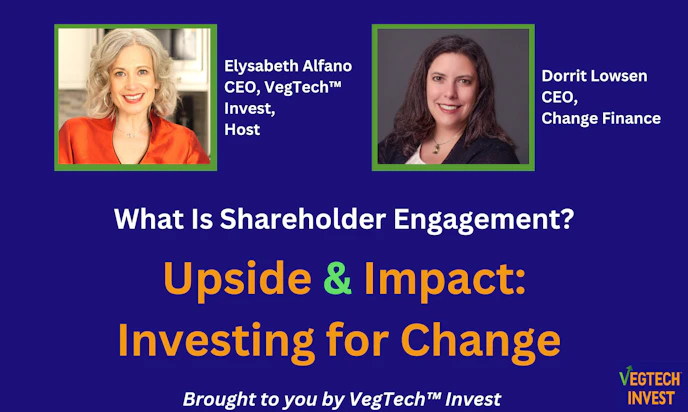
Upside & Impact Ep. 3 - Shareholder Engagement: What Is It and How You Can Get Involved
On episode 3 of Upside & Impact: Investing for Change, Dorrit Lowsen, Co-CEO of Change Finance joins CEO of VegTech Invest Elysabeth Alfano to discuss shareholder engagement best practices.

Keep up with what matters in ETFs
Get timely ETF insights, market trends, and top ideas straight to your inbox.
Your newsletter subscriptions with us are subject to ETF Central's Privacy Policy and Terms and Conditions.
Are you interested in impact investing, but want to understand how you can also partake in shareholder engagement? Listen to this podcast in which Dorrit Lowsen, Co-CEO of Change Finance, and Elysabeth Alfano, CEO of VegTech Invest, discuss shareholder engagement best practices.
In this episode, they discuss 1) what is shareholder engagement and can anyone do it? 2) When is it appropriate to do shareholder engagement and what kind of outcomes can one expect? 3) Must you have a certain level of investment for shareholder investment and must you have a coalition? Lastly the two discuss 4) best practices for successful shareholder
The ETF Industry Is Evolving Fast
From AI infrastructure to active strategies, the ETF landscape is shifting. Share your perspective in the 7th Annual Global ETF Survey and get exclusive early access to the final report.
Listen to the podcast here:
TRANSCRIPT:
Elysabeth: Hey everyone, welcome to the VegTech Invest Upside & Impact podcast. I’m your host, Elysabeth Alfano, the CEO of VegTech Invest, Advisor to the Plant-based Innovation and Climate ETF, EATV. On Upside & Impact I chat with the leaders and movers who are shaping and growing impact investing for meaningful change. We “pull up as we go up” as the expression goes so this podcast is all about making meaningful and productive impact while also managing one’s portfolio for upside. Of course, always managing for upside.
If you’d like more information about VegTech Invest you can visit us at VegTechInvest.com and subscribe to our newsletter. You can also find us on LinkedIn and on Twitter at VegTech Invest. We record live every first and third Wednesday of the month on our LinkedIn page at 1:30pm eastern standard time. So, check us out live and be sure to bring your questions.
Now if you’re listening as part of a podcast, of course subscribe to this podcast right now so that you never miss an episode. And if you’re listening on iTunes, be sure to leave a 5-star review. It really does help.
So now let’s get down to today’s show and thanks for being with me on today’s episode of VegTech Invest’s Upside & Impact. And as always, a reminder, this podcast is for informational purposes only and is not meant to recommend any specific company or investment. Now, onto the show.
Hi everyone, it’s Elysabeth Alfano, the CEO of VegTech Invest and the host of Upside & Impact: Investing for Change. I thought I would give you a little personal note and just kind of guide you through our podcast experience. So perhaps you’ve already listened to the first two episodes of Upside & Impact: Investing for Change on the New York Stock Exchange platform ETFCentral.com, and if so, thank you. They’re great episodes. They were sort of starter episodes, if you will, as I was finding the right format for Upside & Impact.
Also sometimes, as is the case with the second interview which was Jen Bartashus who is the Senior Analyst at Bloomberg Intelligence who covers big box stores, food systems transformation, and plant-based innovation companies, Jen was originally a Plantbased Business Hour podcast which is another podcast that I do which is really a deep dive on sustainable food systems transformation. So, as I bring together the right mix of people for Upside & Impact and as I solidify and formalize this structure for this new podcast, you’ll see that sometimes there are re-edited podcasts from the Plantbased Business Hour. Or sometimes I have a live event that I’ve gone to, and I’ve covered the information in a new format or maybe I’m on the road and it’s live. So, I just ask that you come with me on this journey and know that the first couple episodes are sort of finding the format that works the best really for the ETFCentral.com platform.
As a reminder, you can always find me on LinkedIn at Elysabeth Alfano. So, if you would like to see a topic covered, if you have questions for me personally, or if you just want to give feedback, of course please find me there and then I must say share, share, share, share. That really is the best way to pass along the knowledge drop and that is the intention of this podcast: to share knowledge that is helpful for you, helpful for your clients, helpful for the people that you know. So really do give a 5-star rating if you’re listening to this on iTunes or Spotify and of course, share, share, share.
Now with today’s particular episode, which is kind of an older one, really the early days of Upside & Impact with Dorrit Lowsen of Change Finance, we talk a lot about shareholder engagement. And I just wanted to say that in the coming weeks a future episode will be with Harvard University. VegTech Invest and Harvard University are putting the finishing touches right now on a white paper on the best practices for shareholder engagement specifically around food systems transformation, but not limited to that. We’ve done a deep dive into what has worked in the past, what hasn’t, and best practices going forward, again with Harvard University.
So, this is kind of a prelude to what that episode will be which is all about how to engage in shareholder engagement, who it’s for, if anyone can do it, how to be the most impactful with your time and of course your dollars which is what we talk about here on Upside & Impact: Investing for Change. Thank you for allowing me to share a little bit of how in the first couple of episodes we were still finding our stride but the intention here is to be a knowledge drop on investing for change and impact investing. And thank you everyone for listening, for sharing, for giving a 5-star review, and mostly for caring about this topic and putting your expertise, your time, and your dollars in line with your values. I do believe that is how we make real change so let’s get into today’s episode with Dorrit Lowsen.
Hey, everybody. I’m Elysabeth Alfano, the CEO of VegTech Invest. Welcome to our monthly webinar series. We have a webinar the first Wednesday of every month at 1:30pm eastern time. We’ll be tackling different subjects in every webinar. Now, you’re probably saying to yourself, “but wait a minute, today is not the first Wednesday of the month.” That is true. Today I made an exception because I like my guest so much, I wanted to make sure that they could come on and that this could be a part of their schedule.
So, I will go ahead and introduce the CEO of Change Finance, Dorrit Lowsen, in just a minute. But first, I would be remiss if I didn’t tell you the upcoming schedule. Starting in November, we will go right back to that first Wednesday of every month at 1:30pm eastern time. And our topic on November 2nd is, “Is it good to be good or is it good to be bad?” We’ll have The BAD Investment Company here with me. I would argue that it’s good to be good, but he’s going to have an argument of his own. So, if you are grappling with good or bad, how do you want to go? Please join us on November 2nd at 1:30pm eastern time right here on the VegTech Invest LinkedIn page. We will always be going live there. No need to register although you can, and we’d like to know how many people are coming in advance, but you can count on us first Wednesday every month on the VegTech Invest page on LinkedIn.
So let me bring on my guest today. It is the CEO of Change Finance, Dorrit Lowsen. We are talking today about shareholder engagement. What is it and how do you do it?
Dorrit Lowsen: Great question, Elysabeth. Thank you. Shareholder engagement really encompasses a whole range of techniques, but at its base, it’s about how you use your voice and your power as an investor to drive the behavior that you want to see out of the companies you invest in. One of the great things about being an investor, it means you’re part owner of the company and that means that you have a voice, and there are a lot of ways to engage that voice to make the change that you want.
The most fundamental is proxy voting. You probably get them in the mail, maybe you get them in your email now, but so well as only recently, mostly in the mail, thick bundles of very, very thin paper with a really teeny tiny print and you probably throw them in the trash, certainly for many years. That’s what I did because they’re a little hard to follow, but those are important. They're your proxy ballots, and they tell you what kinds of things you can express an opinion about to the company that you own.
In recent years, there have really been a lot of opportunities on those ballots to ask companies to do more to address climate change and to address diversity and other issues you might really care about. So, I advise you to start paying attention to those. And you’re probably saying to yourself, “but most of my investments are mutual funds and ETFs. Do I still get those? That’s a lot of companies.”
Well, the truth is, you probably don’t get those. You probably aren’t going to vote proxies for every company that’s inside those mutual funds or ETF holdings. But what you can do is ask the managers of those funds how they vote their proxies. They’ve got to report that to you, and you can look, and you can think about how they’re doing that and if they are voting the way you would vote on the things that matter to you.
Elysabeth, speaking of mutual funds and ETFs, you’ve got to really have a specific team and strategy that you invest in, and you invest for change. Can you share with us what that’s all about?
Elysabeth: I’m happy to do that. I just want to first reiterate something that you’re saying that I think is so powerful. So, if we come to impact investing, it’s because we want to use our dollars to make change and go further. Now, when you couple using those dollars with your voice, you are so, so powerful. Consumers do it all the time at the grocery store, and they use their voice and their dollars to say, “Hey, I want to buy this and not this.” But you can do the exact same thing with your investments and money talks folks. People pay attention to that.
So, thank you, Dorrit, for asking about what we do here at VegTech Invest. We do have a very particular strategy, Dorrit, and we are the first and only plant-based innovation and alternative proteins index out there. And probably the best way to share the VegTech Invest strategy and philosophy is to share that index and information about the index with you.
So, I’m going to go ahead and share my screen. Now, I do have to warn everyone that I am not always the best at tech stuff, but let’s see if I can do that right here. Everybody should be able to see my screen and let me kind of walk you through what is the EATVi, the EATV index, the world’s first plant-based innovation and alternative proteins index?
So first, why would we want to create this index? It’s because we, like Dorrit, we’re here for change and we’re here for change in our lifetimes. So, we wanted to couple our voice with our dollars, addressing a problem. Ultimately, that’s what business does so well. It addresses a problem with a solution at scale, and we’d like to see that kind of disruption in the global food supply system for sustainability.
So, what is the problem that we have on hand? Well, according to the United Nations, 14.5% of the world’s greenhouse gas emissions come from animal agriculture. A whopping 37% of all U.S. methane comes from animal agriculture. That is according to the EPA, the Environmental Protection Agency. So, I would argue that you will not sufficiently impact climate change in the timeframe that we need to do it if you do not address animal agriculture. 37% of the U.S. methane, about a third of the world’s global methane, is just a number too large to ignore, which is why we do what we do. We don’t want to ignore it.
So, we also see that animal agriculture is a leading cause of deforestation. You think, “Well, why would that be?” Well, because there are 80 billion animals in factories. There are only 8 billion people on the planet. So, you see that there are 10 times more animals in factories churned out than there are people on earth. Well, of course, they need land, they need water, they need time, they need food. So, we cut down the trees. The trees that pull carbon from the air, by the way but oh well, we cut them down. We’ll see that it’s 41% of all the tropical deforestation in the world. This is due to animal agriculture to make room for grazing.
But okay, so we cut down these trees and we grow crops. These crops that are food, they have fiber, they have protein. Are we giving this food to people? No, we’re giving it to animals. And then again, they need more land, water, resources, time, and food. So, a major source of deforestation, but really what we’re talking about is a major source of inefficiency. So again, we talked about how business loves efficiency and it rewards efficiency. And we see our current global food supply system is very inefficient and inefficiency leads to food insecurity.
We saw during COVID how many people were affected by food insecurity. And now we’re seeing this awful combination of war and climate change also impacting food security and how much food is traded and available to people. That’s only going to grow as our resources, the amount of water that we have available and the amount of land that we have available to us. That’s only going to become scarcer. When we know that, you know, animal agriculture already uses 42% of the world’s clean water source.
So, with climate change, we’re going to have less water, we’re going to have to be smarter with it, particularly as the population grows from 7.7 billion to 9.8 billion, but we’re not getting more land and we’re not getting more water. So, we’re going to have to be smarter about how we use our resources. This is why it’s prime for disruption so that we can be more efficient. We look here at my cursor. This is from OurWorldInData.org. We see that 77% of our agricultural land is used to graze animals and raise crops for them and grow crops for them, giving us only 18%, this number here, 18% of our calories. So that’s just not going to work if we have a growing population. We’ve not going to get more land and we’re going to need to produce more food.
Ultimately, this is the problem that we have at hand. We need to create more food more nutritiously in a shorter amount of time using fewer resources and creating less damage. Again, a system ripe before disruption. And oh, hey, bonus by the way, it’s not just better for planetary health, it’s better for people as well and their health. So, you know, many of the products that you see in climate-based innovation, are they a carrot? No, are they broccoli? No, but they don’t have trimethylamine n-oxide. They don’t have cholesterol. So, they are better than, healthier than, options. And certainly, they reduce the risk and get the risk off our balance sheets for things like pandemics. The United Nations says that the top three reasons for the next pandemic are all related to consuming meat. Two of those top three are all related to the intensification of animal agriculture. So, we want to reduce the risk of pandemics.
We’re going through all this quantitative tightening now because of all the quantitative easing from Covid prior. This has been painful. Let’s not do this again. That’s the kind of pain that pandemics put forth. So, we would like to get that kind of risk off our balance sheets. So, we see, this is an example of Beyond Meat, but it really could be anything in the plant-based sector. Generally, this is indicative of the whole sector. You see that a Beyond Meat burger versus a beef burger, according to the University of Michigan Life Cycle Analysis study, says that they use 99% less water, 93% less land, 90% fewer greenhouse gas emissions are emitted and 46% less energy use. So that’s the kind of efficiency that we’re looking for. This is why we created the EATVi Index to hold companies that are innovating with plants and plant-derived ingredients with the purpose of really creating animal-free foods for sustainable consumption.
Ultimately, you positively impact climate change and food security when you have a more efficient and sustainable system. That’s why we created this benchmark for this new impact asset class of plant-based innovation and alternative proteins. And sometimes people ask me, “Well, what the heck is plant-based innovation?” It is the plant-based foods that we see today in the marketplace, but it’s also some neat technologies coming down the pipeline for fermented proteins and cultivated meat. And these things that are controlled, grown in a controlled scenario, use no antibiotics, no hormones, not having to deforest, using much less water, etc. So, we can talk about that on another webinar, what the cool innovations are that are coming down the pipeline.
I just want you to know that plant-based innovation is kind of a broad term to reflect not just the current plant-based products and the innovation coming, but also to represent up and down the supply chain. So, it’s a pure play index representing companies at any stage of business in the supply chain that are innovating to replace animals for sustainability. So, we have your ag tech, your greenhouse gasses, and vertical farms, we have those technology and innovation companies, those B2B companies that are licensing out these new technologies to make food more efficiently using fewer resources, but at the same time, more nutritiously. And then we have the ingredients companies and the flavor and texture companies working on novel ingredients and working on making those ingredients taste just like people want them to taste. Of course, everyone’s got to like what they’re eating. That’s a big part of this.
And then at the end of the supply chain we have consumer packaged goods and materials so those brand names that you would know in plant-based innovation, which is for food, but also for, you know, think about the inhospitable industry that is the heather tannery industry for the environment. So, it’s not just our food supply system that we want to be sustainable, but it’s also our material supply system and so you see those kinds of consumer recognizable brands also in the index.
So perhaps one of the coolest slides that I’m going to show today is this study by the Boston Consulting Group, showing that it is 3 times to 40 times more impactful to invest in plant-based innovation and alternative proteins than it is to invest in other green technologies to reduce greenhouse gas emissions. So here you see it’s 3 times more impactful at reducing greenhouse gas emissions than investing in alternative cement products. It’s 11 times more impactful than investing in alternative cars and electric vehicles, alternative road transport, and more than 11 times more impactful than investing in alternative energy products in terms of reducing greenhouse gas emissions. And the reason that is, is that not everyone can rip off the roof of their house and put on solar panels. It’s quite expensive. Not everybody can chuck their car and move over to an electric vehicle which is also quite expensive. It’s certainly very expensive to retrofit a building and put in green materials or build that building from scratch.
But it’s not that hard to let your fingers do the walking in the grocery store and move on over to plant-based bacon or steak or chicken or what-have-you or burgers if that’s what you want or sausages. Move on over to that category. Sure, you’re going to pay a little bit more but it’s not completely inaccessible to people where some of these others really are.
So that’s kind of our take on this entire global food supply system that needs to be disrupted and how by using our voice and using our investment dollars, we can make that kind of change. We’re excited to see the systems disrupted for the benefit of the planet and people as we look to be more sustainable. Just kind of a quick note here. People are always asking, “Well, where do you think this sector is really growing?” So, I always point to Bloomberg that says the plant-based industry is growing to 8% of the meat market by 2030. That represents about $162 billion, and it represents, according to the Boston Consulting Group, 11% of the market by 2035. That’s a $290 billion representation. So, we see enormous growth coming from the $39 billion that we have today, and we do see mass adoption as there’s this planetary pressure to really clean up, if you will, our global food supply system.
So let me see if I can stop sharing this now, and we can come back to Dorrit, which I’d like to do. Hi there, Dorrit. Thanks for listening and hearing out about our strategy. You know, I’m wondering, Dorrit, you at Change Finance, you have a very particular strategy as well, and you come to it from a personal space. So, before you started Change Finance, you had some personal experiences that really kind of led you down this path, and I’m wondering if you can share just what happened personally that made you say, “Okay, I’m going to start Change Finance."
Dorrit Lowsen: Sure, I’d be happy to share. Before I do though, maybe I’ll take just a minute if it’s okay, to talk briefly about what it is that Change Finance does, because that is integral to that journey.
Change Finance, like VegTech Invest, has an investment strategy that we take in a different way. I love what you’re doing, Elysabeth, and I think paired with other kinds of strategies, our focus is really on identifying the companies across the economy with a few exceptions like fossil fuels that are already showing some leadership through the companies that we believe are doing the best right now for people and the planet. But also, because they are showing leadership, we believe that they are the companies that have the most opportunity to drive change. They’re already setting the bar, and we can get them to set the bar higher for what is acceptable when it comes to greenhouse gas emissions or water usage or deforestation or all the other wonderful issues that Elysabeth mentioned.
We can drive change across the economy. So that’s the strategy that we are taking with our investments and then that’s the strategy that we’re taking with our shareholder engagement. But you asked me, Elysabeth, how I got here on a personal level. Well, the truth is I have done a little of everything. I have worked in large companies and small ones in the private sector. I have worked in nonprofit and impact investing. I have worked for the government on environmental issues, among other things. And each of those has their place. But what I found is that policy, which is essential to driving the kind of change that we want, is incremental and very, very slow. Big corporations have a lot of power to make big changes.
I was inspired by a story at Walmart when they decided they would no longer sell meat grown with human growth. It’s not meat, sorry, milk with human growth hormone in it. Within months, literally within months of when they announced that decision, the U.S. dairy industry had stopped using human growth hormone completely because there is no company, no dairy that can afford to be unable to sell milk through Walmart. And so that demonstrated how much power big corporations have.
So, I could have stayed inside big corporations and tried to make change from inside within a corporation. I tried. I tried the startup investing in early-stage enterprises doing really great things. That’s exciting. That’s where a lot of innovation happens. But when I looked around, I really felt like the place that I had the most opportunity to make a difference was in a place where I could influence a lot of big corporations. And the way I thought I could do that was through finance, which is how I landed here at Change Finance, and how I landed on shareholder engagement as a really important element of the work that we do.
Also, on a more personal note, as I started to think more about that and about how I made choices, not just with my consumer dollars and what I bought at the grocery store, but also with my investment dollars, I began to realize that I needed to ask more questions. My personal finances were managed by a financial advisor, somebody who had managed assets for my grandparents and my parents, and by then me. And I started to ask him what my investments were doing, and paying more attention to what I was invested in. Those brochures full of proxy votes that I couldn’t understand, I started to pay more attention to what was in those, and I started to ask questions.
Could he reduce my exposure to fossil fuels or ideally eliminate my exposure to fossil fuels? Could he identify investments where I could have more of a voice? And it turns out he had a really hard time doing that. Why? Because he was constrained by the investment options available to him through the large firm that he worked for. I must give him a lot of credit. He worked very hard to find the best of what they had to offer. And for what I wanted to do, the best of what they had to offer at that time wasn’t good enough. I moved to an independent financial advisor who had more flexibility, who was paying attention to those issues, who when I delegated proxy voting authority to them, I knew I could trust them to vote the proxies in the way that I would and to vote with an eye towards environmental impact and social impact. And in fact, it led the way.
And I’m proud that my personal assets were used to file shareholder proposals at a couple of companies, one of which last year was successful in being passed and is going to drive a real meaningful change at a company you’ve heard of. Elysabeth, I’d love to know what your tips are for individual inventors. What should they be asking and talking to their financial advisors about or how they might do some due diligence?
Elysabeth: So, a common theme today that we’ll come back to again and again is just how powerful you are. So, when you combine the fact that you’re investing alongside your values and then you are using your voice to underscore that, you really can and will see change. I would argue that I’m always amazed how many people I run into, and they say, “Oh, I don’t even know my financial advisor. I got them because my partner’s mother uses them” or their grandparents handed them down or they have almost no relationship with them. Which is amazing because they control, you know money is like food, it touches every bit of our life. So, to not know that person, it would be a wonderful opportunity to reach out to them. I guarantee you that they want to hear from you just as much as you want to talk to them and in having coffee with them you can share with them what’s important to you, what your values are, and what you would like to see in your portfolio.
You can also ask them, “Hey, you have me in this ETF. Why? What’s in there? I really want to see X, Y, and Z in my portfolio. Does this ETF have it for me?” The thing is that they might not even know. They might be approaching your portfolio strictly from the monetary aspect and not understanding you as a complete person. I guarantee that they do want to understand you as a complete person and you asking these questions is going to prompt them to reach out to that fund or that ETF or what have you and start asking that fund manager questions and that’s going to make that fund manager change maybe what they’re doing.
So, this voice that you have trickles down to so many levels. Then that global wealth manager might have more information because they’ve educated themselves now because of your question so they’ll have more information to share with other investors. So just don’t be afraid to ask those questions and to say what you want and if your financial advisor doesn’t know, just ask them kindly if they could find out for you because this ripple effect is incredibly powerful at moving the needle. For example, your financial manager might not even know that there’s a new impact asset class of plant-based innovation and alternative proteins and I guarantee that they would like to know because it’s now a new ESG lever that they can use for different clients and so just bringing up the questions and starting that relationship really is so very key. But another thing that’s key or at the least the question I get all the time is one I want to throw to you. How much of one’s portfolio do you recommend that they put in impact investing? So, when people ask you this, what do you tell them?
Dorrit Lowsen: I told my financial advisor then and it seems to be true now that I want 100% of my portfolio invested for change. It’s doable. I have done it. There are tools out there like VegTech Invest, like Change Finance and like many many others that are designed to help you accomplish that. Are all of them doing the same thing in the same way? No, of course not. You wouldn’t want your portfolio probably invested 100% all in one thing doing one thing the same way so I don’t advocate that. But you can invest 100% of your portfolio with an eye towards making the change that you want to make because every company out there has changes, they have to make if we are going to be successful. That’s sort of the beauty of it. That’s why proxy votes are important as a starting point because those happen every year at every single company and so it can be, as a starting point, as simple as paying attention to what’s on those ballots.
These days there are a lot of things on those ballots that are very relevant to the kinds of issues that you likely care about there, or dozens, if not hundreds, of proposals on ballots in the last year focused on climate change. In total, there were certainly hundreds of ESG proposals across the range. So, you can think about every single one of your investments as having potential for driving change. And the question is how is it being managed? Are those processes being voted? And that is a question that you can ask. How are they being voted? So that might be the most significant question you can ask your financial advisor to pay attention to in the short term.
Where you are holding individual stocks and you control those proxies, you can express an opinion. You can do it directly and ask to vote those proxies directly. Oftentimes, your financial advisor is voting those proxies on your behalf. You can tell them how you want them to vote. And they have an obligation to follow your direction, just like they do if you tell them to invest in something or not to invest in something. So, I encourage you to start having those conversations or just understand what’s already being done. Wouldn’t surprise me to learn that a lot of things that you’re invested in already are at least occasionally voting in favor of things that are on the ballot that are relevant particularly with respect to climate change. Maybe not everything yet, but certainly some things. There’s a lot more, we talked primarily about proxy voting. There’s a lot more than can happen.
Many investors, asset managers, engage directly with companies that, as they go and have meetings, have conversations with those companies increasingly that can focus on matters relating to climate change and diversity and other kinds of issues that you might care about. So, you can dig even deeper, look to see if the things that you’re invested in do any reporting on how they engage with companies in their portfolio and ask your financial advisor to pay attention.
The other thing that’s important that we haven’t touched on is that it’s not just your financial advisor. You may be holding a lot of investments through your retirement plan, your 401K or pension, and you can ask those questions there as well. You can call the benefits manager in your HR department and ask if there are sustainable investment options in your 401K plan. You can ask if they evaluate how those funds, both their proxies, you can ask if they evaluate what kind of shareholder engagement they do. Those are important questions to ask and the only way we’re going to get all the way there is if everybody starts asking those questions. Just like if you’re the only person buying organic vegetables in the grocery store or buying plant-based meat replacements in the grocery store you’re not going to get very far. But if you and all your friends and all their friends start making those changes and asking those questions, then the world starts to change. That’s where real change happens so start asking and go from there.
Elysabeth: I also want to add on to what we were talking about before. I had mentioned reaching out to your financial advisor, but then there’s also that fund manager at the employer level so as an employee, you are probably investing part of your 401K, and you should have a relationship with that person as well. Again, I guarantee they want to hear from you, and you can say, “Hey, wait a minute, these are my hard-earned dollars. This is what’s important to me. This is what I’d like to be able to invest in. This is what I’d like to see from our employee options.”
And the same thing goes for them. They might not know for example that according to our research from our Bloomberg terminals, 512 ESG funds have meat companies in them. Now how the heck is that possible? Because meat, we know as one of the leading contributors to climate change, one of the leading contributors to methane emissions, uses 42% of the world’s clean water, and is the leading cause of deforestation. How can that be in an ESG fund? Well, they maybe just didn’t look.
So again, your voice is just so powerful. And if you do have any questions, you know, of course, come find Dorrit on LinkedIn or come find me on LinkedIn. We’re always here to help. In fact, Dorrit, something that I think you could help with is really directing people. So, it’s one thing to say, “Okay, reach out to your financial advisor.” But how do you reach out to companies? I’d love to know tactically what Change Finance does to reach out to the company itself or the fund itself and ask for change.
Dorrit Lowsen: Great question. Yeah, we absolutely do. We reach out to companies regularly with a variety of issues that we care about. And we are focusing on reproductive rights and maternal health. We are focusing on corporate money and politics. We are focusing on greenhouse gas emissions, among other things, when we are reaching out directly to companies.
There are a variety of ways to do that. We are reaching out through engagement letters. We write a letter to the company and say here’s our take, here’s what we think is important, here’s why, here’s what we think you should be paying attention to, and here’s what we are asking from you. We are asking for more and better information, for transparency, and for a policy change. We would like to have a conversation. Does every company respond all the time? No, but sometimes they do, and we can sit down and have constructive conversations. They are out there to learn. They want to do things that are going to be good for them and for their investors. And so, they do pay attention.
When they don’t, we can escalate. One way to escalate is to file those shareholder proposals. The things I mentioned that you can vote on, somebody’s got to put them on the ballot. Well, you know who puts them on the ballot? Other investors. So, when reaching out directly doesn’t get us the response that we want, when it doesn’t move the needle, we can file a shareholder proposal that everyone can vote on. And if it does well, that tells the company that it’s not just us, it’s a lot of people, and a lot of their investors. A lot of the dollars that support their work, they care about that issue.
Sometimes when we file a shareholder proposal the company comes to the table and negotiates, and it never even makes it on the final ballot because that’s enough to get them to agree to make the progress that we want to see. Sometimes it lands on the ballot, and sometimes increasingly it passes, and recently we have seen some of those proposals pass with 70 or 80 or 90% of the vote, which is shocking. That means many shareholders have sometimes voted for these proposals in recent years, and that speaks volumes because then you have a strong signal to these companies.
Shareholder proposals aren’t always binding, you should be aware of that. So just because a pass doesn’t mean the company absolutely has to implement it, but very often they’re going to need to do something because if nothing else, it becomes a public relations challenge. It makes news when one of these proposals passes and the company doesn’t want to be stuck in the news because they haven’t followed through with whatever the proposal is asking for.
So, there’s a whole series of things that can be done. Many of them- even you as an individual, can file a shareholder proposal if you meet certain criteria. I don’t necessarily advocate it. It’s finicky to jump through all the hoops, but it can be done. And certainly, as we’ve talked about, you can vote, and you can pay attention to what the asset managers that might run the funds that you invested in are doing. Are they engaging and are they engaging on the issues that you care about? So those are certainly good questions to be asking. Ask your financial advisor or your 401K plan manager.
Elysabeth: So much to unpack there and I didn’t want to interrupt you, so I was wildly taking notes because I want to make sure I hit on this. It goes without saying, again, we’re talking about this power of combining using your money and your voice. When you are reaching out to the company directly, it is important to say what you want and have that ask. So, Dorrit said when she writes to companies she doesn't just say, “I’d like to see things differently.” She says, “Specifically I would like this from you.” That ask is very important. And I find when you tie that ask, it’s a little bit of a one-two punch, so there’s the carrot and the stick you tie that ask to say, “and by the way, you’re currently being exposed to the following risks.”
Because we are a pure play, we at VegTech Invest, our strategy is to only invest in those companies innovating to replace animal products, because that’s how you’re going to get sustainable change in our global food supply system. We point out that there are indeed extreme risks by being one of the leading causes of climate change and being involved in deforestation and being involved in pandemic risk. And as the world moves towards carbon pricing, you are at risk and risk translates to economic downfall or economic weakness, if you will.
As carbon pricing comes, and we all know that it’s coming, I believe that the consumer is going to know their carbon footprint like they know their calories. Ask any woman who’s 25 if she knows the calories of an apple, and she does. And I think it’s going to be like this for people’s carbon footprint. So, there are a lot of risks involved, often with your ask, and you might want to point out, “I ask for this change, and by the way, it helps you too. It’s not just for me, but it takes this risk off your balance sheet.”
I’ll tell you; we’ve had some letter writing campaigns directly to companies. For example, The Tattooed Chef has asked to be included, and we have said that this isn’t something that would work for us because while they call themselves plant-based, everybody must do their own diligence because just because you call yourself something doesn’t mean you are. They use a lot of animal cheese, and there are so many replacements that it could be something that they don’t have to use in their products. So, we reached out and asked to replace the animal cheese and pointed out the risks. So just to kind of help the conversation along, we are so powerful, and if you are waiting on the government, it ain’t ever going to happen. It happens because of us, and I personally don’t want to stand on a street corner with a sign. I’m not doing that. But here’s something I can do easily from my computer.
We are wrapping up. We’re getting close to time. But you said so many great things. There are a couple other things I wanted to ask of you. When I said, “What kind of percentage do you encourage people to put forth towards impact investing?” And you said 100% because there’s Change Finance out there, there’s VegTech Invest, and there are others that you can cobble together. You wouldn’t put it all in Change Finance or all in VegTech Invest, but you could have a diverse portfolio and of course talk to your own financial advisor about your investment goals.
But you could have a diverse portfolio still impacting 100%, but I have a follow up question for you. What is your feeling about transition companies? And a transition company can be a company that has just said on paper, “We’re going to establish goals and we promise by 2050,” which is way too late in my opinion. We can talk about that if we have time. They say they’re going to establish goals that they measure by 2050, so it’s on paper and it’s out there, but they haven’t really changed anything that they do. That can be a transition company who maybe has changed 50% of their policies and are enacting them but have not changed 100% of their policies. How do you feel about including transition companies in Change Finance?
Dorrit Lowsen: That’s a great question and it really depends on what kind of company it is. Is the business model adaptable? In Change Finance we don’t include fossil fuel companies in our strategies, even though one, I suppose, could characterize them as transition companies in the sense that they are making big investments in renewable energy. But it is our belief that they’re egregious contributions to climate change and the pace at which they are shifting is slow. And the risk, you talked about risks. It’s very difficult for us to build a case that they are good long-term investments, even if they do eventually become purely renewable energy companies. To get there, they are going to have to write off a lot of assets that are bound up in the fossil fuel industry. And so, to us, they don’t seem to be good long-term investments.
So that’s sort of at one end of the spectrum. At the other end there may be companies that really are changing. I spoke at the beginning a little bit about our thesis that the companies that are showing leadership and that have shown a willingness to show leadership are important vehicles for change because they set the bar for what we can expect out of their industry. And so, where the industry doesn’t have a business model that’s inherently impossible to see changing, we think transition companies can be important investments because they are the ones that can blaze the trail and show other companies how to get it done.
Elysabeth: So, we feel about transition companies that it would never make it into what we do at VegTech Invest because we’re a pure play and we are really focused on those companies innovating for change. That’s where the growth is. That’s where the revenue is. As you think about the animal agriculture industry, it hasn't changed for thousands of years and a long time ago, even the 1940s it served us well. It had a great place in our history, but it hasn’t changed at all. You think about how we’ve moved from the typewriter to the computer, we’ve moved from the landline to the cell phone, and now we all have microwaves and wouldn't even give it a second thought. So much has changed in our society, but the way that animals are raised and slaughtered, they’ve only been intensified, nothing has been changed.
So, we see real growth is in innovation and therefore the opportunity for money, investment, etc. So, we like to focus on that disruption of the sector, but then also from our very strong sense of moral duty to our pure play strategy, we do not include transition companies. We find that transition companies often, not always, but often move too slowly. And it’s just not enough to say at some point later in the future, “I’ll do it.” So, we really like to focus on those companies innovating for change in the global physical system now and as the only pure play out there reading and defining this new ESG sector, we think it’s important to be a pure play.
But I get this question all the time, “Can’t you just let in Tyson because don’t they have one plant-based product?” They do, but they’re also actively creating more slaughterhouses. And we know the runoff there, we know the greenhouse gas emissions there, and we know the deforestation there. So, it’s not enough to have a token, you really got to move on. That’s where we are. So, we’re pure play. We pretty much say no to transition companies, but we love to talk to them. I invite them to webinars. I mean, amen for moving the needle, amen for taking the steps and it’s fantastic. It’s not going to be in our fund though.
I just want to also follow up on something you had mentioned prior, and I didn’t get a chance to respond. So, when people ask us, “Where should I be in the percentage of my portfolio?” And I always say, it is up to you the extent to which you want to have an impact. I would agree with you, Dorrit. Why wouldn’t you want to have a 100% impact, particularly in your lifetime, right? Things are going to start happening very quickly with climate change. We’re all going to feel the effects of climate change in our lifetime. We’re already feeling the effects of drought, extreme weather, and climate refugees are coming because there’s less land. We give so much land to animals and there’s going to be less land for people as places become too hot to live, et cetera.
So, we always like to say that, “If you have been waiting, we are the first and only plant-based innovation products index in the market.” We always say, “If you’ve been waiting for this kind of strategy for a long time, get in at 10% but you might still want to be in the S&P 500 or you might still want to do Change Finance and others.” If you aren’t doing it for yourself but your kids really get it, a lot of family offices, the people who started the family offices don’t get it, but the millennials really get it and they are happy to now have a topic that’s meaningful to them. Otherwise, they’re not so interested in the family office.
So, we find that a lot of people do 6, 7, or 8% because there are people in the family office. If it’s the folks that just want clean water and want a better planet and feel that this is the right thing to do, then they get in at 2 or 3%. So, you know, it just kind of depends on you or back to the beginning of the webinar, letting yourself be true and knowing what’s important to you. Really map that out for yourself and when you align that with your dollars, you are a powerful individual.
Dorrit Lowsen: That is so true, Elysabeth. One of the things I always like to say is that every dollar you invest has impacts. The question is, what is that impact? Just like every dollar you spend has an impact. The question is, what is that impact? And so that’s why I say 100%. 100% of your investments have impact. They have some kind of impact, and so you can start asking the questions across your portfolio as we talked about. I wouldn’t advocate putting 100% of your assets in any one thing.
Elysabeth: I agree with that.
Dorrit Lowsen: And certainly, you should talk to your financial advisor about your goals, but you can certainly ask the question across your whole portfolio, what is the impact? And you might find that there are alternatives if you aren’t happy with the impact of some particular investment, you might very well find that there are alternatives that can help you achieve your financial goals with a different kind of impact. So that’s why I say 100%.
Elysabeth: And I think it does help people to realize that their voice can make a difference. And you know, if you’re waiting on governments, you’re going to be waiting a long time. Change has always come from the individual, and you look just at during Covid, people really took their health seriously and they decided to take back control of their health. And I think in the same way we’re taking back control of the health of the planet and the health of our bottom line. So, it’s inspiring to hear you say how you reach out to different companies and that you do get a reaction from them and that they listen to you, and they take action based on what you’re doing.
So again, folks, you are so deeply powerful. So, as we wrap up here, Dorrit, I give you the floor again. Is there anything that you’d like to add?
Dorrit Lowsen: Sure. You are right, Elysabeth. Real change starts with individuals. I think I spoke earlier in our conversation about a radical change that Walmart made and how fast it changed the whole industry. But don’t for a second think Walmart made that change for altruistic reasons or that they came up with that idea out of nowhere. They made that change because that’s what their customers were demanding. And so, you as individuals have real power with your dollars. Both your investments and your consumer dollars, and it just takes making the change or even asking the questions. So, I guess I will leave it there. Thank you.
Elysabeth: Well, I agree 100%. Okay everybody, you’ve got your marching orders. So, if you want to find Dorrit Lowsen, the CEO of Change Finance, find her on LinkedIn or you can go to Change-Finance.com. So please reach out to her. And of course, you can always find me on LinkedIn as well and you can visit vegtechinvest.com. Again, vegtechinvest.com and Change-Finance.com. So, you can go find Dorrit or myself. And we might even see you all at the ESG for Impact conference. Looking forward to it. Dorrit, thank you for all you do.
Everybody else, you know that November 2nd, the first Wednesday of the month at 1:30 pm eastern time, we’ll be talking about if it’s good to be good or is it good to be bad? I will see everybody then.
Thanks for being with me everyone on today’s episode of VegTech Invest’s Upside & Impact. I hope that you’ve found this to be a knowledge drop and I’m always here to answer any questions so please feel free to reach out to me on LinkedIn. Elysabeth Alfano, you can find me there. I’m also on Twitter @ElysabethAlfano and you can find the VegTech Invest pages on both LinkedIn and Twitter.
Sign up for our newsletter at VegTechInvest.com and share this podcast with your colleagues, friends, and clients. And of course, be sure to subscribe to this podcast to never miss an episode. Remember we record live on the VegTech Invest LinkedIn page every first and third Wednesday of the month at 1:30pm eastern standard time. So come find us there to join the conversation live. Until then, thanks for leaving a 5-star review on this podcast app because it really does help.
If you’d like more information about VegTech Invest you can visit us at VegTechInvest.com and subscribe to our newsletter. Okay everyone, great show today. See you next time on VegTech Invest’s Upside & Impact.
VegTech Invest is a registered investment advisor focused on investing in sustainable food and materials. This podcast is for informational purposes only and should not be relied on as the basis for investment decisions. It does not constitute either explicitly or implicitly any provision of services or products by VegTech Invest. All statements made regarding companies and securities are strictly beliefs and points of view held by VegTech Invest or podcast guests and are not endorsements or recommendations to buy, sell, or hold any security. Clients of VegTech Invest may maintain positions in the securities discussed in this presentation. VegTech Invest believes that the information presented is accurate and was obtained from sources that VegTech Invest believes to be reliable. However, VegTech Invest does not guarantee the accuracy or completeness of any information and such information may be subject to change without notice from VegTech Invest.
Certain statements in this presentation may be statements of future expectations and other forward-looking statements that are based on VegTech Invest’s views and assumptions at the time of publication and involve risks that could cause actual results, performance or even events to differ materially from what is expressed or implied by such statements. VegTech Invest’s strategies are actively managed and not intended to replicate the performance of any cited index which may differ materially. You cannot invest directly in an index.

Latest ETF News
See all ETF newsThis is How Calamos Turned Wall Street’s $100 Billion Secret Into an ETF


From Dot-Com to ETFs: How One Entrepreneur Helped Spark an Investment Revolution
How Blossom Social Is Revolutionizing Retail Investing and ETF Marketing

Is 2025 the Year for Financing Food Fast?

 Advantages of ETFs over Mutual Funds1/6
Lower Costs
In this guide, we'll explore the advantages of ETFs over mutual funds, giving you valuable insights into why ETFs have gained significant popularity among investors like yourself.
Leveraged ETFs: Unlocking the Potential for Amplified Returns1/6
Understanding Leveraged ETFs
Explore leveraged ETFs: potential for amplified returns & risks. 5 ETFs to consider across equities, commodities & fixed income.
What is a Leveraged ETF?1/6
Introducing Leveraged and Inverse ETFs
In this guide, we'll dive into the world of leveraged ETFs, exploring their definition, mechanics, potential risks, and rewards.
Recent educational content

ETF Trends
ETF Industry KPIs July 20, 2026
This week’s KPI data overview highlights key metrics and trends shaping the ETF landscape.

ETF Trends
ETF Industry KPIs July 13, 2026
This week’s KPI data overview highlights key metrics and trends shaping the ETF landscape.
First Look ETF
First Look ETF: Cash Deployment, Bond, and Hedged ETFs
In this season 6 episode of First Look ETF, Stephanie Stanton examines the latest ETF marketplace trends with NYSE and guests.

ETF Trends
ETF Industry KPIs July 6, 2026
This week’s KPI data overview highlights key metrics and trends shaping the ETF landscape.
Browse all educational columns



Build and Analyze Your ETF Portfolio Like a Pro
Create your own ETF portfolio in minutes and instantly see allocations, exposures, performance, and risk. Visualize diversification across asset classes, regions, and sectors. Stress-test ideas, compare benchmarks, and refine your strategy with professional-grade analytics.