Open Now: The Global ETF Survey Take the Survey →



Tony's ETF Buyer's Guide: Low Volatility and Minimum Volatility ETFs
Both types of ETFs promise to temper market risk but do so in vastly different ways.


Keep up with what matters in ETFs
Get timely ETF insights, market trends, and top ideas straight to your inbox.
Your newsletter subscriptions with us are subject to ETF Central's Privacy Policy and Terms and Conditions.
When it comes to investing in ETFs, it's crucial to understand that similar-sounding names don't always imply similar strategies.
A prime example is the confusion that often arises between low volatility and minimum volatility ETFs. Although both types of ETFs aim to reduce market risk for investors with a defensive, lower risk tolerance, they employ distinctly different methodologies to achieve this goal.
This distinction isn't just semantic; it represents fundamentally different approaches to volatility reduction. While both strategies aim to provide a smoother investment ride, the paths they take diverge significantly.
In this guide, we'll go over the specifics of each, using the Invesco S&P 500 Low Volatility ETF
The ETF Industry Is Evolving Fast
From AI infrastructure to active strategies, the ETF landscape is shifting. Share your perspective in the 7th Annual Global ETF Survey and get exclusive early access to the final report.
Low volatility ETFs
SPLV takes a targeted approach to reducing risk by selecting stocks from the S&P 500 that have exhibited the lowest realized volatility over the past 12 months. This strategy results in a portfolio of 100 stocks that have historically been the least volatile.
Realized volatility is calculated using price return data from the last 252 trading days leading up to each index rebalancing date. Those that meet the eligibility criteria are ranked in descending order based on the inverse of their realized volatility. This means that stocks with lower volatility receive higher weights in the ETF.
This selection method tends to favor stocks from defensive sectors such as consumer staples, utilities, and healthcare due to their naturally lower volatility.
Even within more volatile sectors like financials, the ETF gravitates towards sub-sectors perceived as less risky, such as insurers and exchanges. This strategic overweight to defensive stocks is designed to stabilize portfolio performance during market downturns.
Minimum volatility ETFs
In contrast to the straightforward approach of selecting historically low-volatility stocks, USMV follows a more sophisticated method aligned with the MSCI USA Minimum Volatility (USD) Index.
Unlike strategies that focus on individual stock volatility, USMV employs an optimization-based strategy designed to construct a portfolio that exhibits the lowest possible overall volatility.
This means that while the individual stocks within USMV might have higher volatility on their own, the key is their low correlation with each other. By carefully selecting stocks that react differently to various market conditions, USMV aims to achieve a portfolio whose collective components balance each other out, resulting in lower aggregate volatility.
A significant distinction between USMV and SPLV is its sector composition. USMV maintains a sector distribution that closely mirrors that of the broader S&P 500, typically balancing its holdings across technology, financials, and healthcare sectors.
Low volatility versus minimum volatility
When comparing the performance of low volatility versus minimum volatility strategies, the data shows that minimum volatility has the edge.
From October 20, 2011, to October 3, 2024, the iShares Edge MSCI Min Vol USA ETF
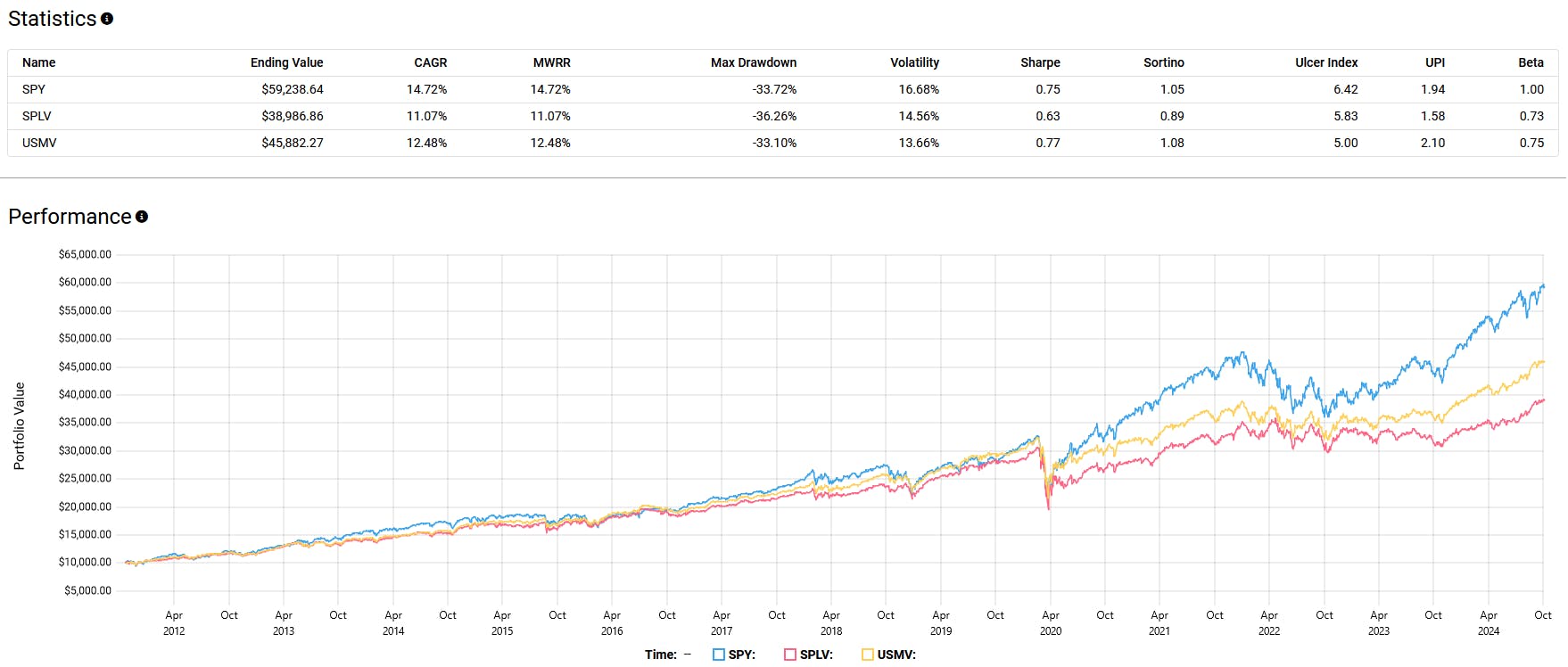
Both strategies effectively reduced overall volatility compared to the broader market. The standard deviation, a measure of market volatility, was 16.68% for SPY, 13.66% for USMV, and 14.56% for SPLV, indicating that both low and minimum volatility strategies managed to smooth out some of the market's rough edges.
However, when it comes to drawdowns, which measure peak-to-trough decline, the benefits were less pronounced. During the 2020 COVID market crash, SPY experienced a maximum drawdown of -33.72%, compared to -33.10% for USMV and -26.26% for SPLV, highlighting that these strategies, while mitigating some risk, do not fully shield against market downturns.
Despite these similarities, USMV's more complex approach resulted in the best risk-adjusted return, with a Sharpe ratio of 0.77, slightly higher than SPY's 0.75 and notably better than SPLV's 0.63. This suggests that while both strategies aim to reduce risk, the minimum volatility approach of USMV
The takeaway here is that low and minimum volatility ETFs are not interchangeable solutions for risk reduction. Each has its merits and can be effective depending on your investment goals and risk tolerance, but historically, minimum volatility has shown a slight advantage.
Please note this article is for information purposes only and does not in any way constitute investment advice. It is essential that you seek advice from a registered financial professional prior to making any investment decision.
Latest ETF News
See all ETF newsHow Investors can Maximize Tax Efficiency with Income ETFs

Trump Accounts: Here's Which ETFs You Can Invest In

The Two Best Types of Fixed-Income ETFs For Managing Cash

ETF Comparison: Roundhill Generative AI & Technology ETF Versus iShares A.I. Innovation and Tech Active ETF




 Advantages of ETFs over Mutual Funds1/6
Lower Costs
In this guide, we'll explore the advantages of ETFs over mutual funds, giving you valuable insights into why ETFs have gained significant popularity among investors like yourself.
Leveraged ETFs: Unlocking the Potential for Amplified Returns1/6
Understanding Leveraged ETFs
Explore leveraged ETFs: potential for amplified returns & risks. 5 ETFs to consider across equities, commodities & fixed income.
What is a Leveraged ETF?1/6
Introducing Leveraged and Inverse ETFs
In this guide, we'll dive into the world of leveraged ETFs, exploring their definition, mechanics, potential risks, and rewards.
Recent educational content

ETF Trends
ETF Industry KPIs July 20, 2026
This week’s KPI data overview highlights key metrics and trends shaping the ETF landscape.

ETF Trends
ETF Industry KPIs July 13, 2026
This week’s KPI data overview highlights key metrics and trends shaping the ETF landscape.

First Look ETF
First Look ETF: Cash Deployment, Bond, and Hedged ETFs
In this season 6 episode of First Look ETF, Stephanie Stanton examines the latest ETF marketplace trends with NYSE and guests.

ETF Trends
ETF Industry KPIs July 6, 2026
This week’s KPI data overview highlights key metrics and trends shaping the ETF landscape.
Browse all educational columns



The ETF Industry Is Evolving Fast
From AI infrastructure to active strategies, the ETF landscape is shifting. Share your perspective in the 7th Annual Global ETF Survey and get exclusive early access to the final report.