From idea to ETF portfolio in minutes. Build yours now →



Tony's ETF Buyer's Guide: Dividend Growth ETFs
In the market for an ETF focusing on growing dividends? Here's how to pick between the top options on the market right now.


Keep up with what matters in ETFs
Get timely ETF insights, market trends, and top ideas straight to your inbox.
Your newsletter subscriptions with us are subject to ETF Central's Privacy Policy and Terms and Conditions.
Many dividend investors overlook a crucial aspect of investing: only total returns truly matter. While receiving those quarterly dividend payments feels rewarding, it's not exactly free money.
According to dividend irrelevance theory, under certain conditions, a company's dividend policy has no effect on its market value or investors' wealth. The company is just returning capital to you in a tax-inefficient manner, and buybacks could achieve the same effect. Just look at Berkshire Hathaway – it pays no dividends, but it's hardly a slouch.
But I think focusing on companies with a history of growing dividends can inadvertently serve as a quality screen, offering a way to access companies with solid fundamentals and potential for growth, often at lower fees than you'd find with a brand-name quality factor ETF.
For those interested in dividend growth ETFs, there are several options to consider, each with its unique features and potential benefits.
In this guide, we'll dive into three of the most popular choices available today: the Vanguard Dividend Appreciation Index Fund ETF (VIG), the iShares Core Dividend Growth ETF (DGRO), and the WisdomTree U.S. Quality Dividend Growth Fund (DGRW).
Let's explore how to choose among these top options for your investment portfolio.
Like what you're reading?
Stay in the loop — get the latest ETF insights: trends, analysis, and expert picks.
Fees and yield
While VIG, DGRO, and DGRW all prioritize a history of increasing dividends over high current yields, they do offer higher 30-day SEC yields compared to the S&P 500 index, with VIG at 1.78%, DGRO at 2.41%, and DGRW at 1.59% as of February 28, 2024.
In terms of fees, Vanguard is renowned for its low-cost offerings, charging a mere 0.06% expense ratio for VIG. DGRO, part of iShares' "core" lineup, comes in slightly higher at 0.08%. DGRW stands out as the costliest of the three at 0.28%.
While beginners might be tempted to choose based on these metrics alone, with DGRO seemingly offering the best balance between yield and fees, such an analysis barely scratches the surface. It's essential to delve into the index methodology of each ETF to understand its true value proposition.
Index methodology
VIG adheres to the S&P U.S. Dividend Growers Index criteria, emphasizing companies with at least a decade of consecutive dividend growth. To filter these companies further, VIG assesses them based on indicated annual dividend yield—annual dividends per share divided by price per share.
It then excludes the top 25% of companies with the highest yields (15% for existing constituents) to avoid potential yield traps. Real Estate Investment Trusts (REITs) are also excluded from consideration.
DGRO, tracking the Morningstar US Dividend Growth Index, demands a shorter history of dividend growth, requiring companies to have increased their dividends for five consecutive years.
Additionally, it considers financial health and sustainability by requiring a positive consensus earnings forecast and a payout ratio under 75%. Similar to VIG, DGRO excludes REITs and the top 10% of stocks with the highest indicative dividend yields, aiming to sidestep yield traps.
DGRW follows the WisdomTree U.S. Quality Dividend Growth Index, with a focus on both growth and quality. It selects the top 300 companies from a primary screening universe based on their market capitalization ($2 billion minimum), combined ranking of growth (long-term earnings growth expectations) and quality factors (three-year historical averages for ROE and ROA).
DGRW annually updates its dividend weighting to reflect the projected share of aggregate cash dividends each company is expected to pay, based on the most recent dividend per share.
Among these ETFs, DGRO and VIG share similarities in excluding REITs and a certain percentage of the highest-yielding stocks to avoid yield traps.
DGRO and DGRW both incorporate quality screens, albeit through different metrics—DGRO uses payout ratio and earnings forecast, while DGRW looks at ROE, ROA, and earnings growth. Additionally, their weighting strategies are fundamentally based, not on market cap, but on dividends.
Factor loadings
In evaluating dividend growth ETFs, one crucial aspect to consider is their exposure to the Fama-French factors of profitability (RMW) and investment (CMA).
RMW, or Robust Minus Weak, measures an ETF's tilt towards companies with high operating profitability versus those with low. High-profitability companies tend to be more efficient and generate higher returns on their assets, making them attractive to quality-focused investors.
CMA, or Conservative Minus Aggressive, assesses an ETF's exposure to firms that invest conservatively relative to their assets. Companies that are conservative in their investments tend to be more stable and less risky, another hallmark of quality.
The regression analysis reveals that all three ETFs—VIG, DGRO, and DGRW—have statistically significant loadings to both RMW and CMA, indicating a meaningful tilt towards high-quality firms.
However, DGRW stands out with the highest loadings for both RMW (0.25) and CMA (0.26), underscoring its stronger focus on quality factors compared to VIG and DGRO.

This is reflected in the annual alpha, where DGRW is the only one of the three to exhibit a positive alpha (0.21%), suggesting it has provided investors with a return above what would be expected given its risk profile.
These factor loadings are essential for investors looking for ETFs that not only aim for growing dividends but also prioritize investment in high-quality companies. Despite DGRW's higher expense ratio of 0.28%, its significant loadings to RMW and CMA and positive alpha indicate that investors might indeed receive "bang for their buck."
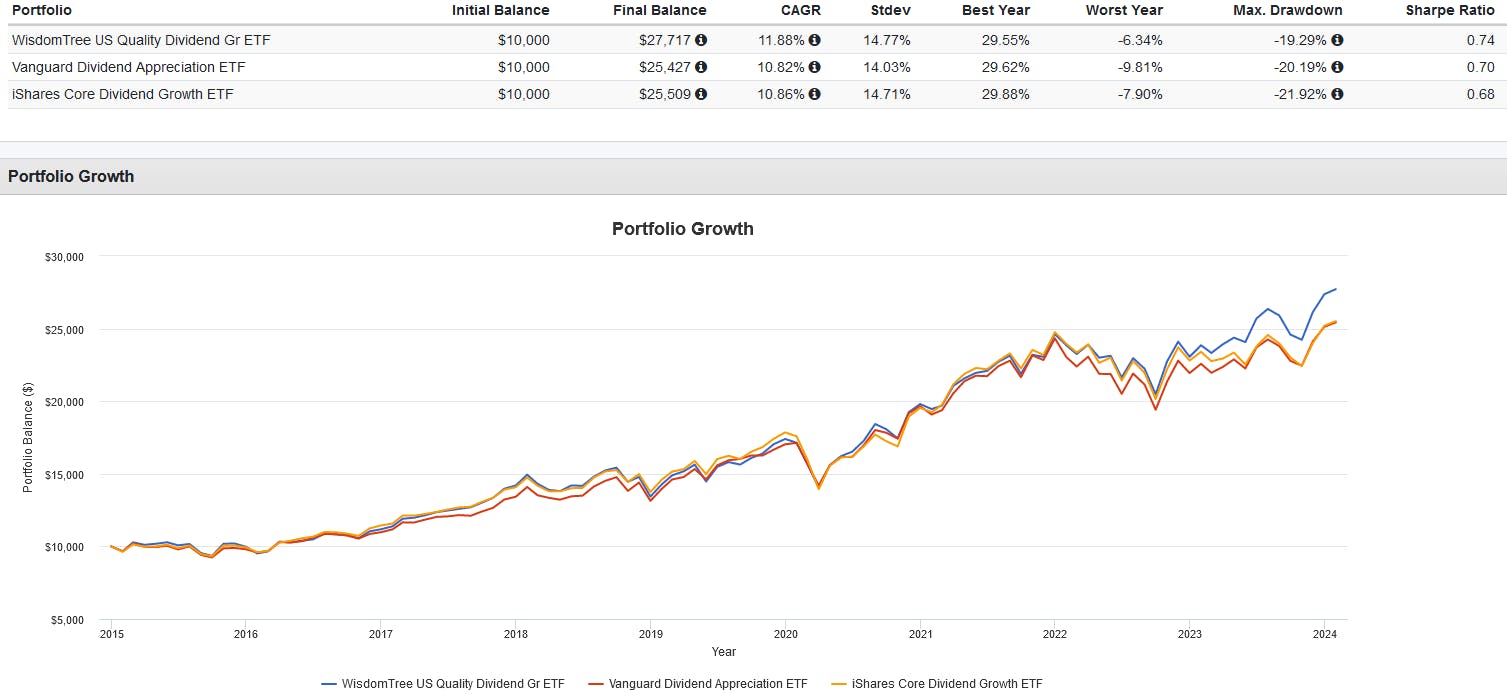
This aligns with historical performance, where DGRW has notably outperformed VIG and DGRO in both total and risk-adjusted returns, making a compelling case for considering more than just fees when selecting a dividend growth ETF.
Please note this article is for information purposes only and does not in any way constitute investment advice. It is essential that you seek advice from a registered financial professional prior to making any investment decision.

Latest ETF News
See all ETF newsCould Water ETFs Be the Next AI Bottleneck Trade?

What is a Boomer Candy ETF?

ETF Comparison: NEOS Nasdaq-100 High Income ETF (QQQI) Versus Goldman Sachs Nasdaq-100 Premium Income ETF (GPIQ)





 Advantages of ETFs over Mutual Funds1/6
Lower Costs
In this guide, we'll explore the advantages of ETFs over mutual funds, giving you valuable insights into why ETFs have gained significant popularity among investors like yourself.
Leveraged ETFs: Unlocking the Potential for Amplified Returns1/6
Understanding Leveraged ETFs
Explore leveraged ETFs: potential for amplified returns & risks. 5 ETFs to consider across equities, commodities & fixed income.
What is a Leveraged ETF?1/6
Introducing Leveraged and Inverse ETFs
In this guide, we'll dive into the world of leveraged ETFs, exploring their definition, mechanics, potential risks, and rewards.
Recent educational content

ETF Trends
ETF Industry KPIs September 8, 2026
This week’s KPI data overview highlights key metrics and trends shaping the ETF landscape.

ETF Trends
ETF Industry KPIs August 31, 2026
This week’s KPI data overview highlights key metrics and trends shaping the ETF landscape.
ETF Trends
ETF Industry KPIs August 24, 2026
This week’s KPI data overview highlights key metrics and trends shaping the ETF landscape.
What’sTheFund
What's the Fund | Ocean Park Diversified Income ETF (DUKZ)
James St Aubin, Chief Investment Officer at Ocean Park Asset Management, discuss the DUKZ ETF, exposing investors to the whole spectrum of asset classes in the fixed income markets, through their rules-based process.

Browse all educational columns



Expert-Built ETF Portfolios, All in One Place
Don’t start from scratch. Discover ready-made ETF portfolios built by professionals to match different goals, timelines, and market views. Use them as inspiration or as a starting point for your own allocation.