Keep tabs on your favorite ETFs with a personalized weekly tracker. Create a Watchlist now →



There's an ETF for That? Magnificent Seven Stocks
Here are three ways to gain exposure to the Magnificent Seven stocks via unique ETFs.


Keep up with what matters in ETFs
Get timely ETF insights, market trends, and top ideas straight to your inbox.
Your newsletter subscriptions with us are subject to ETF Central's Privacy Policy and Terms and Conditions.
Market pundits love giving stocks nicknames. Before the 21st century, there was the "Nifty Fifty" (not to be confused with the Indian market index of the same name), and then the "Dogs of the Dow."
Over the last decade, we had FANG (Facebook, Amazon, Netflix, Google). Today, we have the "Magnificent Seven"—Meta Platforms, Amazon, Microsoft, Google, Nvidia, Apple, and Tesla.
Nothing strikes more fear into the hearts of small-cap value proponents than the dominant performance of these mega-cap growth stocks from the technology, consumer discretionary, and communication sectors.
Just take a look at this chart from Howard Silverblatt, Senior Index Analyst at S&P Dow Jones Indices, which shows just how much some of these companies (Nvidia in particular) have contributed to the S&P 500's YTD return as of May 31, 2024.
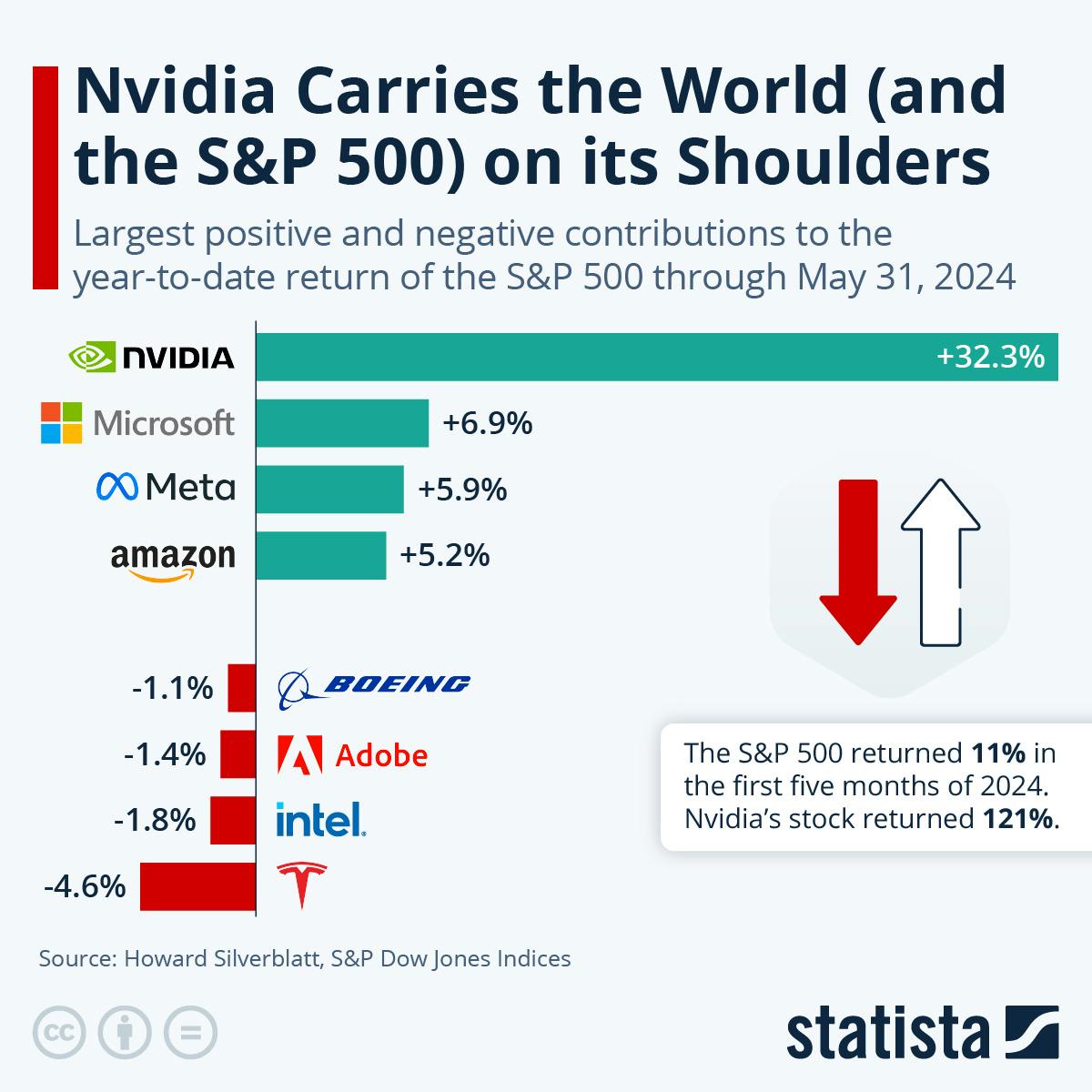
While you can gain exposure to the Magnificent Seven just by buying them directly, there are actually a few ETFs that can provide you with simplified or alternative exposure. Here are a few to watch.
Like what you're reading?
Stay in the loop — get the latest ETF insights: trends, analysis, and expert picks.
Magnificent Seven ETF MAGS-3.35%
Launched in April 2023, MAGS provides pure play exposure to all seven of the Magnificent Seven stocks in a single ticker. Over a year later, it has accumulated $420 million in assets under management (AUM).
If you're planning to go long on each of these stocks individually, you might consider paying Roundhill a 0.29% expense ratio to manage it on your behalf. This strategy can help you lose less to the bid-ask spread of multiple transactions.
The ETF is equally weighted every quarter, meaning it sells winners and buys losers. While this strategy can cap momentum, it also lowers concentration risk if one stock, like Nvidia, significantly pulls ahead.
YieldMax Magnificent 7 Fund of Option Income ETFs YMAG-2.95%
The Magnificent Seven stocks aren't particularly known for their high dividend yields, as most of these companies prefer to reinvest their cash in research and development or keep it on hand. Apple, for example, is notorious for having a large cash balance.
However, if you're looking for exposure to the Magnificent Seven along with income, you can achieve this through options strategies such as selling calls and puts. The ETF to watch here is YMAG, an ETF of ETFs that holds seven other YieldMax single-stock ETFs, each corresponding to one of the Magnificent Seven stocks.
We've covered how the YieldMax ETFs work in a prior article—they use a synthetic covered call strategy. This strategy starts by combining a short put and a long call to simulate owning an actual stock, then selling a short call to generate income.
The goal of YMAG is to provide high monthly income. This strategy effectively offers embedded leverage and converts share price appreciation into options premiums, at the cost of capped upside and the usual exposure to downside risk.
As of June 17, YMAG is paying a 39.78% distribution rate. This rate is calculated by multiplying the ETF's distribution-per-share by twelve (12) and dividing the resulting amount by the ETF's most recent Net Asset Value (NAV).
Invesco S&P 500 Top 50 ETF XLG-2.04%
If the concentration in MAGS and YMAG is too much for you, there's a middle ground with XLG. This straightforward index ETF does exactly what its name suggests—holds the top 50 stocks in the S&P 500.
Given the size of the Magnificent Seven, this naturally results in a high weighting to these stocks. As of June 17, all except Tesla are among the top 10 holdings and collectively account for 54.42% of the ETF's weight.
This means you get significant exposure to the Magnificent Seven while also diversifying your investment across other leading companies in the S&P 500, all for a 0.20% expense ratio.
Please note this article is for information purposes only and does not in any way constitute investment advice. It is essential that you seek advice from a registered financial professional prior to making any investment decision.
Latest ETF News
See all ETF newsBeyond Big Tech: The Increasing Specialization of AI ETFs

There's an ETF for That? Humanoid Robotics and Physical AI

How Some ETF Issuers Use Their Own Funds for Cash Management

These Public-Private ETFs Invest in Polymarket and Anduril

There's an ETF for That? Frontier Markets



 Advantages of ETFs over Mutual Funds1/6
Lower Costs
In this guide, we'll explore the advantages of ETFs over mutual funds, giving you valuable insights into why ETFs have gained significant popularity among investors like yourself.
Leveraged ETFs: Unlocking the Potential for Amplified Returns1/6
Understanding Leveraged ETFs
Explore leveraged ETFs: potential for amplified returns & risks. 5 ETFs to consider across equities, commodities & fixed income.
What is a Leveraged ETF?1/6
Introducing Leveraged and Inverse ETFs
In this guide, we'll dive into the world of leveraged ETFs, exploring their definition, mechanics, potential risks, and rewards.
Recent educational content
First Look ETF
First Look ETF: Income, International, and Cash Flow ETFs
In this season 6 episode of First Look ETF, Stephanie Stanton @etfguide examines the latest ETF marketplace trends with NYSE and guests.


ETF Trends
ETF Industry KPIs October 5, 2026
This week’s KPI data overview highlights key metrics and trends shaping the ETF landscape.

ETF Trends
ETF Industry KPIs September 28, 2026
This week’s KPI data overview highlights key metrics and trends shaping the ETF landscape.
ETF Trends
ETF Industry KPIs September 22, 2026
This week’s KPI data overview highlights key metrics and trends shaping the ETF landscape.
Browse all educational columns



ETFs’ Next Act: From Access to Selection
With 1,790 new products launched by July 2026, choosing is harder than ever. Our Global ETF Survey 2026, built on 620 professional investors and allocators, shows how active, fixed income, options-based and thematic ETFs are reshaping fund selection.