Create, analyze, optimize your ETF portfolio. Start now →



There’s an ETF for That? Air Conditioning Stocks
Europe’s scorching heatwave has spawned not only memes, but also substantial interest in stocks involved in the heating, ventilation, and air conditioning (HVAC) industry.


Keep up with what matters in ETFs
Get timely ETF insights, market trends, and top ideas straight to your inbox.
Your newsletter subscriptions with us are subject to ETF Central's Privacy Policy and Terms and Conditions.
By now, you've probably seen the memes poking fun at the lack of air conditioning in many European countries as another record-breaking heat wave sweeps across the continent. Behind the jokes, however, lies a serious economic story. As temperatures climb, so too does investor interest in the companies that manufacture the equipment keeping homes, offices, factories, and data centers cool.
The numbers have certainly grabbed headlines. During the latest heat wave, the United Kingdom recorded one of its hottest days on record, while large parts of France also experienced record-breaking temperatures. Financial markets have been quick to connect the dots between rising temperatures and rising demand for cooling infrastructure.
For example, CNBC recently highlighted the rally in air conditioning and building efficiency companies as Europe grappled with extreme heat. The Financial Times ran the headline, "Air con stocks become next hot bets as Europe wilts." Meanwhile, analysts at Citi argued that U.S.-listed HVAC manufacturers such as Carrier Global, Trane Technologies, and Johnson Controls could stand to benefit from stronger long-term demand for cooling equipment.
This is one of those situations where a thematic ETF makes a great deal of sense. The category often receives criticism for higher expense ratios and for launching after a trend has already become popular. However, investing in the companies that build and service air conditioning systems is fundamentally different from simply speculating on the weather.
While prediction markets allow investors to wager on future temperatures, those contracts eventually expire, and historically have even experienced controversy from tampering. An ETF, by contrast, owns businesses that generate recurring profits, repurchase shares, and in many cases pay dividends while benefiting from long-term demand for climate control infrastructure.
As with the theme of this column, there's an ETF for that. For investors looking to gain exposure to air conditioning stocks, the current lineup is surprisingly small. At the moment, the only dedicated option appears to come from AdvisorShares.
Like what you're reading?
Stay in the loop — get the latest ETF insights: trends, analysis, and expert picks.
AdvisorShares HVAC and Industrials ETF (HVAC)
For investors looking to express this theme through an ETF, the choices are surprisingly limited. At present, the only dedicated option is the aptly named HVAC.
HVAC is an actively managed fund that invests across the heating, ventilation, and air conditioning ecosystem. According to AdvisorShares, that includes manufacturers, distributors, service providers, software and technology companies, energy management firms, consultants, training providers, and diversified industrial companies with meaningful HVAC operations.
Importantly, the opportunity extends well beyond residential air conditioning. Commercial buildings, hospitals, schools, factories, warehouses, data centers, and other enterprise facilities all require increasingly sophisticated climate control systems. That broad customer base gives the industry multiple sources of demand rather than relying solely on the housing market.
The underlying business model is also more diversified than many investors may realize. Installation is only one piece of the value chain. Companies also generate recurring revenue from inspections, maintenance contracts, repairs, equipment upgrades, replacement parts, energy efficiency retrofits, and building automation systems. While an individual company may specialize in only one part of that ecosystem, an ETF like HVAC allows investors to own the entire value chain.
As expected, industrial companies dominate the fund's holdings. Some of HVAC’s larger positions include Comfort Systems USA, one of North America's leading commercial mechanical contractors; SPX Technologies, which provides HVAC and detection technologies; and Quanta Services, whose infrastructure and electrical expertise supports large-scale commercial and industrial projects.
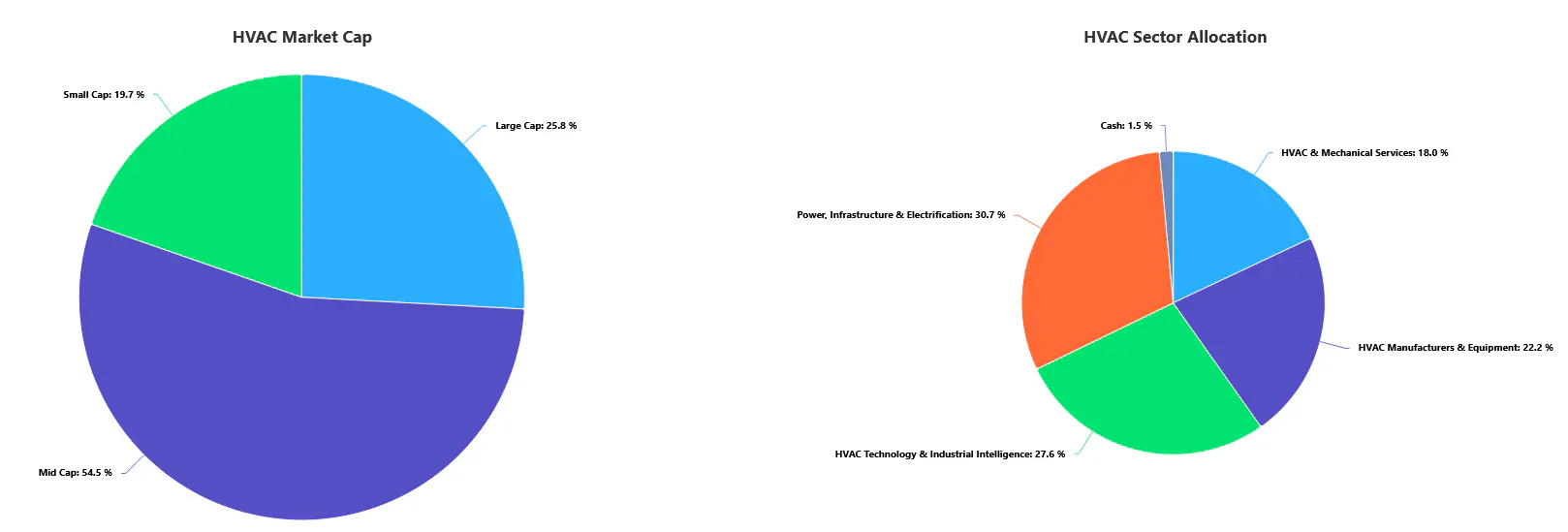
Source: AdvisorShares
The tradeoff for active management is cost. HVAC carries a 1.00% net expense ratio, making it considerably more expensive than a traditional index ETF. Investors should also be aware of liquidity considerations. The fund currently exhibits a relatively wide 30-day median bid-ask spread of approximately 0.375%, while assets under management total just over $16 million, making it an underdog by virtually any ETF industry standard.
How Has HVAC Performed?
Despite those drawbacks, performance has been impressive during the fund's short history. HVAC substantially outperformed both the Industrial Select Sector SPDR Fund
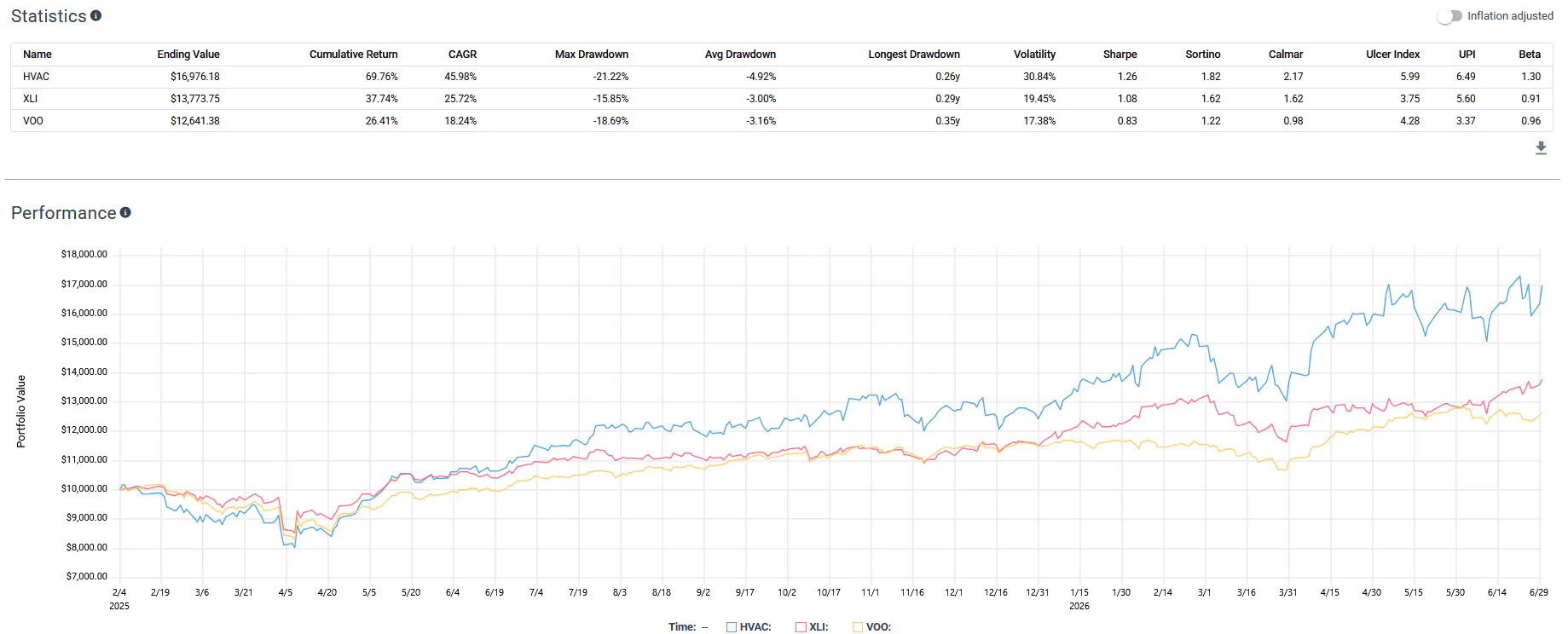
Source: Testfolio.io
Several structural factors continue to support the industry. Although HVAC demand is certainly influenced by construction activity, cooling systems are often necessities rather than discretionary purchases. Equipment eventually fails, buildings must remain habitable, and critical facilities such as hospitals and data centers cannot simply postpone climate control indefinitely. That gives much of the industry's demand a relatively inelastic character.
Population also growth increases the number of buildings requiring climate control, while aging infrastructure creates an ongoing need for replacement and modernization. Climate change may further reinforce these trends as more regions experience prolonged periods of extreme heat, increasing both air conditioning adoption and demand for higher-capacity, more energy-efficient systems.
Another reason the theme remains interesting is that it is still relatively uncrowded. Unlike artificial intelligence, memory, or robotics, HVAC has attracted little attention from ETF issuers despite the industry's attractive long-term fundamentals. Whether competing products eventually enter the market remains to be seen, but for now, AdvisorShares appears to have this niche largely to itself.
If extreme heat continues becoming a more common feature of summers around the world, demand for climate control infrastructure may remain an enduring investment theme. And with much of the summer still ahead, investor attention on the sector may only be getting started.
Please note this article is for information purposes only and does not in any way constitute investment advice. It is essential that you seek advice from a registered financial professional prior to making any investment decision.

Latest ETF News
See all ETF newsThese Public-Private ETFs Invest in Polymarket and Anduril

There's an ETF for That? Frontier Markets

10-Year Treasury Yield Hits 5%: Which Bond ETFs Offer the Most Direct Exposure?

ETF comparison: NEOS S&P 500 High Income ETF (SPYI) Versus Goldman Sachs S&P 500 Premium Income ETF (GPIX)




 Advantages of ETFs over Mutual Funds1/6
Lower Costs
In this guide, we'll explore the advantages of ETFs over mutual funds, giving you valuable insights into why ETFs have gained significant popularity among investors like yourself.
Leveraged ETFs: Unlocking the Potential for Amplified Returns1/6
Understanding Leveraged ETFs
Explore leveraged ETFs: potential for amplified returns & risks. 5 ETFs to consider across equities, commodities & fixed income.
What is a Leveraged ETF?1/6
Introducing Leveraged and Inverse ETFs
In this guide, we'll dive into the world of leveraged ETFs, exploring their definition, mechanics, potential risks, and rewards.
Recent educational content

ETF Trends
ETF Industry KPIs October 5, 2026
This week’s KPI data overview highlights key metrics and trends shaping the ETF landscape.

ETF Trends
ETF Industry KPIs September 28, 2026
This week’s KPI data overview highlights key metrics and trends shaping the ETF landscape.
ETF Trends
ETF Industry KPIs September 22, 2026
This week’s KPI data overview highlights key metrics and trends shaping the ETF landscape.

First Look ETF
First Look ETF: Income, Corporate Arbitrage, and Growth and Value Investing
First Look ETF September 2026: iCapital, Mast Investments and North Square unpack new ETFs targeting monthly income, merger arbitrage and complementary growth and value exposure.

Browse all educational columns



Expert-Built ETF Portfolios, All in One Place
Don’t start from scratch. Discover ready-made ETF portfolios built by professionals to match different goals, timelines, and market views. Use them as inspiration or as a starting point for your own allocation.