Open Now: The Global ETF Survey Take the Survey →



The Summer Weather is Heating Up, Is Your Client’s Portfolio Going to Keep Up?
Explore how HVAC stocks and ETFs are rising with demand, tech upgrades, and policy shifts—offering advisors a resilient, long-term industrial theme.


Keep up with what matters in ETFs
Get timely ETF insights, market trends, and top ideas straight to your inbox.
Your newsletter subscriptions with us are subject to ETF Central's Privacy Policy and Terms and Conditions.
As temperatures soar this summer, so does investor interest in the HVAC (heating, ventilation, and air conditioning) industry. For financial advisors, understanding how this critical sector is recovering from trade disruptions and evolving through sustainability and technology trends can offer valuable context when evaluating long-term opportunities. HVAC companies are rebounding from tariffs, leveraging new legislation, and trying to position themselves as an investable megatrend.
Get data on 14,000+ ETFs
Access Trackinsight's reliable and comprehensive data with 500M+ points on 14,000+ ETFs.
The Importance of HVAC in Today’s Economy
HVAC systems do far more than keep buildings comfortable. They are essential to air quality in hospitals, energy control in data centers, and climate regulation in schools, office buildings, and homes. The global HVAC market is projected to grow to $367 billion by 2030, driven by both new construction in emerging economies and retrofitting initiatives in mature markets.¹
For clients looking for steady exposure to industrial growth, HVAC represents a durable, long-term theme.
Tariffs: A Recent Test of Industry Resilience
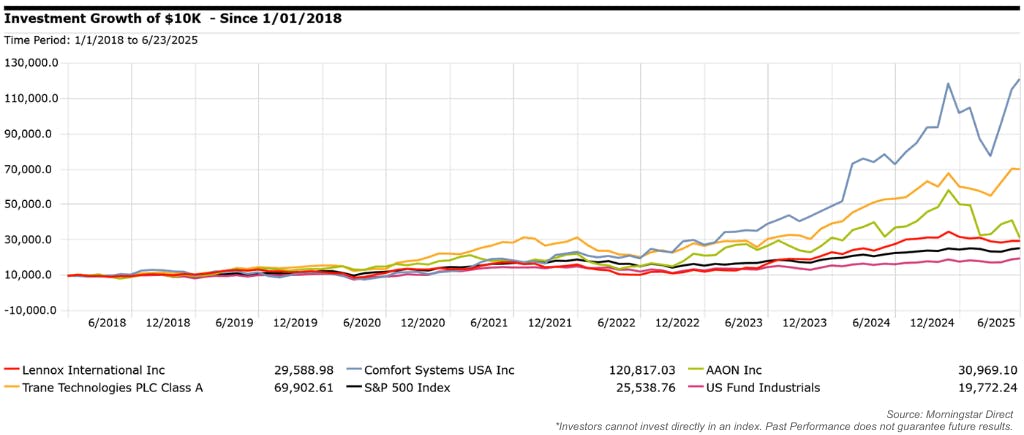
Between 2018 and 2020, U.S. tariffs on steel, aluminum, and imported HVAC components created a challenging environment for manufacturers. HVAC firms reliant on global supply chains faced increased costs, which affected pricing and margins. According to the International Trade Administration, over $4 billion worth of HVAC-related equipment was imported from China annually before tariffs, highlighting the industry’s exposure.
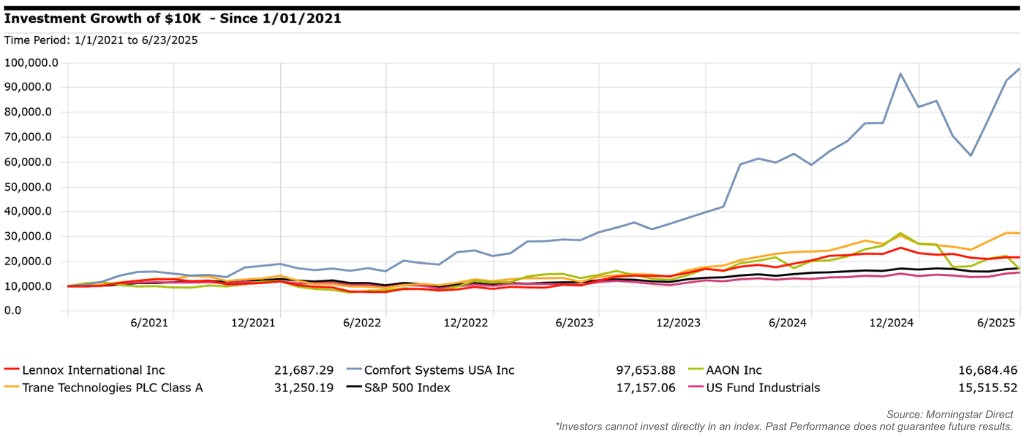
Major players like Carrier and Trane Technologies reported significant cost increases in earnings calls during this period. HVAC manufacturers responded by either reshoring operations or diversifying suppliers, a trend that is currently repeating.
The Recovery: Strategic Shifts and Supportive Policy
Since 2021, companies have regained ground. Diversification of supply chains and adoption of domestic manufacturing strategies helped alleviate tariff pressures. Additionally, the Inflation Reduction Act (IRA) of 2022 introduced tax credits for U.S.-based manufacturing of clean energy technologies, including HVAC systems. These credits have helped soften tariff-related expenses while promoting innovation in energy efficiency.²
According to Bloomberg’s recent outlook, top HVAC manufacturers posted year-over-year organic sales growth in 2024, with positive operating margin outlooks for 2025. This trend signals recovery not only in supply chains but also in demand.²
Rising Demand from New Infrastructure and Technologies
- Urbanization and Emerging Markets: HVAC system installations are on the rise globally. As emerging economies industrialize, demand for climate control in both residential and commercial sectors is surging. By 2050, two-thirds of households worldwide are expected to own air conditioning units.³
- Data Centers and Digital Growth: HVAC plays a critical role in cooling high-performance computing environments. In fact, cooling accounts for 40% of energy usage in data centers. McKinsey projects U.S. electricity demand from data centers to rise 23% between 2024 and 2030.⁴
- Green Buildings and Sustainability Mandates: Governments are tightening building codes to meet emissions targets. Energy-efficient HVAC systems with low-GWP (Global Warming Potential) refrigerants are being adopted in both new construction and retrofits.⁵
Implications for Investment Portfolios
For advisors managing portfolios with exposure to industrials or infrastructure, HVAC can be an appealing component. Its essential nature provides stability across market cycles, while smart technologies and energy mandates create innovation-driven upside. ETFs that track capital goods or infrastructure sectors often include HVAC manufacturers, component suppliers, and service providers, offering diversified access to the theme.
The AdvisorShares whitepaper notes that HVAC stocks have shown strong multi-year performance across various timeframes, supported by secular demand and heightened awareness of indoor air quality since the pandemic.⁶
Cool Stats to Share with Clients:
- Smart thermostats can reduce household energy use by up to 20%, potentially saving hundreds annually.⁷
- Only 8% of homes in some of the world’s hottest regions have AC, suggesting massive upside in adoption.⁸
- HVAC servicing and installation account for 60% of industry revenue, with average system lifespans between 10 and 20 years—supporting consistent demand.⁹
While summer brings a seasonal uptick in HVAC use, the sector’s investment potential extends far beyond hot weather. From adapting to trade headwinds to playing a key role in sustainability and tech infrastructure, HVAC is a story of resilience and evolution.
For financial advisors looking to align clients with long-term industrial and environmental trends, HVAC offers both relevance and reliability.
The opinions expressed in this publication are those of the authors and are subject to change. They do not purport to reflect the opinions or views of ETF Central or its members. ETF Central does not guarantee the accuracy, completeness, or reliability of the information provided.
Sources:
¹ Benchmark International, 2024 Construction Spotlight: Global HVAC Industry Report, May 2024.
² Bloomberg Intelligence, Global HVAC Monthly: Indicators Show Signs of Life, 2024.
³ Science Direct, Projected Global Demand for Air Conditioning, Aug. 2022.
⁴ McKinsey & Company, How Data Centers and the Energy Sector Can Sate AI’s Hunger for Power, Sep. 2024.
⁵ UN Environment Programme, Air Conditioners Fuel the Climate Crisis, June 2023.
⁶ Morningstar Direct.
⁷ Energy Star, Home Energy Efficiency, 2024.
⁸ International Energy Agency, The Future of Cooling, 2018.
⁹ Terry’s A/C & Heating, HVAC Replacement: When Should I Replace My HVAC Unit?, 2024.
¹⁰ International Trade Administration, Trade Statistics, 2023.

Latest ETF News
See all ETF news









 Advantages of ETFs over Mutual Funds1/6
Lower Costs
In this guide, we'll explore the advantages of ETFs over mutual funds, giving you valuable insights into why ETFs have gained significant popularity among investors like yourself.
Leveraged ETFs: Unlocking the Potential for Amplified Returns1/6
Understanding Leveraged ETFs
Explore leveraged ETFs: potential for amplified returns & risks. 5 ETFs to consider across equities, commodities & fixed income.
What is a Leveraged ETF?1/6
Introducing Leveraged and Inverse ETFs
In this guide, we'll dive into the world of leveraged ETFs, exploring their definition, mechanics, potential risks, and rewards.
Recent educational content

ETF Trends
ETF Industry KPIs July 20, 2026
This week’s KPI data overview highlights key metrics and trends shaping the ETF landscape.

ETF Trends
ETF Industry KPIs July 13, 2026
This week’s KPI data overview highlights key metrics and trends shaping the ETF landscape.

First Look ETF
First Look ETF: Cash Deployment, Bond, and Hedged ETFs
In this season 6 episode of First Look ETF, Stephanie Stanton examines the latest ETF marketplace trends with NYSE and guests.

ETF Trends
ETF Industry KPIs July 6, 2026
This week’s KPI data overview highlights key metrics and trends shaping the ETF landscape.
Browse all educational columns



Have you tried our ETF Compare tool?
Compare ETFs like a pro. Analyze fees, performance, exposure & holdings side-by-side.