Create, analyze, optimize your ETF portfolio. Start now →



The Harry Browne permanent ETF portfolio
Harry Browne favours this simple yet diversified portfolio. Let's break it down.

Keep up with what matters in ETFs
Get timely ETF insights, market trends, and top ideas straight to your inbox.
Your newsletter subscriptions with us are subject to ETF Central's Privacy Policy and Terms and Conditions.
Back in 2001, American writer, politician, and investment advisor Harry Browne laid out the groundwork for his "Permanent Portfolio" in his book Fail-Safe Investing. Browne intended this portfolio to be a one-size-fits-all, permanent holding suitable for investors of all ages and risk tolerances.
The point of the permanent portfolio was to create an investment that could withstand most market conditions while still delivering solid returns, thus saving investors the need to time the market or pick which assets would outperform.
Get data on 14,000+ ETFs
Access Trackinsight's reliable and comprehensive data with 500M+ points on 14,000+ ETFs.
How does the permanent portfolio work?
The permanent portfolio is an excellent illustration of the benefits of diversification. Simply put, a portfolio of volatile, uncorrelated assets with positive expected returns can produce more units of return for fewer units of risk compared to a single asset. This is why a 60/40 portfolio of stocks/bonds has a historically better Sharpe ratio than the S&P 500.
Diversification aims to produce the best risk-adjusted return, not maximize absolute returns. Ideally, the more volatility and drawdowns we risk, the more returns we should be compensated with. Spreading our sources of risk out among different assets with varying degrees of correlation to each other helps achieve this.
Brown outlined four different asset classes that were expected to outperform based on his theory of economic scenarios:
- Economic expansion: U.S. stocks.
- Economic deflation: U.S. long-term Treasury bonds.
- Economic recession: Cash & money market instruments.
- Economic inflation: Gold bullion.
The role of stocks
Stocks will drive most of the portfolio's returns during bull markets. Browne suggested using the total U.S. stock market, which saves investors the trouble of picking stocks. The S&P 500 could work, but in this case, maximizing diversification by including mid and small-cap stocks is probably a good idea.
The following low-cost index ETFs could work:
The role of bonds
Bonds (Treasurys) provide deflationary crash protection. When a market crash occurs, central banks often drop interest rates to stimulate the economy, which sends bond prices (especially long-term Treasurys) soaring. This is called the "flight to safety." Bonds also generally lower volatility (in a non-rising rate environment). Browne favoured long-term Treasurys, which provide the highest sensitivity to interest changes.
The following low-cost index ETFs could work:
The role of gold
Gold's inflation protection is debatable. Over the long term (think 50+ years), gold acts as a value store. In the short term, gold is too volatile and can easily tank when inflation soars due to other variables. I conceded that it acts as a safe haven for political/socio-economic turmoil and has a low correlation with stocks and bonds, making it a valuable diversifier.
The following low-cost index ETFs could work:
The role of cash
When all else fails, cash is king. Despite losing value to inflation, cash is unaffected by market crashes, giving investors some respite when the rest of their portfolio draws down. Now Browne didn't advocate for stuffing cash under your mattress. Instead, he suggested money market instruments like ultra short-term Treasury bills (T-Bills).
The following low-cost index ETFs could work:
Constructing the portfolio
Browne suggested the following equal weight allocation:
- 25% stocks
- 25% long-term Treasurys
- 25% gold
- 25% cash
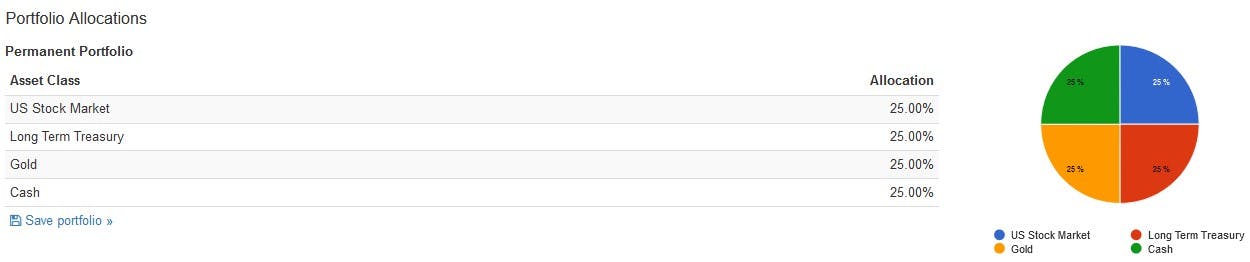
These allocations are not mean-variance optimized or accurate for a true risk parity weighting. Browne's weights were intended to be a helpful rule of thumb for investors that could be easy to implement. I would also be cautious of using backtests to find the "correct" allocations as that is highly subject to over-fitting data.
That being said, here's how it has performed compared to the S&P 500 since 1978 with annual rebalancing:
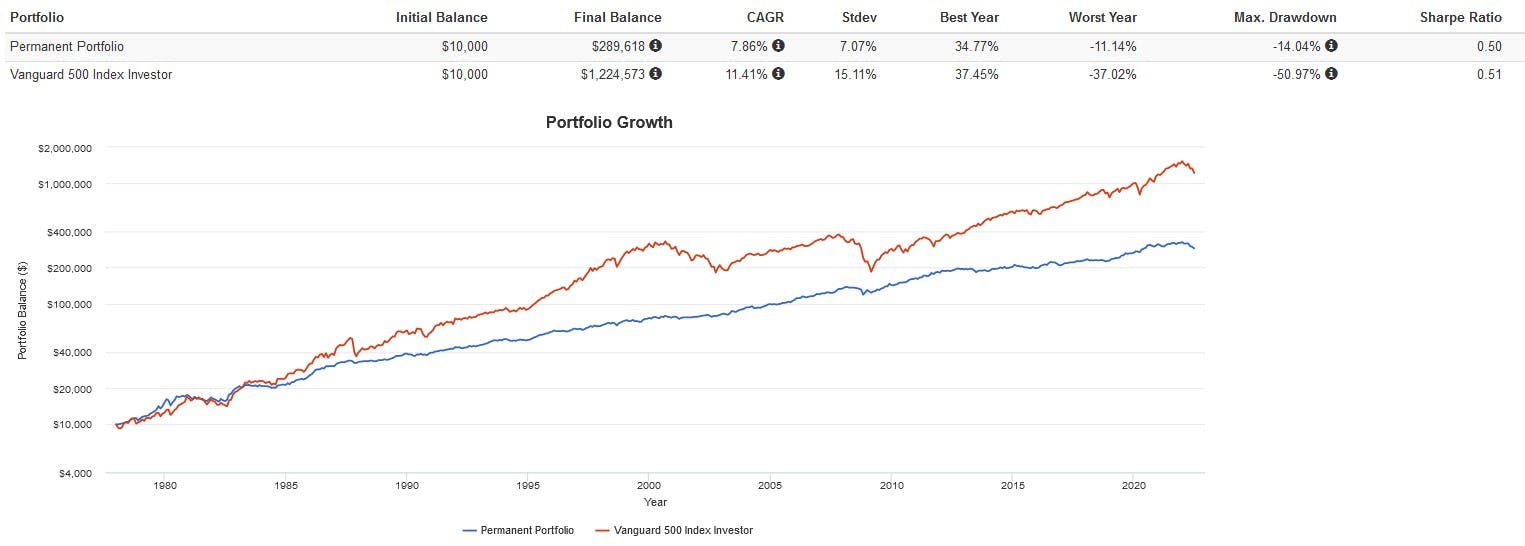
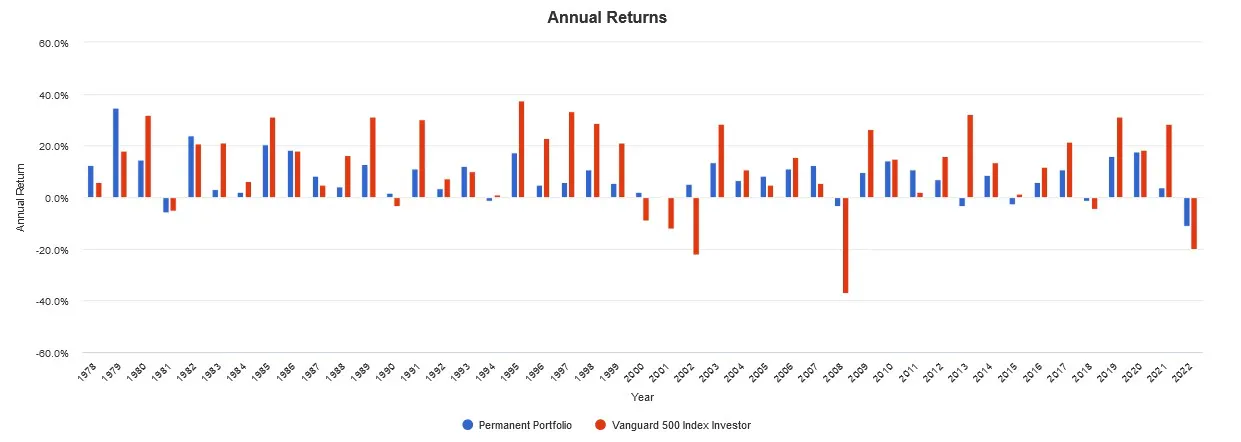
We see slightly better risk-adjusted returns (Sharpe ratio) but significantly lower volatility and drawdowns. Overall, the sequence of returns was much more predictable, which can be desirable for low-risk investors.
Personally, I would prefer a lower allocation to gold and cash (10% each) and replace some of the long-term Treasurys with intermediate duration ones. I would also swap out the U.S. stock market with the total world stock market. Then again, who am I to argue against Harry Browne?
Latest ETF News
See all ETF news10-Year Treasury Yield Hits 5%: Which Bond ETFs Offer the Most Direct Exposure?

ETF comparison: NEOS S&P 500 High Income ETF (SPYI) Versus Goldman Sachs S&P 500 Premium Income ETF (GPIX)

There’s an ETF for That? Investing Like University Endowments

Could Water ETFs Be the Next AI Bottleneck Trade?

What is a Boomer Candy ETF?



 Advantages of ETFs over Mutual Funds1/6
Lower Costs
In this guide, we'll explore the advantages of ETFs over mutual funds, giving you valuable insights into why ETFs have gained significant popularity among investors like yourself.
Leveraged ETFs: Unlocking the Potential for Amplified Returns1/6
Understanding Leveraged ETFs
Explore leveraged ETFs: potential for amplified returns & risks. 5 ETFs to consider across equities, commodities & fixed income.
What is a Leveraged ETF?1/6
Introducing Leveraged and Inverse ETFs
In this guide, we'll dive into the world of leveraged ETFs, exploring their definition, mechanics, potential risks, and rewards.
Recent educational content

ETF Trends
ETF Industry KPIs September 14, 2026
This week’s KPI data overview highlights key metrics and trends shaping the ETF landscape.

ETF Trends
ETF Industry KPIs September 8, 2026
This week’s KPI data overview highlights key metrics and trends shaping the ETF landscape.
ETF Trends
ETF Industry KPIs August 31, 2026
This week’s KPI data overview highlights key metrics and trends shaping the ETF landscape.
ETF Trends
ETF Industry KPIs August 24, 2026
This week’s KPI data overview highlights key metrics and trends shaping the ETF landscape.
Browse all educational columns



Build and Analyze Your ETF Portfolio Like a Pro
Create your own ETF portfolio in minutes and instantly see allocations, exposures, performance, and risk. Visualize diversification across asset classes, regions, and sectors. Stress-test ideas, compare benchmarks, and refine your strategy with professional-grade analytics.