Open Now: The Global ETF Survey Take the Survey →



ETF Comparison: SPDR S&P Aerospace & Defense ETF (XAR) Versus Invesco Aerospace & Defense ETF (PPA)
Two of the top NYSE-listed aerospace & defense ETFs go head-to-head in this week’s ETF comparison.

Keep up with what matters in ETFs
Get timely ETF insights, market trends, and top ideas straight to your inbox.
Your newsletter subscriptions with us are subject to ETF Central's Privacy Policy and Terms and Conditions.
With the war in Ukraine now dragging on for over 1,000 days, the Israeli-Hamas conflict spilling over into Lebanon and Iran, and escalating tensions between NATO and Russia, geopolitical volatility remains a certainty.
Investors have been pouring money into aerospace and defense ETFs, seeking either a hedge or speculative gains, and so far, it has paid off. This sector has become one of the top performers throughout 2023 and 2024.
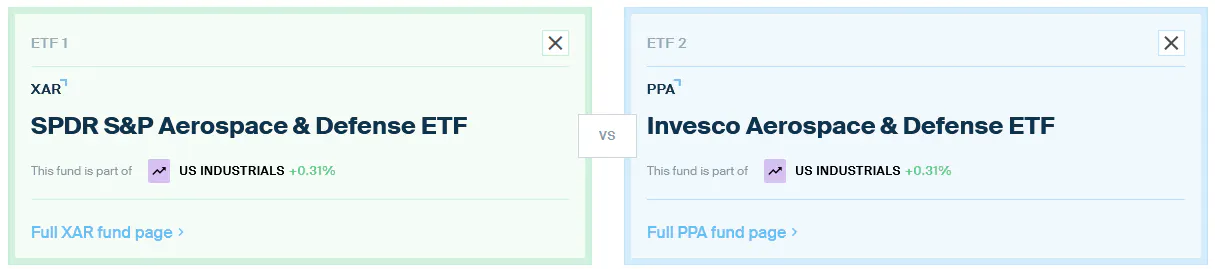
Among the many options in this space—some of which we’ve covered in previous editions of Tony’s ETF Buyers Guide—two major NYSE-listed ETFs stand out: the SPDR S&P Aerospace & Defense ETF
Today, we’ll see how these two heavyweights stack up against each other, using data from the ETF Central comparison tool.
Like what you're reading?
Stay in the loop — get the latest ETF insights: trends, analysis, and expert picks.
XAR vs PPA: Total cost of ownership
When it comes to expense ratios, XAR takes a clear lead at 0.35%. This is the standard pricing State Street SPDR has set for its industry-specific ETFs. On the other hand, Invesco charges 0.57% for PPA. For a $10,000 investment, this translates to $35 annually for XAR versus $57 for PPA—a significant difference.
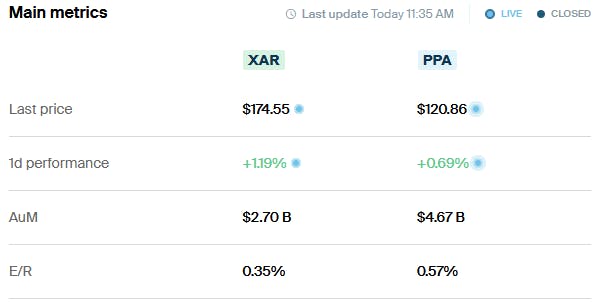
While XAR already stands out on fees, what about implicit costs? When trading these ETFs, PPA shows slightly better liquidity, with a 30-day median bid-ask spread of 0.035% compared to XAR’s 0.041%.
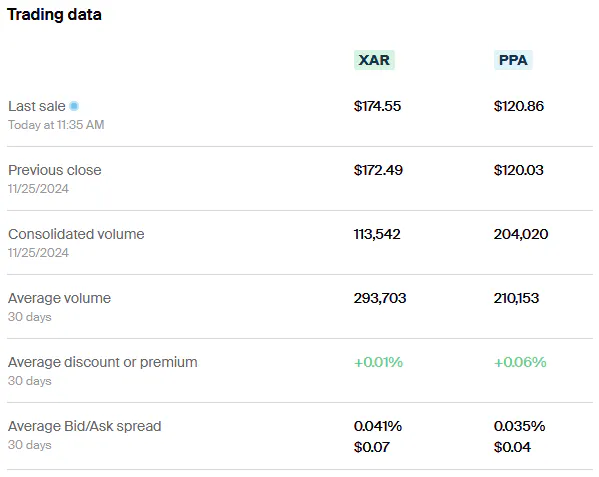
Verdict: XAR wins by a mile. Its lower expense ratio more than compensates for the marginally higher trading costs, making it the more cost-effective choice overall.
XAR vs PPA: Methodology and holdings
Both ETFs take a passive approach to tracking aerospace and defense stocks via their respective benchmark indexes, but their criteria and weighting methodologies differ significantly.
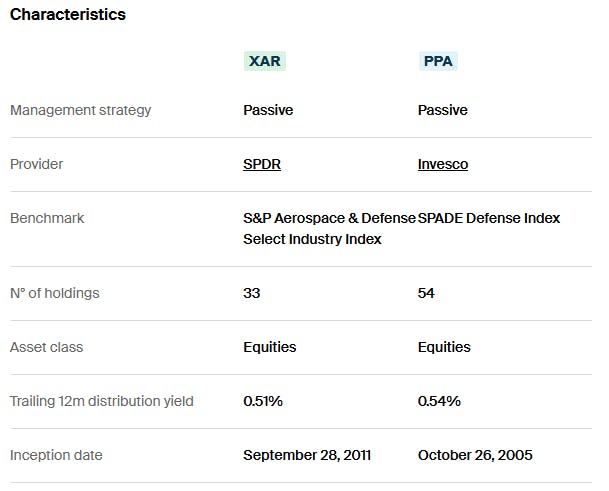
XAR
PPA
This approach adjusts the weight of diversified conglomerates by isolating the relevant business activity within the defense, aerospace, homeland security, or space sectors as if it were a standalone entity. It also highlights “systematically important” firms whose elimination would significantly impact the operations or capabilities of the U.S. Department of Defense.
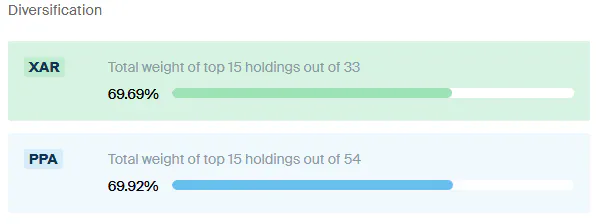
Both ETFs have similar levels of top-heaviness, with around 69% of their total weight concentrated in the top 15 holdings. However, the composition of these top holdings differs.
XAR’s equal-weight strategy means its top holdings are often firms that have performed well between rebalances, emphasizing smaller and mid-cap aerospace names. In contrast, PPA leans heavily on the largest defense contractors, including Raytheon, Boeing, Lockheed Martin, General Dynamics, Northrop Grumman, Honeywell, and L3Harris.
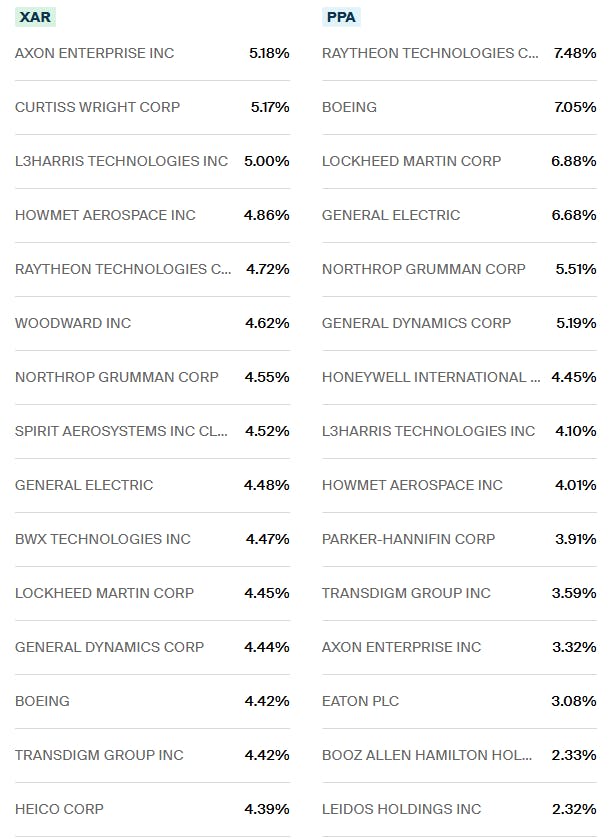
Verdict: In my opinion, PPA wins in this category because it more accurately reflects the true scale of the U.S. military-industrial complex.
XAR vs PPA: Risk and return
Both ETFs have delivered strong double-digit returns in recent years and attracted significant inflows, but PPA
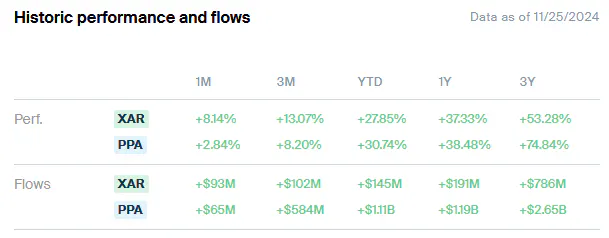
Over the long term, PPA also outperformed, delivering a 17.47% compound annual growth rate (CAGR) compared to XAR’s 17.06%. It achieved better risk-adjusted returns as well, with a Sharpe ratio of 0.87 versus XAR’s 0.77.
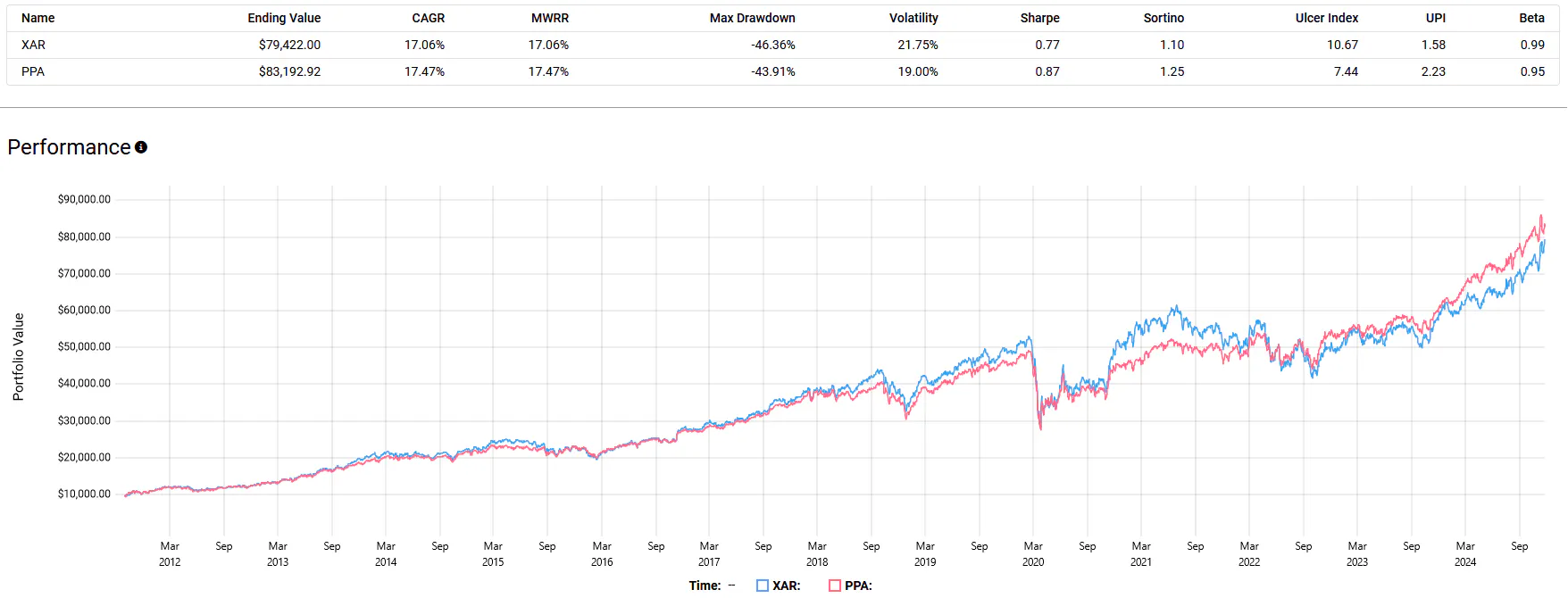
Why? Personally, I think XAR’s equal-weight methodology and frequent rebalances prevent winners from running and reduce exposure to large-cap defense contractors, which have seen the biggest gains during recent conflicts.
In terms of risk, PPA is the clear lower-risk option. It has lower volatility and shorter, shallower drawdowns. XAR’s equal-weighting skews it toward more volatile small- and mid-cap stocks, while PPA’s focus on large contractors with billions in backlogs provides more stability.
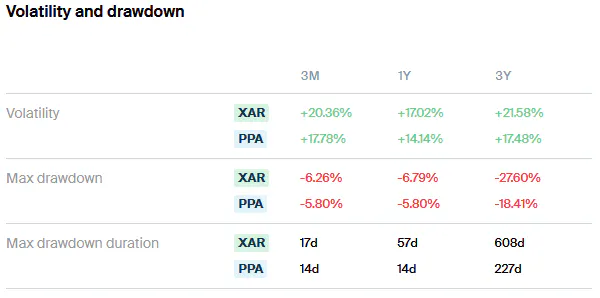
Verdict: PPA wins here, offering higher returns with lower risk, making it the more dependable choice for aerospace and defense exposure.
This article is for informational purposes only and does not in any way constitute investment advice. The author may express their own opinions, which may not represent the opinions of ETF Central or its affiliated partners. It is essential that you seek advice from a registered financial professional prior to making any investment decisions.

Latest ETF News
See all ETF newsHow Investors can Maximize Tax Efficiency with Income ETFs

Trump Accounts: Here's Which ETFs You Can Invest In

The Two Best Types of Fixed-Income ETFs For Managing Cash

ETF Comparison: Roundhill Generative AI & Technology ETF Versus iShares A.I. Innovation and Tech Active ETF




 Advantages of ETFs over Mutual Funds1/6
Lower Costs
In this guide, we'll explore the advantages of ETFs over mutual funds, giving you valuable insights into why ETFs have gained significant popularity among investors like yourself.
Leveraged ETFs: Unlocking the Potential for Amplified Returns1/6
Understanding Leveraged ETFs
Explore leveraged ETFs: potential for amplified returns & risks. 5 ETFs to consider across equities, commodities & fixed income.
What is a Leveraged ETF?1/6
Introducing Leveraged and Inverse ETFs
In this guide, we'll dive into the world of leveraged ETFs, exploring their definition, mechanics, potential risks, and rewards.
Recent educational content

ETF Trends
ETF Industry KPIs July 20, 2026
This week’s KPI data overview highlights key metrics and trends shaping the ETF landscape.

ETF Trends
ETF Industry KPIs July 13, 2026
This week’s KPI data overview highlights key metrics and trends shaping the ETF landscape.

First Look ETF
First Look ETF: Cash Deployment, Bond, and Hedged ETFs
In this season 6 episode of First Look ETF, Stephanie Stanton examines the latest ETF marketplace trends with NYSE and guests.

ETF Trends
ETF Industry KPIs July 6, 2026
This week’s KPI data overview highlights key metrics and trends shaping the ETF landscape.
Browse all educational columns



The ETF Industry Is Evolving Fast
From AI infrastructure to active strategies, the ETF landscape is shifting. Share your perspective in the 7th Annual Global ETF Survey and get exclusive early access to the final report.