Global ETF Survey Is Live! 600+ ETF Professionals Weigh In. See Results →



Sometimes Size Does Matter: A Look at Global Small Cap Equities
Global small-cap equities can provide investors with strong wealth generation over time and have historically shown stellar performance coming out of a market drawdown.


Keep up with what matters in ETFs
Get timely ETF insights, market trends, and top ideas straight to your inbox.
Your newsletter subscriptions with us are subject to ETF Central's Privacy Policy and Terms and Conditions.
Size is not a guarantee of power and bigger isn’t always better. Over the last decade, large-cap companies – mainly Big Tech – have dominated the minds of investors. But, as we enter a new economic landscape where hyper-growth-focused businesses may not thrive as they once did, smaller and nimbler companies will be showcasing the value they provide and the wealth generation they can bring to investors.
Global ETF Survey 2026 is Live!
With 1,790 new products launched by July 2026, choosing is harder than ever. Our Global ETF Survey 2026, built on 620 professional investors and allocators, shows how active, fixed income, options-based and thematic ETFs are reshaping fund selection.
Small in Stature, Big in Impact
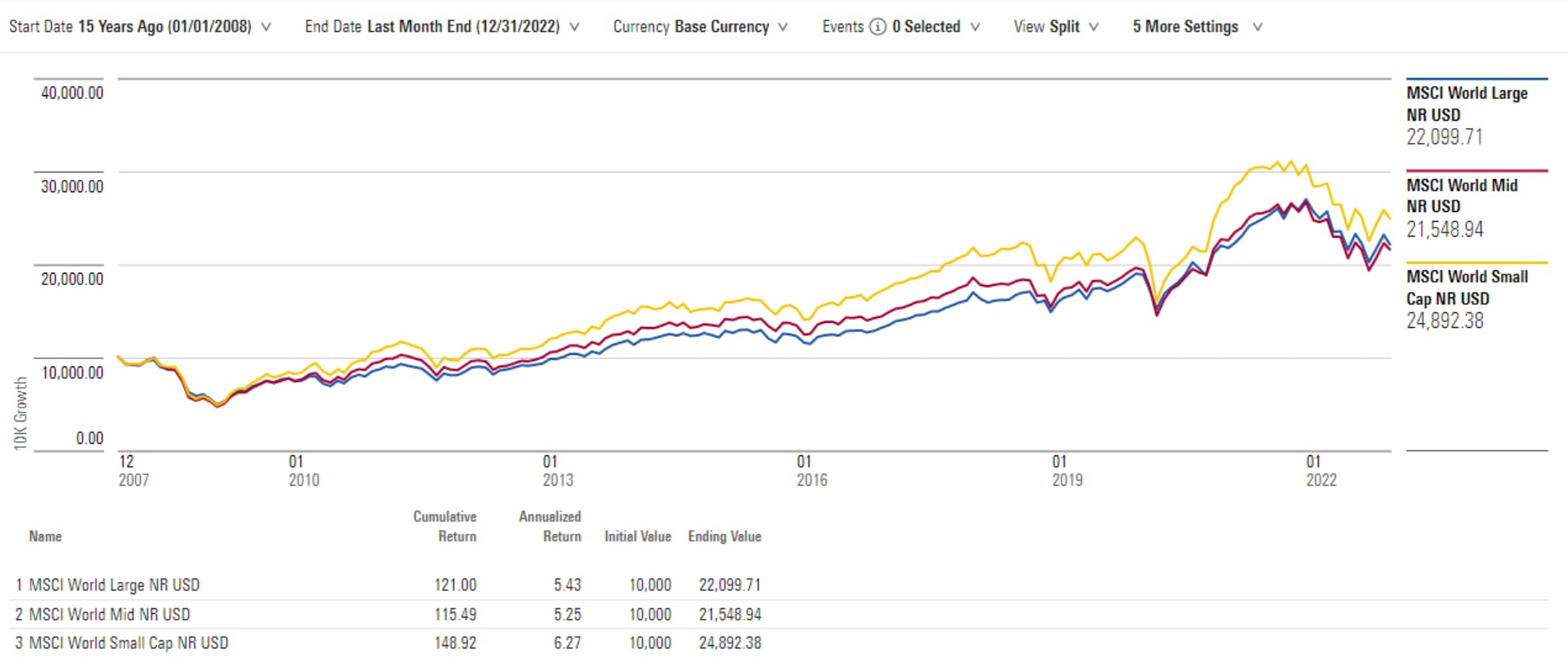
The global equities space is large in nature, but market capitalization allows for rational segmentation among companies. In observing the long-run performance of the global small-cap equities asset class (i.e., companies with a market capitalization between $300 million and $2 billion), collectively they have outperformed their mid-cap and large-cap peers, while also being a stellar source for wealth generation. This point is demonstrated when looking at the long-run performance of the MSCI World Global Small Cap equities index, in contrast to the MSCI World Large and MSCI World Mid indices.
History doesn’t repeat, but it does rhyme
While market drawdowns affect all asset classes, the strong post-drawdown performance of global small-cap equities, relative to its mid-cap and large-cap peers, is a recurring occurrence that has been observed over time.
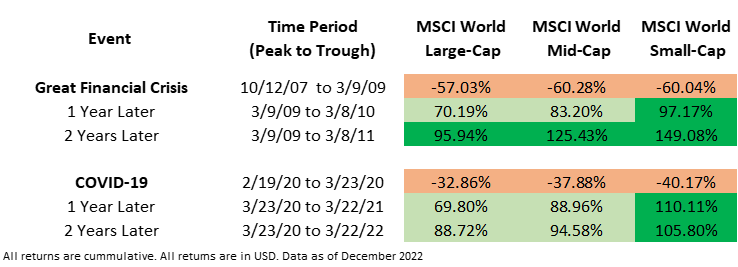
As evidenced by the data, during stark market downturns, the performance of all three indices is similar in nature. However, in the periods following said market drawdown, the global small-cap equities index exhibited a materially better performance in contrast to its peers.
Why consider Global Small Cap Equities now?
As global economies move into a higher interest rate environment, the previous ‘grow at any cost’ regime that was supported by below-average interest rates is no longer present. We are now at a juncture where businesses will have to make judicious decisions regarding how they operate going forward. For many small to medium size business operators, ensuring business continuity and managing in a ‘resource prudent’ manner may already be familiar functions, as such navigating the current environment may not be an entirely difficult endeavor. Conversely, larger firms that went about scaling at any cost are now entering a period of curtailment, which may involve not only cutting back on spending but also reconsidering the viability of their business model; as the market forces that helped them propel their business and assuage their stakeholders are no longer present.
As mentioned in a previous article, the market performance of 2022 was truly exceptional in nature, but it has provided an opportunity for pragmatic investors to capitalize on. With many investment offerings now available at a lower price point, now could be the opportune time for investors to gain exposure to asset classes they may not have thought of before. In the case of global small-cap equities - an asset class that has shown the ability to outperform its larger peers - adding an allocation to one’s portfolio now could prove beneficial in the years to come.
For investors interested in adding global small-cap equities exposure to their portfolio, the Vanguard FTSE All-World ex-US Small-Cap ETF (VSS) is a passively managed index solution that tracks the FTSE Global Small Cap ex US Net Tax (US RIC) Index – USD. The fund has a track record that spans over a decade, with a relatively low expense ratio (0.07%).
Please note this article is for information purposes only and does not in any way constitute investment advice. It is essential that you seek advice from a registered financial professional prior to making any investment decision.
Segments
See all
Mentioned ETFs
Further reading
Latest ETF News
See all ETF newsBeyond Big Tech: The Increasing Specialization of AI ETFs


There's an ETF for That? Humanoid Robotics and Physical AI

How Some ETF Issuers Use Their Own Funds for Cash Management

These Public-Private ETFs Invest in Polymarket and Anduril

There's an ETF for That? Frontier Markets



 Advantages of ETFs over Mutual Funds1/6
Lower Costs
In this guide, we'll explore the advantages of ETFs over mutual funds, giving you valuable insights into why ETFs have gained significant popularity among investors like yourself.
Leveraged ETFs: Unlocking the Potential for Amplified Returns1/6
Understanding Leveraged ETFs
Explore leveraged ETFs: potential for amplified returns & risks. 5 ETFs to consider across equities, commodities & fixed income.
What is a Leveraged ETF?1/6
Introducing Leveraged and Inverse ETFs
In this guide, we'll dive into the world of leveraged ETFs, exploring their definition, mechanics, potential risks, and rewards.
Recent educational content

First Look ETF
First Look ETF: Income, International, and Cash Flow ETFs
In this season 6 episode of First Look ETF, Stephanie Stanton @etfguide examines the latest ETF marketplace trends with NYSE and guests.


ETF Trends
ETF Industry KPIs October 5, 2026
This week’s KPI data overview highlights key metrics and trends shaping the ETF landscape.

ETF Trends
ETF Industry KPIs September 28, 2026
This week’s KPI data overview highlights key metrics and trends shaping the ETF landscape.
ETF Trends
ETF Industry KPIs September 22, 2026
This week’s KPI data overview highlights key metrics and trends shaping the ETF landscape.