Open Now: The Global ETF Survey Take the Survey →



Rate Cuts Incoming? Three Fixed-Income ETFs to Watch
Here's a look at which ETFs might benefit from a potential emergency or future Fed rate cut.


Keep up with what matters in ETFs
Get timely ETF insights, market trends, and top ideas straight to your inbox.
Your newsletter subscriptions with us are subject to ETF Central's Privacy Policy and Terms and Conditions.
Markets experienced a notable downturn on Monday, August 5th, driven by a mix of global and domestic factors. First, a rate hike by the Bank of Japan on July 31 and plans to stop its bond purchases triggered a sharp decline in the Japanese market, which rippled across global markets.
This was compounded by disappointing earnings from major tech companies and a weak non-farm jobs report from the previous Friday that fueled recessionary fears. As a result, the S&P 500 index fell by 3%, while the tech-heavy Nasdaq-100 fared even worse.
The volatility index (VIX) spiked from 23 to above 60, marking its third-highest level, trailing only the COVID-19 pandemic and the 2008 financial crisis.
Amidst this turmoil, one segment showed resilience: bond ETFs, particularly those focused on high-quality Treasury securities and U.S. aggregate bonds. As bond yields dropped broadly, these ETFs saw significant inflows and strong performance.
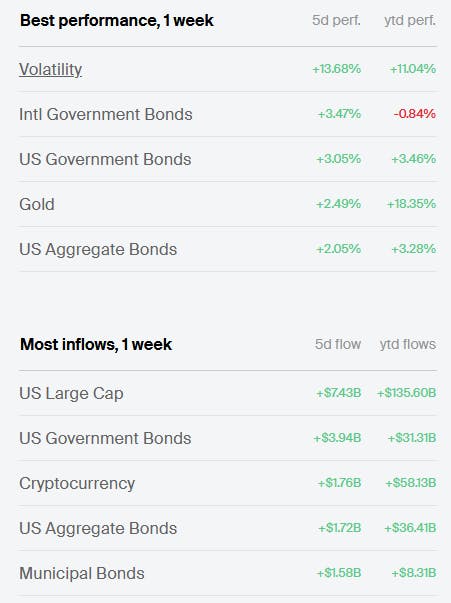
Notably, the yield on the 10-year Treasury fell, and for a brief moment, the yield curves on the 10-year and 2-year Treasuries normalized after being inverted for much of the past year.
With the markets now eagerly anticipating intervention from the Federal Reserve, the CME Group's FedWatch tool indicates a 92.5% probability of a 25 basis point cut at the September 18 policy meeting, with expectations of up to 125 basis points in total cuts by year's end—potentially in five separate increments, a scenario previously considered unlikely.
Given these developments, let's explore some key fixed-income ETFs that stand to benefit from the current economic climate and potential future rate cuts.
Like what you're reading?
Stay in the loop — get the latest ETF insights: trends, analysis, and expert picks.
iShares 20+ Year Treasury Bond ETF TLT+0.65%
TLT, one of the biggest losers in 2022 with a staggering 31.41% loss, is now poised for significant upside should interest rates fall faster or earlier than expected.
With a 16.74-year effective duration, TLT is highly sensitive to interest rate changes. Essentially, if rates fall by 100 basis points, TLT's value should increase significantly, given its long duration, which amplifies the impact of rate decreases on bond prices.
However, investing in TLT is not for the faint of heart. The 20-year end of the yield curve, which TLT tracks, is known for its volatility, and this ETF exemplifies that with a 16.66% standard deviation, which is on par with equities.
It's worth noting that while the three-year equity beta of this ETF is 0.61, indicating its tendency to fall alongside stocks in turbulent times like 2022, it has historically displayed lower, and sometimes even negative, beta during other periods, such as during the COVID-19 pandemic.
TLT has a 0.15% expense ratio, offers a 4.19% 30-day SEC yield, and makes monthly distributions. It's also one of the most liquid fixed-income ETFs on the market, with a 0.01% 30-day median bid-ask spread, which underscores its appeal among traders and long-term investors alike.
iShares 20+ Year Treasury Bond BuyWrite Strategy ETF TLTW+0.51%
TLTW operates exactly as its name suggests—it buys shares of TLT and then systematically writes (sells) one-month expiry covered call options on them.
This strategy allows investors to forfeit the potential upside of TLT in exchange for receiving very high monthly income and experiencing reduced volatility. Currently, TLTW boasts a 9.95% distribution yield, which is the expected income if the most recent payout remains consistent moving forward.
It's important to emphasize the "if" here—the yield from TLTW can fluctuate based on changes in implied volatility and the underlying price of TLT.
Moreover, in scenarios where investors typically benefit from the flight-to-safety effect—where TLT's value might spike due to market downturns—TLTW holders will not see the same gains due to the covered calls capping the upside. Essentially, there's no free lunch when opting for this strategy.
TLTW charges a reasonable expense ratio of 0.35%, which is quite fair considering the convenience it offers. For those who prefer a hands-off approach to buying TLT and selling calls themselves, TLTW provides an efficient alternative with less direct involvement.
Direxion Daily 20+ Year Treasury Bull 3x Shares TMF+1.85%
TMF is a highly leveraged version of TLT, employing swaps to deliver three times the daily returns of the ICE U.S. Treasury 20+ Year Bond Index.
Recall in my article on the Hedgefundie portfolio, I mentioned that some investors were using TMF as a component of a 3x leveraged 60/40 portfolio. This strategy proved highly effective during the COVID pandemic but faced significant challenges in 2022.
The reason lies in TMF's design; it magnifies TLT's duration of 16.6 years by 3x. When interest rates fall, as they did during COVID, TMF's value can spike significantly, making it an effective hedge.
However, when interest rates rise, the impact on TMF is severely negative. In 2022, the ETF experienced substantial losses and even underwent a reverse split as its price fell below $5 per share.
Given these dynamics, I would not recommend TMF as a buy-and-hold investment. Aside from the unpredictable effects of the 3x leverage, which can lead to challenging compounding issues, TMF also carries a high expense ratio of 1.01%. These factors make it more suitable as a trading tool.
Please note this article is for information purposes only and does not in any way constitute investment advice. It is essential that you seek advice from a registered financial professional prior to making any investment decision.
Mentioned ETFs
Further reading

Latest ETF News
See all ETF newsHow Investors can Maximize Tax Efficiency with Income ETFs

Trump Accounts: Here's Which ETFs You Can Invest In

The Two Best Types of Fixed-Income ETFs For Managing Cash

ETF Comparison: Roundhill Generative AI & Technology ETF Versus iShares A.I. Innovation and Tech Active ETF




 Advantages of ETFs over Mutual Funds1/6
Lower Costs
In this guide, we'll explore the advantages of ETFs over mutual funds, giving you valuable insights into why ETFs have gained significant popularity among investors like yourself.
Leveraged ETFs: Unlocking the Potential for Amplified Returns1/6
Understanding Leveraged ETFs
Explore leveraged ETFs: potential for amplified returns & risks. 5 ETFs to consider across equities, commodities & fixed income.
What is a Leveraged ETF?1/6
Introducing Leveraged and Inverse ETFs
In this guide, we'll dive into the world of leveraged ETFs, exploring their definition, mechanics, potential risks, and rewards.
Recent educational content

ETF Trends
ETF Industry KPIs July 20, 2026
This week’s KPI data overview highlights key metrics and trends shaping the ETF landscape.

ETF Trends
ETF Industry KPIs July 13, 2026
This week’s KPI data overview highlights key metrics and trends shaping the ETF landscape.
First Look ETF
First Look ETF: Cash Deployment, Bond, and Hedged ETFs
In this season 6 episode of First Look ETF, Stephanie Stanton examines the latest ETF marketplace trends with NYSE and guests.

ETF Trends
ETF Industry KPIs July 6, 2026
This week’s KPI data overview highlights key metrics and trends shaping the ETF landscape.
Browse all educational columns



Expert-Built ETF Portfolios, All in One Place
Don’t start from scratch. Discover ready-made ETF portfolios built by professionals to match different goals, timelines, and market views. Use them as inspiration or as a starting point for your own allocation.