Turn ETF ideas into real portfolios. Try the builder now →



Moving Beyond the 60/40 Convention
What alternative is there to the 60/40 portfolio?


Keep up with what matters in ETFs
Get timely ETF insights, market trends, and top ideas straight to your inbox.
Your newsletter subscriptions with us are subject to ETF Central's Privacy Policy and Terms and Conditions.
A long-held convention within portfolio management has been that a 60/40 allocation between equities and fixed income is the ideal asset allocation. However, the current market landscape has called into question the veracity of this asset allocation and its long-term effectiveness.
Like what you're reading?
Stay in the loop — get the latest ETF insights: trends, analysis, and expert picks.
The 60/40 Convention Explained
The traditionalist view of the 60/40 portfolio holds that equities are the growth engine of the portfolio and fixed income is a ballast, the stabilizer of the two asset classes. During periods of economic normalcy or recovery the stock component drives performance, whereas, during economic slowdowns, fixed income serves as a loss mitigator. The real underlying thesis of this view is that, during economic slowdowns, central banks will cut rates to stimulate the economy. When interest rates are cut, bond yields drop but bond prices go up; thus, supporting the overall portfolio.
The 60/40 Portfolio, within the current landscape
In the current market environment, where central banks are raising rates to combat inflation, equities have begun to underperform and bond prices are also being adversely impacted. As observed in the 2022 calendar year, both US equity and fixed income indices had negative returns, rendering the ‘growth-stabilizing’ relationship between the two asset classes ineffective. As mentioned by the Federal Reserve, short-term rates are forecasted to reach the range of 5% to 5.25% by the end of 2023 – further minimizing the stabilizing impact of fixed income instruments. Simply put, fixed income may be a reliable diversifier when economic growth is slowing – but not necessarily when inflation is increasing.
So what alternative is there to the 60/40 portfolio?
Let’s talk about alternative investments
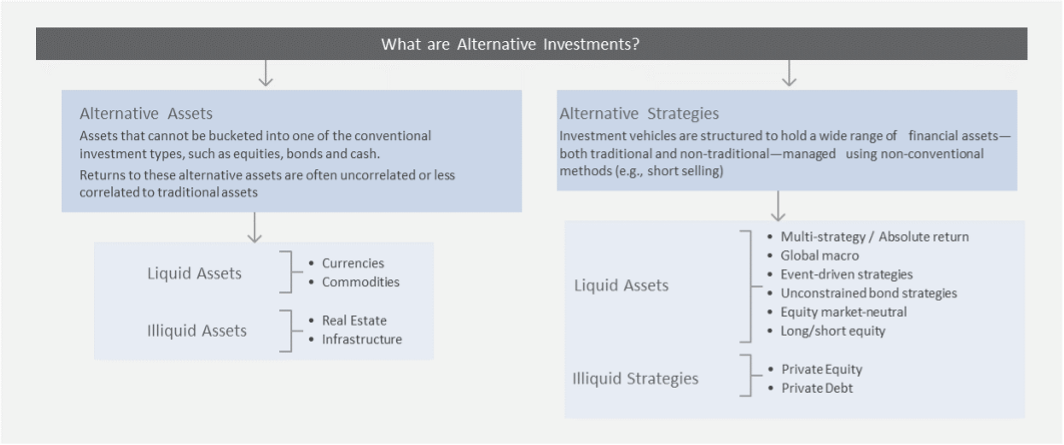
Alternative investments are generally characterized as investments that are not long positions in equities or fixed income, but that is often a simplistic definition. In truth, alternative investments cover a wide range of both liquid and illiquid offerings that can be performance additives to one’s portfolio, while also offsetting the inherent risk of traditional investment; given their comparatively lower correlation to equities and fixed income.
Alternative investments generally fall into two categories, alternative assets and alternative strategies. While the former may be more familiar to investors through either direct ownership (i.e., owning a rental property) or an investment vehicle (i.e., REIT or ETF), the latter provides investors with a much broader opportunity set of investment strategies and specialties that can be included within their existing portfolio of traditional assets.
Investing in alternative investment solutions
Though the suggested alternative investment allocation within a portfolio is between 5 to 15 percent, determining the most suitable allocation in one’s portfolio should be based on the alternative investment solution’s strategy and how it aligns with your overall portfolio objective.
For investors seeking to hedge against inflation, alternative asset investing allows them to gain exposure to economically important infrastructure, such as marine ports, gas & electric utilities, or airport & highway services, that has always been a haven in times of uncertainty. The iShares Global Infrastructure ETF (IGF) is a solution that fits this billing as it provides pure-play exposure to long-tenured assets that provide a needed benefit or service, regardless of the macroeconomic environment.
Alternative strategies provide investors with the opportunity to participate in novel and sophisticated investment strategies that are focused on achieving specific return outcomes, regardless of the market environment. SPDR SSGA Multi-Asset Real Return ETF (RLY) provides investors with exposure to inflation-protected securities issued domestically and internationally; the solution has a decade long track record that showcases the efficacy of its underlying strategy. Though different in its investment approach, with a shorter track record, the Core Alternative ETF (CCOR) has exhibited relatively strong performance during a volatile period, all while exhibiting a lowered risk profile.
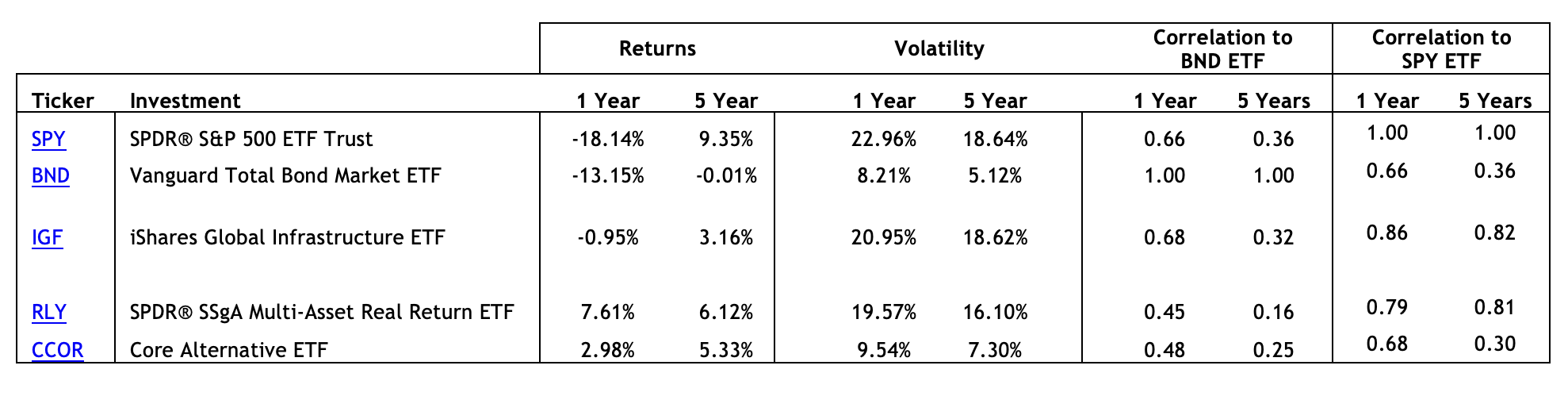
Data as of December 2022
For investors, looking to move beyond their 60/40 allocation, including alternative investments within their portfolio allocation can be of benefit to their overall portfolio.
Please note this article is for information purposes only and does not in any way constitute investment advice. It is essential that you seek advice from a registered financial professional prior to making any investment decision.
Latest ETF News
See all ETF newsCould Water ETFs Be the Next AI Bottleneck Trade?


What is a Boomer Candy ETF?

ETF Comparison: NEOS Nasdaq-100 High Income ETF (QQQI) Versus Goldman Sachs Nasdaq-100 Premium Income ETF (GPIQ)





 Advantages of ETFs over Mutual Funds1/6
Lower Costs
In this guide, we'll explore the advantages of ETFs over mutual funds, giving you valuable insights into why ETFs have gained significant popularity among investors like yourself.
Leveraged ETFs: Unlocking the Potential for Amplified Returns1/6
Understanding Leveraged ETFs
Explore leveraged ETFs: potential for amplified returns & risks. 5 ETFs to consider across equities, commodities & fixed income.
What is a Leveraged ETF?1/6
Introducing Leveraged and Inverse ETFs
In this guide, we'll dive into the world of leveraged ETFs, exploring their definition, mechanics, potential risks, and rewards.
Recent educational content

ETF Trends
ETF Industry KPIs September 8, 2026
This week’s KPI data overview highlights key metrics and trends shaping the ETF landscape.

ETF Trends
ETF Industry KPIs August 31, 2026
This week’s KPI data overview highlights key metrics and trends shaping the ETF landscape.
ETF Trends
ETF Industry KPIs August 24, 2026
This week’s KPI data overview highlights key metrics and trends shaping the ETF landscape.
What’sTheFund
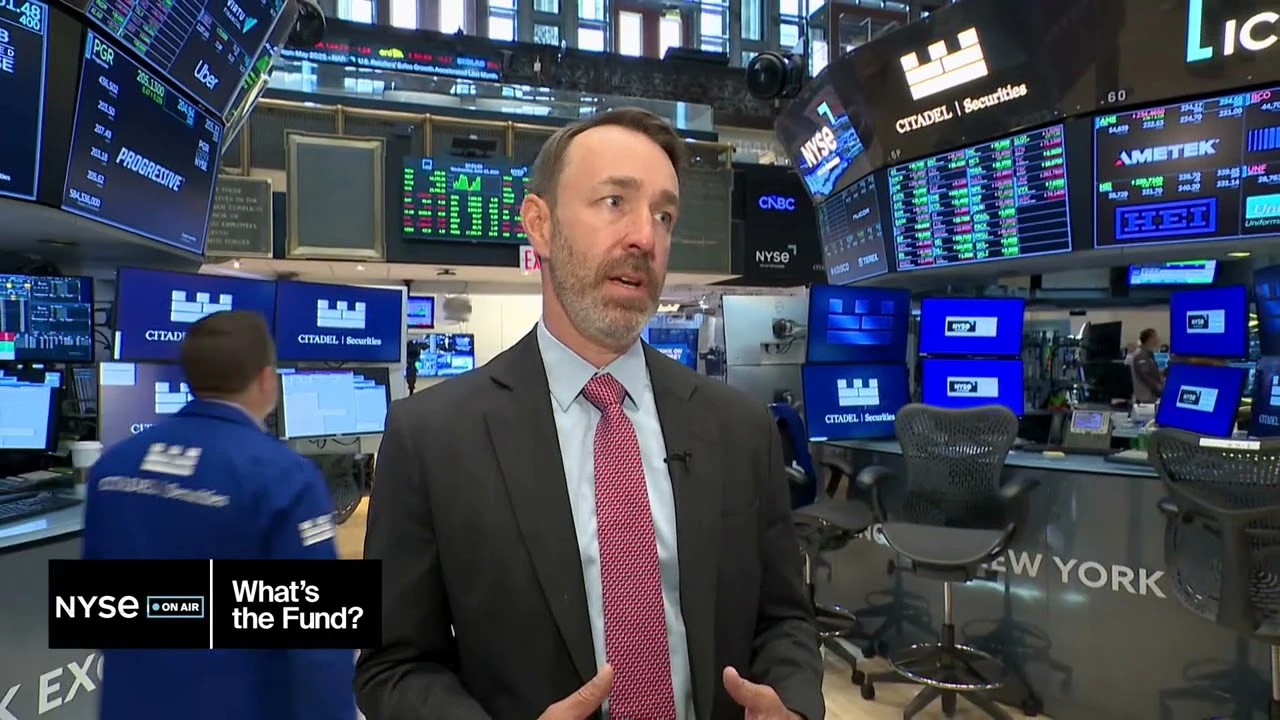
What's the Fund | Ocean Park Diversified Income ETF (DUKZ)
James St Aubin, Chief Investment Officer at Ocean Park Asset Management, discuss the DUKZ ETF, exposing investors to the whole spectrum of asset classes in the fixed income markets, through their rules-based process.

Browse all educational columns



Expert-Built ETF Portfolios, All in One Place
Don’t start from scratch. Discover ready-made ETF portfolios built by professionals to match different goals, timelines, and market views. Use them as inspiration or as a starting point for your own allocation.