NYSE CRTR Economy Event Watch the replay →



Low Volatility U.S. ETFs: How do they work?
Low volatility investing is an anomaly worth exploring, given its ability to produce higher risk-adjusted returns.


Keep up with what matters in ETFs
Get timely ETF insights, market trends, and top ideas straight to your inbox.
Your newsletter subscriptions with us are subject to ETF Central's Privacy Policy and Terms and Conditions.
Investment is about taking on enough risk to achieve the returns you need. Too much of the former, and your chances of ensuring the latter are dramatically reduced. An often-cited rule is "more risk = more returns," formalized by the Capital Asset Pricing Model (CAPM). CAPM states that there should be a positive relationship between the systematic risk exposure of a stock and its expected future returns.
Depending on the risk factor under consideration, this is generally true. For instance, investing in stocks versus bonds grants you the "market" risk factor, evidenced by how stocks generally (but not always) return more than bonds as an asset class.
Tilting your portfolio further towards other compensated risks (like the Fama-French factors of size, value, profitability, and investment) can lead to even more excess returns over the market (otherwise known as "alpha"). I wrote earlier about small-cap value factor tilts, so give that a read if you need a refresh.
There is a notable exception, and it’s the historical tendency of low-volatility stocks to outperform their higher-risk counterparts consistently. It's known as the "low volatility anomaly" or "low volatility paradox," and it could be a way to beat the market over time.
The ETF Industry Is Evolving Fast
From AI infrastructure to active strategies, the ETF landscape is shifting. Share your perspective in the 7th Annual Global ETF Survey and get exclusive early access to the final report.
What is volatility?
When it comes to individual equity-like securities (stocks, ETFs), volatility is primarily measured by two concepts: standard deviation and beta.
- Standard deviation: The square root of an investment's variance measures the percentage of how much investment has historically fluctuated on average from its expected return. A stock with an average compound annual growth rate (CAGR) of 7% with a standard deviation of 15% is much more volatile than one with a CAGR of 7% but a standard deviation of 10%.
- Beta: measures how sensitive investment is relative to a market index, such as the S&P 500. A beta of greater than 1 means an investment is more volatile than the market and moves in line with it, a beta of between 0 and 1 means the investment is less volatile and moves in line with it, albeit more muted, and a negative beta means the investment moves inversely to the market.
Low volatility investments are, therefore, stocks or ETFs with a lower-than-average standard deviation and beta compared to a benchmark. Investors can therefore screen for stocks with historically low amounts of either. While this approach is past-looking, it actually serves as a fairly predictable indicator of future volatility compared to using past returns to extrapolate future returns.
Explanations for low-volatility investing
Explaining the low volatility phenomenon is a herculean research endeavour in and of itself, with numerous studies finding evidence for different reasons. To save you time, I've summarized some of the more notable ones below:
- Low-volatility stocks tend to be mature, stable companies with excellent balance sheets, strong revenues, consistent earnings, and good cash flows. Thus, they provide excellent exposure to the profitability and investment risk factors, which explains their out-performance.
- Low-volatility stocks minimize the negative effects of large compounding losses. For example, losing 33% in a year requires a 50% return in the following year to break even due to how the geometric mean works. For that reason, avoiding large losses should be more important than chasing high returns, and low-volatility stocks do that better.
- Low-volatility stocks are often overlooked by investors in favour of high-beta growth stocks (think about all the tech sector bubbles that occurred). Thus, they tend to be underpriced relative to their fundamentals and, according to the value risk factor, can provide a higher return.
The real answer is still unknown and not agreed upon, but if I had to guess, I would wager it's a mixture of the three mentioned above. Whatever the case is, low volatility investing has worked historically.
Low-volatility investing using ETFs
Investors can use a stock screener to pick a portfolio of low-volatility companies, but this approach is time-consuming, difficult to rebalance, and may incur substantial trading commissions and bid-ask slippage. A better way is via ETFs, and the following funds might work:
- iShares MSCI USA Min Vol Factor ETF (USMV): 0.15% expense ratio.
- Invesco S&P 500 Low Volatility ETF (SPLV): 0.25% expense ratio.
Let's see how both funds have historically performed versus the S&P 500:
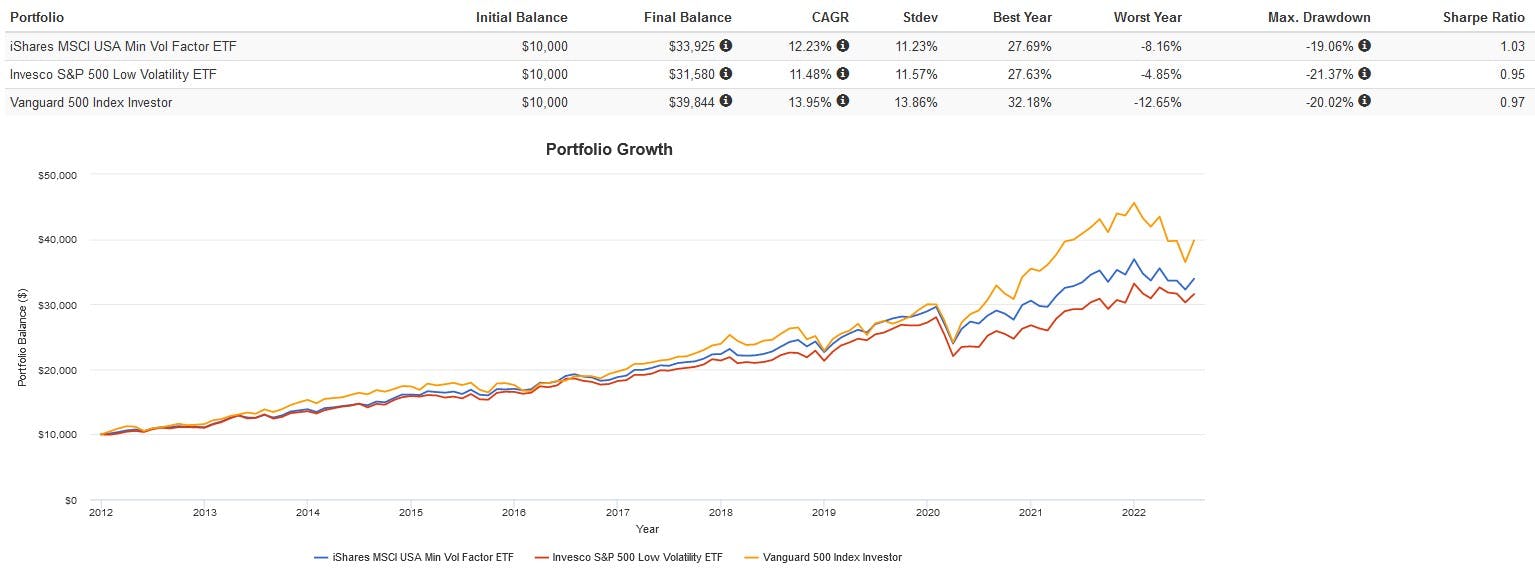
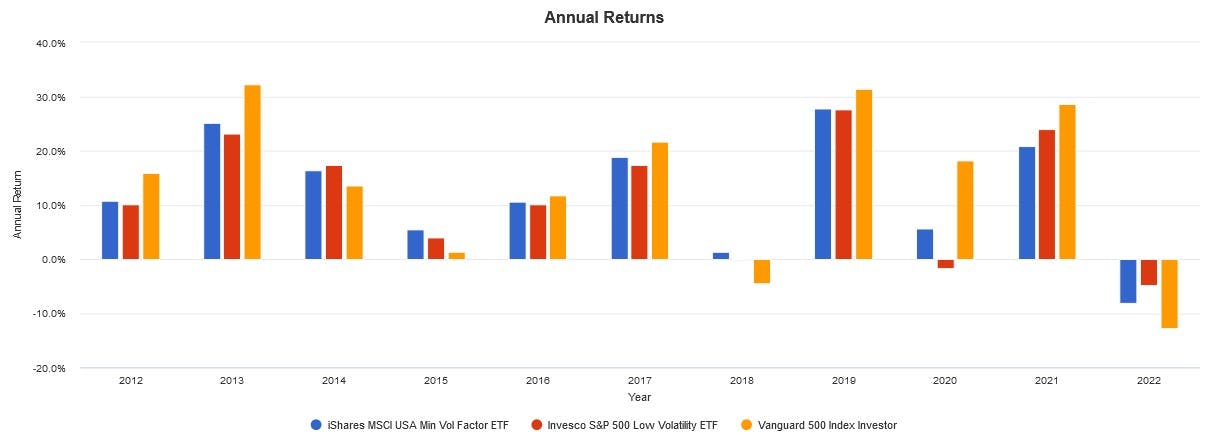
Both ETFs underperformed the S&P 500 in terms of CAGR, but USMV outperformed in terms of risk-adjusted returns, with a higher Sharpe ratio and lower max drawdown. The period of the backtest was constrained by the inception date of the funds in 2011 and covered an unusually long low-interest rate bull market that helped high-beta technology stocks in the S&P 500 outperform. It's worth noting that in 2022, both low volatility ETFs fell significantly less than the S&P 500.
Latest ETF News
See all ETF newsThe Super El Niño Trade: Two Potential ETF Winners and Losers


The SpaceX (SPCX) IPO: Here's Which ETFs Already Own it




 Advantages of ETFs over Mutual Funds1/6
Lower Costs
In this guide, we'll explore the advantages of ETFs over mutual funds, giving you valuable insights into why ETFs have gained significant popularity among investors like yourself.
Leveraged ETFs: Unlocking the Potential for Amplified Returns1/6
Understanding Leveraged ETFs
Explore leveraged ETFs: potential for amplified returns & risks. 5 ETFs to consider across equities, commodities & fixed income.
What is a Leveraged ETF?1/6
Introducing Leveraged and Inverse ETFs
In this guide, we'll dive into the world of leveraged ETFs, exploring their definition, mechanics, potential risks, and rewards.
Recent educational content
Asset TV
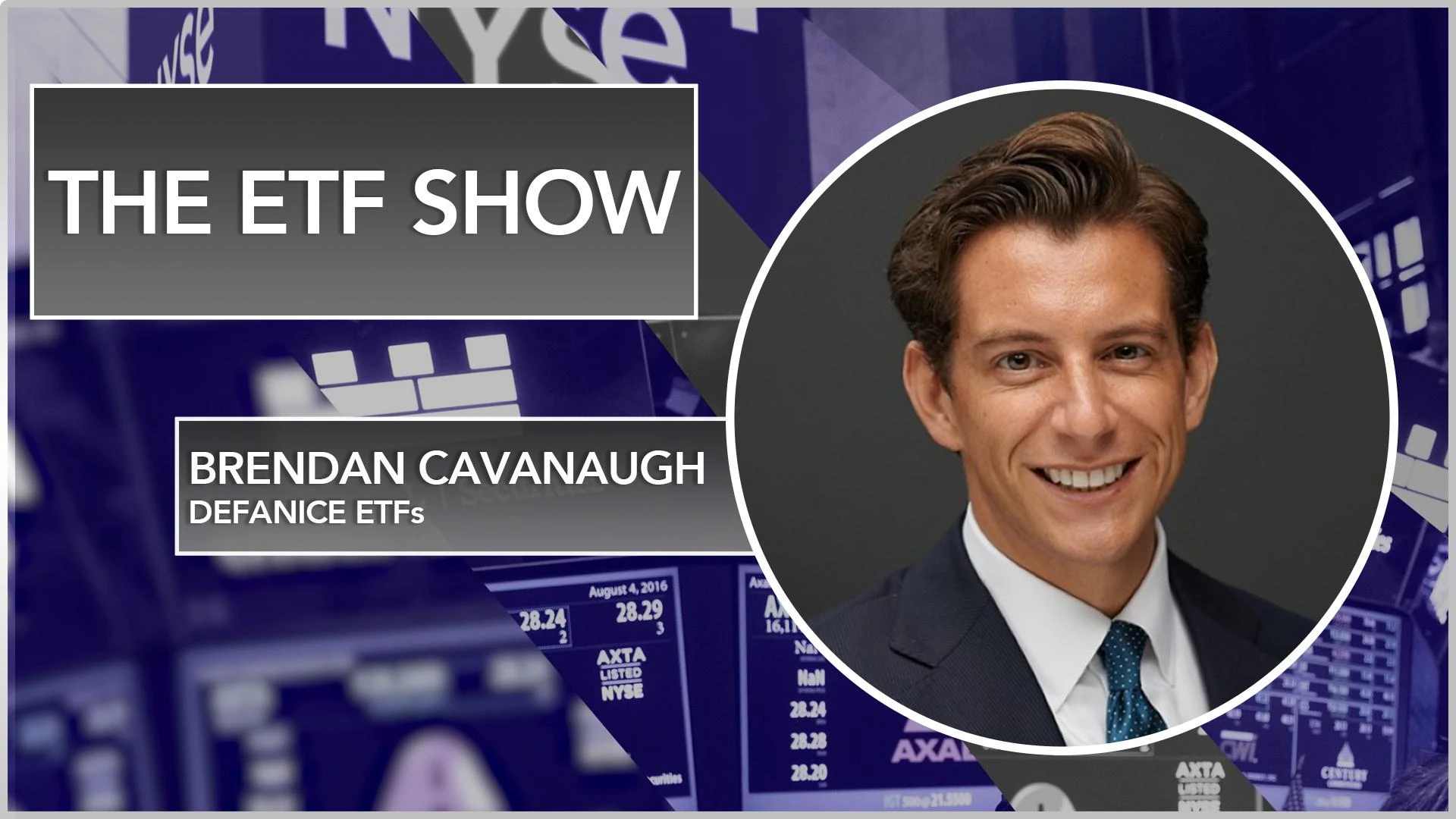
The ETF Show - New Autism-Impact ETF Launched
Defiance ETFs has launched the first ETF, $ASD, focused on the autism ecosystem, investing in companies that provide services, products, and research related to autism and neurodivergence.


ETF Trends
ETF Industry KPIs June 1, 2026
The ETF Industry saw 22 New Launches, 1 Ticker Change and 1 closure last week.

ETF Trends
ETF Industry KPIs May 20, 2026
The ETF Industry saw 44 New Launches, 3 Mutual Fund Conversions and 9 closures last week.
Asset TV
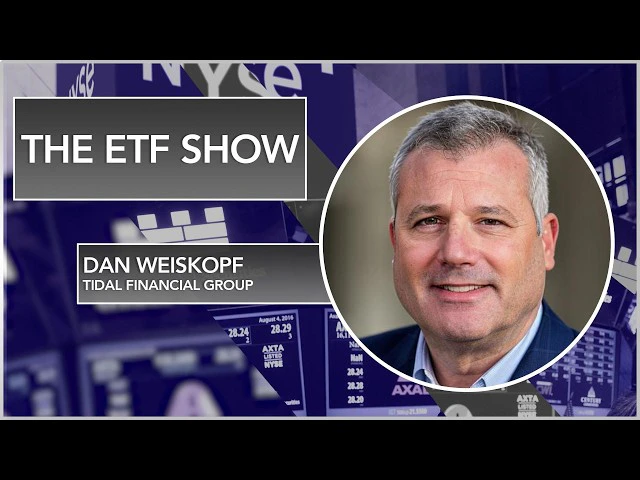
The ETF Show - Politics Becomes Investable Trade through ETFs
Dan Weiskopf, Senior Portfolio Manager at Tidal Financial Group spoke with the ETF Show about Subversive ETFs that help investors trade like politicians.
Browse all educational columns



Expert-Built ETF Portfolios, All in One Place
Don’t start from scratch. Discover ready-made ETF portfolios built by professionals to match different goals, timelines, and market views. Use them as inspiration or as a starting point for your own allocation.