Create, analyze, optimize your ETF portfolio. Start now →



Investing in international small-cap value ETFs
International small-cap value funds can offer additional sources of alpha.


Keep up with what matters in ETFs
Get timely ETF insights, market trends, and top ideas straight to your inbox.
Your newsletter subscriptions with us are subject to ETF Central's Privacy Policy and Terms and Conditions.
Previously in July, I wrote about U.S. Small-Cap Value ETFs as a potential way to beat the market over the long-term by targeting the Fama-French "size" and "value" risk factors. If you haven't read that article yet, I suggest doing so as it delves into the rationale behind a small-cap value tilt.
Now, U.S. stocks only comprise about 60% of the world's stock market by market capitalization. I went over the reasons for investing in international ETFs in an earlier article. Most investors have a home-country bias where they overweight U.S. equities, but some international allocation is sensible.
So, there's another 40% of stocks from international developed and emerging markets worth investing in and guess what – some of them come in a small-cap value flavor. Like U.S. small-cap value, international small-cap value exposes investors to a plethora of additional compensated risk factors from which they may derive better long-term returns. Let’s explore the options.
Like what you're reading?
Stay in the loop — get the latest ETF insights: trends, analysis, and expert picks.
A brief re-introduction to factor investing & small-cap value
Back in the 1990s, Eugene Fama and Kenneth French identified a set of three (later expanded to five) risk factors that drove investment returns. Today, the list includes market, size, value, profitability, and investment.
Of interest to us are the size and value factors:
- Size: Returns of small-cap stocks minus the returns of large-cap stocks (Small minus Big, or SmB).
- Value: Returns of high-book-value stocks minus the returns of low-book-value stocks (High minus Low, or HmL).
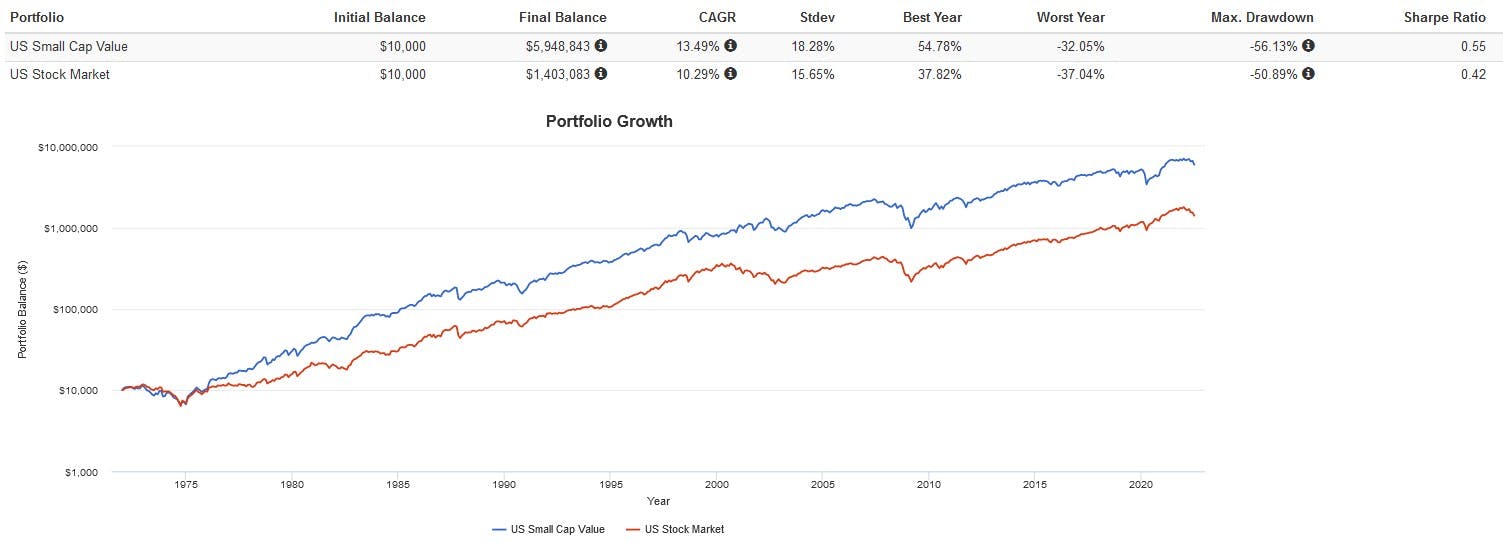
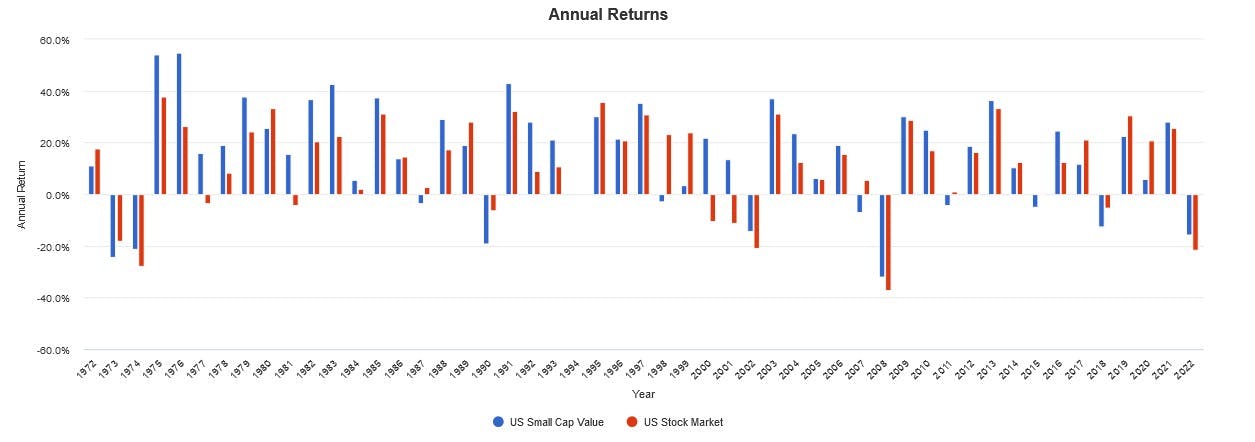
Combining the two factors creates small-cap value stocks, which have historically been the strongest performing component of the U.S. market by a long shot.
The small-cap value effect can also be found internationally, as seen here with a backtest of international small-cap value stocks vs. the global ex-U.S. stock market:
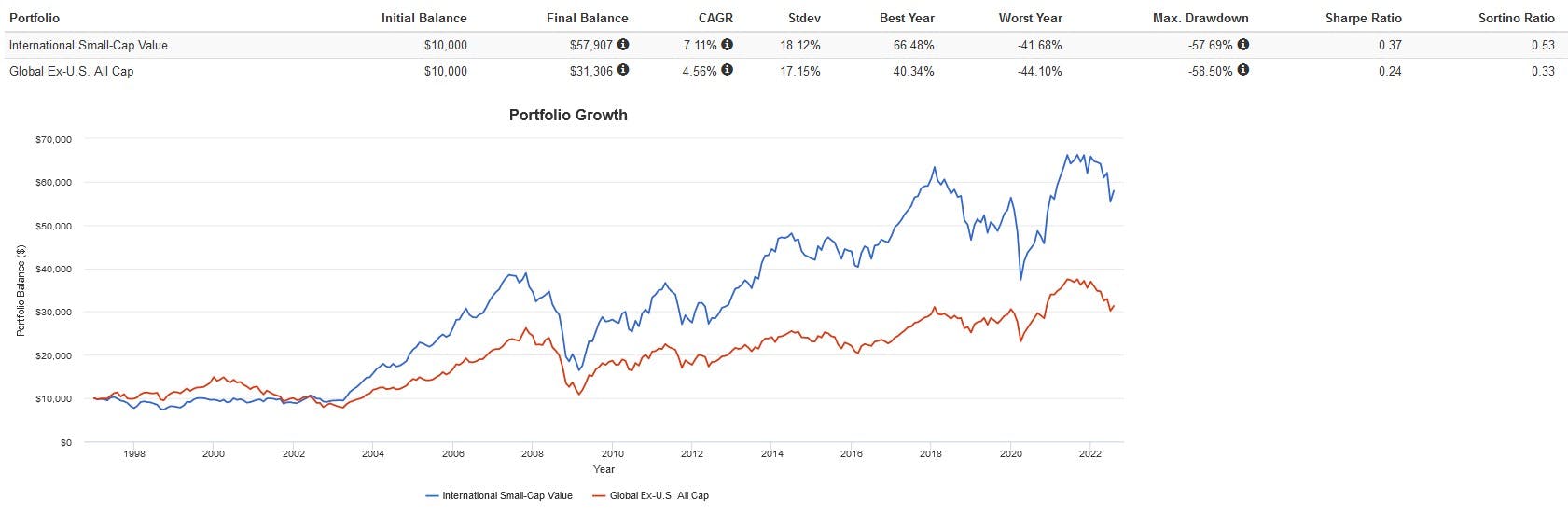
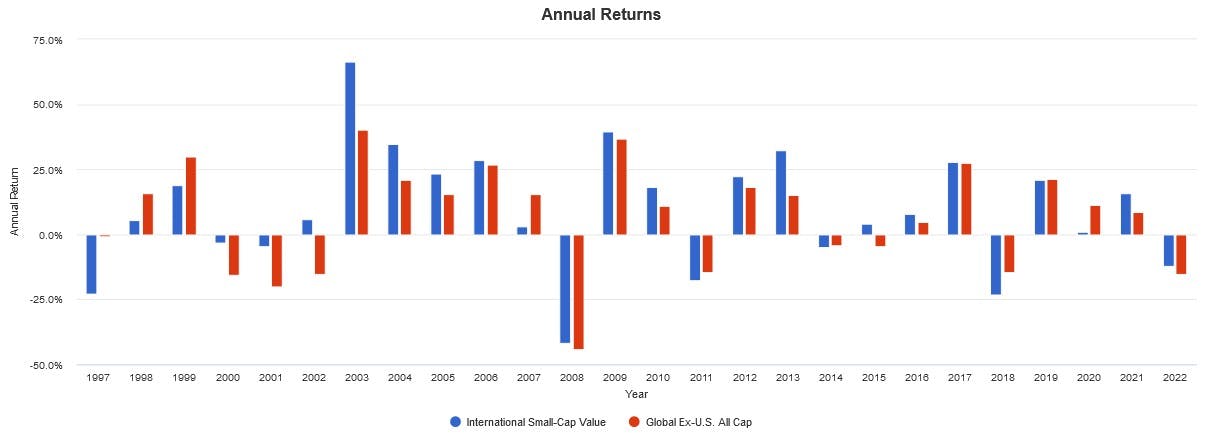
There have been periods of time, however, where the small-cap value premium returns negative. That is, large-cap growth stocks beat them. This is to be expected. Even the market risk premium has returned negative at times, with risk-free T-Bills beating stocks. A small-cap value tilt requires a long-time horizon and conviction to pay off.
International small-cap value ETFs
Investors should note that currently only international small-cap value funds that hold developed market (Europe, Canada, Japan, etc.) equities exist. As of right now, there are no dedicated international emerging (China, Russia, Africa, Middle East, South America) small-cap value funds, only proxies that target small-cap dividend stocks that offer incidental exposure.
Moreover, selecting a small-cap value fund isn’t as easy as just looking at the name of the ETF. Many funds purport to target small-cap value but actually hold mid-caps or non-value stocks. A better way is to conduct a factor regression analysis, which can be done via Portfolio Visualizer. Investors can use factor regression for back-testing various funds and comparing their "loadings" for the size and value factors.
In my opinion, the best small-cap value ETFs on the market come from two fund managers with a strong history of factor investing expertise: Dimensional Fund Advisors and Avantis Investors. Some examples of their ETFs include:
- Dimensional International Small Cap Value ETF (DISV): 0.51% expense ratio
- Avantis International Small Cap Value ETF (AVDV): 0.36% expense ratio
Both ETFs use systemic screening methodologies and rigorous frameworks to sift out small-cap stocks that truly trade in value territory. DISV, in particular, is the ETF variant of Dimensional's existing small-cap value mutual fund, which has been in operation since 1997.
For a more passive, lower-cost approach, investors can also use more traditional index ETFs, but keep in mind that for factor investing, these funds might have lower loadings:
- iShares International Developed Small Cap Value Factor ETF (ISVL): 0.40% expense ratio.
Please note this article is for information purposes only and does not constitute investment advice.
Segments
See all
Mentioned ETFs
Further reading

Latest ETF News
See all ETF newsHow Some ETF Issuers Use Their Own Funds for Cash Management

These Public-Private ETFs Invest in Polymarket and Anduril

There's an ETF for That? Frontier Markets

10-Year Treasury Yield Hits 5%: Which Bond ETFs Offer the Most Direct Exposure?




 Advantages of ETFs over Mutual Funds1/6
Lower Costs
In this guide, we'll explore the advantages of ETFs over mutual funds, giving you valuable insights into why ETFs have gained significant popularity among investors like yourself.
Leveraged ETFs: Unlocking the Potential for Amplified Returns1/6
Understanding Leveraged ETFs
Explore leveraged ETFs: potential for amplified returns & risks. 5 ETFs to consider across equities, commodities & fixed income.
What is a Leveraged ETF?1/6
Introducing Leveraged and Inverse ETFs
In this guide, we'll dive into the world of leveraged ETFs, exploring their definition, mechanics, potential risks, and rewards.
Recent educational content

ETF Trends
ETF Industry KPIs October 5, 2026
This week’s KPI data overview highlights key metrics and trends shaping the ETF landscape.

ETF Trends
ETF Industry KPIs September 28, 2026
This week’s KPI data overview highlights key metrics and trends shaping the ETF landscape.
ETF Trends
ETF Industry KPIs September 22, 2026
This week’s KPI data overview highlights key metrics and trends shaping the ETF landscape.

First Look ETF
First Look ETF: Income, Corporate Arbitrage, and Growth and Value Investing
First Look ETF September 2026: iCapital, Mast Investments and North Square unpack new ETFs targeting monthly income, merger arbitrage and complementary growth and value exposure.

Browse all educational columns



ETFs’ Next Act: From Access to Selection
With 1,790 new products launched by July 2026, choosing is harder than ever. Our Global ETF Survey 2026, built on 620 professional investors and allocators, shows how active, fixed income, options-based and thematic ETFs are reshaping fund selection.