Open Now: The Global ETF Survey Take the Survey →



How Covered Call ETFs Turn Volatility Into Income
Covered call ETFs are booming, but do you really know how they make their money?


Keep up with what matters in ETFs
Get timely ETF insights, market trends, and top ideas straight to your inbox.
Your newsletter subscriptions with us are subject to ETF Central's Privacy Policy and Terms and Conditions.
Options-based income ETFs have become a popular part of the derivatives-driven ETF launch playbook. These funds are actively managed, with expense ratios typically ranging from 1% to 1.5%.
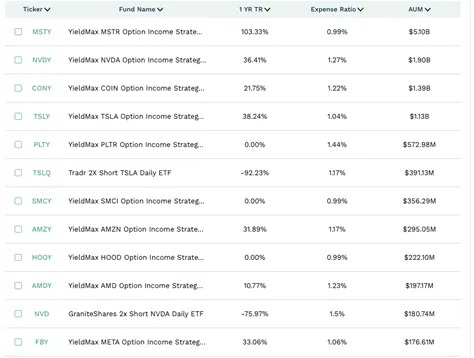
Many of the most popular launches focus on so-called “meme” names or baskets of them, where heavy retail participation drives deep liquidity in both the stock and options markets.
This combination of liquidity and elevated implied volatility¹ makes these names ideal candidates for generating options-based yield.
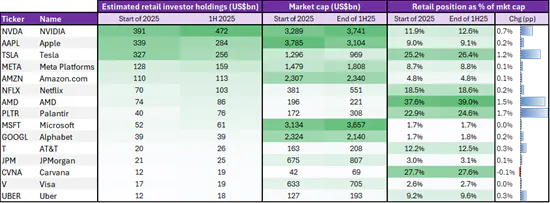
Source: Goldman Sachs / Zerohedge
Like what you're reading?
Stay in the loop — get the latest ETF insights: trends, analysis, and expert picks.
Structures
The buy-write², also known as the covered call, is the core structure behind most single-stock options income ETFs.
Issuers use several variations depending on the income profile or growth objective.
YieldMax MSTY (MSTR Covered Call)
MSTY builds a synthetic forward³ position on MicroStrategy (MSTR) by going long calls and short puts, a setup known as a reverse conversion⁴. It then sells additional calls against that forward to collect income from implied volatility¹. Cash received from investors is invested in short-term Treasuries to generate additional yield.
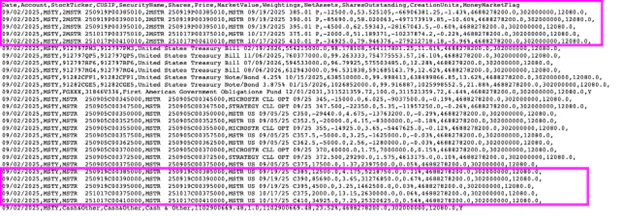
The implied funding cost⁵, or repo rate, embedded in the one- to two-month forward is usually the cheapest point on the funding curve except during seasonal spikes.
However, it still tends to be higher than the yield earned on the cash held in T-bills. The fund prefers front-week options⁶ because they tend to be the most liquid across expirations, making execution more efficient.
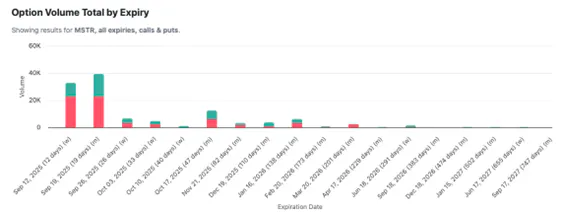
It is difficult to verify spot prices at the exact time the covered calls are written, but using shorter-term, roughly 20-delta⁷ calls helps to limit the amount of equity upside sacrificed.
T-Rex COII (Partial Overwrite)
Some ETFs aim to balance growth and income.
T-Rex’s COII, for example, only sells calls on half of its synthetic forward³ portfolio. This setup keeps half of the portfolio with uncapped upside potential while generating income from the overwritten half, a method known as partial overwrite⁸.
Defiance SPYT and QQQT (Call Credit Spread on Broad Indices)
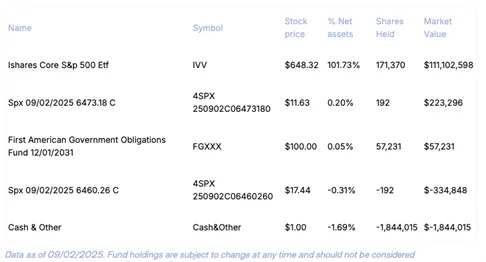
Defiance uses a different playbook with SPYT, which holds a low-cost S&P 500 tracker such as IVV and sells next-expiry call credit spreads⁹ on the SPX index.
It sells a lower strike call and buys a higher strike call, keeping the premium if the index remains below the lower strike. If the index rises past that level, the maximum loss is limited to the difference between the two strikes minus the premium earned.
Gains from the IVV holdings can help offset part of that loss. Defiance’s QQQT follows the same structure on the Nasdaq 100. Other issuers have adapted this strategy for portfolios of individual stocks.
YieldMax SDTY, QDTY, RDTY (Synthetic Index with Daily 0DTE Overwrite)
YieldMax has also developed a synthetic forward³ covered call structure for broad indices.
These funds buy longer-dated, deep in-the-money calls to replicate long index exposure and sell zero-days-to-expiry (0DTE)¹⁰ near-the-money calls on a daily basis to generate income.
Defiance Leveraged Strategies
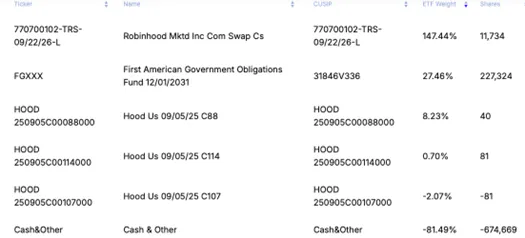
Defiance offers leveraged versions that use swaps to gain exposure while selling call credit spreads⁹ for additional income.
These strategies add counterparty credit risk¹¹ and higher funding costs⁵, which are not included in the published expense ratio. They also share the same gap risk¹² found in other leveraged ETFs.
Liquidity
Liquidity is critical for these strategies.
For index options, 0DTE¹⁰ contracts have become a dominant part of daily volumes.
According to a June 2, 2025, report from CBOE, retail participation in SPX 0DTE trading rebounded after a decline in April, rising from 47% to 54% of total volume.
These dynamics make 0DTE options attractive from a liquidity standpoint, although bid-ask spreads can still widen seasonally or during periods of volatility.
This happens even in the most liquid instruments, such as S&P 500 E-mini futures.
For single stocks, volume data shows a similar trend.
On August 29, 2025, MSTR, TSLA, PLTR, COIN, and NVDA all ranked among the top 20 names for single-stock options volume, indicating strong liquidity and tight bid-ask spreads.
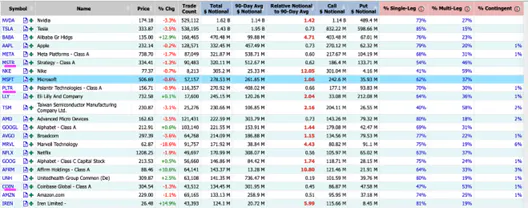
Source: MarketChameleon
Turnover data (see below) reflects the same pattern, showing how heavy retail participation drives volumes and volatility in these names.
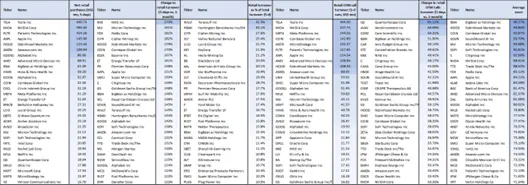
Source: Goldman Sachs/Zerohedge
Performance and Yield
Covered call ETFs often advertise appealing income statistics, but these numbers come with important caveats.
The income generated from selling calls depends on implied volatility¹, which can change quickly. The distribution rate shown is typically annualized from the most recent payout and may not accurately represent future income levels.
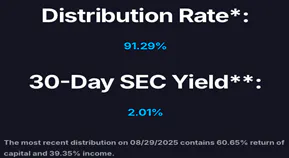
MSTY Distribution Rate*. Source: YieldMax
High-volatility names with over $50B in market cap (as of August 29, 2025) such as HOOD, MSTR, COIN, PLTR, and TSLA consistently top the charts for implied volatility¹.
This makes them ideal candidates for extracting premium income and explains why they appear frequently in single-stock income ETF portfolios.
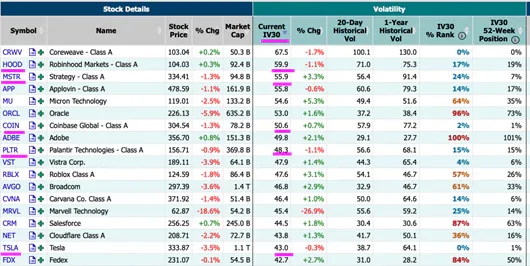
Source: MarketChameleon
Risks
While these products can deliver attractive income, they also carry significant and complex risks.
Covered calls are a form of options overlay strategy, meaning they are sensitive to a range of factors. Price changes in the underlying stock (delta⁷), shifts in interest rates (rho¹³), changes in implied volatility (vega¹⁴), realized volatility (gamma¹⁵), dividend adjustments (nu¹⁶), and funding costs (mu¹⁷) can all impact returns.
For single-stock strategies, American-style options¹⁸ introduce the possibility of early exercise and pin risk¹⁹.
When swaps are used for leverage, additional risks appear, including higher funding costs⁵, counterparty credit risk¹¹, uncleared margin costs, and heightened gap risk¹².
Managing these products requires experienced derivatives professionals. Even then, investors need to understand that higher potential income comes with higher complexity and exposure.
The Bottom Line
Single-stock and index-based covered call ETFs can enhance portfolio income in volatile markets, but they are not simple income solutions. These strategies involve synthetic positions, funding costs, and liquidity dynamics that require careful evaluation. For investors who understand these trade-offs, they can be a powerful tool. For others, the risks may outweigh the potential rewards.
Expanded Glossary
- Implied volatility (IV): The market’s expectation of future volatility embedded in option prices. Higher IV usually means higher premiums.
- Buy-write (covered call): Holding a stock or synthetic stock position while selling call options against it to generate income.
- Synthetic forward: A derivatives position that mimics being long a stock or index, often created with options.
- Reverse conversion: A synthetic forward built by combining a long call and a short put at the same strike and expiry.
- Implied funding (repo rate): The financing cost embedded in synthetic positions, linked to short-term borrowing costs.
- Front-week options: Options that expire within the next week, often the most liquid contracts.
- Delta: Measures how much an option price moves for a $1 change in the underlying stock price.
- Partial overwrite: Selling calls on only part of the portfolio, balancing income generation with upside potential.
- Call credit spread: Selling a lower strike call and buying a higher strike call to limit risk and cap income.
- 0DTE options: Options expiring on the same day they are traded, allowing daily income but with high risk.
- Counterparty credit risk: The risk that a swap or derivative counterparty defaults on its obligations.
- Gap risk: The risk of sharp, sudden price moves that create unexpected losses.
- Rho: Sensitivity of an option’s price to changes in interest rates.
- Vega: Sensitivity of an option’s price to changes in implied volatility.
- Gamma: Measures how quickly delta changes as the underlying price moves.
- Nu: Sensitivity of an option’s value to changes in dividends.
- Mu: Sensitivity of a synthetic option structure to changes in repo or financing rates.
- American-style option: An option that can be exercised any time before expiration, creating early assignment risk.
- Pin risk: The risk of an option being exercised unexpectedly when the stock closes near the strike price at expiration.
Please note that this article reflects the author’s personal views and does not represent the opinions of the publication or its affiliates. It is for informational purposes only and does not constitute investment advice. It is essential to seek guidance from a registered financial professional before making any investment decisions.


Latest ETF News
See all ETF newsHedging the Hedge: Can Gold Itself Be Protected?



 Advantages of ETFs over Mutual Funds1/6
Lower Costs
In this guide, we'll explore the advantages of ETFs over mutual funds, giving you valuable insights into why ETFs have gained significant popularity among investors like yourself.
Leveraged ETFs: Unlocking the Potential for Amplified Returns1/6
Understanding Leveraged ETFs
Explore leveraged ETFs: potential for amplified returns & risks. 5 ETFs to consider across equities, commodities & fixed income.
What is a Leveraged ETF?1/6
Introducing Leveraged and Inverse ETFs
In this guide, we'll dive into the world of leveraged ETFs, exploring their definition, mechanics, potential risks, and rewards.
Recent educational content

ETF Trends
ETF Industry KPIs July 20, 2026
This week’s KPI data overview highlights key metrics and trends shaping the ETF landscape.

ETF Trends
ETF Industry KPIs July 13, 2026
This week’s KPI data overview highlights key metrics and trends shaping the ETF landscape.
First Look ETF
First Look ETF: Cash Deployment, Bond, and Hedged ETFs
In this season 6 episode of First Look ETF, Stephanie Stanton examines the latest ETF marketplace trends with NYSE and guests.

ETF Trends
ETF Industry KPIs July 6, 2026
This week’s KPI data overview highlights key metrics and trends shaping the ETF landscape.
Browse all educational columns



Expert-Built ETF Portfolios, All in One Place
Don’t start from scratch. Discover ready-made ETF portfolios built by professionals to match different goals, timelines, and market views. Use them as inspiration or as a starting point for your own allocation.