Turn ETF ideas into real portfolios. Try the builder now →



Hedging the Hedge: Can Gold Itself Be Protected?
Gold has long been the world’s ultimate hedge, but with its rally stretched and volatility rising, the question now is whether the hedge itself needs protection.


Keep up with what matters in ETFs
Get timely ETF insights, market trends, and top ideas straight to your inbox.
Your newsletter subscriptions with us are subject to ETF Central's Privacy Policy and Terms and Conditions.
Gold has been on a tear (approx. +43% YTD) this year as geopolitical tensions, trade wars, portfolio diversification, policy uncertainty, central bank buying, recession fears, Fed independence concerns, and rate cuts have dominated headlines.
While prominent strategists remain bullish on gold and momentum appears supportive, retail investors may be more cautious about how much further this rally can run. Options-based buffer ETFs can help address this conundrum by offering partial upside participation while protecting against some downside risk.
It is essential to understand the underlying liquidity of the gold complex before exploring options-based wrappers, since healthy liquidity is critical for options hedging, market making, and the overall cost of ETF ownership.
Get data on 14,000+ ETFs
Access Trackinsight's reliable and comprehensive data with 500M+ points on 14,000+ ETFs.
The Gold Ecosystem
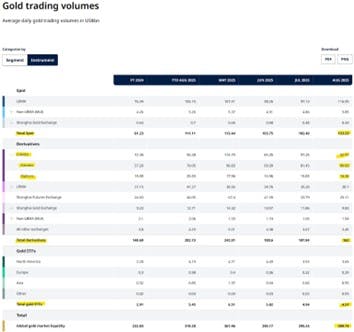
Spot gold (bullion), gold derivatives, and ETFs collectively trade around $290bn per day (per WGC).
The spot gold market primarily trades OTC (over-the-counter), with a large share of volume concentrated in the “Loco London” (LBMA) market.
Typical participants include central banks, governments, gold miners, refiners, and fabricators.
This market accounts for roughly 40% of total gold-related volumes.
Source: World Gold Council (WGC)
Gold ETFs and Liquidity
In the ETF cash trading world, numerous gold tracker ETFs provide direct exposure to the performance of physical gold.
Physical gold ETFs hold bullion in secured bank vaults and pass along storage and insurance costs via the expense ratio.
SPDR Gold Shares ETF (GLD) is the largest physically backed gold ETF (by AuM), featuring tight bid/ask spreads and high institutional ownership.
It is also among the top 10 US ETFs by average daily volume (ADV).
Delta One and ETF market-making desks provide screen liquidity, handle block orders, trade linear derivatives (EFPs, swaps, reversal conversions), arbitrage NAV dislocations, and participate in create-to-lend activity on GLD.
Trading in the inter-dealer market on platforms like TradeWeb further complements GLD’s liquidity ecosystem.
Although other physical gold ETFs (IAU, OUNZ) offer lower expense ratios, they cannot rival the institutional ownership and liquidity profile of GLD.
The Gold Derivatives Ecosystem
The gold derivatives market brings together institutional participants such as CTAs, gold producers, sovereign wealth funds, pension funds, asset managers, wealth managers, leveraged ETF providers, hedge funds, and the sell-side community (ETF market makers, swap dealers, options desks).
These players use gold futures and options to follow trends, trade macro events, diversify portfolios, rebalance exposures, hedge gold production, arbitrage dislocations, and express cyclical macro views.
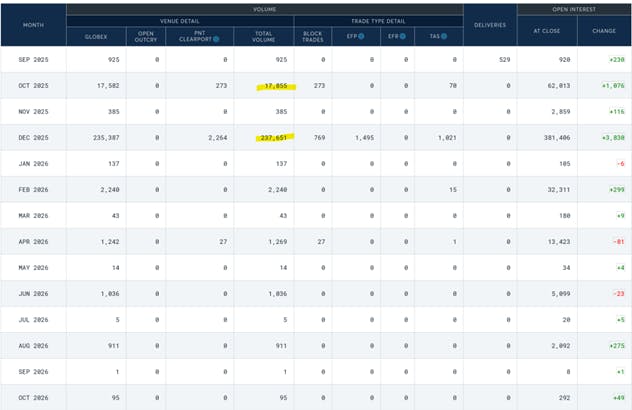
Futures are available across multiple monthly expiries, with the December contract currently the most liquid.
Options on gold futures trade daily in the near term and monthly thereafter, reflecting strong demand.
GLD options also rank among the five most actively traded ETF options, which generates natural hedging flows from options market makers.
Source: CME
This well-developed liquidity ecosystem and the diversity of instruments across spot, futures, options, and ETFs help ensure that ETF prices remain closely aligned with NAV (well-arbitraged), bid/ask spreads stay tight, trading costs remain low, and round-the-clock price discovery supports efficient hedging of options flows.
Gold Buffer Protection ETFs
There are relatively few buffer ETFs tied to gold in the US, but one example is the FT Vest Gold Strategy Quarterly Buffer ETF (BGLD).
Buffer ETFs like BGLD typically define how much upside will be capped in order to offer partial downside protection, provided the ETF is held for the entire “outcome period.”
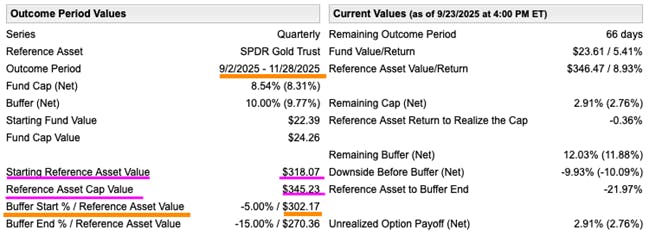
In the current target outcome period (Sep 2 to Nov 28), BGLD seeks to match GLD’s returns up to a predetermined upside cap of 8.54% ($345.23) while providing a buffer against GLD losses between -5% ($302.17) and -15% ($270.36).
This is achieved through a bullish seagull options structure.
Source: FT Vest
How the Structure Works
In practical terms, the fund buys GLD Nov 28 call spreads (302.17/345.23) to participate in upside exposure and sells Nov 28 puts to help finance those spreads and step in to buy GLD at a discount.
If GLD rises from $318.07 (starting reference value), the maximum gain is the difference between the top strike ($345.23) and the bottom strike ($302.17), less any options premiums.
If the price of GLD declines from $318.07, the maximum loss on the call spreads (at the end of the outcome period) will be limited to the premium paid.
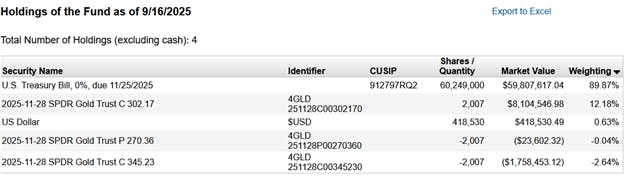
Source: FT Vest
If GLD falls beyond -15%, the short puts are exercised. The call spreads reach maximum loss, while the $60m in cash held in T-bills (net of premiums) is used to purchase GLD at the strike.
The premium collected on the puts provides a modest cushion. The fund’s exposure then resembles being long GLD at a 15% discount to Sep 2 levels ($270.36).
This structure can be attractive, but gold prices often fluctuate significantly across different macro, interest rate, and volatility regimes.
Caution is warranted, especially if rate cuts and geopolitical or policy uncertainty continue to drive momentum.
Bottom Line
There are important caveats regarding the embedded costs and payoff profiles of buffered ETFs. Target outcome ETFs generally fall into the actively managed category, with expense ratios close to 1% — much higher than those of passive ETFs.
In addition, gold options typically trade with a negative skew, meaning upside volatility is more expensive than downside volatility.
As a result, the premium collected on the OTM put provides limited compensation for the cost of the call spread.
Another key point is that payoff convexity only materializes at the end of the outcome period. Interim mark-to-market gains or losses may not accurately reflect the final outcome.
Finally, with both sides of the Fed’s mandate (2% inflation and maximum employment) still under pressure, the path to interest rate cuts remains highly uncertain.
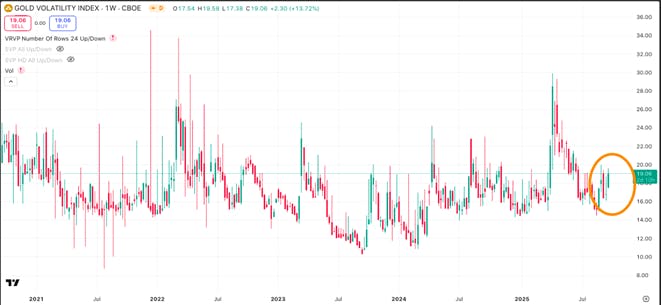
This makes non-interest-bearing GLD vulnerable to volatility (GVZ – the Gold Volatility Index), raising the cost of call spreads without guaranteeing that long exposure will pay off.
Please note that this article reflects the author’s personal views and does not represent the opinions of the publication or its affiliates. It is for informational purposes only and does not constitute investment advice. It is essential to seek guidance from a registered financial professional before making any investment decisions.
Topics
See all
This article does not have a tagged topic
Mentioned ETFs
Further reading


Latest ETF News
See all ETF newsHow Covered Call ETFs Turn Volatility Into Income




 Advantages of ETFs over Mutual Funds1/6
Lower Costs
In this guide, we'll explore the advantages of ETFs over mutual funds, giving you valuable insights into why ETFs have gained significant popularity among investors like yourself.
Leveraged ETFs: Unlocking the Potential for Amplified Returns1/6
Understanding Leveraged ETFs
Explore leveraged ETFs: potential for amplified returns & risks. 5 ETFs to consider across equities, commodities & fixed income.
What is a Leveraged ETF?1/6
Introducing Leveraged and Inverse ETFs
In this guide, we'll dive into the world of leveraged ETFs, exploring their definition, mechanics, potential risks, and rewards.
Recent educational content

ETF Trends
ETF Industry KPIs September 8, 2026
This week’s KPI data overview highlights key metrics and trends shaping the ETF landscape.

ETF Trends
ETF Industry KPIs August 31, 2026
This week’s KPI data overview highlights key metrics and trends shaping the ETF landscape.
ETF Trends
ETF Industry KPIs August 24, 2026
This week’s KPI data overview highlights key metrics and trends shaping the ETF landscape.
What’sTheFund
What's the Fund | Ocean Park Diversified Income ETF (DUKZ)
James St Aubin, Chief Investment Officer at Ocean Park Asset Management, discuss the DUKZ ETF, exposing investors to the whole spectrum of asset classes in the fixed income markets, through their rules-based process.

Browse all educational columns



Build and Analyze Your ETF Portfolio Like a Pro
Create your own ETF portfolio in minutes and instantly see allocations, exposures, performance, and risk. Visualize diversification across asset classes, regions, and sectors. Stress-test ideas, compare benchmarks, and refine your strategy with professional-grade analytics.