Open Now: The Global ETF Survey Take the Survey →



Exploring low-cost versions of popular ETFs
Many ETFs have less expensive versions available. Here's why they're better for long-term investors.


Keep up with what matters in ETFs
Get timely ETF insights, market trends, and top ideas straight to your inbox.
Your newsletter subscriptions with us are subject to ETF Central's Privacy Policy and Terms and Conditions.
One of the easiest risk factors to control in your ETF portfolio is the expense ratio. This is the percentage fee deducted from your total investment on an annual basis. For example, an ETF that charges an expense ratio of 0.50% will cost you around $50 in annual fees for a $10,000 investment.
It might not seem like much at first but given how compounding and the time value of money works, high expense ratios can lead to diminishing returns and opportunity costs down the line. For example, take a look at this calculation from learningtofi.com that shows the difference between two ETFs that returned the same, but had different expense ratios.
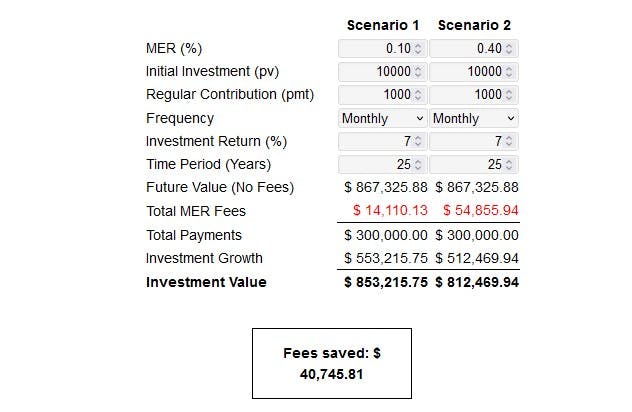
The lesson here is to keep fees low and shop around for the best ETF for your needs (a great tool to use here is the ETF Central screener). That being said, the ETF industry is always in an arms race to lower fees. Some popular fund managers like State Street and Invesco have released "mini" versions of popular funds with lower share prices and expense ratios. Let's take a look at some today.
The ETF Industry Is Evolving Fast
From AI infrastructure to active strategies, the ETF landscape is shifting. Share your perspective in the 7th Annual Global ETF Survey and get exclusive early access to the final report.
State Street: SPY ETF
State Street offers the very popular SPDR S&P 500 ETF Trust (SPY). SPY is the largest and most liquid ETF in the world, with an astounding $358 billion in assets under management (AUM) and millions of shares traded monthly. The ETF has a highly developed options chain and is a favorite for day and swing traders. That being said, as a long-term passive buy-and-hold investment, SPY isn't the best option. The ETF currently charges an expense ratio of 0.09%, which is higher than the industry lowest of 0.03%. Fortunately, State Street released the SPDR Portfolio S&P 500 ETF (SPLG).
SPLG holds the exact same assets as SPY does. It is identical in every single way in terms of holdings and composition. The difference is in the expense ratio, which is significantly lower at 0.03%. As well, SPLG trades for just $46.46 per share at the time of writing, compared to SPY at $396.42. This makes it more accessible for investors with a smaller portfolio.
The downside is a less developed options chain. This means wider bid-ask spreads for options and fewer selections for strike prices and expiry dates. However, for the average index investor this is not a concern. Traders can still make use of SPY as their holding period is so short that the higher expense ratio isn't an issue.
Invesco: QQQ ETF
Invesco manages the highly popular Invesco QQQ Trust Series 1 (QQQ). If SPY is State Street's flagship fund, then QQQ is Invesco's. QQQ tracks the NASDAQ 100, a very popular choice among traders and investors alike. Like SPY, QQQ has a very high AUM ($164 billion) and a high volume traded daily. The ETF also has a strong options chain thanks to its high implied volatility.
However, QQQ is expensive for a vanilla index ETF, costing an expense ratio of 0.20%. This is as expensive as some actively managed factor funds out there. However, having recognized that some investors want to buy and hold the NASDAQ 100 long-term, Invesco released the Invesco NASDAQ 100 ETF (QQQM) as an alternative.
Like QQQ, QQQM also tracks the NASDAQ 100. The funds are identical in terms of holdings and composition. The difference is once again in the expense ratios – QQQM is 0.05% less at 0.15%. In exchange, you have a less developed options chain, but as mentioned earlier this is not a concern for long-term buy-and-hold investors.
Which ETF to buy?
Both SPLG and QQQM are great lower-cost alternatives to SPY and QQQ. If you're not into day or swing-trading, you can forego the lower bid-ask spreads and better options chains of SPY and QQQ to save on the expense ratios. While it might not seem like much, the few percentages you save can make a big difference over the long term, especially as your portfolio grows larger. If you're curious about the differences between the S&P 500 and NASDAQ 100, I suggest giving this article a read.
Please note this article is for information purposes only and does not constitute investment advice.
Latest ETF News
See all ETF newsThe Two Best Types of Fixed-Income ETFs For Managing Cash

ETF Comparison: Roundhill Generative AI & Technology ETF Versus iShares A.I. Innovation and Tech Active ETF

Crypto Income ETFs: Futures, Options, or Staking?

There’s an ETF for That? Air Conditioning Stocks




 Advantages of ETFs over Mutual Funds1/6
Lower Costs
In this guide, we'll explore the advantages of ETFs over mutual funds, giving you valuable insights into why ETFs have gained significant popularity among investors like yourself.
Leveraged ETFs: Unlocking the Potential for Amplified Returns1/6
Understanding Leveraged ETFs
Explore leveraged ETFs: potential for amplified returns & risks. 5 ETFs to consider across equities, commodities & fixed income.
What is a Leveraged ETF?1/6
Introducing Leveraged and Inverse ETFs
In this guide, we'll dive into the world of leveraged ETFs, exploring their definition, mechanics, potential risks, and rewards.
Recent educational content

ETF Trends
ETF Industry KPIs July 13, 2026
This week’s KPI data overview highlights key metrics and trends shaping the ETF landscape.

First Look ETF
First Look ETF: Cash Deployment, Bond, and Hedged ETFs
In this season 6 episode of First Look ETF, Stephanie Stanton examines the latest ETF marketplace trends with NYSE and guests.

ETF Trends
ETF Industry KPIs July 6, 2026
This week’s KPI data overview highlights key metrics and trends shaping the ETF landscape.
Asset TV
The ETF Show - The Evolution of Leveraged & Inverse ETFs
Leveraged and inverse ETFs have exploded in popularity over the past decade capturing more assets as retail traders seek to capture volatility.

Browse all educational columns



The ETF Industry Is Evolving Fast
From AI infrastructure to active strategies, the ETF landscape is shifting. Share your perspective in the 7th Annual Global ETF Survey and get exclusive early access to the final report.