Explore professionally built ETF model portfolios. Discover now →



ETF Model Portfolios: The Geopolitical Risk Thematic Hedge
This four-ETF model portfolio seeks to provide exposure to asset classes that may benefit from or remain resilient during periods of elevated geopolitical uncertainty.

Keep up with what matters in ETFs
Get timely ETF insights, market trends, and top ideas straight to your inbox.
Your newsletter subscriptions with us are subject to ETF Central's Privacy Policy and Terms and Conditions.
Geopolitical risk has returned as a major consideration for investors. The war in Ukraine continues to reshape European defense spending and energy markets. In the Middle East, the conflict between Israel and Hamas remains ongoing, while military operations involving Lebanon have raised concerns about broader regional escalation. More recently, tensions between the United States and Iran have focused attention on the Strait of Hormuz, one of the world's most important energy shipping corridors and a critical chokepoint for global oil supplies.
Despite this backdrop, equity markets have remained remarkably resilient. Major indexes continue to trade near record highs, corporate earnings have generally held up, and investor risk appetite remains strong. Part of that resilience may reflect the reality that investors have few attractive alternatives. Cash yields are falling as central banks ease policy, while inflation continues to erode purchasing power over time. For many investors, equities remain one of the few asset classes capable of generating meaningful real returns.
That does not mean geopolitical risks should be ignored. Rather than attempting to predict the next conflict or headline, a more practical approach may be to identify assets that either benefit from, or are relatively insulated from, periods of geopolitical stress.
The framework used here is intentionally top-down. Different conflicts affect different parts of the economy. Military spending can benefit defense contractors. Supply chain disruptions can support commodity prices. Energy transportation risks can affect oil markets. Safe-haven demand may flow into precious metals. Instead of making a single concentrated bet, the goal is to map these potential drivers into a diversified collection of asset classes.
To illustrate the concept, ETF Central's Model Portfolio tool was used to construct what can I call the Geopolitical Risk Thematic Hedge Portfolio. The portfolio consists of four ETFs, equally weighted and rebalanced quarterly. Two funds come from State Street Investment Management and two from Invesco.
The objective is not to predict geopolitical events. Rather, it is to build exposure to areas of the market that may possess positive sensitivity to rising geopolitical tensions while still maintaining the potential for long-term capital appreciation.
Like what you're reading?
Stay in the loop — get the latest ETF insights: trends, analysis, and expert picks.
Invesco's Contribution: Defense and Swiss Francs
At a 25% allocation each, the first two positions in the Geopolitical Risk Thematic Hedge Portfolio are the Invesco Aerospace & Defense ETF
One of the most consistent consequences of geopolitical tension is increased military spending. Governments facing new security threats typically respond by replenishing depleted munitions stockpiles, accelerating procurement programs, increasing defense budgets, and investing in emerging military technologies.
For defense contractors, this often translates into larger order books and growing backlogs. Backlogs are particularly important because they represent contracted future revenue. A defense contractor with a backlog stretching years into the future has greater earnings visibility than many businesses operating in cyclical industries.
PPA provides exposure through the SPADE Defense Index. The resulting portfolio contains 61 holdings and reads like a who's who of the American defense establishment. Top positions include GE Aerospace, Boeing, RTX, Lockheed Martin, Honeywell, General Dynamics, Northrop Grumman, and L3Harris.
Performance has also been impressive. Since its October 2005 inception, PPA has delivered annualized returns of 13.86%. For comparison, the broader S&P Composite 1500 Aerospace & Defense Index generated 13.64% annually over the same period. That comparison is particularly notable because indexes do not incur management fees, whereas PPA charges a 0.58% expense ratio.
Balancing the portfolio's defense allocation is FXF, which serves a very different purpose. Unlike an equity ETF, FXF is a grantor trust that simply holds Swiss francs.
Investors who own FXF are gaining direct exposure to movements in the Swiss franc relative to the U.S. dollar. When the U.S. dollar strengthens, FXF tends to decline. When the Swiss franc appreciates against the dollar, FXF tends to rise.
The reason for choosing Swiss francs instead of Swiss equities is focus. Swiss stocks introduce equity market risk, sector risk, and company-specific risk. FXF strips those variables away and provides more direct exposure to the currency itself.
Switzerland has long been viewed as one of the world's premier safe-haven jurisdictions. The country maintains a longstanding policy of neutrality, possesses strong institutions, enjoys significant political stability, and sits on a robust fiscal foundation. During periods of international uncertainty, capital has often flowed toward Swiss assets and the Swiss franc.
One tradeoff is income. Because Swiss interest rates currently sit near zero, FXF generates no yield after accounting for the fund's 0.40% expense ratio, investors should view it primarily as a capital appreciation vehicle rather than an income-producing holding.
Within this portfolio framework, FXF effectively serves as a substitute for part of a traditional cash or bond allocation. Whereas PPA seeks to benefit from rising defense expenditures and military spending, FXF provides a potential hedge against U.S. dollar weakness and broader geopolitical instability.
State Street's Contribution: Energy and Gold
The remaining 50% of the portfolio is split equally between the Energy Select Sector SPDR Fund
XLE provides exposure to rising energy and commodity prices, a trend that has historically accompanied many geopolitical conflicts. While every conflict is unique, certain economic consequences tend to appear repeatedly.
Supply chains become disrupted. Governments increase military activity, which consumes significant amounts of fuel and energy. Strategic petroleum reserves can be drawn down. Shipping routes become less secure. All of these factors can place upward pressure on energy prices.
The recent tensions involving Iran and concerns surrounding the Strait of Hormuz provide a useful example. Roughly a fifth of global petroleum consumption moves through this narrow waterway. Even the possibility of disruptions can ripple through energy markets and influence oil prices worldwide.
XLE offers a relatively straightforward way to express that view. The fund owns energy companies within the S&P 500, providing exposure across the industry's value chain, including exploration and production companies, integrated oil majors, refiners, midstream operators, and energy services firms.
Because the underlying universe comes from the S&P 500, investors benefit from a built-in quality screen. Constituents must satisfy market capitalization, liquidity, and profitability requirements before entering the index. The result is a portfolio dominated by established companies.
XLE has returned approximately 26.7% year-to-date, benefiting from higher energy prices. The fund also generates decent income, currently sporting a 30-day SEC yield of roughly 2.8%. As one of State Street's 11 Select Sector ETFs, XLE remains highly cost-effective with an expense ratio of just 0.08%.
The final component of the portfolio is GLDM, which occupies the portfolio's dedicated precious metals allocation. Gold has served as a store of value for thousands of years and continues to play an important role within the global financial system. Central banks remain significant buyers, particularly in recent years as countries seek to diversify reserve assets away from traditional foreign currency holdings.
Within this portfolio, gold serves a somewhat different purpose than the Swiss franc. Both can function as safe-haven assets, but they derive their value from different drivers. The Swiss franc remains a fiat currency tied to the economic fortunes and monetary policy of a specific country. Gold, by contrast, is a globally recognized monetary asset that exists outside the traditional banking system.
More broadly, the goal is diversification through non-correlated assets. If the portfolio's defense allocation benefits from rising military spending and the energy allocation benefits from supply disruptions, gold provides exposure to an entirely different set of drivers, including currency debasement concerns, central bank demand, and investor risk aversion.
GLDM offers a particularly efficient implementation. The physically backed grantor trust manages $28 billion in assets and charges a 0.10% expense ratio. The fund has historically tracked spot gold prices closely during market hours and remains highly liquid, with a 30-day median bid-ask spread of 0.01%.
Together, XLE and GLDM round out the portfolio by adding exposure to two asset classes that have historically responded favorably to many of the same forces that emerge during periods of geopolitical stress: concerns about supply security and demand for alternative stores of value.
How the Portfolio Performed
I used a straightforward equal-weight approach with quarterly rebalancing. The result is a portfolio that remains easy to understand and implement while still providing exposure to several distinct geopolitical risk factors. The weighted average expense ratio remains a reasonable 0.29%.
The strategy was benchmarked against the S&P 500 Total Return Index over the roughly five-year period between June 2021 and June 2026. The portfolio compared favorably on both return and risk metrics, an encouraging result given that the S&P 500 remains one of the most difficult benchmarks for any diversified strategy to outperform.
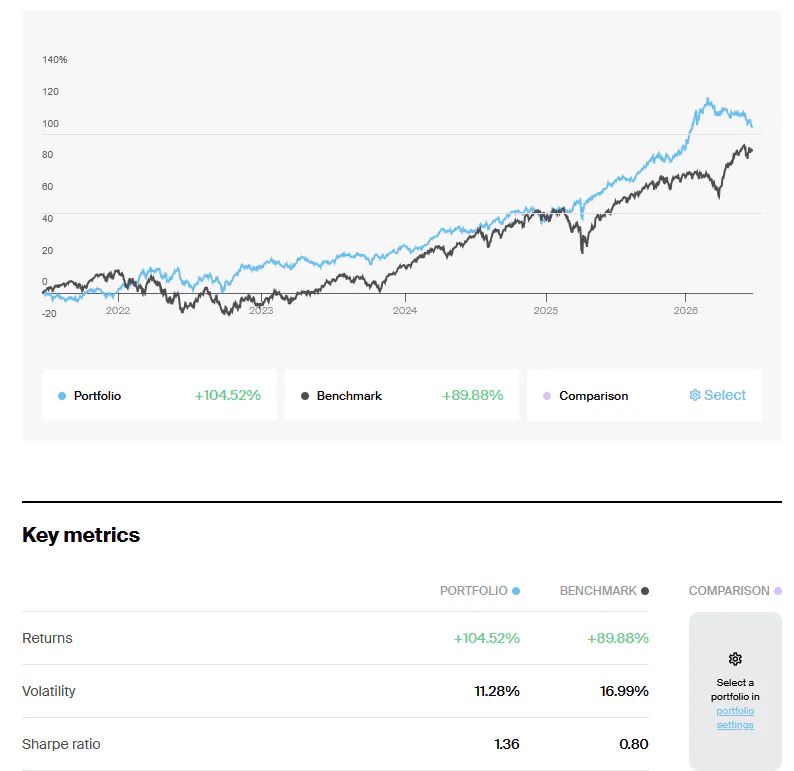
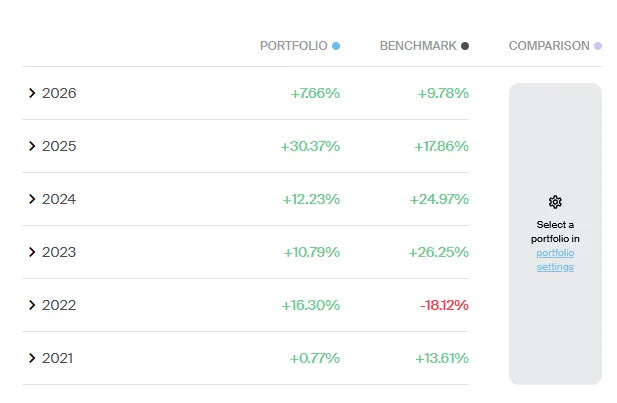
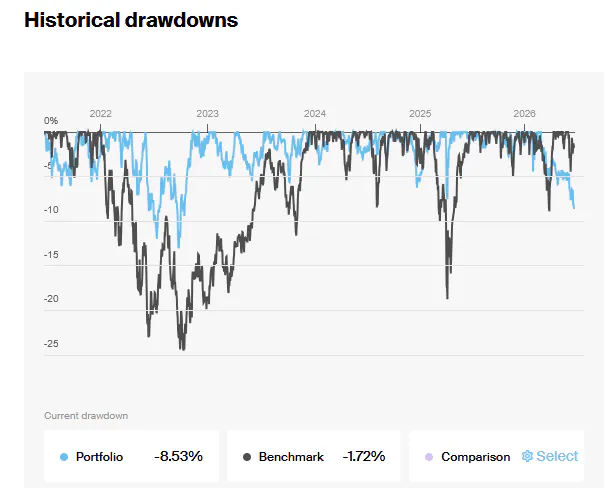
Historical performance suggests the portfolio generally navigated several challenging market environments relatively well, including the inflation-driven volatility of 2022 and the trade-related uncertainty that emerged during 2025.
Risk statistics also paint a favorable picture. Across multiple measures, the portfolio displayed lower historical tail risk, lower volatility, and less dependence on the direction of the broader stock market.
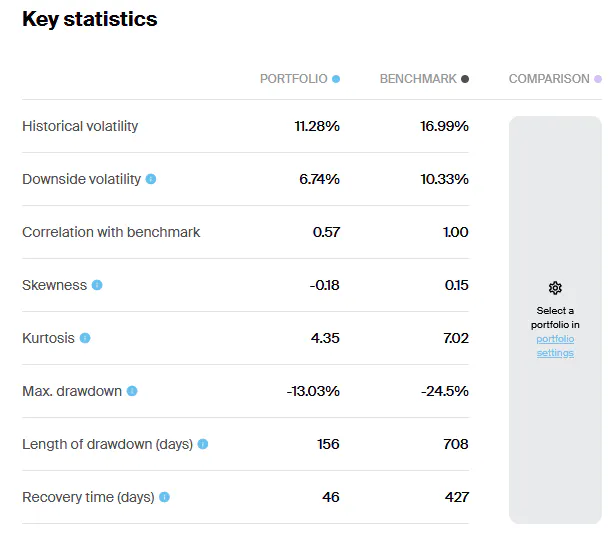
Max drawdown depth and length were also muted, and recovery periods following market declines were also generally shorter than those experienced by the benchmark.
Of course, none of this guarantees future results. The portfolio was specifically designed around a particular macroeconomic view: that geopolitical instability may remain a persistent feature of the investment landscape and that certain asset classes possess structural characteristics that make them more resilient during those periods.
Whether that thesis proves correct remains to be seen. What the exercise does demonstrate is that investors do not necessarily need to rely on broad market indexes alone. By identifying the economic consequences that often accompany geopolitical events and mapping them to specific asset classes, it is possible to build a portfolio that seeks resilience without becoming overly complex or expensive.
Please note this article is for information purposes only and does not in any way constitute investment advice. It is essential that you seek advice from a registered financial professional prior to making any investment decision.

Latest ETF News
See all ETF newsETF Model Portfolios: The Anti-Inflation and Rising Interest Rate Allocation
ETF Model Portfolios: The Boglehead Couch Potato





 Advantages of ETFs over Mutual Funds1/6
Lower Costs
In this guide, we'll explore the advantages of ETFs over mutual funds, giving you valuable insights into why ETFs have gained significant popularity among investors like yourself.
Leveraged ETFs: Unlocking the Potential for Amplified Returns1/6
Understanding Leveraged ETFs
Explore leveraged ETFs: potential for amplified returns & risks. 5 ETFs to consider across equities, commodities & fixed income.
What is a Leveraged ETF?1/6
Introducing Leveraged and Inverse ETFs
In this guide, we'll dive into the world of leveraged ETFs, exploring their definition, mechanics, potential risks, and rewards.
Recent educational content

ETF Trends
ETF Industry KPIs September 28, 2026
This week’s KPI data overview highlights key metrics and trends shaping the ETF landscape.

ETF Trends
ETF Industry KPIs September 22, 2026
This week’s KPI data overview highlights key metrics and trends shaping the ETF landscape.
First Look ETF
First Look ETF: Income, Corporate Arbitrage, and Growth and Value Investing
First Look ETF September 2026: iCapital, Mast Investments and North Square unpack new ETFs targeting monthly income, merger arbitrage and complementary growth and value exposure.

ETF Trends
ETF Industry KPIs September 14, 2026
This week’s KPI data overview highlights key metrics and trends shaping the ETF landscape.
Browse all educational columns



Have you tried our ETF Compare tool?
Compare ETFs like a pro. Analyze fees, performance, exposure & holdings side-by-side.