Ready-made ETF portfolios built for real investor needs. Explore now →



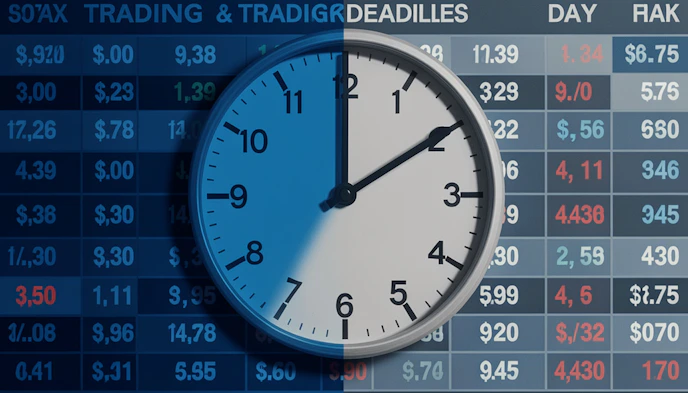
ETF Creation Windows Matter More Than You Think
Why the timing of ETF creation and redemption cutoffs can affect execution quality on large orders.

Keep up with what matters in ETFs
Get timely ETF insights, market trends, and top ideas straight to your inbox.
Your newsletter subscriptions with us are subject to ETF Central's Privacy Policy and Terms and Conditions.
An ETF may trade until 4:00 p.m., but that doesn’t mean the creation and redemption process remains available until the closing bell.
For most investors making a routine trade, that distinction may never matter. For a large ETF order, it can matter quite a bit.
The reason is simple: when a market maker trades with you, the trade doesn’t end when your order is filled. The market maker still has to manage the position left behind.
Get data on 14,000+ ETFs
Access Trackinsight's reliable and comprehensive data with 500M+ points on 14,000+ ETFs.
The Clock Most Investors Don’t See
Every ETF has procedures governing when Authorized Participants can submit creation and redemption orders. Those deadlines vary by fund and can occur well before the ETF stops trading.
Before the cutoff, a market maker accumulating a large ETF position may be able to work through an AP to redeem those shares and receive the underlying basket. A market maker selling ETF shares and becoming short may be able to facilitate a creation to obtain shares needed to cover that position.
After the cutoff, those options may no longer be available for that day.
The ETF is still trading, but the market maker’s choices for managing the resulting inventory may have changed.
Inventory Matters
Suppose an investor comes to market with a large sell order.
A market maker may be willing to buy those ETF shares. If the redemption window is still open, the position may be redeemed and converted into the underlying securities.
If the same order arrives after the cutoff, the market maker may instead have to hold the ETF overnight, hedge the exposure another way or wait until the next opportunity to redeem.
The opposite can happen with a large buy order. A market maker may sell ETF shares to facilitate the trade and end up short the ETF. Market makers have certain regulatory flexibility when shorting securities as part of bona fide market-making activity, but that flexibility isn’t unlimited. Eventually, that short position has to be managed or covered.
The creation process can be one way of doing that.
None of this means a trade cannot happen after the creation/redemption cutoff. It means the economics of providing that liquidity may have changed.
What If the Underlying Market Is Closed Too?
This becomes even more important when the underlying securities are no longer trading.
In my ETF Central article published this Wednesday, I discuss the example of a U.S.-listed ETF holding Israeli equities. Because the Israeli market closes relatively early in the U.S. trading day, the ETF can continue trading in the United States for hours after its underlying market has closed.
A market maker can continue making prices in the ETF. It may use ADRs, currencies, futures or correlated securities to estimate fair value and offset some of its exposure.
But those aren’t necessarily perfect hedges.
Now imagine a large ETF order arriving later in the U.S. session. The underlying Israeli stocks are no longer trading and the ETF’s creation or redemption window may also be closed.
The market maker can still provide liquidity, but it may now be taking risk that cannot be immediately or perfectly hedged.
That additional risk has a price.
It may appear as a wider spread or simply in the level at which the market maker is willing to buy or sell the ETF.
For a large order, the question therefore shouldn’t only be: “Can I trade this ETF?”
Another important question is: “What can the market maker do with the risk after trading with me?”
Other Inventory Considerations
Market makers are also managing settlement obligations, stock borrow and existing inventory across many securities.
There can be situations where a firm needs to acquire a security to satisfy a delivery or buy-in requirement. An unexpected large ETF trade late in the session can change those inventory requirements.
When the underlying markets and creation/redemption window are still available, the trading desk may have several ways to manage the position.
Later in the day, those choices can become more limited.
That doesn’t necessarily mean the market maker won’t trade. It may simply require more edge to compensate for the additional risk.
Give Large Orders Time
This is one reason I prefer giving a trading desk advance notice when executing a meaningful ETF order.
Don’t assume that because an ETF trades until 4:00 p.m., a $5 million order at 3:30 p.m. presents the same risk to a liquidity provider as the identical order earlier in the day.
Know the ETF’s creation/redemption cutoff. Understand when its underlying securities trade. And give liquidity providers enough time to determine how they can efficiently hedge and manage the other side of your trade.
For a large order, working through a block desk that can RFQ multiple ETF market makers can also be valuable.
Competition matters, but time matters too.
Several market makers competing for an order can improve pricing. Giving them sufficient time to evaluate the basket, determine a hedge and potentially access the creation/redemption mechanism can improve it further.
ETF liquidity is about more than what appears on the screen.
Market makers are constantly evaluating what happens after the trade: Can I hedge it? Can I create or redeem? Is the underlying market open? What inventory will I be left with?
For small trades, investors may never need to think about those questions.
For large trades, they can directly affect execution.
The ETF may trade until 4:00 p.m. The market maker’s best options for managing your trade may not.
Disclaimer
Please note this article is for information purposes only and does not in any way constitute investment advice. It is essential that you seek advice from a registered financial professional prior to making any investment decision.
Latest ETF News
See all ETF newsAre ETFs Getting Too Complicated? Not Necessarily, But Complexity Has a Cost

Form 4 Has 20 Transaction Codes. None Say "Section 351 ETF Swap"


Who Really Owns a White-Label ETF?

What If a Futures-Based ETF Never Had to Roll Again?

How Do You Build a Winning ETF Business?

Losers Of Q2 2026 REIT Earnings Season



 Advantages of ETFs over Mutual Funds1/6
Lower Costs
In this guide, we'll explore the advantages of ETFs over mutual funds, giving you valuable insights into why ETFs have gained significant popularity among investors like yourself.
Leveraged ETFs: Unlocking the Potential for Amplified Returns1/6
Understanding Leveraged ETFs
Explore leveraged ETFs: potential for amplified returns & risks. 5 ETFs to consider across equities, commodities & fixed income.
What is a Leveraged ETF?1/6
Introducing Leveraged and Inverse ETFs
In this guide, we'll dive into the world of leveraged ETFs, exploring their definition, mechanics, potential risks, and rewards.
Recent educational content

ETF Trends
ETF Industry KPIs September 28, 2026
This week’s KPI data overview highlights key metrics and trends shaping the ETF landscape.

ETF Trends
ETF Industry KPIs September 22, 2026
This week’s KPI data overview highlights key metrics and trends shaping the ETF landscape.
First Look ETF
First Look ETF: Income, Corporate Arbitrage, and Growth and Value Investing
First Look ETF September 2026: iCapital, Mast Investments and North Square unpack new ETFs targeting monthly income, merger arbitrage and complementary growth and value exposure.

ETF Trends
ETF Industry KPIs September 14, 2026
This week’s KPI data overview highlights key metrics and trends shaping the ETF landscape.
Browse all educational columns



Expert-Built ETF Portfolios, All in One Place
Don’t start from scratch. Discover ready-made ETF portfolios built by professionals to match different goals, timelines, and market views. Use them as inspiration or as a starting point for your own allocation.