Create, analyze, optimize your ETF portfolio. Start now →



Why the Time of Day Matters When Trading an ETF
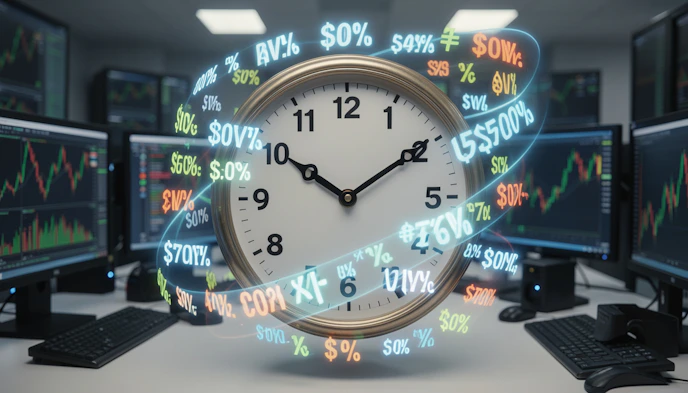
An ETF may trade from 9:30 a.m. to 4:00 p.m., but that doesn’t mean every minute of the trading day is created equal.

Keep up with what matters in ETFs
Get timely ETF insights, market trends, and top ideas straight to your inbox.
Your newsletter subscriptions with us are subject to ETF Central's Privacy Policy and Terms and Conditions.
One of the advantages of ETFs is intraday liquidity. Investors can buy and sell shares throughout the trading session. But the fact that an ETF is open for trading doesn’t necessarily mean that all of its underlying securities—or the instruments market makers use to hedge it—are trading under the same conditions.
That distinction can affect spreads, price discovery and ultimately execution.
Like what you're reading?
Stay in the loop — get the latest ETF insights: trends, analysis, and expert picks.
Be Careful at the Open
I have never been a fan of Market-on-Open orders in ETFs.
At 9:30 a.m., price discovery is occurring across the U.S. market. Some securities in an ETF’s basket may not have opened yet, overnight information is being incorporated into prices, and markets can move quickly.
There is another reason I prefer giving ETF markets some time to establish themselves.
At the opening bell, ETF market makers are establishing markets across hundreds or even thousands of ETFs at essentially the same time. Risk is being evaluated, hedges are being established, underlying securities are opening, and automated pricing models are adjusting to rapidly changing information.
As a result, ETF spreads at the open can be wider than they are only minutes later.
Importantly, this can be true even when an ETF’s underlying market is already open.
Consider a U.S.-listed ETF holding European equities. Europe has already been trading for hours when the U.S. market opens, so a market maker may have a very good idea of the ETF’s fair value.
But knowing fair value and being willing to immediately quote a tight market at 9:30 are two different things.
A market maker isn’t necessarily unhappy to buy an ETF below fair value or sell it above fair value during the opening process. That additional edge compensates the liquidity provider for taking risk during one of the busiest and potentially most uncertain periods of the trading day.
Investors don’t need to give that edge away unnecessarily.
My preference is simple: let the ETF market establish itself and use a limit order when appropriate. There is rarely a reason to give away price unnecessarily.
When the Underlying Market Is Open
Once the underlying securities are actively trading and markets have settled into the regular session, market makers generally have more information with which to price an ETF.
For a U.S. equity ETF, the market maker can observe where the underlying stocks are actually trading, calculate the value of the basket, and execute the securities or other instruments needed to hedge an ETF trade.
That doesn’t mean there is one universally perfect time to trade. Volatility, news and liquidity conditions can change throughout the day.
But as a general principle, the ability to observe and trade the underlying assets gives a market maker greater certainty when pricing an ETF.
For international ETFs, however, things can get more complicated.
The Best Trading Window Isn’t Always Obvious
International ETFs can create situations where the normal rules of thumb don’t work particularly well.
Consider a U.S.-listed ETF holding Israeli equities. During the summer, the Tel Aviv market begins moving toward its close at roughly 10:15 a.m. Eastern Time Monday through Thursday. Since the U.S. market doesn’t open until 9:30, there is only a relatively short period when both markets are open.
For an ETF order of meaningful size, that window is even shorter than it appears.
The order needs to be evaluated and priced, accepted and executed, and the market maker may need enough time to execute the underlying securities used to hedge the trade before the local market closes.
So waiting until 10:00 a.m. to begin working a sizable order may already be getting late.
But there’s a catch: I also don’t like blindly sending a large ETF order into the market at 9:30. ETF market makers are establishing markets across thousands of products at the opening bell, spreads can initially be wider, and price discovery is still taking place.
You therefore have two competing clocks.
You want to give the U.S.-listed ETF enough time to establish an orderly market, but you also want to execute while the underlying Israeli securities are still open and available for hedging.
For a larger trade, this is where execution strategy becomes important. Rather than simply entering the entire order into the displayed market, an investor may want to work with a block desk that can solicit competitive prices from multiple ETF market makers. An RFQ can create competition for the trade while still giving liquidity providers enough time to evaluate and hedge the exposure before the underlying market closes.
Once the Israeli market closes, the ETF can continue trading in the United States. But the market maker can no longer execute the underlying Israeli basket in real time and may need to rely more heavily on currencies, futures, correlated securities or other indications of fair value.
That doesn’t mean the ETF suddenly becomes illiquid. It means the risk of providing liquidity has changed.
The lesson isn’t that investors should always trade international ETFs at a particular time. It’s that they should understand when the underlying market is available and, for larger orders, think about how the trade is executed as well as when.
Be Careful Near the Close, Too
The final minutes of the U.S. trading day deserve attention for many of the same reasons.
There can be substantial liquidity near the close, and institutional investors may have legitimate reasons to participate in closing auctions. But depending on the ETF, some underlying markets may have been closed for hours, and certain hedging instruments may be less liquid or unavailable.
As the trading day winds down, a market maker may also have less time to offset newly acquired risk before the end of the session.
Again, that doesn’t mean investors should never trade an ETF near the close. It means they should understand what is happening underneath the ETF before assuming that displayed volume automatically translates into the best possible execution.
The Bottom Line
There is no single best time to trade every ETF.
A highly liquid U.S. equity ETF is very different from an ETF holding European stocks, Israeli equities, Asian securities, bonds or other assets operating on different trading schedules.
The important question isn’t simply whether the ETF is trading. Investors should also consider whether the underlying assets are trading and how efficiently a market maker can price and hedge the exposure at that moment.
When possible, I prefer avoiding the opening and closing minutes of the session and using limit orders to maintain greater control over execution price. For larger international ETF trades, understanding the underlying market’s hours—and working the order appropriately—can be just as important.
When trading an ETF, don’t just look at the clock on the exchange. Look at the clocks underneath the ETF.
Disclaimer
Please note this article is for information purposes only and does not in any way constitute investment advice. It is essential that you seek advice from a registered financial professional prior to making any investment decision.
Latest ETF News
See all ETF newsForm 4 Has 20 Transaction Codes. None Say "Section 351 ETF Swap"


Who Really Owns a White-Label ETF?

What If a Futures-Based ETF Never Had to Roll Again?

How Do You Build a Winning ETF Business?

Losers Of Q2 2026 REIT Earnings Season


Winners of Q2 2026 REIT Earnings Season


 Advantages of ETFs over Mutual Funds1/6
Lower Costs
In this guide, we'll explore the advantages of ETFs over mutual funds, giving you valuable insights into why ETFs have gained significant popularity among investors like yourself.
Leveraged ETFs: Unlocking the Potential for Amplified Returns1/6
Understanding Leveraged ETFs
Explore leveraged ETFs: potential for amplified returns & risks. 5 ETFs to consider across equities, commodities & fixed income.
What is a Leveraged ETF?1/6
Introducing Leveraged and Inverse ETFs
In this guide, we'll dive into the world of leveraged ETFs, exploring their definition, mechanics, potential risks, and rewards.
Recent educational content

ETF Trends
ETF Industry KPIs September 22, 2026
This week’s KPI data overview highlights key metrics and trends shaping the ETF landscape.

First Look ETF
First Look ETF: Income, Corporate Arbitrage, and Growth and Value Investing
First Look ETF September 2026: iCapital, Mast Investments and North Square unpack new ETFs targeting monthly income, merger arbitrage and complementary growth and value exposure.

ETF Trends
ETF Industry KPIs September 14, 2026
This week’s KPI data overview highlights key metrics and trends shaping the ETF landscape.
ETF Trends
ETF Industry KPIs September 8, 2026
This week’s KPI data overview highlights key metrics and trends shaping the ETF landscape.
Browse all educational columns



Have you tried our ETF Compare tool?
Compare ETFs like a pro. Analyze fees, performance, exposure & holdings side-by-side.