ETF model portfolios designed for real investor needs. Discover →



ETF Contrarian Corner: Two Unloved Segments That Investors Are Ignoring
Contrarian investors looking to avoid an AI-crowded market environment may find these unloved ETFs an appealing overweight.


Keep up with what matters in ETFs
Get timely ETF insights, market trends, and top ideas straight to your inbox.
Your newsletter subscriptions with us are subject to ETF Central's Privacy Policy and Terms and Conditions.
AI investors aren't just targeting large language model developers, hyperscalers, or semiconductor manufacturers anymore. The trade has become increasingly specific. We've moved beyond buying the landlords that own AI data centers and into individual links within the value chain itself.
Memory stocks have been one of the biggest examples, particularly those tied to DRAM and NAND flash storage, which have become critical bottlenecks in the AI buildout. More recently, I've seen a wave of ETF launches and filings targeting optics and photonics.
At the same time, financial advisors and market commentators continue to debate the concentration risk within the S&P 500. Concerns range from the dominance of the top 10 holdings to the increasingly large weight of the technology sector itself.
Meanwhile, several index providers have relaxed seasoning requirements for newly public companies, potentially allowing highly anticipated IPOs such as SpaceX to enter benchmarks more quickly than in the past. That has raised concerns among some investors that public markets are increasingly becoming exit liquidity for private shareholders and venture capital firms.
But what about the unloved parts of the market? What about the ETFs investors have been actively avoiding? To answer that question, I turned to ETF Central's segment screening tool. The platform currently tracks 107 ETF categories. Specifically, I was looking for categories that exhibited one or both of the following characteristics: poor trailing performance and significant investor outflows.
Poor performance by itself does not necessarily create opportunity. Sometimes an ETF category is falling because fundamentals are deteriorating. Likewise, outflows alone do not automatically make an investment attractive. Investors can be selling for perfectly rational reasons.
However, when entire themes become broadly disliked, it often creates situations where sentiment becomes disconnected from fundamentals. Investors extrapolate recent weakness indefinitely into the future, capital leaves the category, valuations compress, and expectations fall. That does not guarantee future outperformance, but it can create fertile hunting grounds for contrarian investors willing to look.
So today, we're going to examine a few ETF categories that have fallen out of favor, drill down into several notable funds within those segments, and determine whether the pessimism is justified or whether investors may be overlooking some attractive opportunities.
Like what you're reading?
Stay in the loop — get the latest ETF insights: trends, analysis, and expert picks.
FinTech ETFs
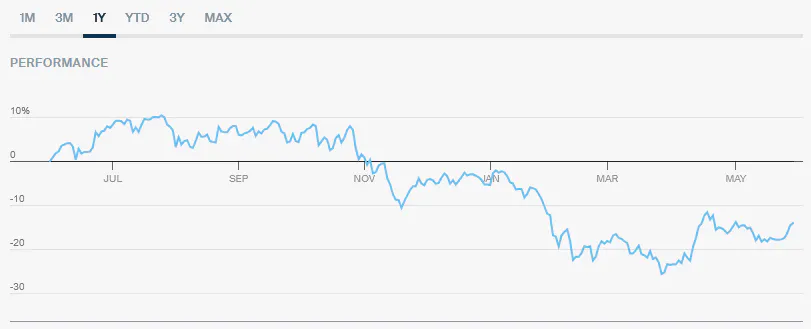
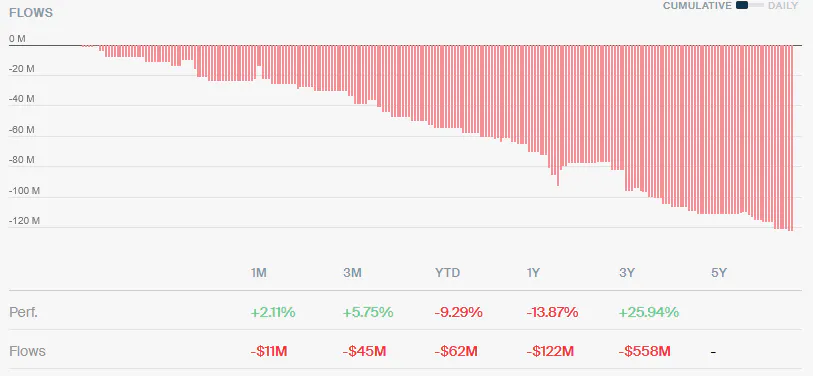
One ETF segment that immediately jumped out at me was fintech. As of June 1, the five ETFs within the segment had collectively delivered an average one-year loss of -13.87%.
Investors have not exactly been rushing in to buy the dip either. The category has experienced roughly $122 million in net outflows over the same period and, altogether, the segment only accounts for about $413 million in assets under management.
That is a far cry from the enthusiasm fintech enjoyed during the COVID-era boom. Back then, investors were convinced that traditional banking was on the verge of disruption. Buy now, pay later platforms exploded in popularity. Digital wallets gained traction. Commission-free brokerages brought millions of new investors into markets. Cryptocurrency exchanges, payment processors, neobanks, and alternative lenders all attracted substantial attention from both venture capital and public markets.
Today, the narrative is less exciting. Part of that comes from the simple reality that many fintech products have matured. Investors are no longer assigning sky-high valuations to companies simply because they happen to operate through an app rather than a physical branch.
The other challenge is AI, which has the potential to automate many of the intermediary functions that fintech firms were originally built around. Whether that's customer service, underwriting, financial planning, payments processing, or transaction routing, investors are increasingly questioning which companies benefit and which become disrupted themselves.
I don't think there's anything fundamentally broken about fintech as an investment theme. If anything, digital payments, online lending, and financial software continue to gain share globally. The question is whether expectations have become too low.
One ETF worth examining is the iShares FinTech Active ETF
The portfolio leans heavily toward consumer-facing fintech businesses. Buy now, pay later providers such as Klarna and Affirm feature prominently. There is also meaningful exposure to brokerage and trading platforms, including Robinhood and eToro, alongside established fintech names such as Block, Global Payments, and Chime.
One aspect I do find interesting is that the active mandate allows the managers to venture beyond traditional financial stocks. The portfolio includes companies such as Sea Limited and MercadoLibre, both of which have built substantial fintech ecosystems alongside their e-commerce operations. That flexibility creates a broader view of financial technology than simply owning payment processors.
Competing against it is the Amplify Digital Payments ETF
The benchmark focuses on payment networks, payment processors, financial infrastructure providers, and digital transaction platforms. Compared to BPAY, the portfolio skews much larger. Roughly 75% of holdings have market capitalizations exceeding $10 billion.
While investors still get exposure to names such as Block and Affirm, the portfolio is anchored by what are arguably some of the highest-quality businesses in the financial sector. Visa, Mastercard, and American Express benefit from powerful network effects and consistently high profit margins.
There is also exposure to more traditional fintech names, including PayPal, which some investors now view as a potential deep value play, though there is no guarantee sentiment ever fully recovers. The portfolio even includes a modest allocation to cryptocurrency infrastructure through Coinbase.
If I were forced to pick between the two, I'd lean toward IPAY. The expense ratio is higher, but the portfolio quality is noticeably stronger. Visa, Mastercard, and American Express have proven business models, durable competitive advantages, and generate substantial free cash flow.
Crypto ETFs
As of June 1, the 91 funds within ETF Central's cryptocurrency segment had collectively declined 29.64% over the trailing one-year period. That's a rough outcome for a category that, not too long ago, was being touted as one of the biggest ETF growth stories in history.
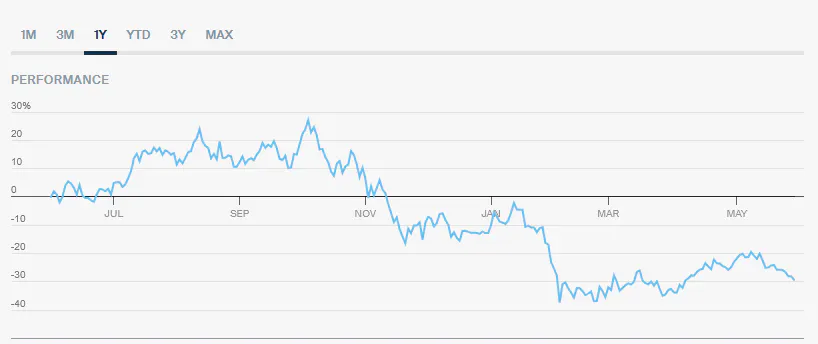
Curiously, though, investors have more or less been religiously buying the dip. Despite the dismal performance, the category attracted $27.21 billion in net inflows over the same period, swelling total assets under management across the segment to $110.82 billion.
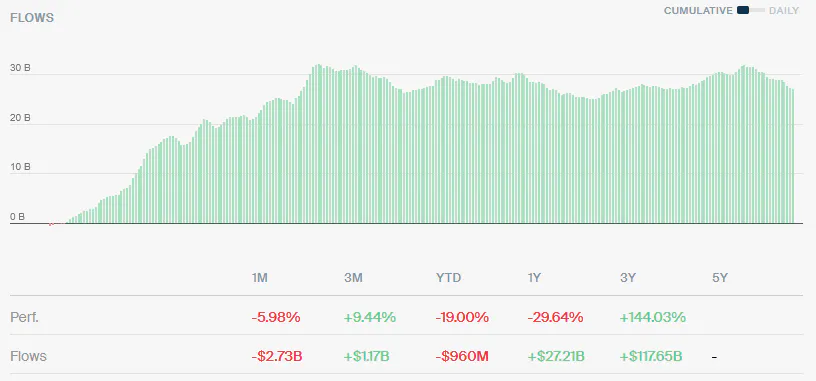
Naturally, most of those assets remain concentrated within spot Bitcoin ETFs. But the industry has moved well beyond Bitcoin and Ethereum. Today, investors can find spot ETFs tracking everything from Solana and Sui to Polkadot, Hyperliquid, and a growing list of other altcoins.
I'm not a cryptocurrency expert, so I'm not going to pretend I know whether all of these assets are undervalued. Frankly, crypto remains one of those asset classes where reasonable people still debate whether intrinsic value even exists.
That said, if I were looking for opportunities within the segment, I think there is at least a case for examining some of the harder-hit Ethereum products and Bitcoin-linked funds rather than chasing whatever the newest token happens to be.
If we filter the category by trailing one-year performance, one thing immediately stands out: Ethereum ETFs have had a rough time. Ethereum differs from Bitcoin in that it is designed not only as a digital asset but also as a programmable blockchain capable of running smart contracts and decentralized applications. While Bitcoin is often viewed primarily as digital gold, Ethereum serves as the backbone for much of the decentralized finance and tokenization ecosystem.
If I had to pick a spot Ethereum ETF, I'd probably go with the Bitwise Ethereum ETF
The other thing I appreciate about ETHW is transparency. Bitwise publicly discloses the ETF's Ethereum reserves. As of June 1, 2026, the trust held 106,814 Ethereum, representing approximately $213 million in assets under management. Each share corresponded to roughly 0.007154 Ethereum.
The holdings are also subject to independent daily examinations and attestations. That's important because crypto investors ultimately need confidence that the assets supposedly backing the ETF actually exist. Independent verification helps reduce counterparty concerns and provides a greater level of transparency than many investors receive elsewhere in the crypto ecosystem.
The second ETF that always catches my attention is the ProShares Bitcoin Strategy ETF
That remains the strategy today. Rather than holding Bitcoin directly, BITO gains exposure primarily through CME Bitcoin futures contracts, supplemented by a CME Bitcoin futures daily roll index swap with Société Générale and collateral holdings through a ProShares money market ETF.
As a result, investors should not expect perfect tracking of spot Bitcoin prices. Over longer periods the performance tends to be reasonably close, but futures contracts introduce additional costs and frictions from mechanics like contango.
One characteristic that immediately grabs attention is BITO's trailing 12-month yield of roughly 72%. Before investors get too excited, it's important to understand where that yield comes from.
As a regulated 1940 Act fund, BITO must distribute realized gains. When futures contracts are rolled and gains are realized, those gains are passed through to shareholders as distributions. The distribution itself is not free money. On the ex-distribution date, the ETF's net asset value falls by the amount distributed.
There can also be tax consequences, and distributions will vary significantly from month to month depending on market conditions. They can increase dramatically during strong Bitcoin rallies or disappear almost entirely during weaker periods.
BITO is also expensive relative to newer spot Bitcoin ETFs, carrying a 0.95% expense ratio. Still, for investors looking for Bitcoin exposure coupled with a meaningful distribution stream, and who do not want to venture into the newer generation of covered call Bitcoin ETFs, BITO remains a perfectly serviceable option with approximately $1.65 billion in assets under management.
Please note this article is for information purposes only and does not in any way constitute investment advice. It is essential that you seek advice from a registered financial professional prior to making any investment decision.
Mentioned ETFs
Further reading


Latest ETF News
See all ETF newsBeyond Big Tech: The Increasing Specialization of AI ETFs

There's an ETF for That? Humanoid Robotics and Physical AI

How Some ETF Issuers Use Their Own Funds for Cash Management

These Public-Private ETFs Invest in Polymarket and Anduril

There's an ETF for That? Frontier Markets



 Advantages of ETFs over Mutual Funds1/6
Lower Costs
In this guide, we'll explore the advantages of ETFs over mutual funds, giving you valuable insights into why ETFs have gained significant popularity among investors like yourself.
Leveraged ETFs: Unlocking the Potential for Amplified Returns1/6
Understanding Leveraged ETFs
Explore leveraged ETFs: potential for amplified returns & risks. 5 ETFs to consider across equities, commodities & fixed income.
What is a Leveraged ETF?1/6
Introducing Leveraged and Inverse ETFs
In this guide, we'll dive into the world of leveraged ETFs, exploring their definition, mechanics, potential risks, and rewards.
Recent educational content

First Look ETF
First Look ETF: Income, International, and Cash Flow ETFs
In this season 6 episode of First Look ETF, Stephanie Stanton @etfguide examines the latest ETF marketplace trends with NYSE and guests.


ETF Trends
ETF Industry KPIs October 5, 2026
This week’s KPI data overview highlights key metrics and trends shaping the ETF landscape.

ETF Trends
ETF Industry KPIs September 28, 2026
This week’s KPI data overview highlights key metrics and trends shaping the ETF landscape.
ETF Trends
ETF Industry KPIs September 22, 2026
This week’s KPI data overview highlights key metrics and trends shaping the ETF landscape.