Keep tabs on your favorite ETFs with a personalized weekly tracker. Create a Watchlist now →



ETF Comparison: Vanguard Growth ETF (VUG) Versus Vanguard Value ETF (VTV)
Vanguard’s flagship large-cap value and growth ETFs face off head-to-head in this week’s ETF comparison.

Keep up with what matters in ETFs
Get timely ETF insights, market trends, and top ideas straight to your inbox.
Your newsletter subscriptions with us are subject to ETF Central's Privacy Policy and Terms and Conditions.
One of ETF Central’s most viewed ETF comparisons this year was the Vanguard Dividend Appreciation ETF (VIG) versus the Vanguard High Dividend Yield ETF (VYM)—two highly popular, low-cost Vanguard index ETFs with diametrically different strategies.
Today, we’re extending that theme to equity styles with a showdown between the Vanguard Growth ETF
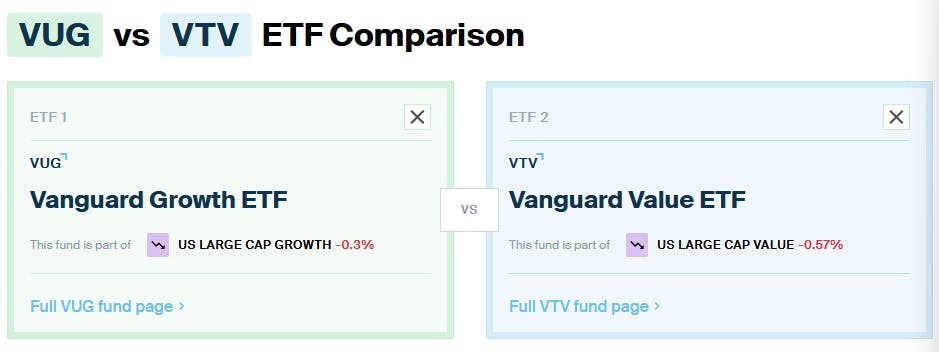
Here’s a comprehensive look at how they stack up, using data from the ETF Central comparison tool.
Like what you're reading?
Stay in the loop — get the latest ETF insights: trends, analysis, and expert picks.
VUG vs VTV: Total cost of ownership
Vanguard is renowned for its low fees, and neither ETF disappoints—both VUG
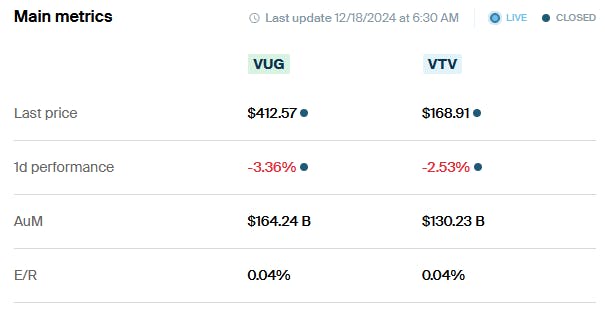
Trading costs are similarly minimal. VUG has a 30-day median bid-ask spread of 0.022%, while VTV is slightly tighter at 0.017%. The difference is negligible for most investors, making it a moot point here.
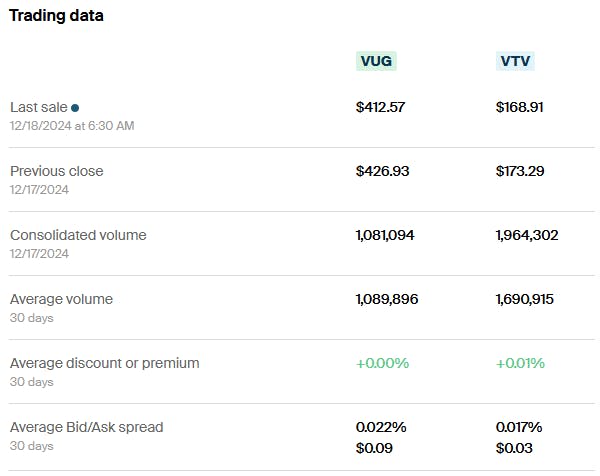
One notable factor, though, is tax efficiency. VTV has a higher trailing 12-month yield of 2.29%, compared to VUG’s much lower 0.46%. While this makes VTV more attractive for income-focused investors, it also creates more tax drag in taxable accounts.
Verdict: This would be a tie in most cases, but factoring in tax efficiency as part of total ownership costs pushes VUG ahead.
VUG vs VTV: Methodology and holdings
This is where VUG
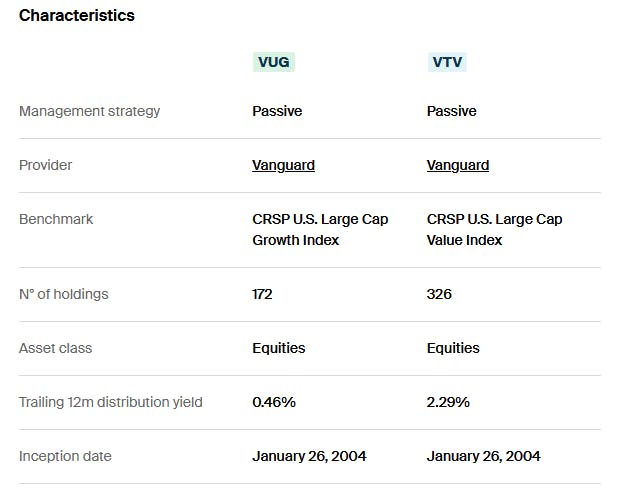
Starting with VUG, it tracks the CRSP U.S. Large Cap Growth Index, a benchmark of 172 holdings covering the largest 85% of cumulative capitalization in the CRSP U.S. Total Market.
Stocks here are definitively growth-focused, with an average P/E ratio of 39.7x, P/B ratio of 11.4x, return on equity (ROE) of 37%, and an earnings growth rate of 26.2%.
VTV, on the other hand, follows the CRSP U.S. Large Cap Value Index, also selecting from the top 85% of the U.S. market but prioritizing value stocks.
As a result, it trades at a much lower 21.3x P/E and 3x P/B ratio. However, these stocks also deliver a more modest 16% ROE and 11.1% earnings growth rate.
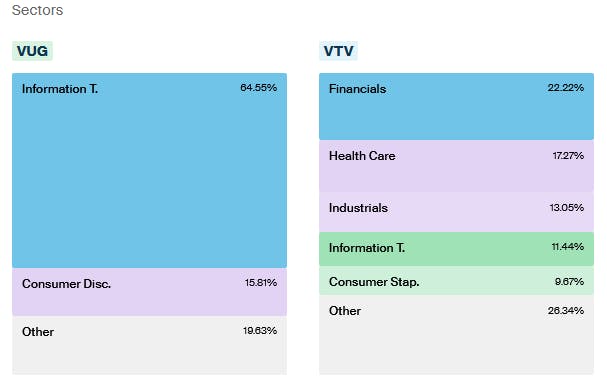
The sector composition is distinctly different: VUG is heavily overweighted in technology (64%), with consumer discretionary and communications trailing behind. VTV skews toward “old economy” sectors like financials, healthcare, and industrials.
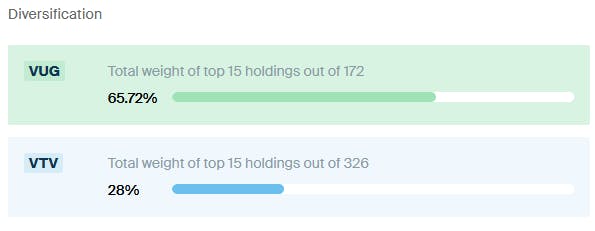
As expected, VUG is much more top-heavy. Its top 15 holdings account for 65% of the ETF’s weight, dominated by the “Magnificent Seven” stocks: Microsoft, Apple, Alphabet, Meta Platforms, Tesla, Amazon, and Nvidia.
By contrast, VTV is far more balanced, with its top 15 holdings making up just 28%. Its largest positions are more traditional, including Berkshire Hathaway, JPMorgan Chase, UnitedHealth, Exxon Mobil, Home Depot, Procter & Gamble, Walmart, and Johnson & Johnson.
Right now, the two portfolios share 24 overlapping holdings, representing 7.2% of VTV’s 340 holdings and 13.4% of VUG’s 186 holdings.
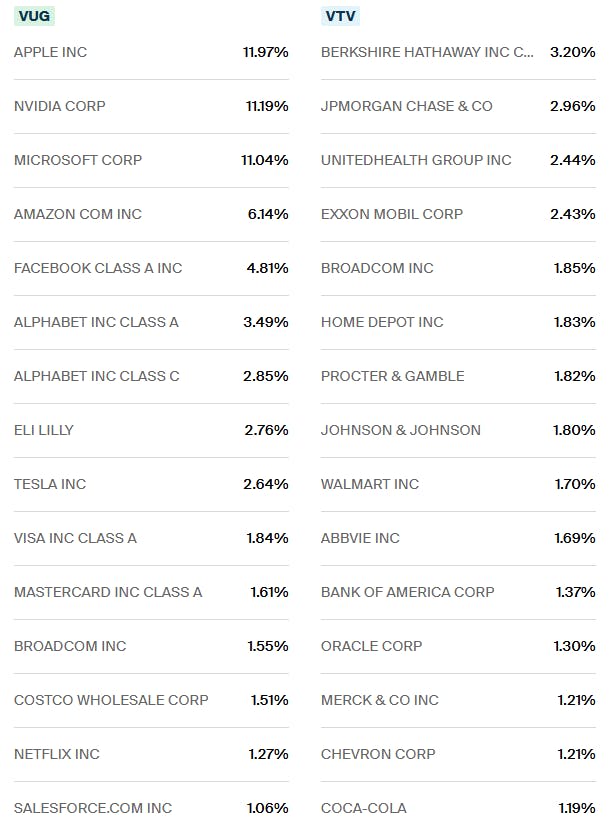
Verdict: It really depends on what you’re looking for. Personally, I’m not fond of tech concentration in indexes, so I would use VTV as a satellite allocation. But if you want to double down on tech and growth, VUG is a strong pick.
VUG vs VTV: Risk and return
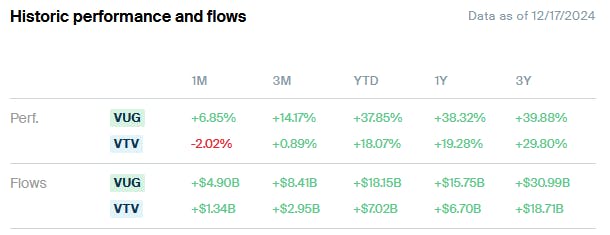
Given the dramatically different strategies of VUG and VTV, an apples-to-apples comparison isn’t entirely fair. Growth stocks have vastly outperformed value over the past decade, but let’s look at the numbers anyway.
Short term, VUG
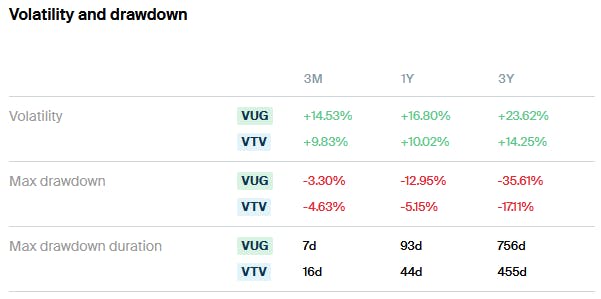
What about risk? Short term, VTV has been markedly less volatile than VUG and experienced smaller maximum drawdowns. It especially held up well during the 2022 bear market.
Long term, from Jan. 30, 2004, to Dec. 17, 2024, VUG has delivered a 12.06% compound annual growth rate (CAGR) compared to VTV’s 9.03%. But it also did better in terms of risk too.
Over the same backtest period, VUG had a maximum drawdown of 50.67%, while VTV saw a steeper 59.26% decline. Both have had similar volatility, but VUG has delivered the better risk-adjusted returns, with a Sharpe ratio of 0.59 versus VTV’s 0.47.
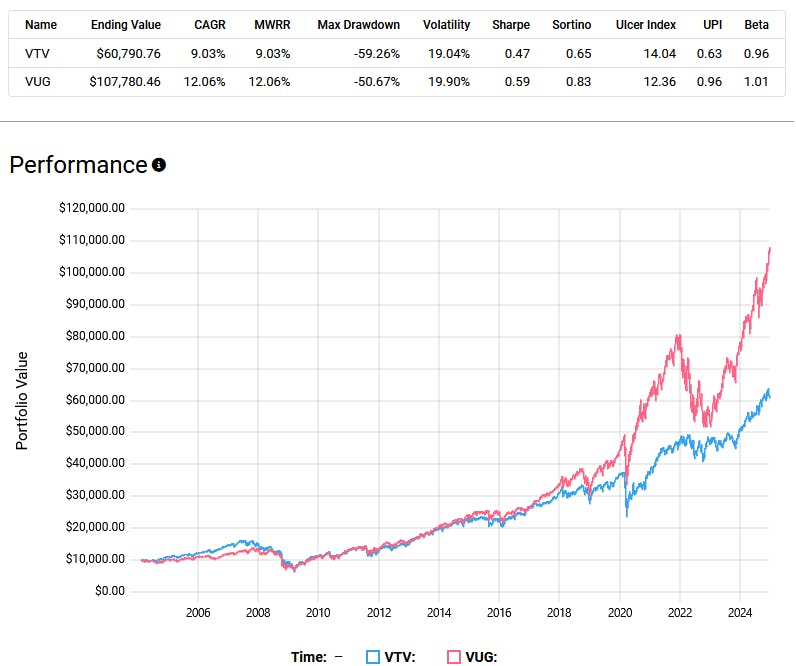
Verdict: Objectively, VUG has been the better performer. If you believe growth stocks will continue to lead, VUG is the way to go. However, if you’re a contrarian investor looking for a deal, VTV offers an attractive alternative.
This article is for informational purposes only and does not in any way constitute investment advice. The author may express their own opinions, which may not represent the opinions of ETF Central or its affiliated partners. It is essential that you seek advice from a registered financial professional prior to making any investment decisions.
Segments
See all
Mentioned ETFs
Further reading

Latest ETF News
See all ETF newsCould Water ETFs Be the Next AI Bottleneck Trade?

What is a Boomer Candy ETF?

ETF Comparison: NEOS Nasdaq-100 High Income ETF (QQQI) Versus Goldman Sachs Nasdaq-100 Premium Income ETF (GPIQ)





 Advantages of ETFs over Mutual Funds1/6
Lower Costs
In this guide, we'll explore the advantages of ETFs over mutual funds, giving you valuable insights into why ETFs have gained significant popularity among investors like yourself.
Leveraged ETFs: Unlocking the Potential for Amplified Returns1/6
Understanding Leveraged ETFs
Explore leveraged ETFs: potential for amplified returns & risks. 5 ETFs to consider across equities, commodities & fixed income.
What is a Leveraged ETF?1/6
Introducing Leveraged and Inverse ETFs
In this guide, we'll dive into the world of leveraged ETFs, exploring their definition, mechanics, potential risks, and rewards.
Recent educational content

ETF Trends
ETF Industry KPIs September 8, 2026
This week’s KPI data overview highlights key metrics and trends shaping the ETF landscape.

ETF Trends
ETF Industry KPIs August 31, 2026
This week’s KPI data overview highlights key metrics and trends shaping the ETF landscape.
ETF Trends
ETF Industry KPIs August 24, 2026
This week’s KPI data overview highlights key metrics and trends shaping the ETF landscape.
What’sTheFund
What's the Fund | Ocean Park Diversified Income ETF (DUKZ)
James St Aubin, Chief Investment Officer at Ocean Park Asset Management, discuss the DUKZ ETF, exposing investors to the whole spectrum of asset classes in the fixed income markets, through their rules-based process.

Browse all educational columns



Expert-Built ETF Portfolios, All in One Place
Don’t start from scratch. Discover ready-made ETF portfolios built by professionals to match different goals, timelines, and market views. Use them as inspiration or as a starting point for your own allocation.