Global ETF Survey Is Live! 600+ ETF Professionals Weigh In. See Results →



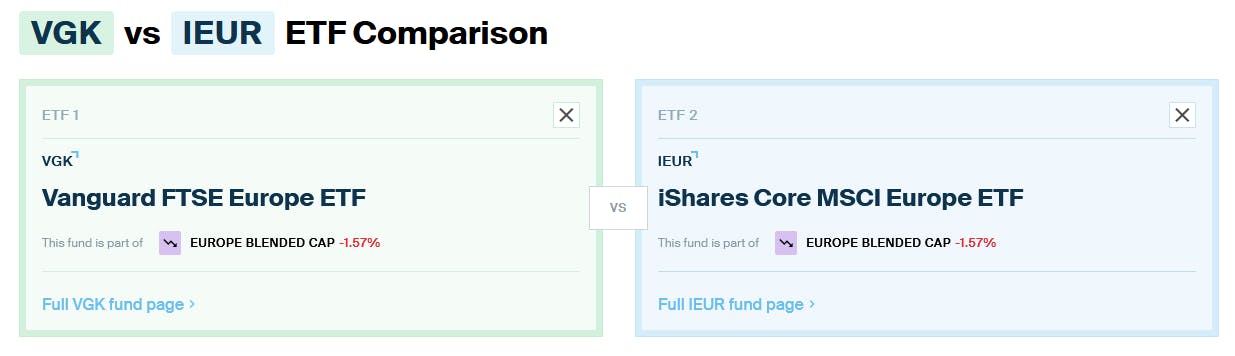
ETF Comparison: Vanguard FTSE Europe ETF (VGK) Versus iShares Core MSCI Europe ETF (IEUR)
Both low-cost passive ETFs provide exposure to broad European equities but do so via different benchmark indexes.

Keep up with what matters in ETFs
Get timely ETF insights, market trends, and top ideas straight to your inbox.
Your newsletter subscriptions with us are subject to ETF Central's Privacy Policy and Terms and Conditions.
International diversification is paying off in 2025. As Trump-era tariff threats send U.S. markets tumbling, European equities have held their ground.
A stronger sense of unity across the EU, alongside renewed investment in defense, manufacturing, and technology, has helped insulate the region from broader market volatility.
Investors are also starting to take notice of Europe’s much lower valuations, which have long been ignored in favor of pricier U.S. growth stocks. If you’re interested in European equities but want to reduce exposure to a rising U.S. dollar, check out our piece from on currency-hedged ETF options.
That being said, for low-cost, broadly diversified exposure to the region, U.S. investors largely gravitate towards the Vanguard FTSE Europe ETF
Global ETF Survey 2026 is Live!
With 1,790 new products launched by July 2026, choosing is harder than ever. Our Global ETF Survey 2026, built on 620 professional investors and allocators, shows how active, fixed income, options-based and thematic ETFs are reshaping fund selection.
VGK vs. IEUR: Total Cost of Ownership
VGK comes out ahead on explicit fees, charging 0.06% compared to IEUR’s 0.09%. On a $10,000 investment, that’s $6 versus $9 annually — not a dealbreaker, but VGK is objectively cheaper.
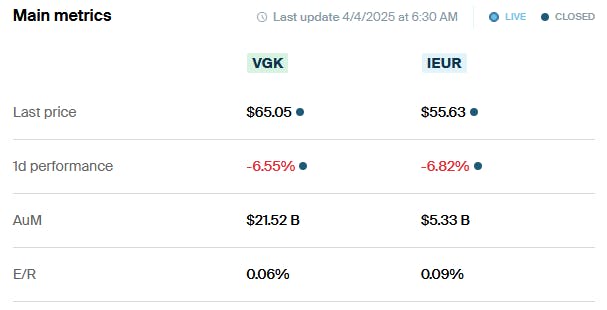
When it comes to implicit costs, VGK also leads. Its 30-day median bid-ask spread sits at just 0.015%, while IEUR’s is noticeably wider at 0.046%. That difference matters, especially for larger trades or frequent rebalancing, as wider spreads increase trading costs.
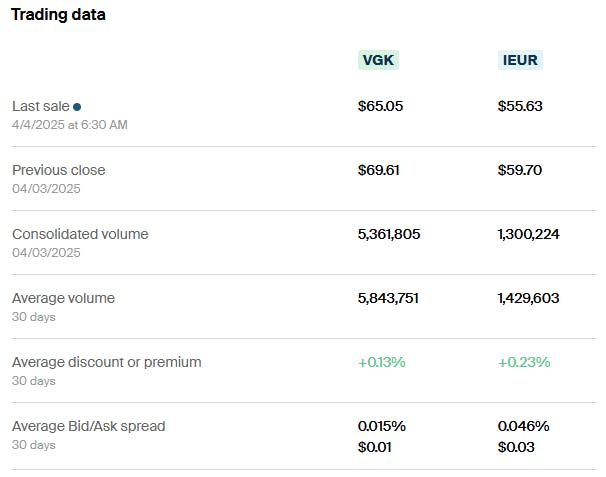
Verdict: Add the expense ratio and trading costs together, and VGK comes out as the lower-cost option. It’s cheaper to own and more efficient to trade.
VGK vs. IEUR: Methodology and Holdings
It’s not worth diving too deep into each ETF’s specific benchmark rules — in practice, the differences are minimal and inconsequential for investors.
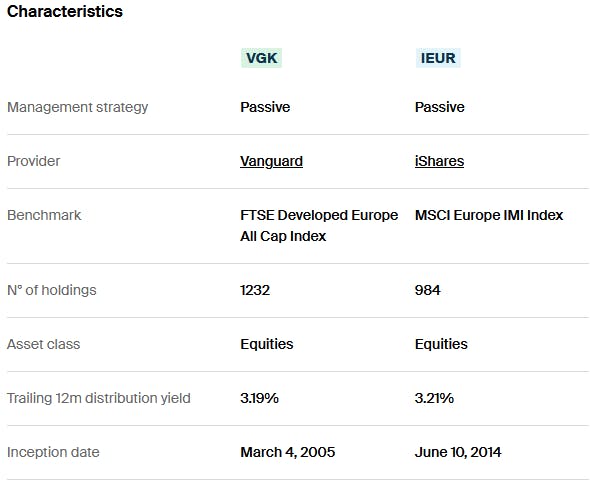
VGK
Yes, MSCI and FTSE sometimes differ on country and size classifications — for instance, FTSE considers South Korea developed while MSCI classifies it as emerging — but that’s irrelevant here.
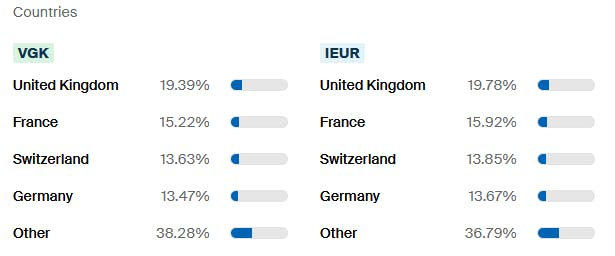
Both funds yield around 3% (VGK at 3.19%, IEUR at 3.21%) and concentrate most of their weight in the same countries: the U.K. (post-Brexit, no longer EU), France, Switzerland, and Germany.
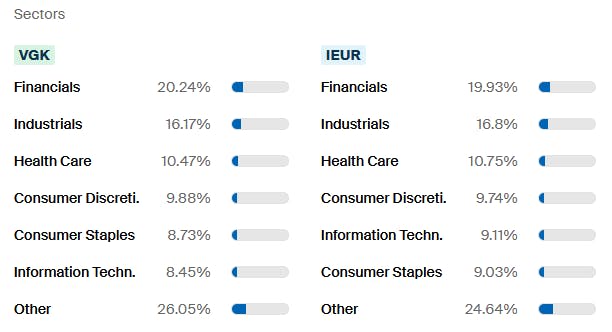
Sector exposures are also aligned, led by financials, industrials, healthcare, and consumer discretionary. Top holdings are familiar European multinationals like SAP, Novo Nordisk, Nestlé, AstraZeneca, Roche, Novartis, HSBC, Shell, LVMH, and Siemens.
Thanks to their broad diversification, neither ETF is top-heavy — less than 25% of total assets sit in the top 15 names, something that you don’t see for U.S. equity ETFs.
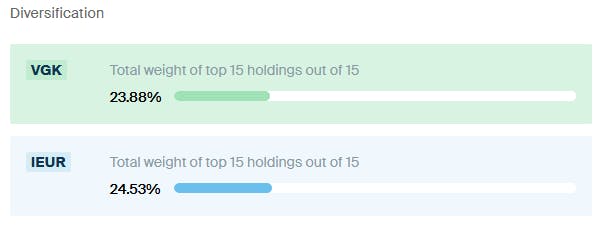
Verdict: It’s a wash — and pun fully intended. The two ETFs are nearly identical in sector, country, and stock exposure despite tracking different benchmarks, making them suitable tax-loss harvesting substitutes without triggering a wash sale.
VGK vs. IEUR: Risk and Return
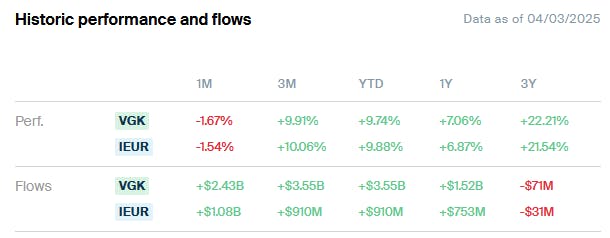
Short-term performance has been nearly identical. Over the past three years, one year, and year-to-date, VGK and IEUR have tracked within 1% of each other. Both ETFs have also attracted strong inflows as investors have finally started to appreciate Europe’s relative value.
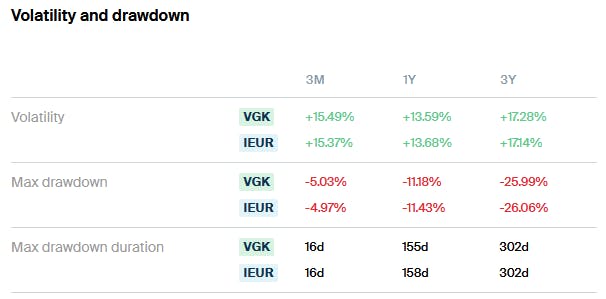
On the risk side, they’re just as close. Annualized volatility, max drawdown depth, and drawdown duration are virtually the same. It’s yet another sign that despite different benchmark providers, these ETFs behave almost identically — think Coca-Cola vs. Pepsi.
A longer-term backtest from June 12, 2014, to April 3, 2025, shows IEUR with a 4.60% CAGR and VGK just behind at 4.57%. Both posted a Sharpe ratio of 0.24 over that period, meaning they were identical on a risk-adjusted basis.
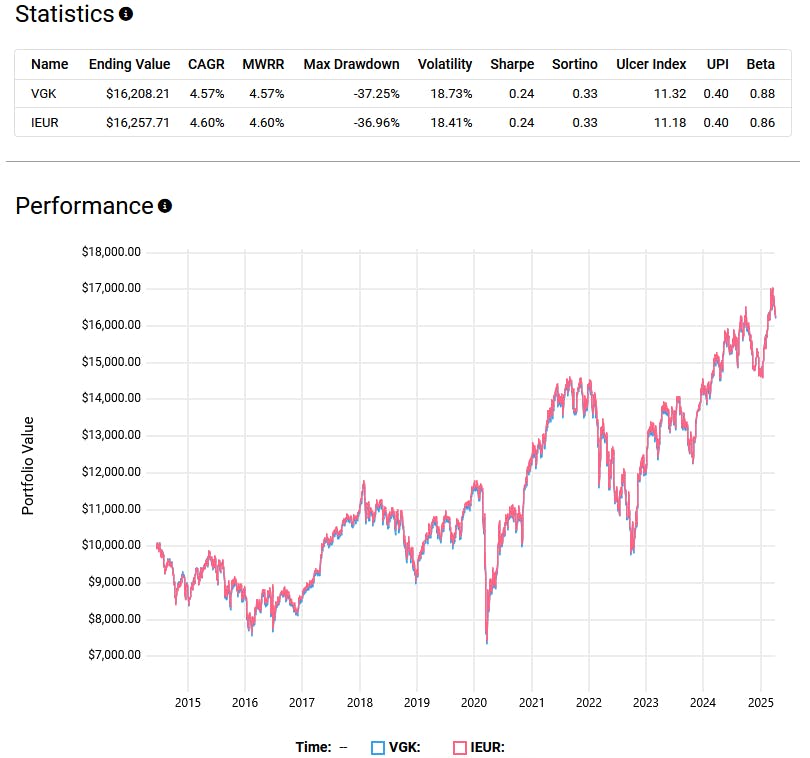
Verdict: Another tie. Flip a coin. You can expect these ETFs to deliver almost identical performance over time, barring a modest divergence of 100 basis points or less.
Please note that this article reflects the author’s personal views and does not represent the opinions of the publication or its affiliates. It is for informational purposes only and does not constitute investment advice. It is essential to seek guidance from a registered financial professional before making any investment decisions.


Latest ETF News
See all ETF newsBeyond Big Tech: The Increasing Specialization of AI ETFs

There's an ETF for That? Humanoid Robotics and Physical AI

How Some ETF Issuers Use Their Own Funds for Cash Management

These Public-Private ETFs Invest in Polymarket and Anduril

There's an ETF for That? Frontier Markets



 Advantages of ETFs over Mutual Funds1/6
Lower Costs
In this guide, we'll explore the advantages of ETFs over mutual funds, giving you valuable insights into why ETFs have gained significant popularity among investors like yourself.
Leveraged ETFs: Unlocking the Potential for Amplified Returns1/6
Understanding Leveraged ETFs
Explore leveraged ETFs: potential for amplified returns & risks. 5 ETFs to consider across equities, commodities & fixed income.
What is a Leveraged ETF?1/6
Introducing Leveraged and Inverse ETFs
In this guide, we'll dive into the world of leveraged ETFs, exploring their definition, mechanics, potential risks, and rewards.
Recent educational content

First Look ETF
First Look ETF: Income, International, and Cash Flow ETFs
In this season 6 episode of First Look ETF, Stephanie Stanton @etfguide examines the latest ETF marketplace trends with NYSE and guests.


ETF Trends
ETF Industry KPIs October 5, 2026
This week’s KPI data overview highlights key metrics and trends shaping the ETF landscape.

ETF Trends
ETF Industry KPIs September 28, 2026
This week’s KPI data overview highlights key metrics and trends shaping the ETF landscape.
ETF Trends
ETF Industry KPIs September 22, 2026
This week’s KPI data overview highlights key metrics and trends shaping the ETF landscape.