Global ETF Survey Is Live! 600+ ETF Professionals Weigh In. See Results →



Should You Hedge Currency Risk in European Equity ETFs?
Learn the pros and cons of currency-hedged vs. unhedged European equity ETFs and how exchange rates can impact your returns.


Keep up with what matters in ETFs
Get timely ETF insights, market trends, and top ideas straight to your inbox.
Your newsletter subscriptions with us are subject to ETF Central's Privacy Policy and Terms and Conditions.
One silver lining of the uncertainty stirred up by President Trump’s new round of tariffs has been the strong start to 2025 for international stocks—particularly in the Eurozone. With domestic equities under pressure, some investors are looking abroad for opportunity.
Still, skepticism lingers. After all, over the past decade, U.S. equities have soundly outperformed their European counterparts, leaving many investors cautious about venturing too far from home.
But here’s the thing: the performance gap between U.S. and European stocks wasn’t always about fundamentals. In many cases, it came down to one overlooked detail—whether or not your European equity ETF was currency-hedged.
Here’s a breakdown of the two approaches and how each has fared over the years.
Global ETF Survey 2026 is Live!
With 1,790 new products launched by July 2026, choosing is harder than ever. Our Global ETF Survey 2026, built on 620 professional investors and allocators, shows how active, fixed income, options-based and thematic ETFs are reshaping fund selection.
Unhedged European equity ETFs
Unhedged European equity ETFs remain the most popular and cost-effective option for investors seeking exposure to developed markets abroad.
Examples include the Vanguard FTSE Europe ETF
These ETFs offer broad diversification across hundreds—or in some cases, thousands—of market cap-weighted European stocks. They’re an easy and inexpensive way to gain international exposure. But there’s one important caveat: they do nothing to hedge foreign exchange (FX) risk.
Because the underlying securities are primarily priced in euros, but the ETFs themselves trade in U.S. dollars, currency fluctuations directly affect performance.
When the U.S. dollar strengthens relative to the euro, it reduces the value of those euro-denominated holdings when translated back into dollars—causing the ETF’s price to lag, even if European stocks themselves are rising in local terms.
However, the reverse is also true. If the dollar weakens against the euro, these ETFs can enjoy a tailwind from currency translation.
But over the last decade, the U.S. dollar has mostly held strong—thanks in part to its role as the world’s reserve currency and its tendency to attract flight-to-safety capital during times of global stress.
Until that paradigm shifts, unhedged European ETFs may continue to face a performance headwind—even when the underlying equities perform well in local markets.
Hedged European equity ETFs
The alternative to unhedged exposure comes in the form of currency-hedged European equity ETFs, such as the WisdomTree Europe Hedged Equity Fund
First, the cost. These funds are significantly more expensive than their unhedged counterparts. HEDJ carries an expense ratio of 0.58%, while DBEU charges 0.45%—several times the cost of ETFs like VGK, IEUR, or SPEU. They also differ in how they build their portfolios.
As expected from WisdomTree, HEDJ takes a fundamentally weighted approach, requiring that companies derive at least 50% of their revenue from exports outside Europe. Stocks are weighted based on cash dividends paid, with caps of 5% per stock, 25% per sector, and 25% per country. DBEU, by contrast, tracks a more traditional market-cap weighted index.
What both funds have in common is their currency hedge. They use derivatives—specifically forward contracts—to offset fluctuations between the euro and the U.S. dollar.
For example, DBEU’s benchmark, the MSCI Europe US Dollar Hedged Index, is 100% hedged to the U.S. dollar by selling each foreign currency forward at the one-month forward rate. That means for every euro of exposure, the fund enters a forward contract to sell euros and buy dollars one month out, resetting this hedge regularly.
Therefore, these ETFs won’t benefit if the dollar weakens, but they also avoid losses when the dollar strengthens. Over the past decade—an environment where the dollar has mostly been strong—hedged European equity ETFs have often outperformed their unhedged peers, simply by neutralizing a consistent headwind.
Which is better?
Looking at performance data from June 12, 2014 to March 31, 2025, currency-hedged ETFs like DBEU and HEDJ have significantly outperformed their unhedged counterparts—including VGK, IEUR, and SPEU—on both a total return and risk-adjusted basis.
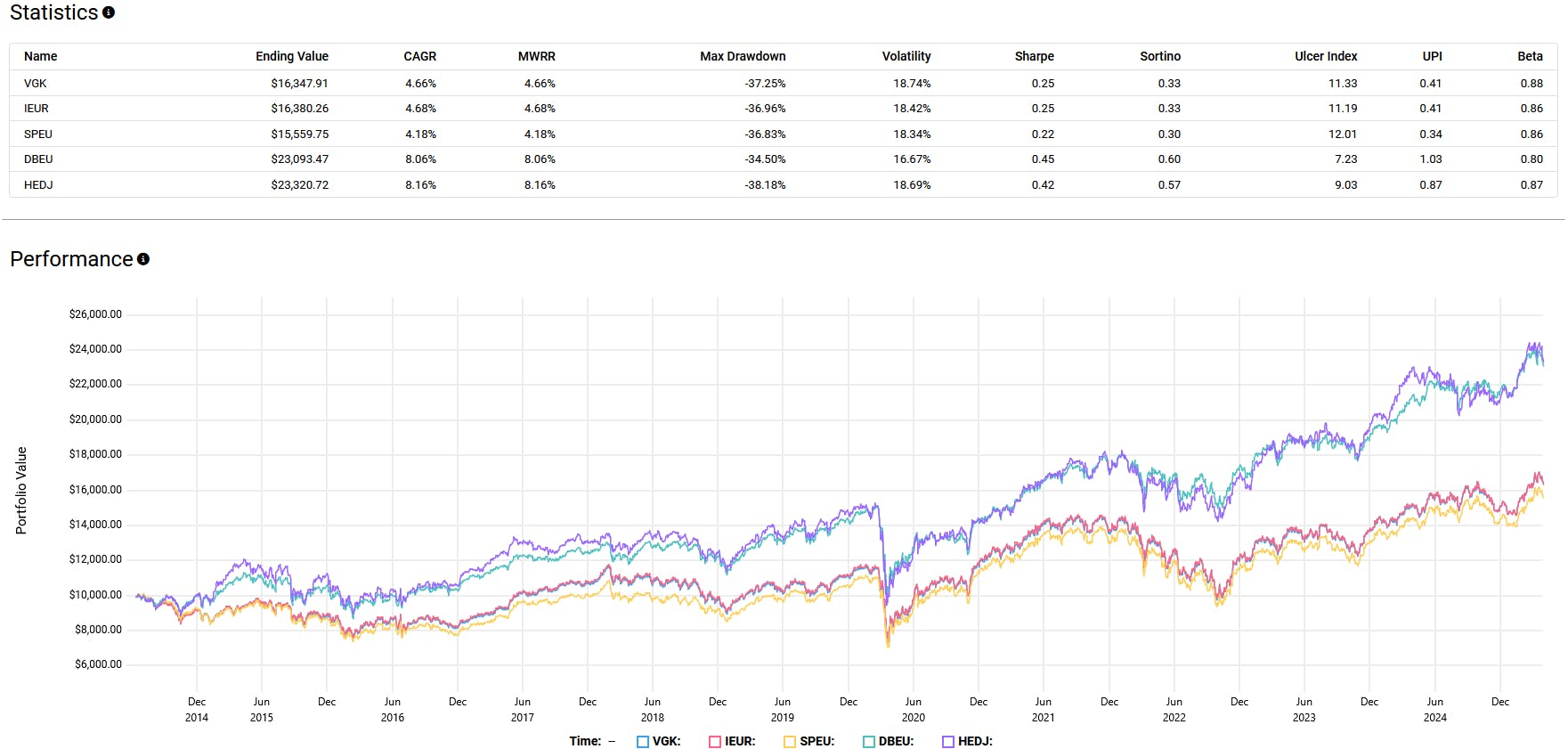
That outperformance is still evident when analyzing rolling return periods, which help smooth out the impact of isolated market events and reduce the timing bias that can skew point-to-point comparisons.
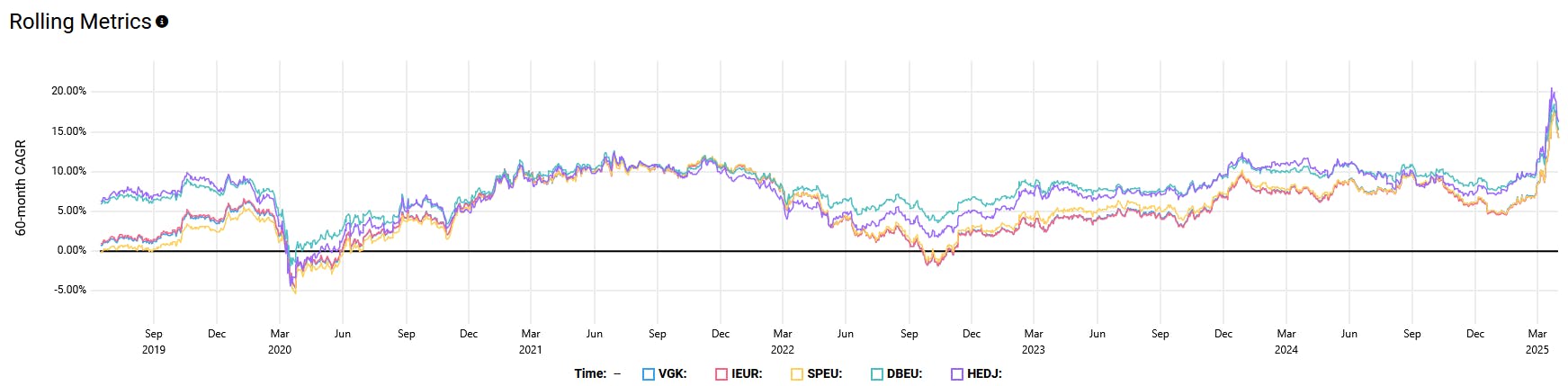
As for the future, it really comes down to your view on the U.S. dollar’s strength and persistence as the global reserve currency. But from a portfolio construction standpoint, the more practical approach may be this: buy the stock, not the currency.
If I’m investing in European companies, I want my returns to come from the performance of those businesses—not from unpredictable swings in exchange rates that offer no expected compensation for the added risk over time.
Even though hedged ETFs cost more, I’m willing to accept the higher expense ratio in exchange for peace of mind. Currency-hedged products let me focus on the fundamentals of the market I’m targeting, without second-guessing whether gains or losses are being driven by the euro-dollar exchange rate.
In short, whether the U.S. dollar rises or falls, I’d rather not have that blur the outcome of my international equity exposure.
This article is for informational purposes only and does not in any way constitute investment advice. The author may express their own opinions, which may not represent the opinions of ETF Central or its affiliated partners. It is essential that you seek advice from a registered financial professional prior to making any investment decisions.
Segments
See all
Mentioned ETFs
Further reading
Latest ETF News
See all ETF newsBeyond Big Tech: The Increasing Specialization of AI ETFs

There's an ETF for That? Humanoid Robotics and Physical AI

How Some ETF Issuers Use Their Own Funds for Cash Management

These Public-Private ETFs Invest in Polymarket and Anduril

There's an ETF for That? Frontier Markets



 Advantages of ETFs over Mutual Funds1/6
Lower Costs
In this guide, we'll explore the advantages of ETFs over mutual funds, giving you valuable insights into why ETFs have gained significant popularity among investors like yourself.
Leveraged ETFs: Unlocking the Potential for Amplified Returns1/6
Understanding Leveraged ETFs
Explore leveraged ETFs: potential for amplified returns & risks. 5 ETFs to consider across equities, commodities & fixed income.
What is a Leveraged ETF?1/6
Introducing Leveraged and Inverse ETFs
In this guide, we'll dive into the world of leveraged ETFs, exploring their definition, mechanics, potential risks, and rewards.
Recent educational content

First Look ETF
First Look ETF: Income, International, and Cash Flow ETFs
In this season 6 episode of First Look ETF, Stephanie Stanton @etfguide examines the latest ETF marketplace trends with NYSE and guests.


ETF Trends
ETF Industry KPIs October 5, 2026
This week’s KPI data overview highlights key metrics and trends shaping the ETF landscape.

ETF Trends
ETF Industry KPIs September 28, 2026
This week’s KPI data overview highlights key metrics and trends shaping the ETF landscape.
ETF Trends
ETF Industry KPIs September 22, 2026
This week’s KPI data overview highlights key metrics and trends shaping the ETF landscape.