Turn ETF ideas into real portfolios. Try the builder now →



ETF Comparison: Vanguard Dividend Appreciation ETF (VIG) Versus iShares Core Dividend Growth ETF (DGRO)
Vanguard and iShares' flagship dividend growth ETFs go head-to-head in this week's ETF comparison.

Keep up with what matters in ETFs
Get timely ETF insights, market trends, and top ideas straight to your inbox.
Your newsletter subscriptions with us are subject to ETF Central's Privacy Policy and Terms and Conditions.
The ETF rivalry between Vanguard and iShares is nothing short of legendary, with each firm boasting an extensive lineup that captures substantial attention from both retail investors and financial advisors.
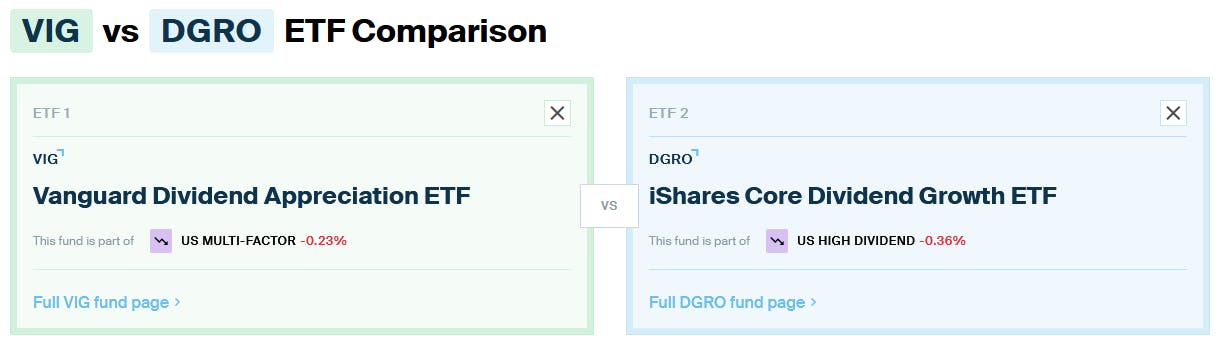
This week, we're doing a head-to-head comparison of their flagship dividend growth strategies: the Vanguard Dividend Appreciation ETF
Let's explore how these two giants stack up against each other, utilizing data from ETF Central's comparison tool.
Get data on 14,000+ ETFs
Access Trackinsight's reliable and comprehensive data with 500M+ points on 14,000+ ETFs.
VIG vs DGRO: Total cost of ownership
Both VIG and DGRO are known for their affordability, aligning with Vanguard's reputation for low-cost offerings and iShares' commitment to economical investments through its "Core" series.
When we look at the expense ratios, VIG charges a minimal 0.06%, which translates to just $6 per $10,000 invested annually, whereas DGRO has an expense ratio of 0.08%, or $8 per $10,000 invested per year.
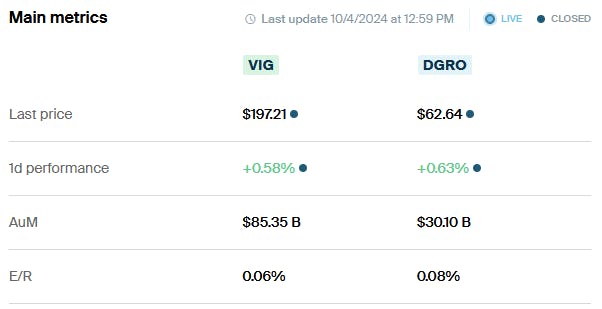
Turning to trading costs, both ETFs boast low 30-day median bid-ask spreads, with VIG at 0.024% and DGRO slightly lower at 0.021%.
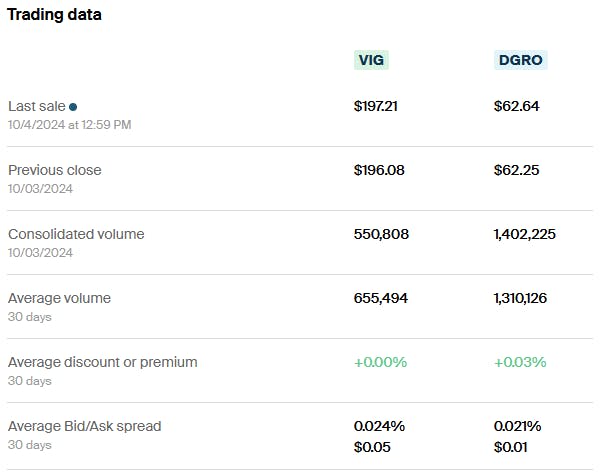
This makes for a tight competition in terms of total cost of ownership, but VIG just narrowly edges out DGRO in overall cost-effectiveness.
VIG vs DGRO: Methodology and holdings
The comparison between VIG and DGRO in methodology and holdings reveals distinct approaches to dividend growth investing.
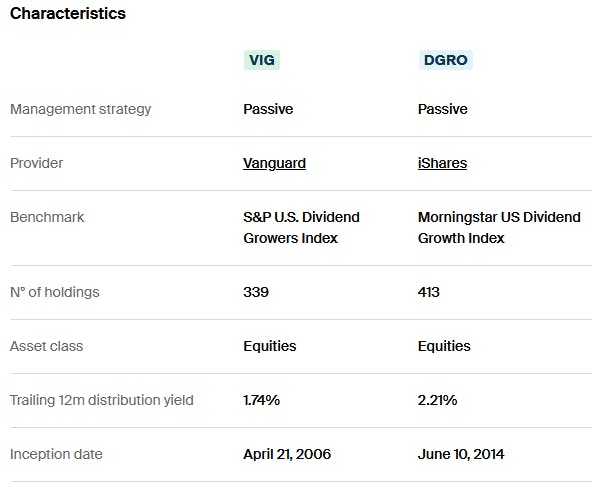
VIG tracks the S&P U.S. Dividend Growers Index, which has 339 holdings with a trailing 12-month yield of 1.74%. This index is strict about inclusion, requiring a 10-year history of dividend growth and excluding the top 25% highest-yielding companies, applying a market-cap weight with a 4% cap per stock, and eschewing REITs.
Contrastingly, DGRO follows the Morningstar US Dividend Growth Index with 413 holdings boasting a higher trailing yield of 2.21%. It requires a shorter history of dividend increases—only five years—and focuses on financial sustainability by excluding companies with a payout ratio over 75% and the highest 10% by dividend yield within its selection universe. Holdings are weighted by the total dollar value of dividends paid, not by yield, with a maximum of 3% per holding.
Both ETFs show similar sector focuses—technology, healthcare, and financials top the list, supplemented by industrials and consumer staples, excluding real estate.

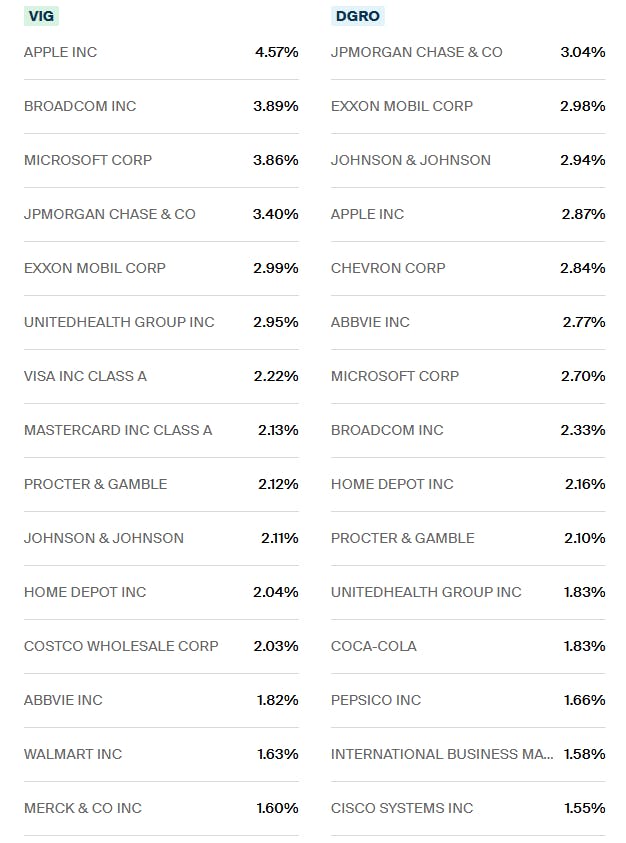
While VIG is slightly more concentrated with the top 15 holdings accounting for 39.36% compared to DGRO's 35.18%, both strategies offer diversified exposure to dividend growth stocks.

Their top holdings still overlap significantly, featuring major blue-chip names like Apple, Broadcom, Microsoft, Exxon Mobil, Procter & Gamble, and Home Depot.
VIG vs DGRO: Risk and return
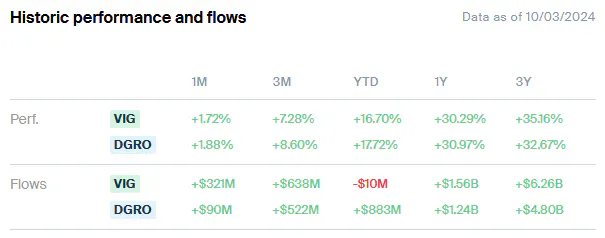
When examining risk and return profiles, both VIG and DGRO have demonstrated closely matched performance over the years, with investor interest slightly favoring VIG due to its slightly higher asset inflows.
Looking at a longer historical period from June 12, 2014, to October 3, 2024, DGRO slightly edges out VIG with a compound annual growth rate (CAGR) of 11.99% compared to VIG's 11.69%. However, when considering risk-adjusted returns, VIG takes a slight lead with a Sharpe ratio of 0.60 against DGRO's 0.59, indicating a marginally better return per unit of risk.

Both ETFs also show similar short-term risk metrics, including volatility levels and the depth and length of drawdowns. In other words, you would've experienced roughly the same risk holding either VIG or DGRO.
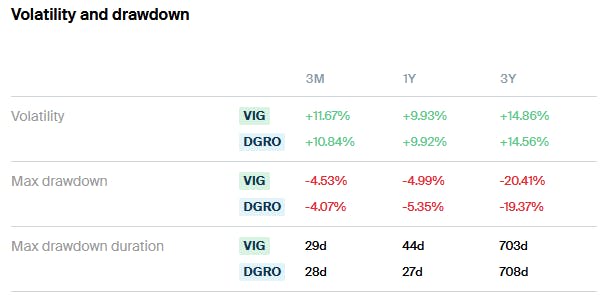
Ultimately, choosing between VIG and DGRO might boil down to a preference for their specific selection criteria and portfolio composition. Both ETFs offer robust, transparent, and objective approaches to dividend growth investing.
For those looking to optimize their portfolio management strategies, incorporating both and employing techniques like tax loss harvesting could be a strategic decision, leveraging the slight differences to enhance overall portfolio efficiency.
Please note this article is for information purposes only and does not in any way constitute investment advice. It is essential that you seek advice from a registered financial professional prior to making any investment decision.
Latest ETF News
See all ETF newsCould Water ETFs Be the Next AI Bottleneck Trade?

What is a Boomer Candy ETF?

ETF Comparison: NEOS Nasdaq-100 High Income ETF (QQQI) Versus Goldman Sachs Nasdaq-100 Premium Income ETF (GPIQ)





 Advantages of ETFs over Mutual Funds1/6
Lower Costs
In this guide, we'll explore the advantages of ETFs over mutual funds, giving you valuable insights into why ETFs have gained significant popularity among investors like yourself.
Leveraged ETFs: Unlocking the Potential for Amplified Returns1/6
Understanding Leveraged ETFs
Explore leveraged ETFs: potential for amplified returns & risks. 5 ETFs to consider across equities, commodities & fixed income.
What is a Leveraged ETF?1/6
Introducing Leveraged and Inverse ETFs
In this guide, we'll dive into the world of leveraged ETFs, exploring their definition, mechanics, potential risks, and rewards.
Recent educational content

ETF Trends
ETF Industry KPIs September 8, 2026
This week’s KPI data overview highlights key metrics and trends shaping the ETF landscape.

ETF Trends
ETF Industry KPIs August 31, 2026
This week’s KPI data overview highlights key metrics and trends shaping the ETF landscape.
ETF Trends
ETF Industry KPIs August 24, 2026
This week’s KPI data overview highlights key metrics and trends shaping the ETF landscape.
What’sTheFund
What's the Fund | Ocean Park Diversified Income ETF (DUKZ)
James St Aubin, Chief Investment Officer at Ocean Park Asset Management, discuss the DUKZ ETF, exposing investors to the whole spectrum of asset classes in the fixed income markets, through their rules-based process.

Browse all educational columns



Build and Analyze Your ETF Portfolio Like a Pro
Create your own ETF portfolio in minutes and instantly see allocations, exposures, performance, and risk. Visualize diversification across asset classes, regions, and sectors. Stress-test ideas, compare benchmarks, and refine your strategy with professional-grade analytics.