Global ETF Survey Is Live! 600+ ETF Professionals Weigh In. See Results →



ETF Comparison: Sprott Uranium Miners ETF (URNM) Versus VanEck Uranium + Nuclear Energy ETF (NLR)
Both ETFs provide exposure to the nuclear energy theme but with notable differences in terms of holdings and sector representation.

Keep up with what matters in ETFs
Get timely ETF insights, market trends, and top ideas straight to your inbox.
Your newsletter subscriptions with us are subject to ETF Central's Privacy Policy and Terms and Conditions.
One of the long-standing challenges in commodity investing is actually owning the commodity itself. Some assets, such as gold and silver, can be held directly and stored at home. Others, like crude oil and natural gas, are effectively inaccessible outside of futures markets.
Uranium sits at the more extreme end of that spectrum. For obvious regulatory and safety reasons, it is not something investors can buy and store themselves. While a small number of closed-end funds do hold physical uranium, most market participants gain exposure through uranium mining equities instead.
These companies offer operating leverage to uranium prices, but they also introduce equity risk, jurisdictional considerations, and company-specific execution factors. At the same time, uranium’s role in global electrification and long-term energy security has broadened the investment narrative. Uranium exposure is no longer limited to miners alone.
Nuclear power operators, equipment manufacturers, fuel processors, and related utilities increasingly form part of the theme, reflecting the growing focus on uranium as a stable, low-carbon power source. These businesses often fall outside the materials sector, landing instead in industrials and utilities.
That split in approach shows up clearly in today’s ETF comparison. We’ll look at two of the most notable NYSE-listed options: the Sprott Uranium Miners ETF
Global ETF Survey 2026 is Live!
With 1,790 new products launched by July 2026, choosing is harder than ever. Our Global ETF Survey 2026, built on 620 professional investors and allocators, shows how active, fixed income, options-based and thematic ETFs are reshaping fund selection.
URNM vs. NLR: Total Cost of Ownership
Neither of these ETFs would be considered inexpensive from a fee standpoint. URNM carries an expense ratio of 0.85%, while NLR charges 0.89%. On a $10,000 investment, that works out to roughly $85 per year in fees for URNM versus $89 for NLR. The difference is marginal, but if you look at expense ratio alone, URNM has a slight edge.
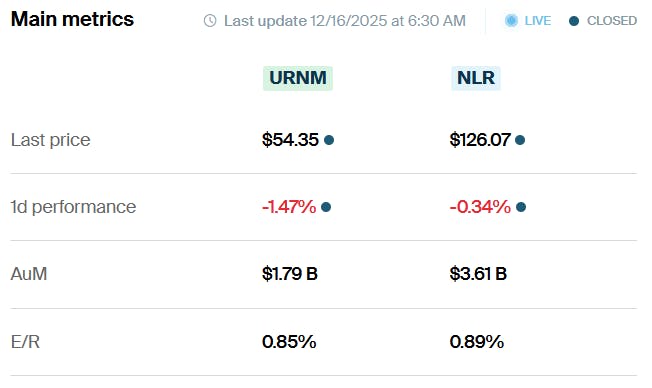
Expense ratios, however, are only part of the cost equation. Trading costs also matter, particularly the bid-ask spread. Using the 30-day average, URNM
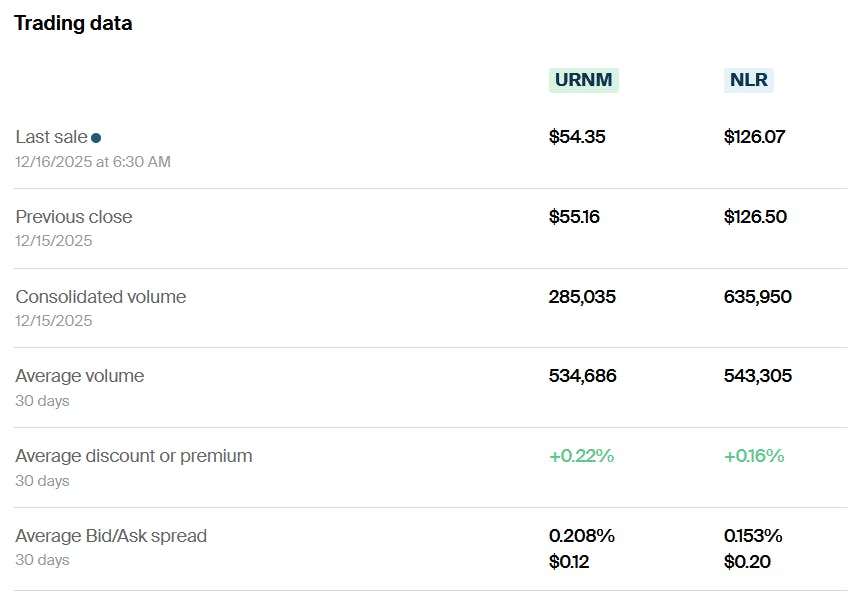
Verdict: When you combine both elements, the picture evens out. URNM is marginally cheaper on ongoing fees, while NLR is marginally cheaper to trade. Adding those together, the total cost of ownership is effectively a tie. Neither ETF is cheap, and the difference between them comes down to a basis point or two rather than a clear cost advantage.
URNM vs. NLR: Methodology and Exposure
This is where the differences between the two ETFs become much clearer. Both URNM and NLR are passive ETFs. Neither relies on discretionary stock picking or a portfolio manager’s judgment. Instead, each tracks a rules-based index, which means outcomes are driven largely by index construction and inclusion criteria rather than active views.
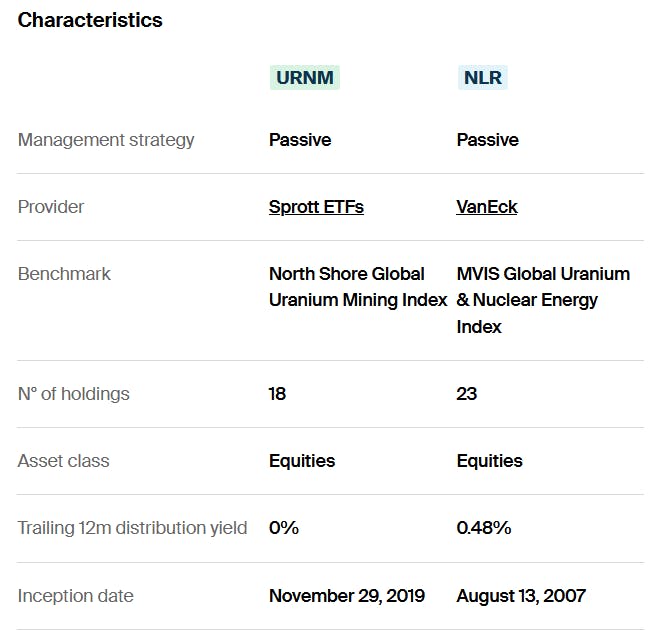
URNM
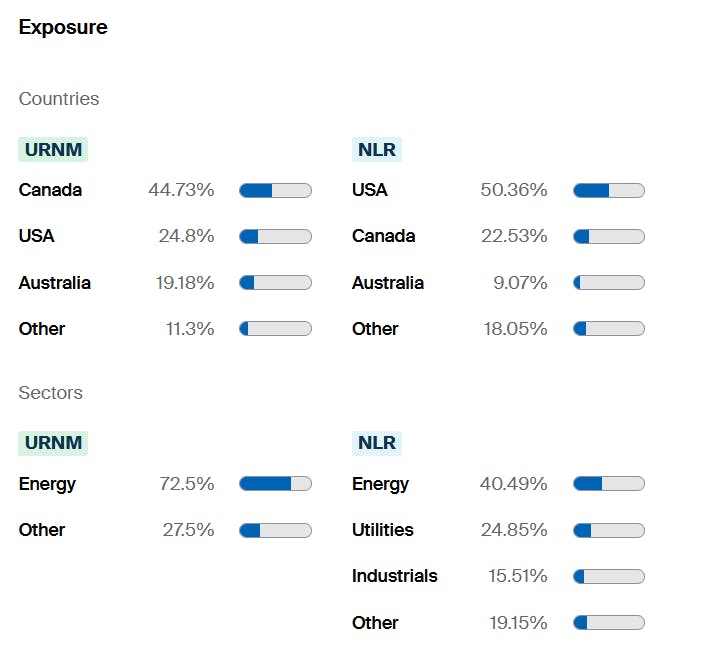
Beyond Canada, URNM has meaningful exposure to the United States at roughly 25% and Australia at around 20%, reflecting the importance of those regions in uranium mining and development. From a sector perspective, URNM is overwhelmingly tilted toward energy, as uranium itself is not a formal sector but is captured through mining and fuel production companies.
NLR
Sector exposure is more diversified as well. While energy still accounts for about 40%, utilities represent roughly 25% of the portfolio and industrials around 15%, intentionally expanding the scope beyond uranium mining alone.
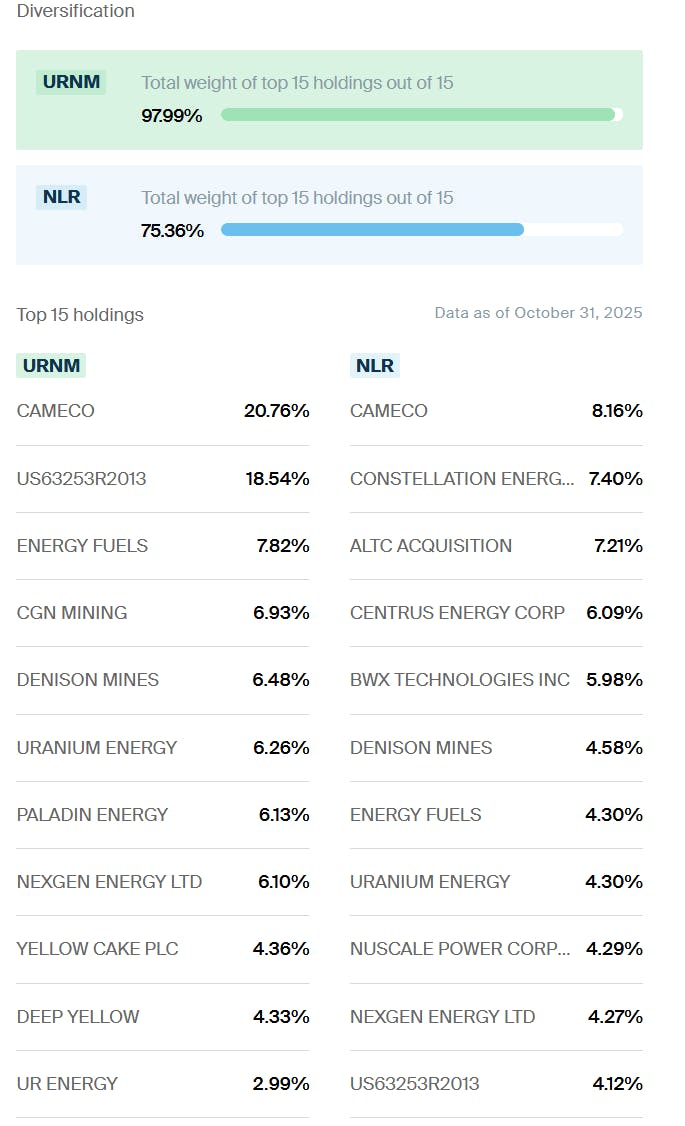
That difference is most apparent when you look at the top holdings. URNM is effectively a pure-play uranium mining ETF. Its largest position is Cameco, the world’s leading uranium producer, followed by a substantial allocation of roughly 18% to the Sprott Physical Uranium Trust, which introduces a degree of spot-price sensitivity to balance out miner-specific risks.
Beyond that, the portfolio consists largely of uranium miners and developers such as Energy Fuels, Denison Mines, and Paladin Energy across Canada and Australia.
NLR, while also holding Cameco as its largest position, is far less concentrated, with Cameco representing just over 8% of the fund. The next largest holdings include nuclear-focused utilities such as Constellation Energy, as well as industrial companies like BWX Technologies, which manufactures nuclear components and fuel systems for both civilian power generation and defense applications.
These businesses benefit from nuclear demand without being directly tied to uranium prices, adding a different risk and return profile to the portfolio.
The concentration gap between the two ETFs is significant. In URNM, the top 15 holdings account for nearly 98% of the portfolio, making performance heavily dependent on a small group of companies. In NLR, the top 15 holdings represent about 75%, providing broader diversification across business models and revenue drivers.
Verdict: While URNM offers amplified exposure to uranium prices through miners and physical holdings, it is also far more concentrated NLR’s broader exposure across miners, utilities, and nuclear infrastructure creates a more balanced way to access the uranium and nuclear energy theme. For investors looking beyond pure commodity sensitivity and toward a more diversified expression of long-term nuclear adoption, I think NLR is the more attractive option.
URNM vs. NLR: Risk and Return
Uranium has been in what many investors would describe as a supercycle, supported by several structural tailwinds.
Rising electricity demand tied to AI and data centers, renewed focus on energy security in Europe following the war in Ukraine, and a more supportive policy environment for nuclear power have all helped push uranium prices to new highs.
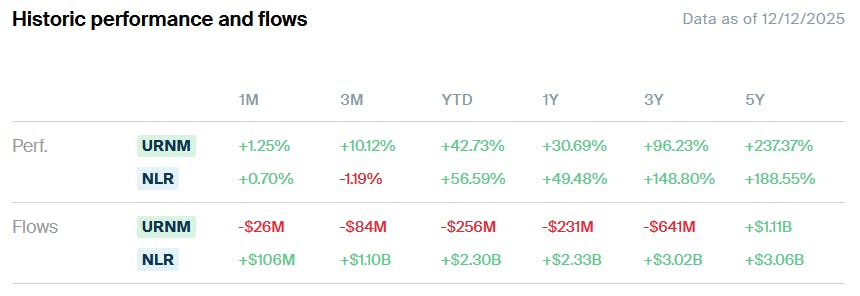
Against that backdrop, it is not surprising that both URNM and NLR have delivered strong near-term performance, but looking across trailing periods, performance leadership has rotated.
Over the past five years, URNM comes out ahead, reflecting its heavier exposure to uranium miners during earlier phases of the cycle. Over the three-year period, however, NLR has taken the lead. Over shorter horizons, including one year and year-to-date, the two ETFs have continued to trade places, underscoring how sensitive returns are to shifts in sentiment, pricing, and positioning within the nuclear value chain.
Fund flows tell a similar story. Both ETFs have attracted net inflows over the full five-year window, but over the past three years, one year, and year-to-date, URNM has experienced periods of outflows while NLR has continued to gather assets and has grown meaningfully in size.
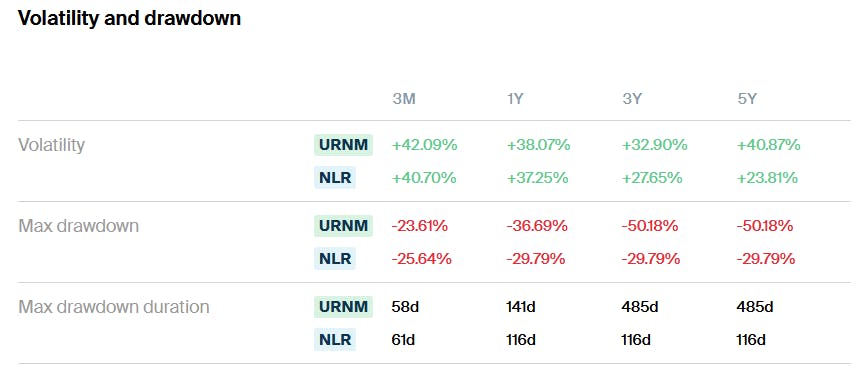
On the risk side, the differences are more consistent. Both ETFs are volatile, as expected for a theme tied to a single commodity and a capital-intensive industry. That said, URNM
Uranium miners exhibit operating leverage, meaning changes in uranium prices tend to translate into amplified swings in earnings and equity prices. When prices rise, miners can outperform dramatically, but when prices fall, losses are often magnified. That dynamic shows up in the data. Across five-, three-, and one-year periods, URNM has exhibited higher volatility than NLR
Maximum drawdowns tell an even clearer story. Over both the five- and three-year windows, URNM experienced peak-to-trough losses approaching 50%, nearly double the drawdowns observed in NLR. Those drawdowns also lasted much longer, with recovery periods stretching as long as 485 days for URNM compared with roughly 116 days for NLR.
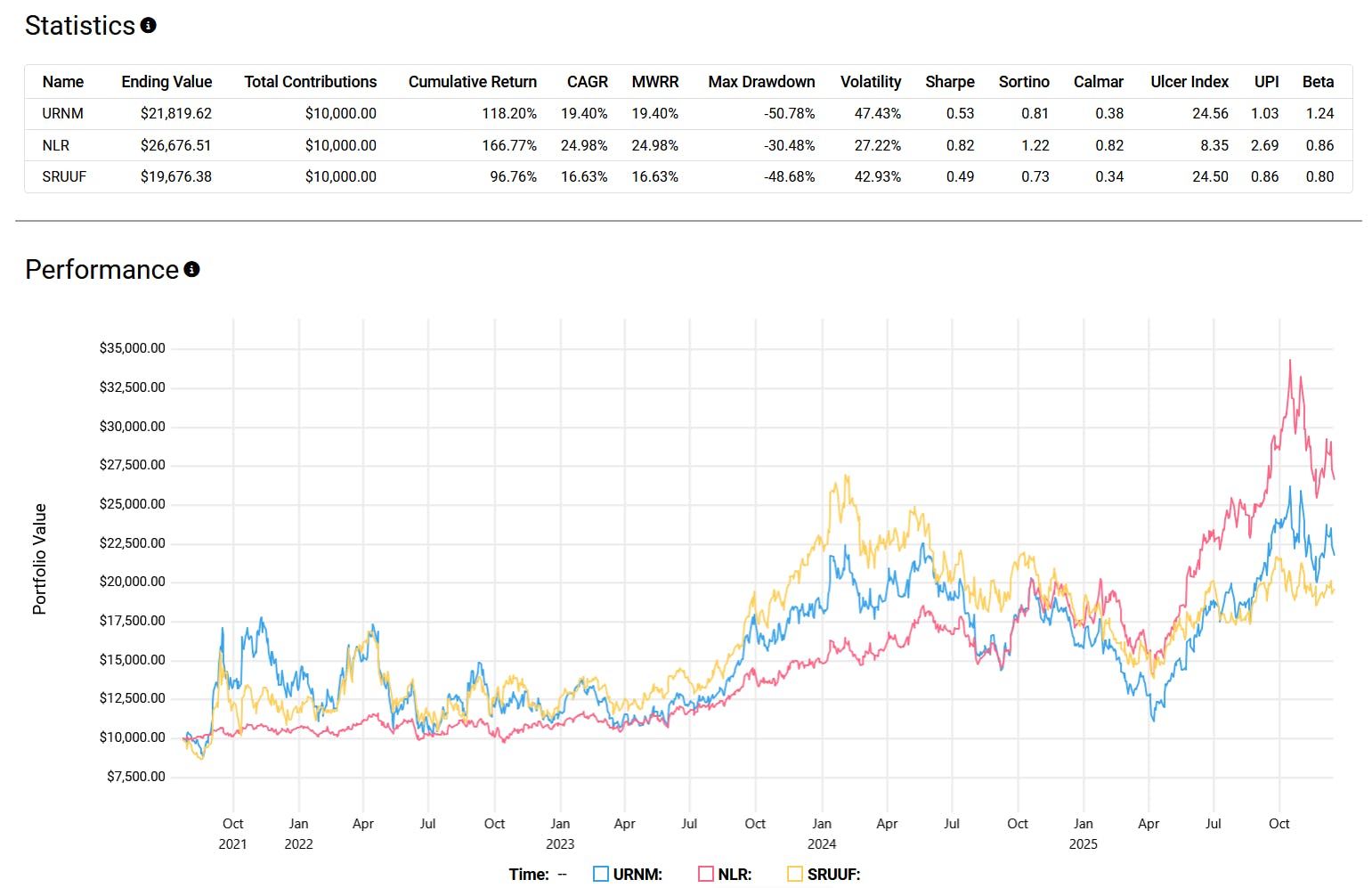
A longer backtest from July 22, 2021, to December 15, 2025, covering approximately 4.4 years, reinforces that distinction. Over that period, NLR delivered a higher cumulative return, a higher annualized return, lower volatility, and a smaller maximum drawdown, resulting in a superior risk-adjusted profile relative to URNM.
It is also worth noting that during this cycle, both URNM and NLR outperformed spot uranium exposure as measured by the Sprott Physical Uranium Trust. That outcome is typical in an upcycle, as equities tied to production, generation, and infrastructure tend to benefit from operating leverage and expanding margins when underlying commodity prices rise.
Verdict: While URNM
Please note this article is for information purposes only and does not in any way constitute investment advice. It is essential that you seek advice from a registered financial professional prior to making any investment decision.

Latest ETF News
See all ETF newsBeyond Big Tech: The Increasing Specialization of AI ETFs

There's an ETF for That? Humanoid Robotics and Physical AI

How Some ETF Issuers Use Their Own Funds for Cash Management

These Public-Private ETFs Invest in Polymarket and Anduril

There's an ETF for That? Frontier Markets



 Advantages of ETFs over Mutual Funds1/6
Lower Costs
In this guide, we'll explore the advantages of ETFs over mutual funds, giving you valuable insights into why ETFs have gained significant popularity among investors like yourself.
Leveraged ETFs: Unlocking the Potential for Amplified Returns1/6
Understanding Leveraged ETFs
Explore leveraged ETFs: potential for amplified returns & risks. 5 ETFs to consider across equities, commodities & fixed income.
What is a Leveraged ETF?1/6
Introducing Leveraged and Inverse ETFs
In this guide, we'll dive into the world of leveraged ETFs, exploring their definition, mechanics, potential risks, and rewards.
Recent educational content

First Look ETF
First Look ETF: Income, International, and Cash Flow ETFs
In this season 6 episode of First Look ETF, Stephanie Stanton @etfguide examines the latest ETF marketplace trends with NYSE and guests.


ETF Trends
ETF Industry KPIs October 5, 2026
This week’s KPI data overview highlights key metrics and trends shaping the ETF landscape.

ETF Trends
ETF Industry KPIs September 28, 2026
This week’s KPI data overview highlights key metrics and trends shaping the ETF landscape.
ETF Trends
ETF Industry KPIs September 22, 2026
This week’s KPI data overview highlights key metrics and trends shaping the ETF landscape.