Keep tabs on your favorite ETFs with a personalized weekly tracker. Create a Watchlist now →



ETF Comparison: Schwab U.S. Dividend Equity ETF (SCHD) Versus Vanguard Dividend Appreciation ETF (VIG)
Two of the largest and most popular low-cost dividend ETFs go head-to-head for this week's ETF comparison.

Keep up with what matters in ETFs
Get timely ETF insights, market trends, and top ideas straight to your inbox.
Your newsletter subscriptions with us are subject to ETF Central's Privacy Policy and Terms and Conditions.
I'm a big fan of low-cost dividend ETFs, not necessarily for the dividend payments themselves but for their capacity to provide affordable factor exposure and a shift away from the typical market-cap weighted indexes. In the vast sea of choices within this space, a few names stand out.
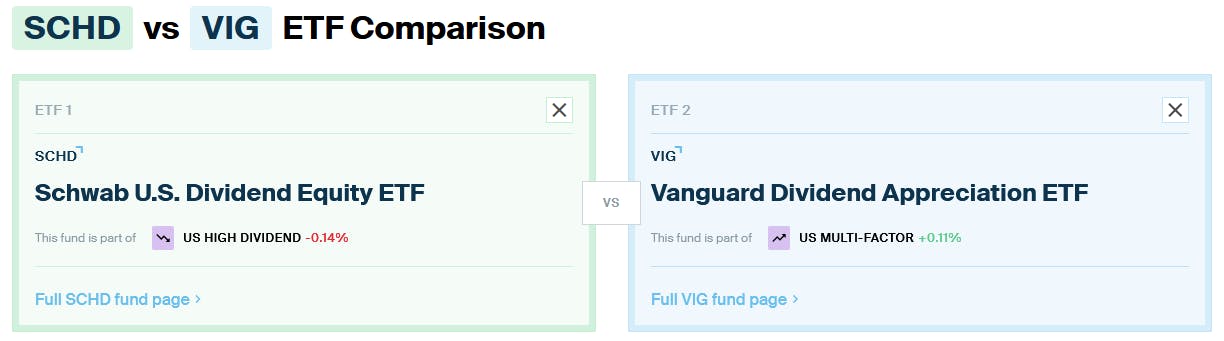
Today, we're sizing up two giants: the Schwab U.S. Dividend Equity ETF
Like what you're reading?
Stay in the loop — get the latest ETF insights: trends, analysis, and expert picks.
SCHD vs VIG: Total cost of ownership
Both SCHD and VIG boast incredibly low expense ratios of 0.06%, translating to just $6 in annual fees on a $10,000 investment—a cost-effective choice for dividend seekers.
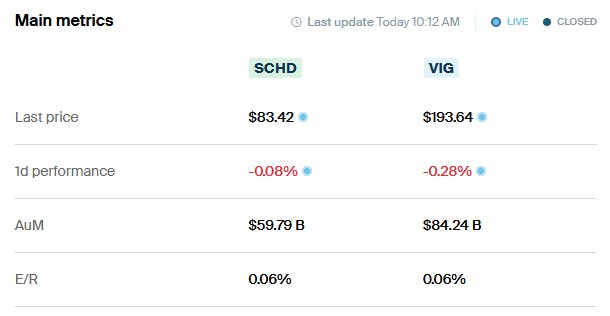
When it comes to trading costs, both ETFs are competitive in terms of bid-ask spreads. SCHD shows an average spread of $0.02, or 0.018%, while VIG's spread is slightly wider at $0.04, equating to 0.023%.
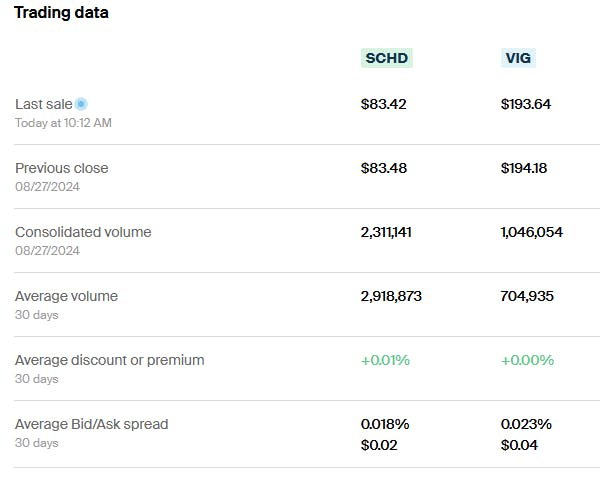
Overall, while SCHD appears marginally cheaper when combining expense ratios and trading spreads, the difference is minimal. Both ETFs stand out as cost-effective and highly liquid options, making them ideal for buy-and-hold investors focused on dividends.
SCHD vs VIG: Methodology and holdings
This is where the two ETFs start to show their distinct strategies, driven by their respective benchmarks. SCHD follows the Dow Jones U.S. Dividend 100 Index, while VIG is pegged to the S&P U.S. Dividend Growers Index.
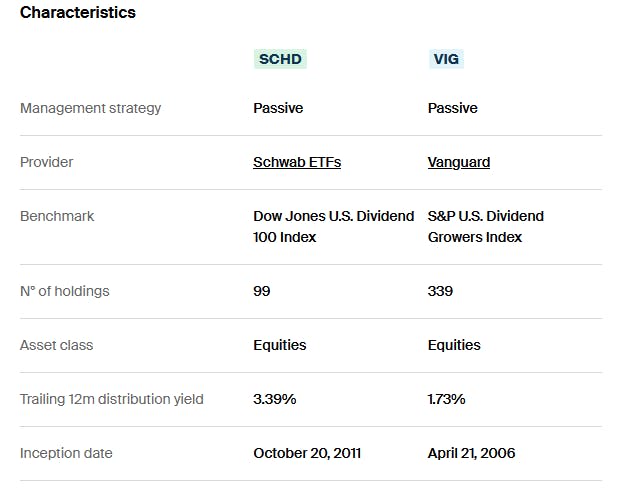
SCHD's selection process is multifaceted: it requires stocks to have a minimum 10-year streak of paying dividends and sufficient liquidity in terms of float-adjusted market cap and daily trading volume. The ETF then uses a fundamental indexing approach, ranking eligible stocks based on a composite score that evaluates annual yield, free cash flow to total debt, return on equity, and five-year dividend growth rate.
VIG, in contrast, filters its holdings by looking for companies that have increased dividends for at least 10 years. It then removes the top 25% of these stocks based on dividend yield to avoid potential yield traps, ensuring a focus on sustainable dividend growth rather than just high payouts. The remaining companies are market-cap weighted with a 4% cap on any single stock.
These methodologies influence the sector exposure of each ETF: SCHD leans towards sectors like financials, healthcare, consumer staples, and energy—typically associated with higher dividend yields. VIG's holdings more closely resemble the broader S&P 500's sector breakdown, with significant allocations to technology, financials, and healthcare.
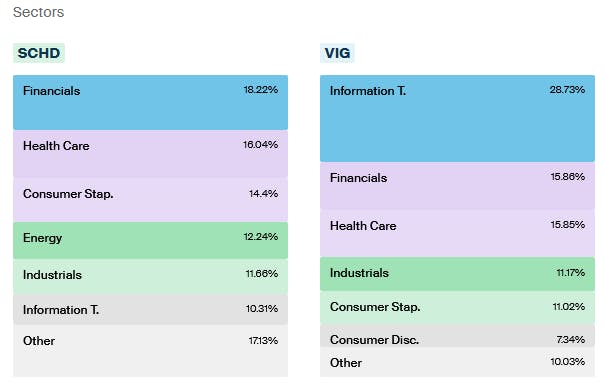
In terms of holdings, SCHD tends to favor large-cap companies that are major dividend payers with value characteristics. VIG offers a more diversified blend, including some growth-oriented stocks.
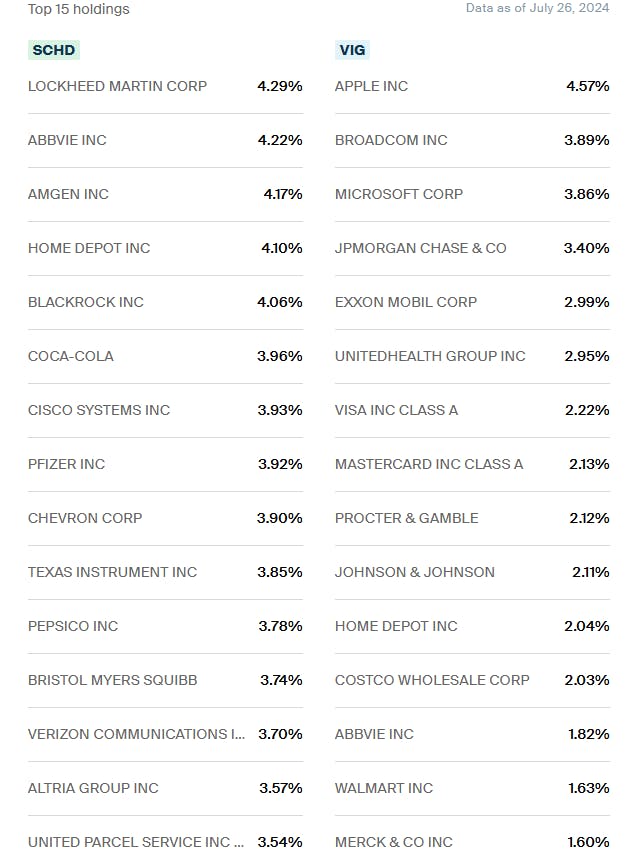
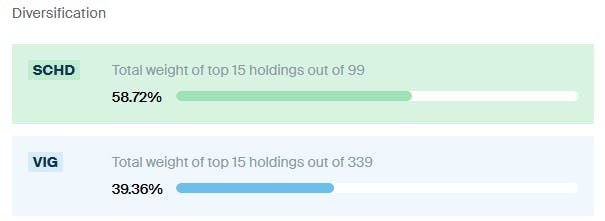
Consequently, SCHD's portfolio is more concentrated, with the top 15 holdings accounting for 58.72% of its assets compared to VIG's 39.36%.
A factor analysis shows that SCHD’s methodology exhibits significant exposure to the value (HML), profitability (RMW), and investment (CMA) factors, aligning it with specific investment styles. Meanwhile, VIG primarily aligns with the profitability and investment factors, lacking the pronounced value tilt seen in SCHD.

SCHD vs VIG: Risk and return
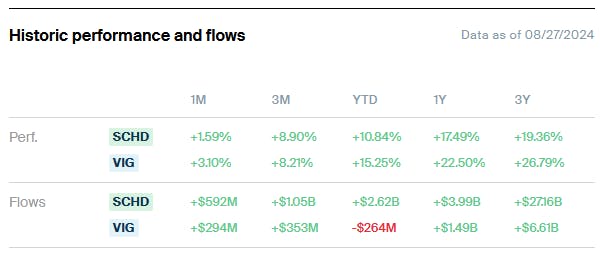
In recent years, VIG has outperformed SCHD, primarily due to its heavier allocation to tech stocks, which have seen significant gains. However, SCHD has attracted more investor interest over the past year, as evidenced by higher net inflows, suggesting that many value its approach during uncertain market conditions.
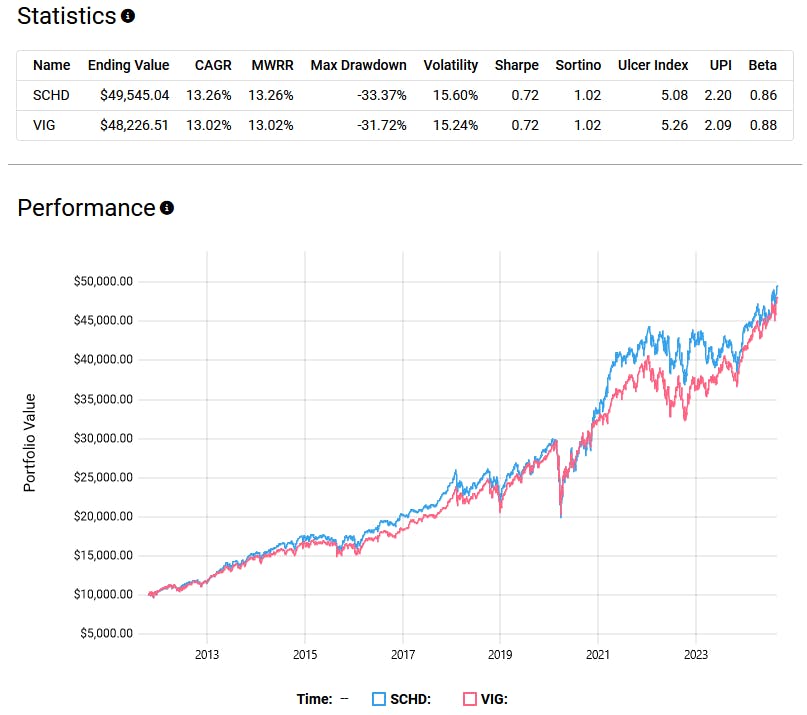
Looking at long-term performance, SCHD has a slight edge with a compound annual growth rate (CAGR) of 13.26%, compared to VIG's 13.02%, and both ETFs share identical Sharpe ratios of 0.72. SCHD particularly stood out in 2022 when it experienced less severe declines than VIG, though VIG has nearly closed that gap recently.
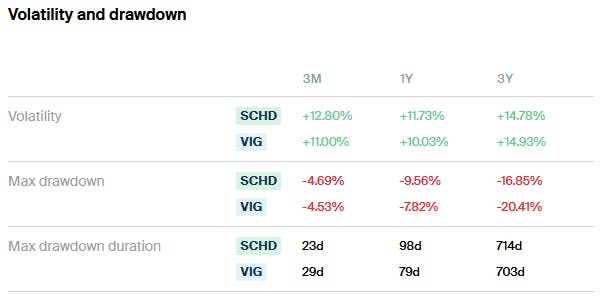
From a risk perspective, SCHD shows a bit more volatility with a higher standard deviation and maximum drawdown duration. This increased volatility is largely due to its concentration in value stocks, which can fall out of favor quickly and dramatically depending on market trends.
Personally, I like VIG as a "core" holding within a dividend-oriented ETF portfolio due to its broader holdings and sector alignment with the S&P 500, including growth stocks which provide more balanced exposure as opposed to most dividend ETFs that tilt value.
SCHD, on the other hand, serves well as a satellite position, offering a tilt towards large-cap quality stocks with value characteristics and a higher yield, making it a potent complement to a well-rounded investment strategy.
Please note this article is for information purposes only and does not in any way constitute investment advice. It is essential that you seek advice from a registered financial professional prior to making any investment decision.
Latest ETF News
See all ETF newsCould Water ETFs Be the Next AI Bottleneck Trade?

What is a Boomer Candy ETF?

ETF Comparison: NEOS Nasdaq-100 High Income ETF (QQQI) Versus Goldman Sachs Nasdaq-100 Premium Income ETF (GPIQ)





 Advantages of ETFs over Mutual Funds1/6
Lower Costs
In this guide, we'll explore the advantages of ETFs over mutual funds, giving you valuable insights into why ETFs have gained significant popularity among investors like yourself.
Leveraged ETFs: Unlocking the Potential for Amplified Returns1/6
Understanding Leveraged ETFs
Explore leveraged ETFs: potential for amplified returns & risks. 5 ETFs to consider across equities, commodities & fixed income.
What is a Leveraged ETF?1/6
Introducing Leveraged and Inverse ETFs
In this guide, we'll dive into the world of leveraged ETFs, exploring their definition, mechanics, potential risks, and rewards.
Recent educational content

ETF Trends
ETF Industry KPIs September 8, 2026
This week’s KPI data overview highlights key metrics and trends shaping the ETF landscape.

ETF Trends
ETF Industry KPIs August 31, 2026
This week’s KPI data overview highlights key metrics and trends shaping the ETF landscape.
ETF Trends
ETF Industry KPIs August 24, 2026
This week’s KPI data overview highlights key metrics and trends shaping the ETF landscape.
What’sTheFund
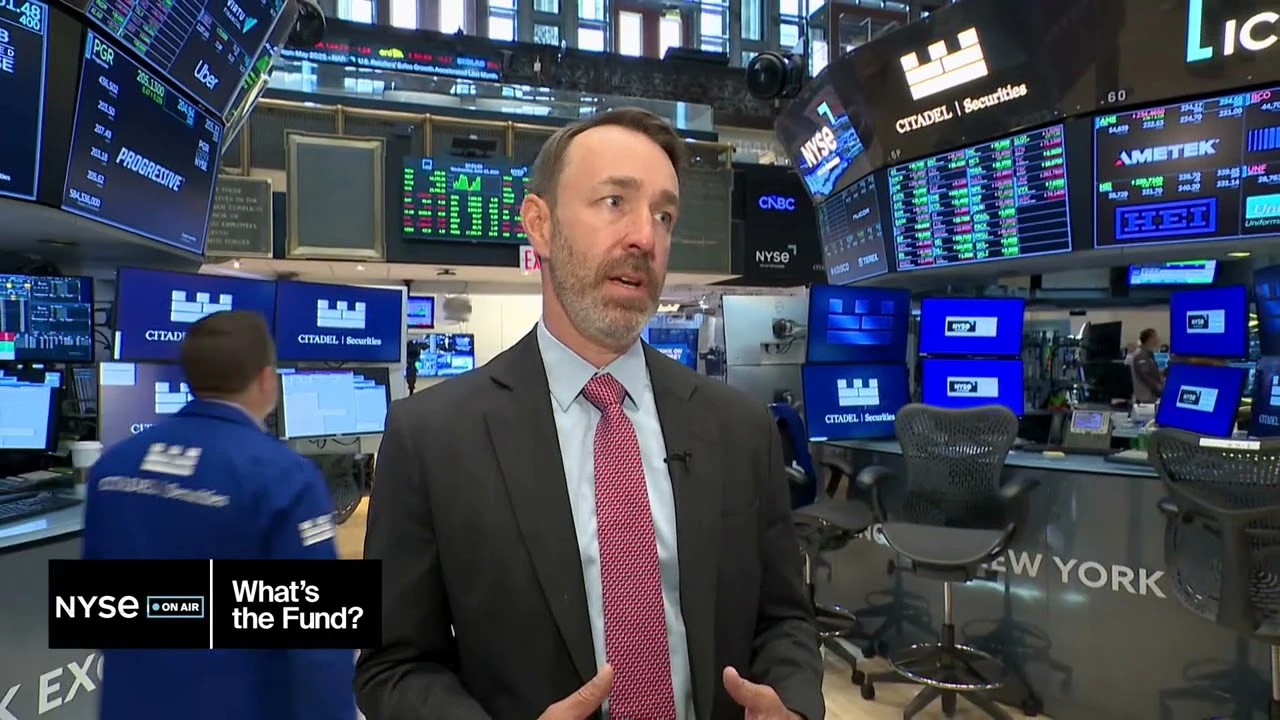
What's the Fund | Ocean Park Diversified Income ETF (DUKZ)
James St Aubin, Chief Investment Officer at Ocean Park Asset Management, discuss the DUKZ ETF, exposing investors to the whole spectrum of asset classes in the fixed income markets, through their rules-based process.

Browse all educational columns



Build and Analyze Your ETF Portfolio Like a Pro
Create your own ETF portfolio in minutes and instantly see allocations, exposures, performance, and risk. Visualize diversification across asset classes, regions, and sectors. Stress-test ideas, compare benchmarks, and refine your strategy with professional-grade analytics.