NYSE CRTR Economy Event Watch the replay →



Forget Factor / Smart-Beta ETFs: Dividend ETFs Can Be Just as Effective
Here's why factor and smart-beta investors should keep this WisdomTree dividend ETF duo on their watchlist.

Keep up with what matters in ETFs
Get timely ETF insights, market trends, and top ideas straight to your inbox.
Your newsletter subscriptions with us are subject to ETF Central's Privacy Policy and Terms and Conditions.
Dividends are a favorite topic for many investors, and it's easy to see why. There's a certain charm to seeing dividend payments pop up in your account, right?
It feels like your investments are actively working for you, even though it's important to remember that each dividend payment slightly reduces an ETF's net asset value (NAV) on the ex-dividend date.
While dividends are often celebrated, they're not just about the cash flow. I've found that dividend ETFs can also serve a dual purpose. They're not only great for generating income but can cleverly mimic some of the strategies you'd find in more complex and expensive factor / smart-beta funds.
Intrigued? Let me explain a bit about how this works using two ETF examples from WisdomTree.
Like what you're reading?
Stay in the loop — get the latest ETF insights: trends, analysis, and expert picks.
What is factor investing?
Factor investing, in simple terms, is a strategy that focuses on specific characteristics or "factors" that have historically been associated with higher expected returns. Think of it as systematically selecting stocks based on certain attributes that research suggests can boost performance.
At the core of factor investing is the idea of the equity risk premium—the extra return you get from owning stocks over safer bets like bonds. This premium compensates you for the additional risks of being in the stock market.
In finance terms, this is often captured by the formula Rm−Rf, where Rm represents the return on the market and Rf is the risk-free rate, typically the return on Treasury bills.
But here's where it gets more interesting. In the early 90s, researchers Eugene Fama and Kenneth French identified several factors beyond just market risk that seemed to influence stock returns. These include:
- Size (SMB, "Small Minus Big"): This factor suggests that, over time, small-cap stocks tend to outperform large-cap stocks.
- Value (HML, "High Minus Low"): This factor indicates that stocks with lower price-to-book ratios (seen as "value" stocks) tend to outperform those with higher ratios.
- Profitability (RMW, "Robust Minus Weak"): Here, companies with strong profitability outperform those with weaker earnings.
- Investment (CMA, "Conservative Minus Aggressive"): This factor shows that firms with conservative investment policies outperform those with more aggressive growth strategies.
Today, many smart-beta ETFs aim to harness these factors, either individually or in combination (known as multi-factor ETFs). For instance, a quality-focused ETF might target the profitability and investment factors, while a small-cap value ETF might focus on the size and value factors.
Why dividend ETFs?
Interestingly, certain dividend ETFs that use fundamental weighting strategies can capture various investment factors surprisingly well. This is because they allocate their holdings based on financial metrics rather than market cap alone.
For example, the WisdomTree U.S. LargeCap Dividend Fund
Despite their differences—DTD includes large, mid, and small caps, while DLN focuses on 300 large caps—as per the ETF Central comparison tool, their top holdings and sector allocations are similar.
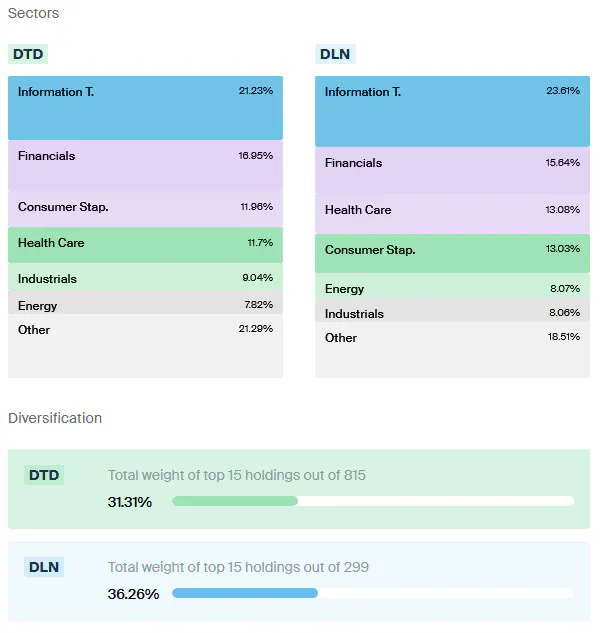
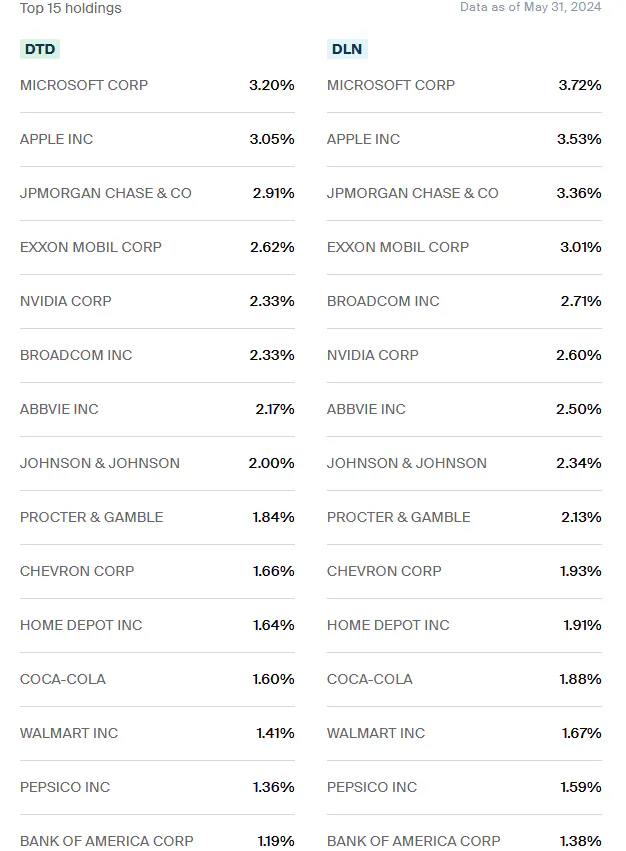
Between March 2018 and June 2024, both ETFs have shown statistically significant alignments with the value, profitability, and investment factors, according to research. This means that their portfolios favor stocks that align with these recognized factors of historical excess returns.
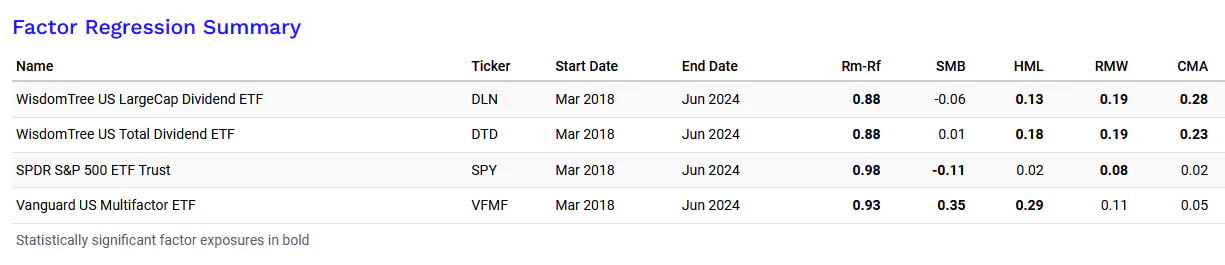
This factor alignment in DLN and DTD is actually competitive with that of the Vanguard US Multifactor ETF
It's interesting to consider why these fundamentally indexed dividend ETFs might offer similar factor exposures: their focus on dividend-paying companies that also meet certain financial criteria helps mimic a factor-based strategy, providing an exposure to value and profitability that you wouldn't necessarily get from a market cap-weighted ETF like the SPDR S&P 500 ETF
Finally, both DLN and DTD offer the additional benefit of monthly distributions, with 30-day SEC yields of 2.03% and 2.10% respectively. Investors can expect a 0.28% expense ratio.
Please note this article is for information purposes only and does not in any way constitute investment advice. It is essential that you seek advice from a registered financial professional prior to making any investment decision.
Latest ETF News
See all ETF newsThe Super El Niño Trade: Two Potential ETF Winners and Losers


The SpaceX (SPCX) IPO: Here's Which ETFs Already Own it




 Advantages of ETFs over Mutual Funds1/6
Lower Costs
In this guide, we'll explore the advantages of ETFs over mutual funds, giving you valuable insights into why ETFs have gained significant popularity among investors like yourself.
Leveraged ETFs: Unlocking the Potential for Amplified Returns1/6
Understanding Leveraged ETFs
Explore leveraged ETFs: potential for amplified returns & risks. 5 ETFs to consider across equities, commodities & fixed income.
What is a Leveraged ETF?1/6
Introducing Leveraged and Inverse ETFs
In this guide, we'll dive into the world of leveraged ETFs, exploring their definition, mechanics, potential risks, and rewards.
Recent educational content
Asset TV
The ETF Show - New Autism-Impact ETF Launched
Defiance ETFs has launched the first ETF, $ASD, focused on the autism ecosystem, investing in companies that provide services, products, and research related to autism and neurodivergence.


ETF Trends
ETF Industry KPIs June 1, 2026
The ETF Industry saw 22 New Launches, 1 Ticker Change and 1 closure last week.

ETF Trends
ETF Industry KPIs May 20, 2026
The ETF Industry saw 44 New Launches, 3 Mutual Fund Conversions and 9 closures last week.
Asset TV
The ETF Show - Politics Becomes Investable Trade through ETFs
Dan Weiskopf, Senior Portfolio Manager at Tidal Financial Group spoke with the ETF Show about Subversive ETFs that help investors trade like politicians.
Browse all educational columns



Build and Analyze Your ETF Portfolio Like a Pro
Create your own ETF portfolio in minutes and instantly see allocations, exposures, performance, and risk. Visualize diversification across asset classes, regions, and sectors. Stress-test ideas, compare benchmarks, and refine your strategy with professional-grade analytics.