Ready-made ETF portfolios built for real investor needs. Explore now →



ETF Comparison: JPMorgan Nasdaq Equity Premium Income ETF (JEPQ) Versus NEOS Nasdaq 100 High Income ETF (QQQI)
Two of the top-performing Nasdaq-based covered call ETFs go head-to-head in this week’s ETF comparison.

Keep up with what matters in ETFs
Get timely ETF insights, market trends, and top ideas straight to your inbox.
Your newsletter subscriptions with us are subject to ETF Central's Privacy Policy and Terms and Conditions.
Back in June, we put the incumbent covered call heavyweight JPMorgan Equity Premium Income ETF (JEPI) up against the rapidly growing newcomer NEOS S&P 500 High Income ETF (SPYI) in a head-to-head comparison. Now we’re doing the same, but this time in Nasdaq territory.
Both JPMorgan Asset Management and NEOS Investments offer covered call strategies tied to the Nasdaq 100 rather than the S&P 500. That trade-off means higher volatility and more concentration in tech and growth stocks, but also greater yield potential for income-focused investors.
As with JEPI vs. SPYI, the JPMorgan Nasdaq Equity Premium Income ETF
Here’s how the two stack up, based on data from the ETF Central screener.
Global ETF Survey 2026 is Live!
With 1,790 new products launched by July 2026, choosing is harder than ever. Our Global ETF Survey 2026, built on 620 professional investors and allocators, shows how active, fixed income, options-based and thematic ETFs are reshaping fund selection.
JEPQ vs QQQI: Total cost of ownership
When it comes to fees, JEPQ is about as low-cost as it gets for an actively managed strategy that blends stock selection with a covered call overlay.
It charges a 0.35% expense ratio, or $35 annually on a $10,000 investment. QQQI comes in higher at 0.68%, which is more typical for actively managed income-focused ETFs, costing $68 per $10,000 invested.
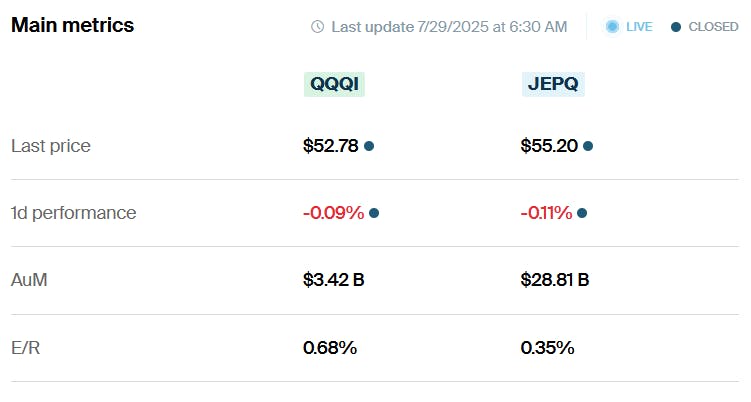
Looking beyond the headline fee, JEPQ also carries lower implicit trading costs. Its 30-day median bid-ask spread is just 0.019%, compared to 0.023% for QQQI.
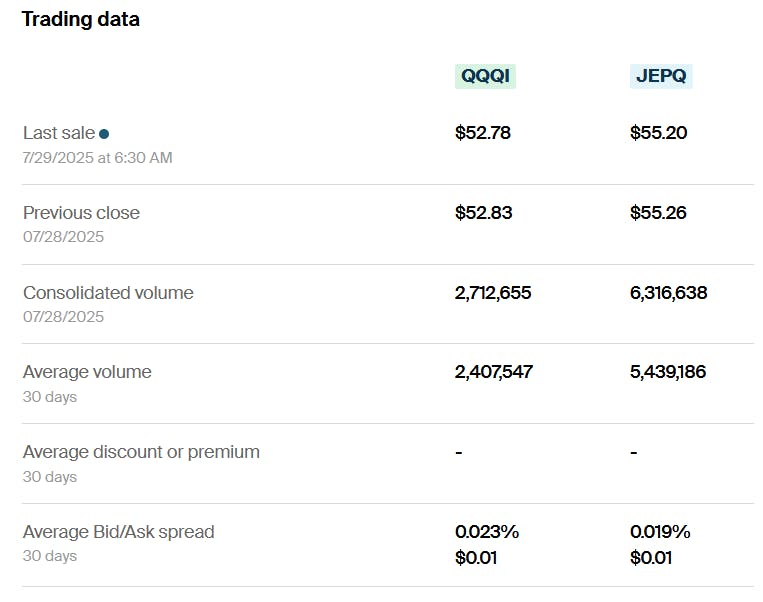
Verdict: Add up both the explicit and implicit costs, and JEPQ remains the more cost-efficient option for long-term investors.
JEPQ vs QQQI: Methodology and holdings
Both JEPQ and QQQI are covered call ETFs built on the Nasdaq 100, but they go about their strategies in very different ways. One noticeable difference is yield: QQQI currently has a 14.65% distribution rate, while JEPQ comes in at 11.24%. These figures can vary over time and shouldn’t be treated as fixed, but they give a sense of each fund’s income profile.
JEPQ actively manages a portfolio of large- and mid-cap Nasdaq-listed stocks, favoring names with lower volatility and attractive fundamentals. Rather than writing options on individual stocks, it uses equity-linked notes (ELNs) to replicate the payoff of one-month, slightly out-of-the-money Nasdaq 100 index calls. The calls are laddered weekly to smooth income and reduce volatility, though much of the payout is classified as ordinary income.
QQQI, in contrast, takes a more mechanical approach. It holds all 100 Nasdaq constituents and writes call options directly on the index using Section 1256 contracts. These options receive favorable 60/40 tax treatment—60% long-term, 40% short-term capital gains—which can help with after-tax returns in non-registered accounts. NEOS also actively tax-loss harvests the portfolio, which has allowed it to classify a high portion of distributions as return of capital.
When it comes to equity exposure, the two are quite similar since they are both based off the same benchmark universe. Expect a top-heavy composition and a high allocation to tech stocks.
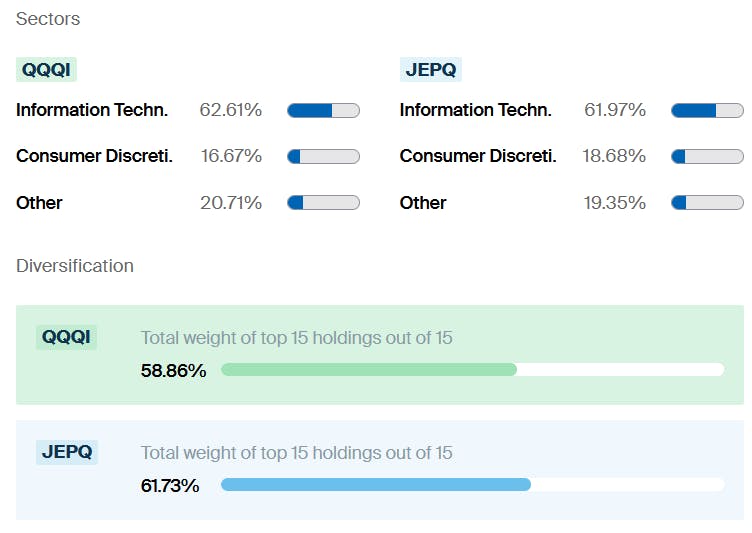
You’ll find all the familiar names like Apple, Microsoft, Nvidia, and Meta. That said, JEPQ’s active management means you’ll occasionally see differences in weights or a few holdings outside the standard top 100, an intentional part of its strategy to manage volatility and optimize yield.
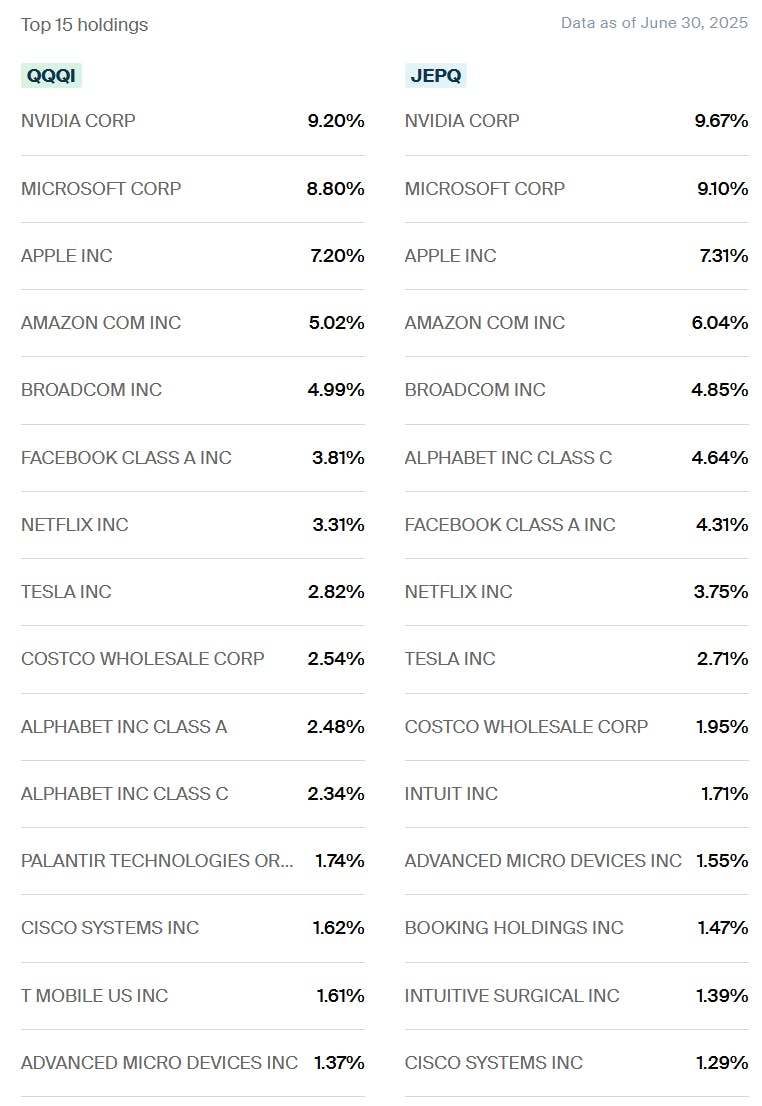
Verdict: JEPQ takes a more hands-on approach, offering a smoother income profile with actively selected stocks and an ELN-based overlay, though with less tax efficiency. QQQI delivers a more index-like experience, but with a tax-aware structure that may be more appealing in a taxable account. For accounts like a Roth IRA, JEPQ is a strong fit.
JEPQ vs QQQI: Risk and return
Both JEPQ and QQQI are relatively new ETFs, so performance history is limited and mostly confined to a bull market environment. That makes it risky to draw long-term conclusions, but there are some short-term differences worth noting.
Over the past year, year-to-date, and even in the most recent 3-month stretch, QQQI has significantly outperformed JEPQ. This makes sense when you consider their strategies. JEPQ is built to be more defensive. QQQI, on the other hand, has more flexibility. In addition to writing calls, it can opportunistically buy options to boost upside capture, which has helped in strong markets.
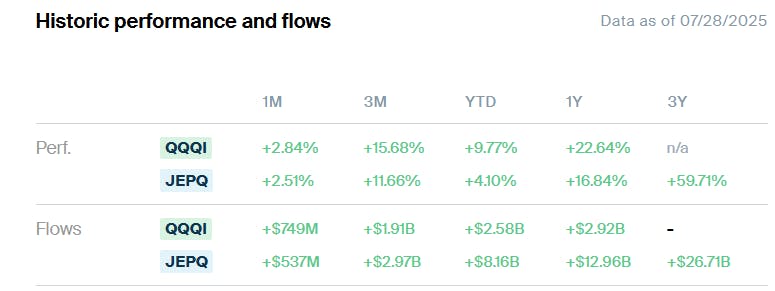
From a risk standpoint, 2024 hasn’t revealed dramatic differences. JEPQ has posted slightly lower volatility, but both ETFs have shown similar maximum drawdowns in terms of depth. However, JEPQ’s drawdowns have taken longer to recover, consistent with its more conservative design.
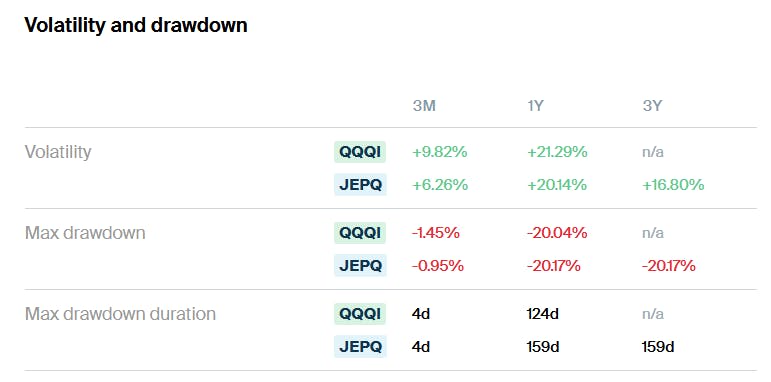
Verdict: If your priority is higher upside potential and you’re willing to accept more volatility, QQQI has shown more near-term strength. If you're focused on risk-adjusted performance and prefer the track record of an experienced active manager like Hamilton Reiner at JPMorgan, JEPQ offers a more seasoned, steady approach.
Please note that this article reflects the author’s personal views and does not represent the opinions of the publication or its affiliates. It is for informational purposes only and does not constitute investment advice. It is essential to seek guidance from a registered financial professional before making any investment decisions.
Latest ETF News
See all ETF newsBeyond Big Tech: The Increasing Specialization of AI ETFs

There's an ETF for That? Humanoid Robotics and Physical AI

How Some ETF Issuers Use Their Own Funds for Cash Management

These Public-Private ETFs Invest in Polymarket and Anduril

There's an ETF for That? Frontier Markets



 Advantages of ETFs over Mutual Funds1/6
Lower Costs
In this guide, we'll explore the advantages of ETFs over mutual funds, giving you valuable insights into why ETFs have gained significant popularity among investors like yourself.
Leveraged ETFs: Unlocking the Potential for Amplified Returns1/6
Understanding Leveraged ETFs
Explore leveraged ETFs: potential for amplified returns & risks. 5 ETFs to consider across equities, commodities & fixed income.
What is a Leveraged ETF?1/6
Introducing Leveraged and Inverse ETFs
In this guide, we'll dive into the world of leveraged ETFs, exploring their definition, mechanics, potential risks, and rewards.
Recent educational content

First Look ETF
First Look ETF: Income, International, and Cash Flow ETFs
In this season 6 episode of First Look ETF, Stephanie Stanton @etfguide examines the latest ETF marketplace trends with NYSE and guests.


ETF Trends
ETF Industry KPIs October 5, 2026
This week’s KPI data overview highlights key metrics and trends shaping the ETF landscape.

ETF Trends
ETF Industry KPIs September 28, 2026
This week’s KPI data overview highlights key metrics and trends shaping the ETF landscape.
ETF Trends
ETF Industry KPIs September 22, 2026
This week’s KPI data overview highlights key metrics and trends shaping the ETF landscape.
Browse all educational columns



ETFs’ Next Act: From Access to Selection
With 1,790 new products launched by July 2026, choosing is harder than ever. Our Global ETF Survey 2026, built on 620 professional investors and allocators, shows how active, fixed income, options-based and thematic ETFs are reshaping fund selection.