ETF model portfolios designed for real investor needs. Discover →



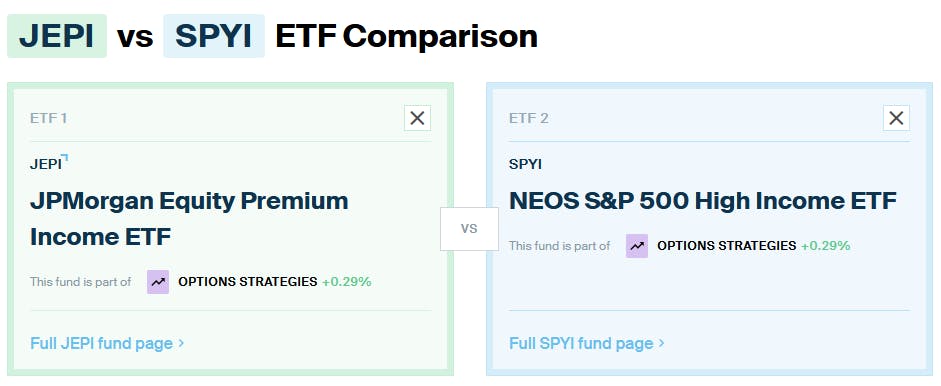
ETF Comparison: JPMorgan Equity Premium Income ETF (JEPI) Versus NEOS S&P 500 High Income ETF (SPYI)
Two of the top-performing covered call ETFs go head-to-head in this week’s ETF comparison.


Keep up with what matters in ETFs
Get timely ETF insights, market trends, and top ideas straight to your inbox.
Your newsletter subscriptions with us are subject to ETF Central's Privacy Policy and Terms and Conditions.
The JPMorgan Equity Premium Income ETF
But JEPI’s success has invited competition. One standout challenger is the NEOS S&P 500 High Income ETF
Here’s how JEPI and SPYI compare, based on data from the ETF Central comparison tool.
Like what you're reading?
Stay in the loop — get the latest ETF insights: trends, analysis, and expert picks.
JEPI vs SPYI: Total cost of ownership
When it comes to fees, JEPI
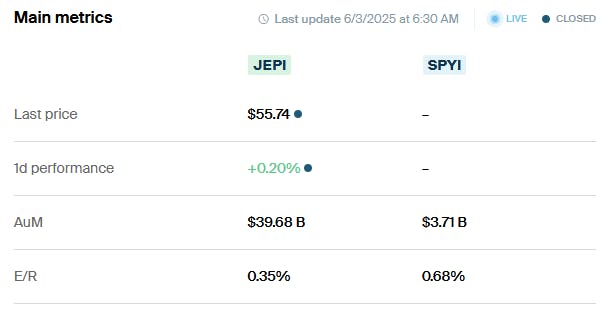
It charges just a 0.35% expense ratio, or $35 annually on a $10,000 investment. In contrast, SPYI comes in at 0.68%, which is more typical for active covered call ETFs, costing you $68 per $10,000 invested.
Looking beyond the headline fee, JEPI also carries lower implicit trading costs. Its 30-day median bid-ask spread is just 0.019%, compared to 0.025% for SPYI.
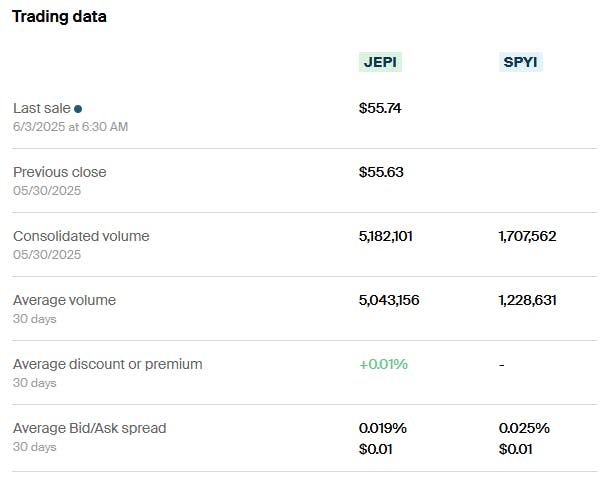
Verdict: Add up both the explicit and implicit costs, and JEPI is meaningfully cheaper to buy, hold, and trade.
JEPI vs SPYI: Methodology and holdings
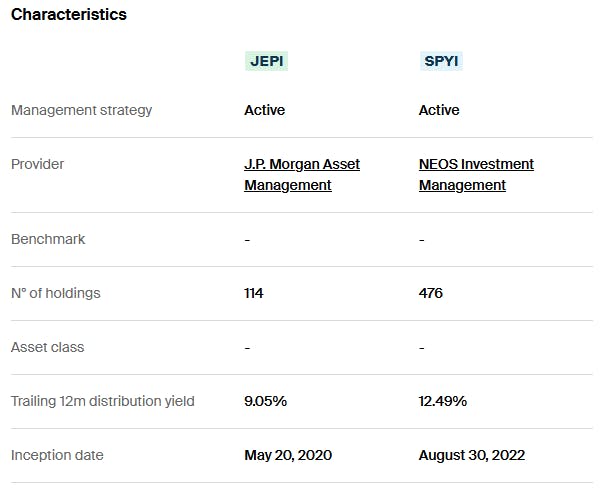
Both JEPI and SPYI are covered call ETFs, but they take very different approaches when it comes to constructing their portfolios and implementing the options overlay.
JEPI
These ELNs replicate the payoff of one-month-out, slightly out-of-the-money SPX index calls, staggered weekly to smooth income. The result is a high 12-month trailing yield of 9.05%, but most of it is taxed as ordinary income.
SPYI
SPYI also actively tax-loss harvests its holdings, which allows the fund to classify more of its monthly distributions as return of capital. That makes the current 12.49% trailing 12-month yield far more tax efficient, with 96% of the latest monthly payout classified as return of capital.
Because of their different equity strategies, sector exposures differ as well. SPYI mirrors the S&P 500 with a typical tilt toward tech, consumer discretionary, and financials. JEPI puts more emphasis on healthcare, consumer staples, and industrials. JEPI is also far less top-heavy—it doesn’t have the same concentration in Magnificent Seven names as SPYI.
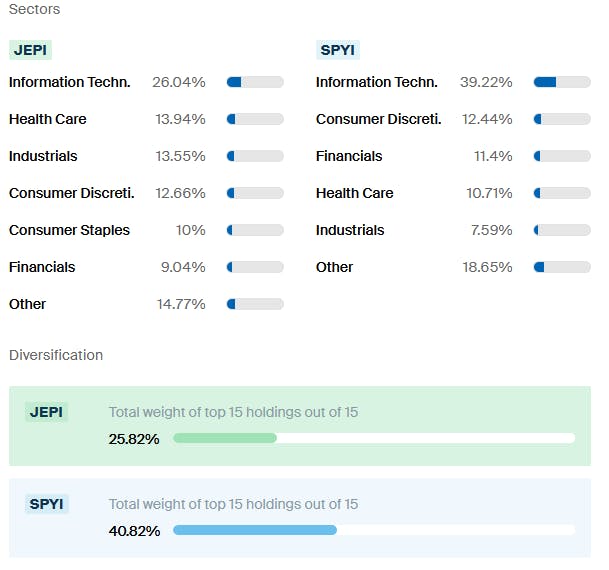
Verdict: JEPI’s combination of low-volatility stock selection and SPX call overlay via ELNs offers a smoother ride and solid income, but sacrifices tax efficiency. SPYI is more vanilla in its holdings, but it’s optimized for tax savings. In a registered account like a Roth IRA, I’d lean toward JEPI. In a taxable brokerage account, SPYI likely makes more sense.
JEPI vs SPYI: Risk and return
SPYI
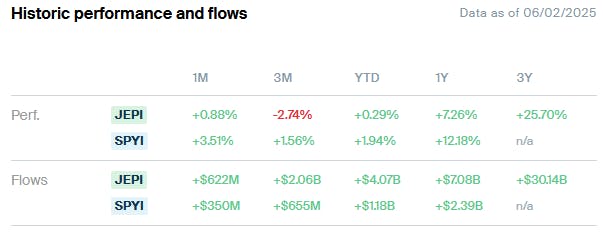
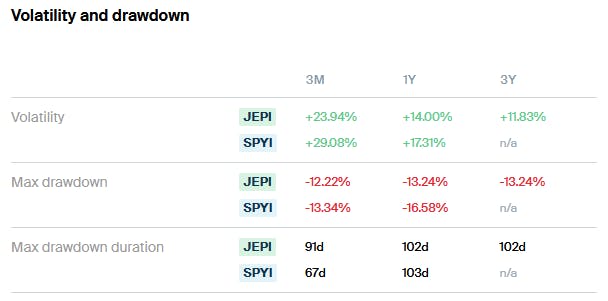
In terms of risk, JEPI has behaved exactly as you’d expect. Over the last year, it’s been less volatile and has experienced a shallower maximum drawdown than SPYI. That lines up with its strategy of focusing on lower-volatility stocks and smoothing income with an options overlay.
Looking at a longer-term backtest from August 30, 2022, to June 2, 2025, SPYI still comes out ahead. It delivered a compound annual growth rate (CAGR) of 12.93% versus 9.3% for JEPI. Despite SPYI’s higher volatility, it also posted a stronger risk-adjusted return with a Sharpe ratio of 0.61 compared to JEPI’s 0.42. So, while JEPI had lower drawdowns and smaller fluctuations, the returns were lower in kind.
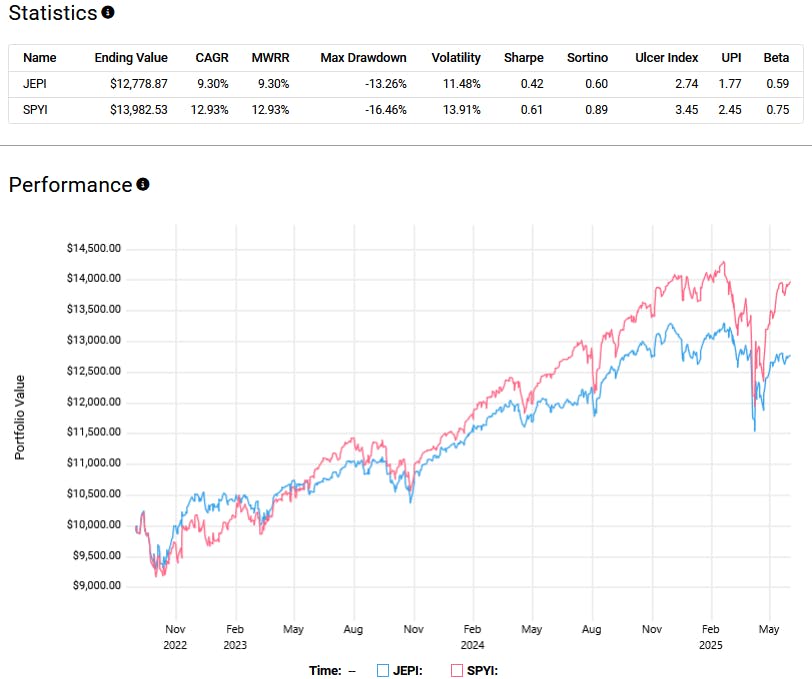
Verdict: SPYI justifies its place in a portfolio, especially if tax efficiency is a priority. You get stronger total and risk-adjusted returns, even if you give up a bit of short-term stability.
Please note that this article reflects the author’s personal views and does not represent the opinions of the publication or its affiliates. It is for informational purposes only and does not constitute investment advice. It is essential to seek guidance from a registered financial professional before making any investment decisions.
Segments
See all
Mentioned ETFs
No specific ETFs were tagged
Further reading
Latest ETF News
See all ETF newsThere's an ETF for That? Humanoid Robotics and Physical AI

How Some ETF Issuers Use Their Own Funds for Cash Management

These Public-Private ETFs Invest in Polymarket and Anduril

There's an ETF for That? Frontier Markets




 Advantages of ETFs over Mutual Funds1/6
Lower Costs
In this guide, we'll explore the advantages of ETFs over mutual funds, giving you valuable insights into why ETFs have gained significant popularity among investors like yourself.
Leveraged ETFs: Unlocking the Potential for Amplified Returns1/6
Understanding Leveraged ETFs
Explore leveraged ETFs: potential for amplified returns & risks. 5 ETFs to consider across equities, commodities & fixed income.
What is a Leveraged ETF?1/6
Introducing Leveraged and Inverse ETFs
In this guide, we'll dive into the world of leveraged ETFs, exploring their definition, mechanics, potential risks, and rewards.
Recent educational content

ETF Trends
ETF Industry KPIs October 5, 2026
This week’s KPI data overview highlights key metrics and trends shaping the ETF landscape.

ETF Trends
ETF Industry KPIs September 28, 2026
This week’s KPI data overview highlights key metrics and trends shaping the ETF landscape.
ETF Trends
ETF Industry KPIs September 22, 2026
This week’s KPI data overview highlights key metrics and trends shaping the ETF landscape.

First Look ETF
First Look ETF: Income, Corporate Arbitrage, and Growth and Value Investing
First Look ETF September 2026: iCapital, Mast Investments and North Square unpack new ETFs targeting monthly income, merger arbitrage and complementary growth and value exposure.

Browse all educational columns



ETFs’ Next Act: From Access to Selection
With 1,790 new products launched by July 2026, choosing is harder than ever. Our Global ETF Survey 2026, built on 620 professional investors and allocators, shows how active, fixed income, options-based and thematic ETFs are reshaping fund selection.