Ready-made ETF portfolios built for real investor needs. Explore now →



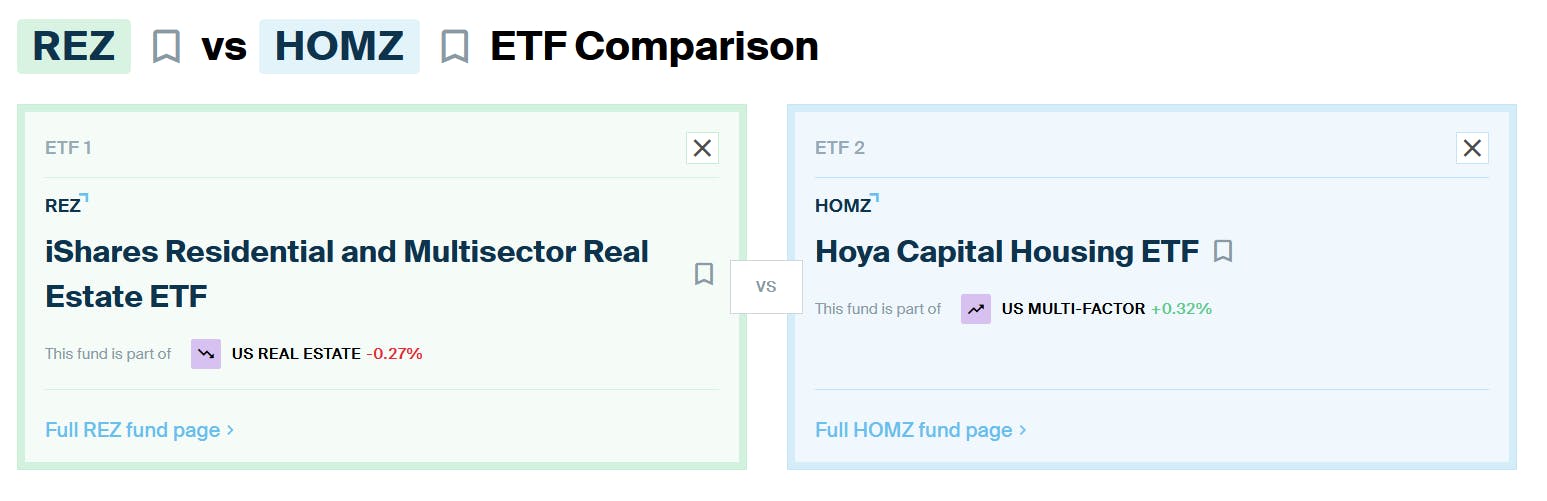
ETF Comparison: iShares Residential and Multisector Real Estate ETF (REZ) Versus Hoya Capital Housing ETF (HOMZ)
Bullish on the U.S. housing market? Both of these NYSE-listed ETFs provide exposure, but via very different methodologies.


Keep up with what matters in ETFs
Get timely ETF insights, market trends, and top ideas straight to your inbox.
Your newsletter subscriptions with us are subject to ETF Central's Privacy Policy and Terms and Conditions.
REIT ETFs have traditionally taken a broad-brush approach to the sector, offering exposure to everything from office buildings and industrial parks to malls, multifamily apartments, hotels, and even casinos.
But just like the rest of the ETF landscape, REIT funds have started to specialize. Investors can now find funds focused specifically on data centers, cell towers, or office properties.
Still, one theme that’s been surprisingly underserved is residential real estate. For a long time, the iShares Residential and Multisector Real Estate ETF
That changed in March 2019, when Hoya Capital, a firm known for its real estate and REIT research, launched the Hoya Capital Housing ETF
But as you’ll see in today’s ETF comparison, size isn’t everything. HOMZ takes a very different approach to housing exposure and may offer features that appeal more to real estate bulls than traditional REIT-heavy funds like REZ.
So, which one should you consider for a housing-themed allocation? Let’s take a critical look using data from the ETF Central comparison tool.
Get data on 14,000+ ETFs
Access Trackinsight's reliable and comprehensive data with 500M+ points on 14,000+ ETFs.
REZ vs HOMZ: Total Cost of Ownership
REZ charges a 0.48% expense ratio, which works out to $48 annually for every $10,000 invested. That’s neither especially high nor low, just about right for a specialized REIT ETF, especially one that launched all the way back in 2007. Still, expense ratios across the ETF industry have steadily declined over the years, and HOMZ undercuts REZ with a lower 0.30% fee, or $30 per $10,000 invested.
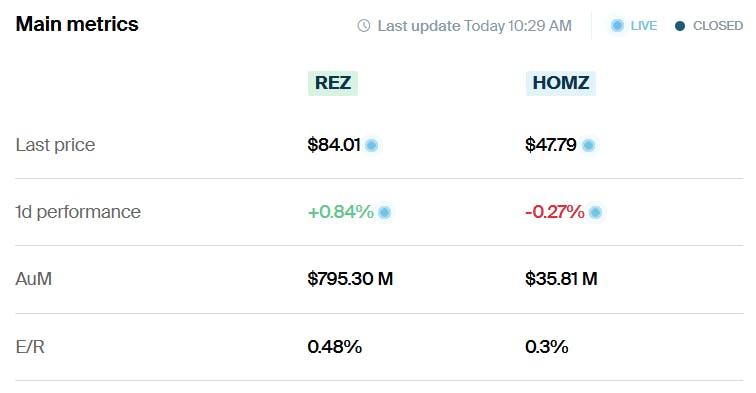
But the expense ratio isn’t the only cost to consider. Bid-ask spread, which is the difference between what buyers are willing to pay and sellers are asking, is another part of the total cost of ownership. And here, REZ has the clear edge, thanks to its scale and liquidity. It trades with a 30-day average bid-ask spread of just 0.06%, compared to 0.145% for HOMZ, which is more than twice as wide.
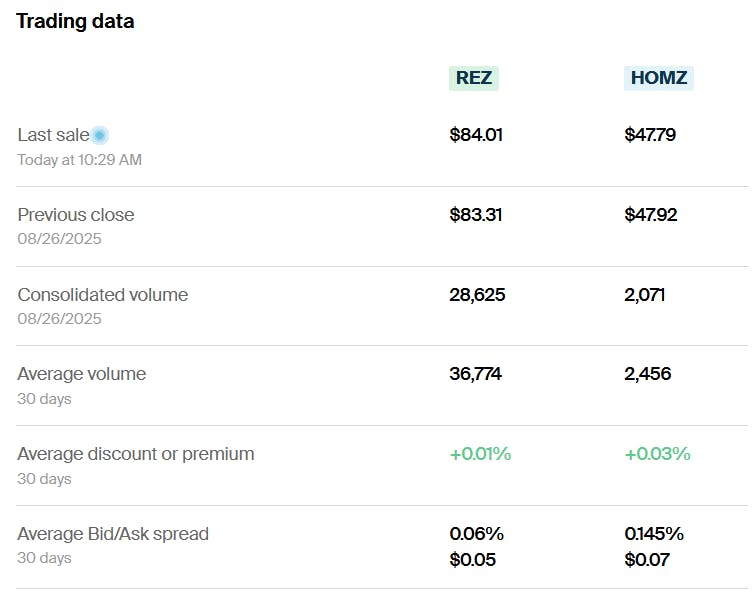
Verdict: While REZ is the better option for traders who prioritize liquidity, long-term investors focused on minimizing ongoing fees would still save more with HOMZ, assuming other factors remain equal.
REZ vs HOMZ: Methodology and Holdings
Both REZ and HOMZ are passive ETFs, but they follow very different benchmarks. REZ tracks the FTSE NAREIT All Residential Capped Index, while HOMZ follows the Hoya Capital Housing 100 Index, which is proprietary. Their focus on real estate exposure gives both funds respectable income profiles, with REZ offering a 2.42% 30-day SEC yield and HOMZ paying 2.28%.
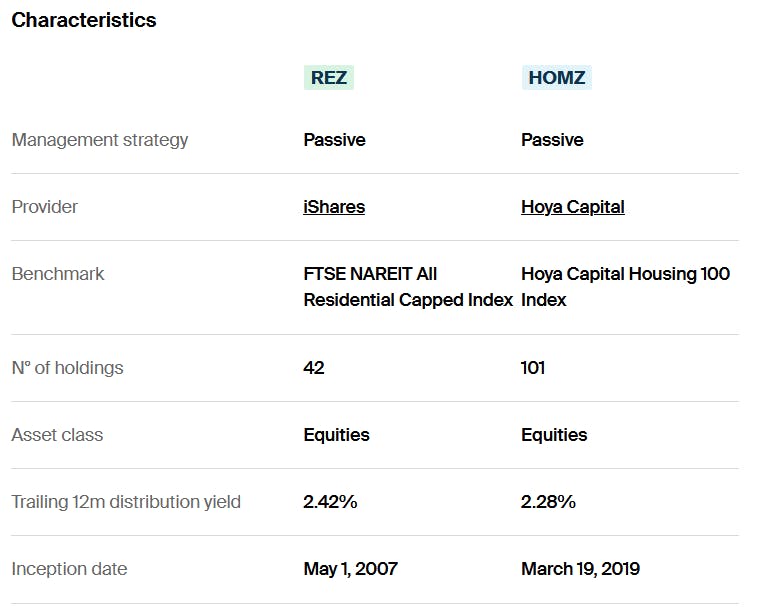
Starting with REZ, it holds 42 REITs that span U.S. residential, healthcare, and self-storage real estate. This is an important distinction - REZ is not a pure-play residential REIT ETF. That niche is considered too narrow for a diversified fund, so the index allows adjacent sectors with similar cash flow dynamics and occupancy-based revenues. As a result, you’ll find heavy allocations to healthcare REITs like Welltower and storage REITs like Public Storage and Extra Space Storage.
HOMZ takes a broader and more targeted approach to the housing theme. Its 100 holdings include not only REITs but also rental operators, homebuilders, home improvement retailers, and real estate technology firms. It’s not a pure REIT product, but the non-REIT names are deeply connected to the housing ecosystem, acting as enablers or direct beneficiaries of housing demand.
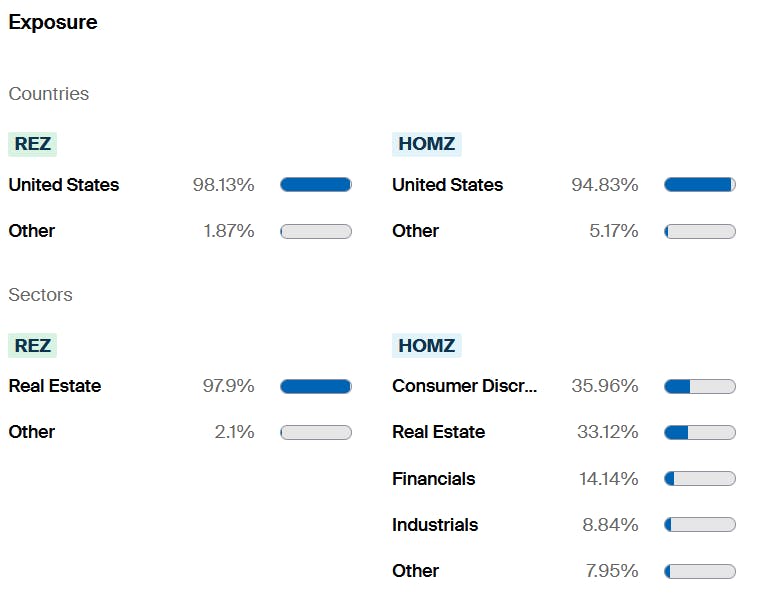
You can see this difference clearly in sector breakdowns. REZ is almost entirely real estate, while HOMZ allocates meaningful weights to consumer discretionary, industrials, and financials.
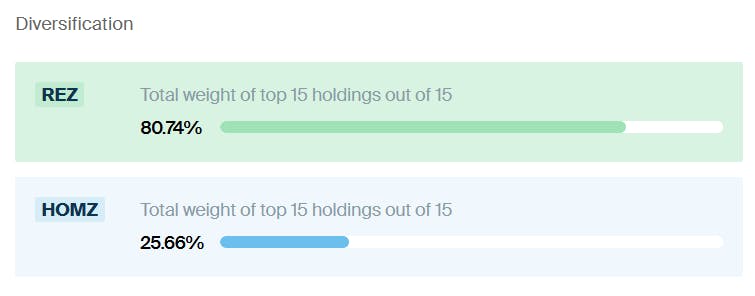
HOMZ’s benchmark is also more balanced: its top 15 holdings make up just 25.66% of the portfolio. REZ, in contrast, is top-heavy, with its top 15 holdings making up 80.74% of the fund.
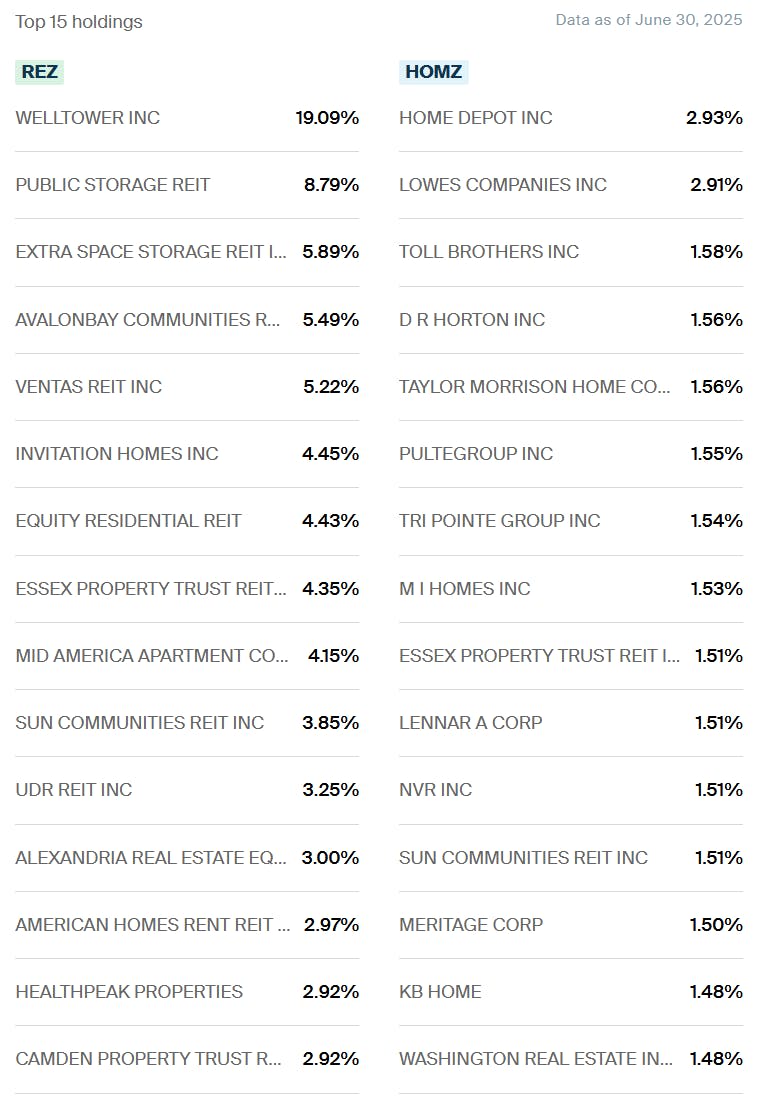
Over 19% of REZ is in Welltower alone, followed by storage REITs like Public Storage and Extra Space Storage. You don’t see a true residential REIT like AvalonBay until the fourth-largest position. HOMZ, on the other hand, spreads its weight across housing-related operators. Top holdings currently include Home Depot and Lowe’s, as well as a range of homebuilders such as Toll Brothers, D.R. Horton, and PulteGroup.
Verdict: HOMZ offers a more thematically focused spin on the housing sector, capturing both real estate ownership and the broader supply chain of residential housing. Despite its greater exposure to cyclical subsectors like homebuilders, it provides more balanced diversification and stronger alignment with housing demand drivers than REZ.
REZ vs HOMZ: Risk and Return
Both REZ and HOMZ have faced macroeconomic headwinds over the past five years, including rising interest rates, housing affordability issues, and periods of elevated inflation. But they’ve handled those conditions quite differently.
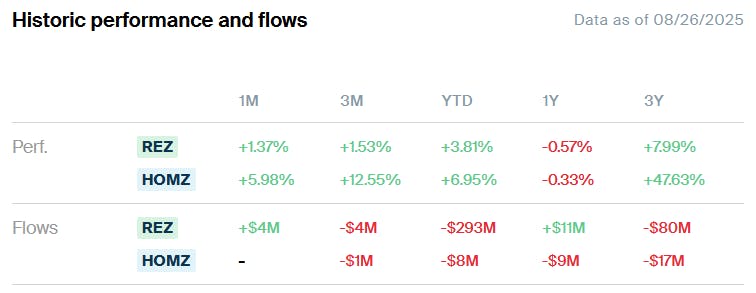
In the short term, HOMZ has outperformed REZ across nearly every time frame. Year-to-date, one-month, three-month, and one-year total returns all show HOMZ leading. Despite being smaller in size, HOMZ has been more resilient from a performance standpoint. Flows have reflected this too - both ETFs have seen outflows, but REZ’s redemptions have been more substantial, suggesting a greater loss in investor confidence.
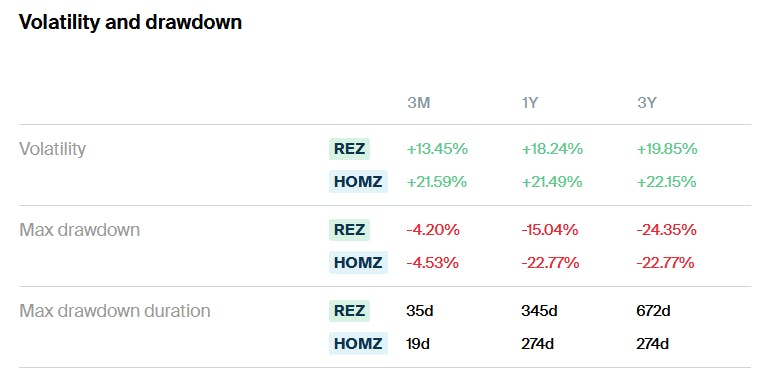
On the risk side, HOMZ has exhibited higher volatility, which isn’t surprising given its allocation to homebuilders and consumer discretionary stocks. But those same sectors have also given HOMZ better upside, and its drawdowns have been shallower and shorter than REZ’s. The inclusion of cyclical growth-oriented housing stocks, gives HOMZ more beta, but also more bounce-back potential.
Looking at longer-term performance, from March 20, 2019, to August 26, 2025 (a period of 6.44 years), the difference is stark. HOMZ has delivered a cumulative total return of 121.22%, while REZ managed just 43.65%. That translates to a compound annual growth rate (CAGR) of 13.13% for HOMZ, more than double REZ’s 5.79%. Risk-adjusted returns also favor HOMZ, with a Sharpe ratio of 0.51 vs 0.25.
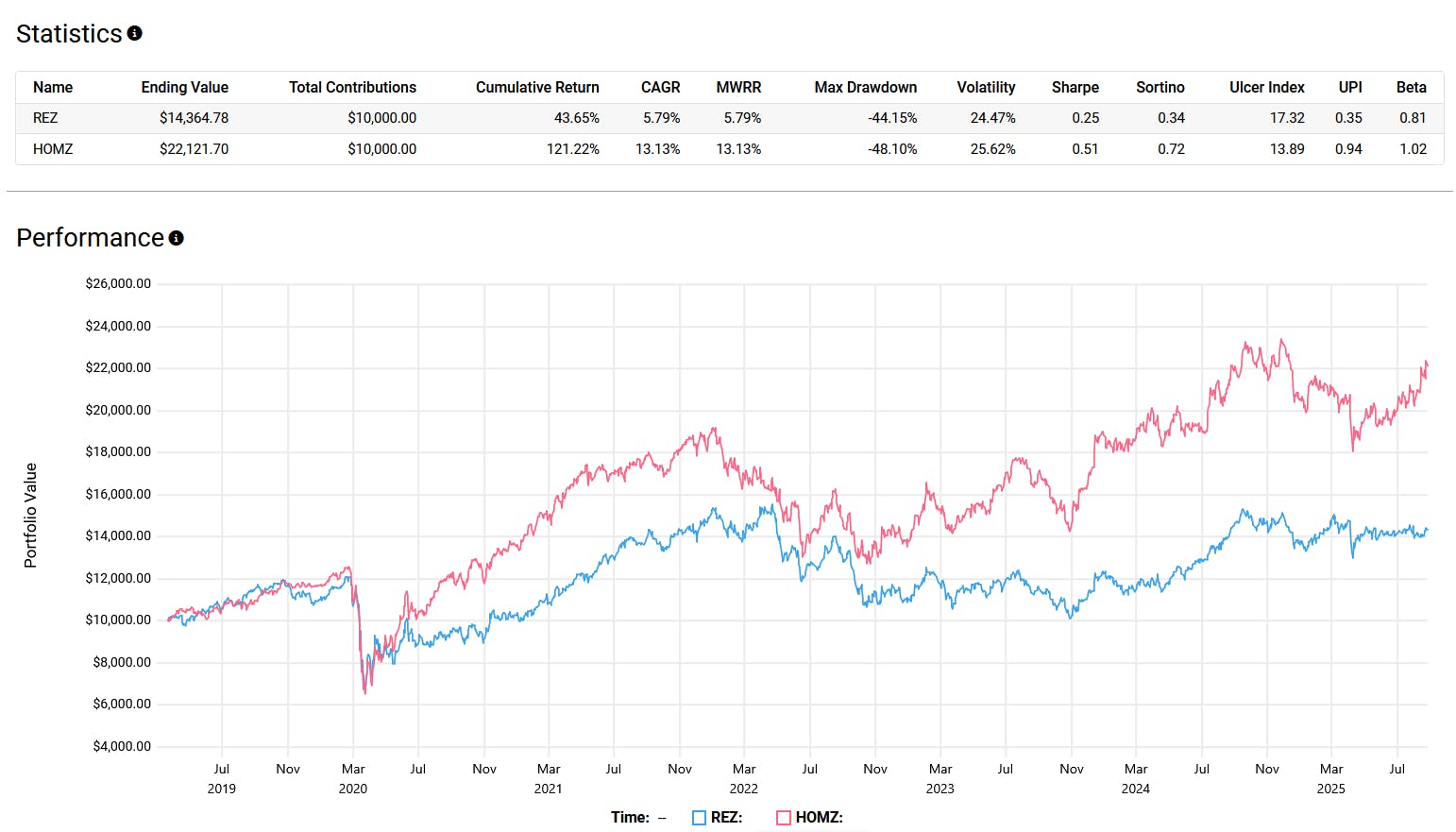
Verdict: HOMZ wins decisively on long-term return potential and has shown more adaptability in the face of macro challenges. Its broader exposure to housing-related equities and not just REITs offers stronger upside, better diversification, and improved resilience, making it the better choice (in my opinion) for investors bullish on the U.S. housing market.
Please note that this article reflects the author’s personal views and does not represent the opinions of the publication or its affiliates. It is for informational purposes only and does not constitute investment advice. It is essential to seek guidance from a registered financial professional before making any investment decisions.

Latest ETF News
See all ETF newsCould Water ETFs Be the Next AI Bottleneck Trade?

What is a Boomer Candy ETF?

ETF Comparison: NEOS Nasdaq-100 High Income ETF (QQQI) Versus Goldman Sachs Nasdaq-100 Premium Income ETF (GPIQ)





 Advantages of ETFs over Mutual Funds1/6
Lower Costs
In this guide, we'll explore the advantages of ETFs over mutual funds, giving you valuable insights into why ETFs have gained significant popularity among investors like yourself.
Leveraged ETFs: Unlocking the Potential for Amplified Returns1/6
Understanding Leveraged ETFs
Explore leveraged ETFs: potential for amplified returns & risks. 5 ETFs to consider across equities, commodities & fixed income.
What is a Leveraged ETF?1/6
Introducing Leveraged and Inverse ETFs
In this guide, we'll dive into the world of leveraged ETFs, exploring their definition, mechanics, potential risks, and rewards.
Recent educational content

ETF Trends
ETF Industry KPIs September 8, 2026
This week’s KPI data overview highlights key metrics and trends shaping the ETF landscape.

ETF Trends
ETF Industry KPIs August 31, 2026
This week’s KPI data overview highlights key metrics and trends shaping the ETF landscape.
ETF Trends
ETF Industry KPIs August 24, 2026
This week’s KPI data overview highlights key metrics and trends shaping the ETF landscape.

What’sTheFund
What's the Fund | Ocean Park Diversified Income ETF (DUKZ)
James St Aubin, Chief Investment Officer at Ocean Park Asset Management, discuss the DUKZ ETF, exposing investors to the whole spectrum of asset classes in the fixed income markets, through their rules-based process.

Browse all educational columns



Have you tried our ETF Compare tool?
Compare ETFs like a pro. Analyze fees, performance, exposure & holdings side-by-side.