From idea to ETF portfolio in minutes. Build yours now →



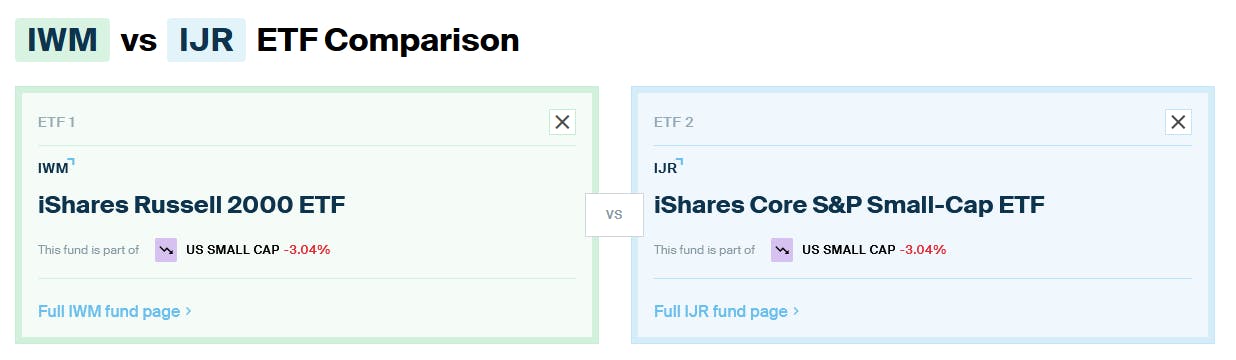
ETF Comparison: iShares Russell 2000 ETF (IWM) Versus iShares Core S&P Small-Cap ETF (IJR)
The Russell 2000 and S&P SmallCap 600 indices go head-to-head for this week's ETF comparison.

Keep up with what matters in ETFs
Get timely ETF insights, market trends, and top ideas straight to your inbox.
Your newsletter subscriptions with us are subject to ETF Central's Privacy Policy and Terms and Conditions.
If you're looking to gain passive exposure to small-cap stocks, you've likely heard of the Russell 2000 Index, with the iShares Russell 2000 ETF
While IWM is a popular choice among investors for small-cap exposure, it's not the only option out there. In fact, it faces stiff competition from a lesser-known but highly capable contender: the iShares Core S&P Small-Cap ETF
Like what you're reading?
Stay in the loop — get the latest ETF insights: trends, analysis, and expert picks.
IJR vs IWM: Total cost of ownership
When it comes to the total cost of ownership, both ETFs — iShares Russell 2000 ETF
However, IJR, part of iShares' "core" lineup, emerges as the more cost-effective choice with an expense ratio of just 0.06%, compared to IWM's 0.19%. This makes IJR significantly cheaper, costing just $6 annually on a $10,000 investment versus $19 for IWM.
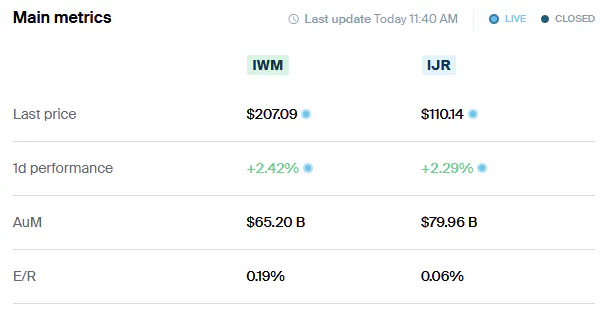
But what about implicit costs, such as the bid-ask spread? Here, IWM has the edge with a 30-day median bid-ask spread of just 0.006%, indicating very high liquidity. IJR, while not as liquid, still performs well with a bid-ask spread of 0.013%.
Although this is double that of IWM, the difference is relatively minimal in practical terms—both essentially round to about 0.01%, which is considered very low.
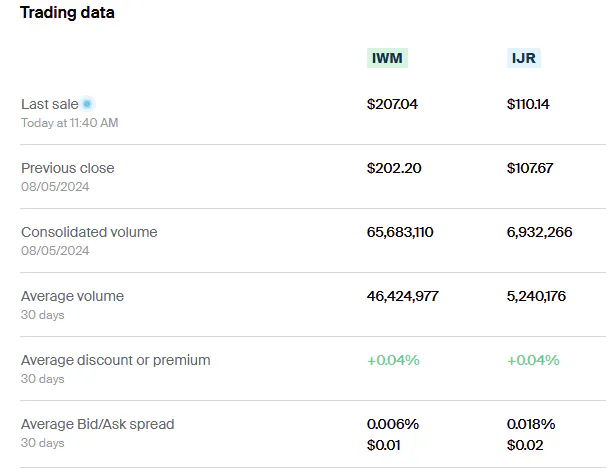
Taking both explicit and implicit costs into account, IJR still holds the advantage as the more economical option between the two, especially when considering long-term investments where even small percentage differences in fees can add up.
IWM vs IJR: Methodology and holdings
Both ETFs embody competing index methodologies from two rival firms: S&P Global and FTSE Russell. As their names suggest, IWM tracks the Russell 2000 Index, while IJR follows the S&P SmallCap 600 Index. While both might seem similar in their yield, the devil is in the details.
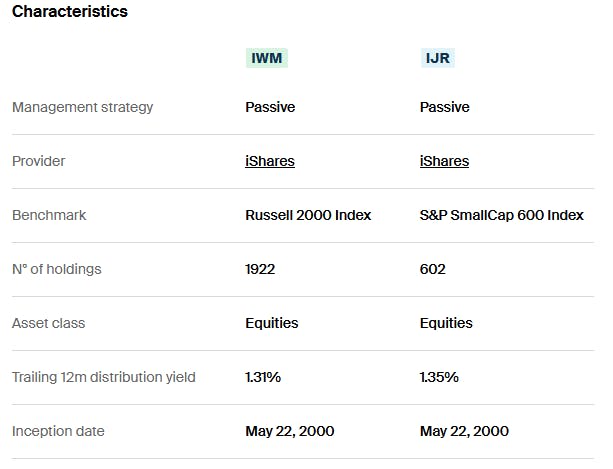
The Russell 2000 Index, tracked by IWM, is broader, containing about three times as many holdings as the S&P SmallCap 600. It includes the 1001st to the 3000th largest U.S. equity stocks, requiring sufficient average daily trading volume and at least a 5% public float. This index is reconstituted annually, with adjustments made for IPOs throughout the year.
On the other hand, the S&P SmallCap 600, the basis for IJR, employs more stringent criteria. It requires annual turnover of 100% of shares outstanding, a minimum of 250,000 traded shares prior to committee evaluation, and at least a 10% public float.
Notably, it also includes a profitability screen—requiring the sum of the last four consecutive quarters' earnings to be positive, plus the most recent quarter. Unlike the Russell 2000, the S&P SmallCap 600's reconstitution is not scheduled annually but occurs as needed, based on committee decisions.
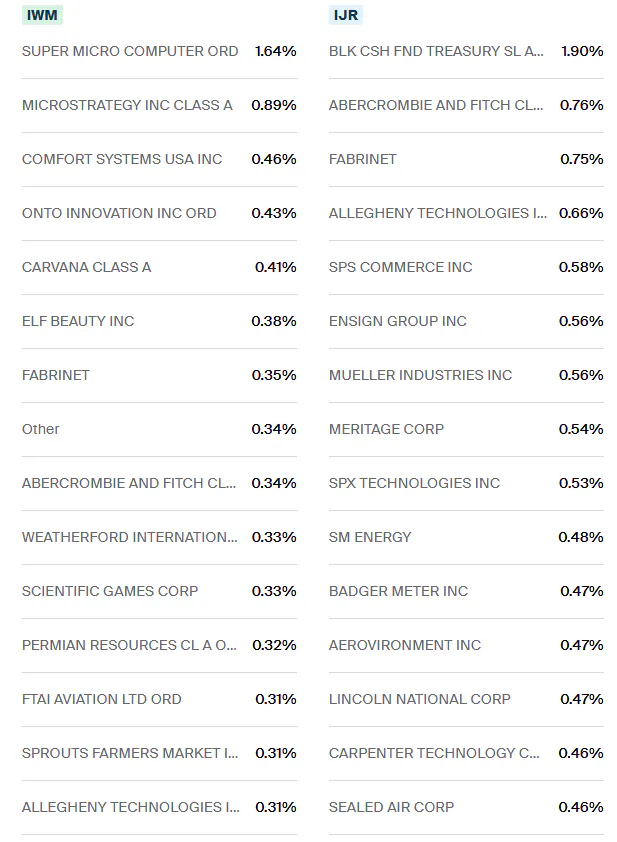
The exposure provided by each ETF also varies significantly: IWM is more heavily weighted towards technology and healthcare sectors, while IJR leans more towards financials and consumer discretionary. Both, however, allocate significantly to industrials.
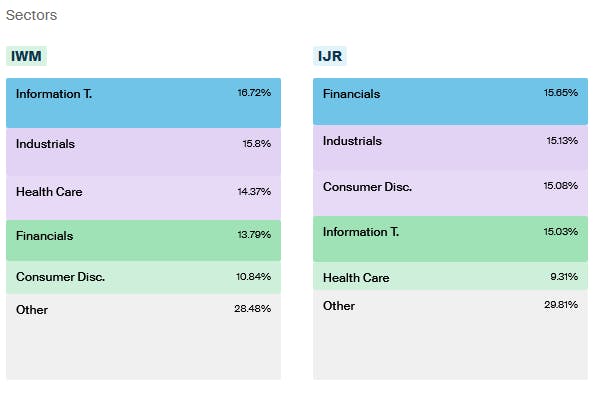
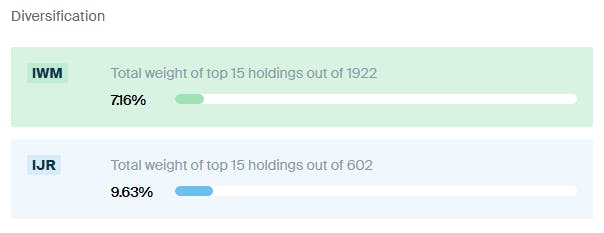
Neither ETF is particularly top-heavy in terms of portfolio composition. Notable top names across these ETFs include companies like MicroStrategy, Super Micro Computer, Carvana, and Abercrombie.
IWM vs IJR: Risk and return
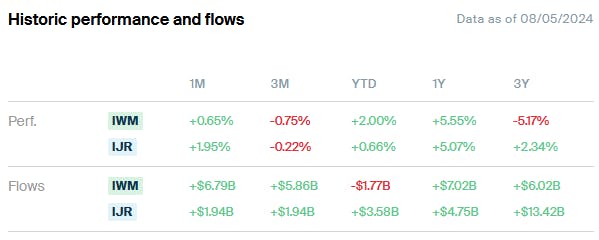
When it comes to historical performance, IJR beats IWM across the board. While the adage "past performance does not predict future results" usually holds true, there are strong reasons to consider an exception in this case.
First, examining the recent data doesn't offer conclusive insights. Over the last year and even on a year-to-date basis, performance comparisons are mixed. However, it's noteworthy that over the past three years, IJR has seen more inflows, indicating growing investor confidence. Conversely, during the same period, there has been a net exodus from IWM, with investors increasingly gravitating towards IJR.
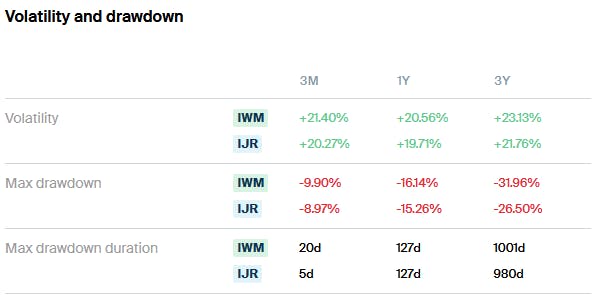
Risk metrics for both ETFs reflect the inherent volatility associated with small-cap investments—both feature high standard deviations and have experienced deep, extended drawdowns. However, IJR shows a slightly better profile, likely due to its index methodology.
Looking further back, when backtesting both ETFs starting from 2000, IJR consistently outperforms IWM across several key metrics: it has a higher CAGR, lower volatility, and a better risk-adjusted return (Sharpe ratio). Why is this the case?
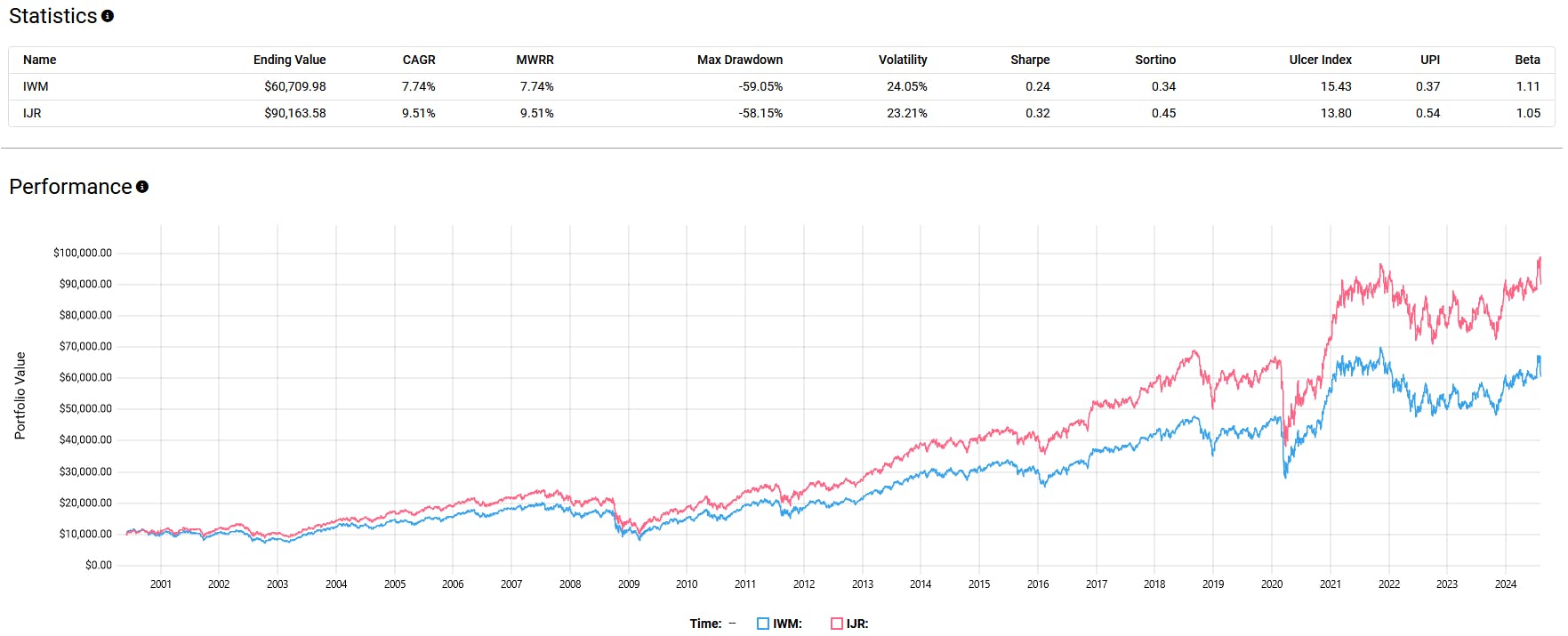
The answer lies primarily in the index criteria:
- Russell 2000 Reconstitution: The annual reconstitution of the Russell 2000 is relatively transparent and predictable, which allows market participants to front-run changes by bidding up stocks about to enter the index, often making them expensive by the time they're included. In contrast, the S&P SmallCap 600's committee-led reconstitution process is more ad hoc and less predictable, which can mitigate such market manipulation.
- Profitability Screen: The lack of a profitability screen in the Russell 2000 allows a broader array of companies, including those not yet profitable, to be included. The S&P SmallCap 600's requirement for a record of recent positive earnings acts as a quality filter that helps exclude financially weaker companies, which is particularly beneficial in the small-cap space.
In conclusion, for long-term buy-and-hold investors, I believe IJR stands out as the superior option due to its more rigorous index criteria and lower fees. However, for those looking to actively trade or utilize options, IWM still holds a place as a gold standard in the small-cap domain, thanks to its liquidity and comprehensive options chain.
Please note this article is for information purposes only and does not in any way constitute investment advice. It is essential that you seek advice from a registered financial professional prior to making any investment decision.
Topics
See all
Segments
See all
Mentioned ETFs
Further reading

Latest ETF News
See all ETF newsThere's an ETF for That? Humanoid Robotics and Physical AI

How Some ETF Issuers Use Their Own Funds for Cash Management

These Public-Private ETFs Invest in Polymarket and Anduril

There's an ETF for That? Frontier Markets




 Advantages of ETFs over Mutual Funds1/6
Lower Costs
In this guide, we'll explore the advantages of ETFs over mutual funds, giving you valuable insights into why ETFs have gained significant popularity among investors like yourself.
Leveraged ETFs: Unlocking the Potential for Amplified Returns1/6
Understanding Leveraged ETFs
Explore leveraged ETFs: potential for amplified returns & risks. 5 ETFs to consider across equities, commodities & fixed income.
What is a Leveraged ETF?1/6
Introducing Leveraged and Inverse ETFs
In this guide, we'll dive into the world of leveraged ETFs, exploring their definition, mechanics, potential risks, and rewards.
Recent educational content

ETF Trends
ETF Industry KPIs October 5, 2026
This week’s KPI data overview highlights key metrics and trends shaping the ETF landscape.

ETF Trends
ETF Industry KPIs September 28, 2026
This week’s KPI data overview highlights key metrics and trends shaping the ETF landscape.
ETF Trends
ETF Industry KPIs September 22, 2026
This week’s KPI data overview highlights key metrics and trends shaping the ETF landscape.

First Look ETF
First Look ETF: Income, Corporate Arbitrage, and Growth and Value Investing
First Look ETF September 2026: iCapital, Mast Investments and North Square unpack new ETFs targeting monthly income, merger arbitrage and complementary growth and value exposure.

Browse all educational columns



ETFs’ Next Act: From Access to Selection
With 1,790 new products launched by July 2026, choosing is harder than ever. Our Global ETF Survey 2026, built on 620 professional investors and allocators, shows how active, fixed income, options-based and thematic ETFs are reshaping fund selection.