Create, analyze, optimize your ETF portfolio. Start now →



ETF Comparison: iShares Bitcoin Trust ETF (IBIT) Versus Grayscale Bitcoin Mini Trust ETF (BTC)
Two of the most prominent spot Bitcoin ETFs go head-to-head in this week’s ETF comparison.

Keep up with what matters in ETFs
Get timely ETF insights, market trends, and top ideas straight to your inbox.
Your newsletter subscriptions with us are subject to ETF Central's Privacy Policy and Terms and Conditions.
January 2024 brought ETF investors 11 options for spot Bitcoin exposure, a long-awaited milestone for the cryptocurrency market. Now, nearly a year later, it’s clear that some ETFs have pulled ahead in the race for inflows.
Two standout leaders have emerged: the iShares Bitcoin Trust ETF
Which one is the better buy if you’re looking for a spot Bitcoin ETF? Here’s my analysis based on the latest data and features from the ETF Central comparison tool.

Global ETF Survey 2026 is Live!
With 1,790 new products launched by July 2026, choosing is harder than ever. Our Global ETF Survey 2026, built on 620 professional investors and allocators, shows how active, fixed income, options-based and thematic ETFs are reshaping fund selection.
IBIT vs BTC: Total cost of ownership
Both IBIT and BTC are relatively affordable, especially when compared to older Bitcoin futures ETFs that charge a steep 0.95% in annual fees.
IBIT charges a 0.25% sponsor fee. However, there’s a temporary waiver for the first 12 months beginning January 11, 2024, reducing the fee to 0.12% on the first $5 billion in assets.
On the other hand, BTC is more straightforward. It carries a 0.15% expense ratio with no waivers or temporary discounts. What you see is what you’ll pay moving forward.
Trading costs are another consideration. IBIT boasts a tight 0.021% 30-day median bid-ask spread, while BTC’s spread sits at 0.079%, more than three times as much. While both are still small, this difference matters for frequent traders.
Verdict: Overall, factoring in trading costs and the eventual expiration of IBIT’s waiver, BTC emerges as the slightly cheaper option for long-term buy-and-hold investors.
IBIT vs BTC: Methodology and holdings
Both IBIT and BTC deliver spot Bitcoin exposure but track different benchmarks.
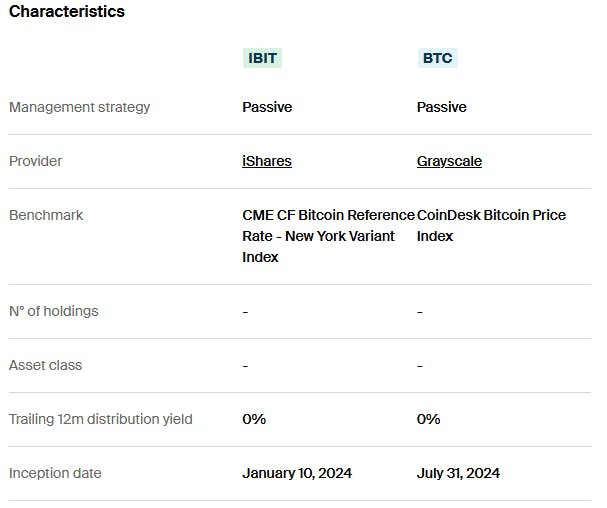
IBIT uses the CME CF Bitcoin Reference Rate – New York Variant. This benchmark aggregates trade data from multiple Bitcoin-USD markets, but only those that meet CME CF Constituent Exchange Criteria—essentially ensuring higher quality and reliability.
BTC, on the other hand, tracks the CoinDesk Bitcoin Price Index. This benchmark has been around for years and serves as an industry-provided alternative to more institutional options like IBIT’s.
When it comes to holdings, there’s not much to discuss—it’s spot Bitcoin held in trust with custodians. Both ETFs rely on Coinbase Custody Trust Company, LLC to store their Bitcoin securely.
Finally, it’s worth noting that neither ETF is an investment company registered under the Investment Company Act of 1940, meaning they aren’t regulated like typical ETFs. Instead, both operate as grantor trusts, a structure commonly used for gold ETFs.
Verdict: This point is largely moot. While the benchmarks differ, it doesn’t change the fact that both ETFs fundamentally provide spot Bitcoin exposure—the core purpose for investors.
IBIT vs BTC: Performance and risk
There’s no point diving too deep into performance and risk here—both IBIT and BTC have only been around for a short while. Bitcoin itself has performed exceptionally well recently, but as investors know, it’s a highly volatile asset, prone to dramatic swings both up and down.
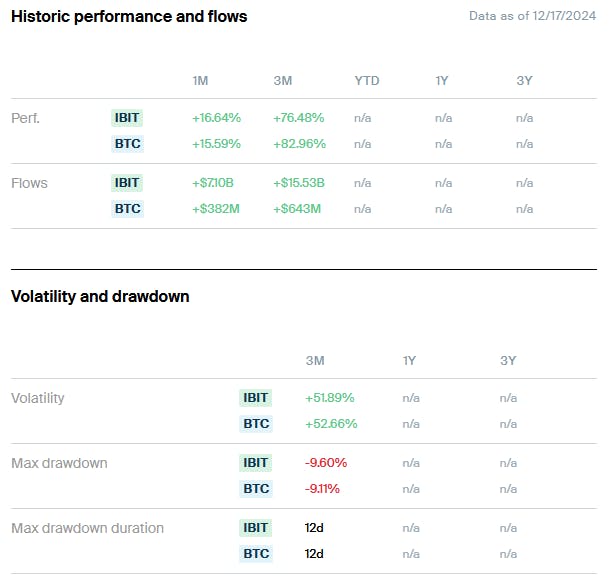
Instead, focus on replication quality. The key metrics to watch are tracking error and tracking difference, which measure how closely an ETF mirrors the spot price of Bitcoin. These are particularly important for spot Bitcoin ETFs, as deviations can signal inefficiencies in trading, custody, or fund management.
Right now, IBIT shows better replication metrics, with lower tracking error and tighter alignment to the Bitcoin price. However, the evaluation period is still very short, and it’s reasonable to expect BTC to tighten up its metrics over time as the fund matures.
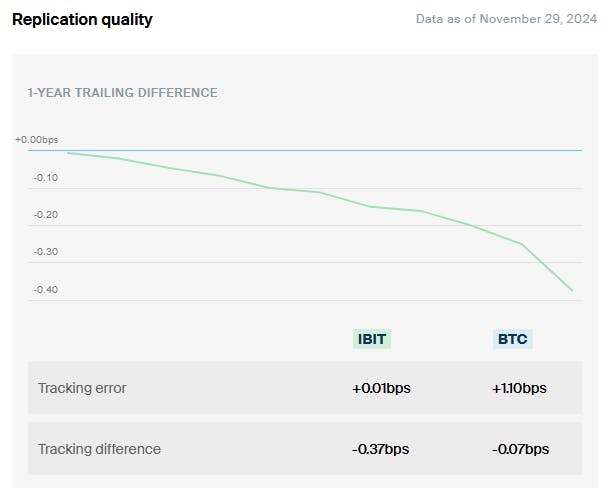
Verdict: IBIT takes the edge for now, but it’s too early to declare a clear winner. I expect BTC to close the gap as time goes on.
This article is for informational purposes only and does not in any way constitute investment advice. The author may express their own opinions, which may not represent the opinions of ETF Central or its affiliated partners. It is essential that you seek advice from a registered financial professional prior to making any investment decisions.


Latest ETF News
See all ETF newsThere's an ETF for That? Humanoid Robotics and Physical AI

How Some ETF Issuers Use Their Own Funds for Cash Management

These Public-Private ETFs Invest in Polymarket and Anduril

There's an ETF for That? Frontier Markets




 Advantages of ETFs over Mutual Funds1/6
Lower Costs
In this guide, we'll explore the advantages of ETFs over mutual funds, giving you valuable insights into why ETFs have gained significant popularity among investors like yourself.
Leveraged ETFs: Unlocking the Potential for Amplified Returns1/6
Understanding Leveraged ETFs
Explore leveraged ETFs: potential for amplified returns & risks. 5 ETFs to consider across equities, commodities & fixed income.
What is a Leveraged ETF?1/6
Introducing Leveraged and Inverse ETFs
In this guide, we'll dive into the world of leveraged ETFs, exploring their definition, mechanics, potential risks, and rewards.
Recent educational content

First Look ETF
First Look ETF: Income, International, and Cash Flow ETFs
In this season 6 episode of First Look ETF, Stephanie Stanton @etfguide examines the latest ETF marketplace trends with NYSE and guests.


ETF Trends
ETF Industry KPIs October 5, 2026
This week’s KPI data overview highlights key metrics and trends shaping the ETF landscape.

ETF Trends
ETF Industry KPIs September 28, 2026
This week’s KPI data overview highlights key metrics and trends shaping the ETF landscape.
ETF Trends
ETF Industry KPIs September 22, 2026
This week’s KPI data overview highlights key metrics and trends shaping the ETF landscape.
Browse all educational columns



ETFs’ Next Act: From Access to Selection
With 1,790 new products launched by July 2026, choosing is harder than ever. Our Global ETF Survey 2026, built on 620 professional investors and allocators, shows how active, fixed income, options-based and thematic ETFs are reshaping fund selection.