Ready-made ETF portfolios built for real investor needs. Explore now →



ETF Central's Guide to Defensive Sector Investing
Here’s my crash course on how to position an ETF portfolio defensively while sticking to equities.


Keep up with what matters in ETFs
Get timely ETF insights, market trends, and top ideas straight to your inbox.
Your newsletter subscriptions with us are subject to ETF Central's Privacy Policy and Terms and Conditions.
There are several ways to take risk off the table when building an ETF portfolio, and each comes with trade-offs.
For decades, the dominant approach was simple. Add fixed income. Investors typically used aggregate bond ETFs, and some went further out on the curve with long-duration Treasuries. That worked well during a four-decade period of falling interest rates, when bonds often rallied as stocks fell. Then 2022 arrived. Bonds drew down almost as sharply as equities, and correlations turned positive, undermining the traditional 60-40 hedge.
Other approaches try to hedge equity risk more directly through options overlays. Buffer ETFs, put strategies, put spreads, and laddered put spreads aim to limit drawdowns in exchange for capped upside or premium costs. I have covered several of these in prior articles on hedged equity ETFs. They can work, but they introduce complexity, path dependency, and often higher fees.
Factor strategies are another route, particularly low volatility and minimum volatility ETFs. While the terms sound interchangeable, they are not. Low volatility strategies typically screen for and weight stocks based on their historical price variability, often selecting the least volatile names within a universe. Minimum volatility strategies go further by using an optimization process to construct a portfolio designed to minimize overall variance, taking correlations between holdings into account.
There is also a more straightforward path: think like a macro investor. Step back and focus on sectors that, for structural and persistent reasons, have historically exhibited lower beta to the broader market and less variability of returns.
These are the defensive sectors. Their unifying trait is inelastic demand. Consumers still pay for electricity, buy household essentials, and fill prescriptions regardless of where we are in the business cycle. The three primary defensive sectors are utilities, consumer staples, and healthcare.
Below is my breakdown of each, using the relevant Select Sector ETFs from State Street Investment Management. I favor these because they are among the cheapest in the industry at a 0.08% expense ratio and draw from the S&P 500, providing a consistent baseline for market capitalization, liquidity, and earnings durability.
Global ETF Survey 2026 is Live!
With 1,790 new products launched by July 2026, choosing is harder than ever. Our Global ETF Survey 2026, built on 620 professional investors and allocators, shows how active, fixed income, options-based and thematic ETFs are reshaping fund selection.
Defensive sector ETFs explained
We’ll start with the sector you likely recognize from the products in your bathroom and the food in your fridge: the Consumer Staples Select Sector SPDR Fund
This ETF holds 38 consumer staples names drawn from the S&P 500. The portfolio spans several familiar categories. You have big box retailers such as Walmart, Costco, and Target. You have beverage giants like Coca-Cola and PepsiCo. Household product leaders include Procter & Gamble and Colgate-Palmolive. Food producers such as Mondelez and Kraft Heinz round out the pantry. And then there is tobacco, represented by companies like Philip Morris and Altria.
Consumer staples are considered inelastic because demand for these goods does not fluctuate dramatically with economic conditions. People still need toothpaste, laundry detergent, groceries, and basic household items whether GDP is expanding or contracting. That makes the sector largely non-cyclical. The numbers reflect that. XLP has a five-year monthly beta of about 0.60, meaning it has historically moved only 60% as much as the broader market.
The primary risk I see today is valuation. On a trailing 12-month basis, the sector trades around 27 times earnings. Even defensive businesses can deliver disappointing returns if you overpay for them.
Next are the companies that keep your water running and your lights on, represented by the Utilities Select Sector SPDR Fund
This ETF holds 31 companies, with heavy exposure to electric utilities such as NextEra Energy, Southern Company, and Duke Energy. There are also multi-utilities, gas utilities, and water providers sprinkled throughout the portfolio.
Utilities are often referred to as “widows and orphans” stocks. The label comes from their historically steady earnings and dividends. Think about consumer behavior during a downturn. You might cancel streaming subscriptions or dine out less often. You are far less likely to stop paying your power bill. As a result, utilities tend to show lower market sensitivity. XLU’s five-year monthly beta sits around 0.78.
The risks here are different. Utilities are capital-intensive businesses. They borrow heavily to finance infrastructure, expand their rate base, and maintain transmission and distribution networks. That makes them sensitive to higher interest rates. There is also growing disaster risk. Many utilities operate in regions where hurricanes, storms, and wildfires are becoming more frequent.
Finally, we have the companies that fill prescriptions and manufacture the drugs and devices people rely on, represented by the Health Care Select Sector SPDR Fund
The U.S. healthcare system is complex and often controversial. That complexity, however, has historically translated into strong profit pools for pharmaceutical companies, medical device manufacturers, biotech firms, healthcare providers, life science tool companies, and insurers.
Healthcare demand is also relatively inelastic. While you may hear stories of individuals rationing medications, most people prioritize medical care as much as possible because it is essential to quality of life. Reflecting that resilience, XLV carries a five-year monthly beta of roughly 0.68.
The key risk in healthcare is regulation. Political scrutiny can quickly shift sentiment and valuations. Recent controversies surrounding billing practices and claim denials within major insurers such as UnitedHealth have shown how regulatory and reputational risk can weigh on the sector.
Defensive sector ETF investing in practice
Each of these three sectors shares a common thread: essential services with relatively stable demand. They will not eliminate equity risk, but they can dampen volatility and provide a more defensive posture while remaining fully invested in stocks.
Another important point is that while each of these ETFs individually exhibits lower volatility than the broader market, they are not perfectly correlated with one another. Consumer staples, utilities, and healthcare respond to different drivers.
When you combine them and rebalance periodically, you introduce the potential to harvest a modest rebalancing premium. In simple terms, you are systematically trimming relative winners and adding to laggards, which can improve risk-adjusted returns over time.
To see how this works in practice, I used ETF Central’s new portfolio analyzer tool to build an equally weighted portfolio of XLP, XLU, and XLV, with quarterly rebalancing.
The five-year backtest compares this defensive mix against the S&P 500. On a total return basis, the S&P 500 has clearly outperformed. That is not surprising. We have been in a bull market led by cyclical and growth-oriented sectors such as technology, communication services, and consumer discretionary, none of which are meaningfully represented in this defensive basket.
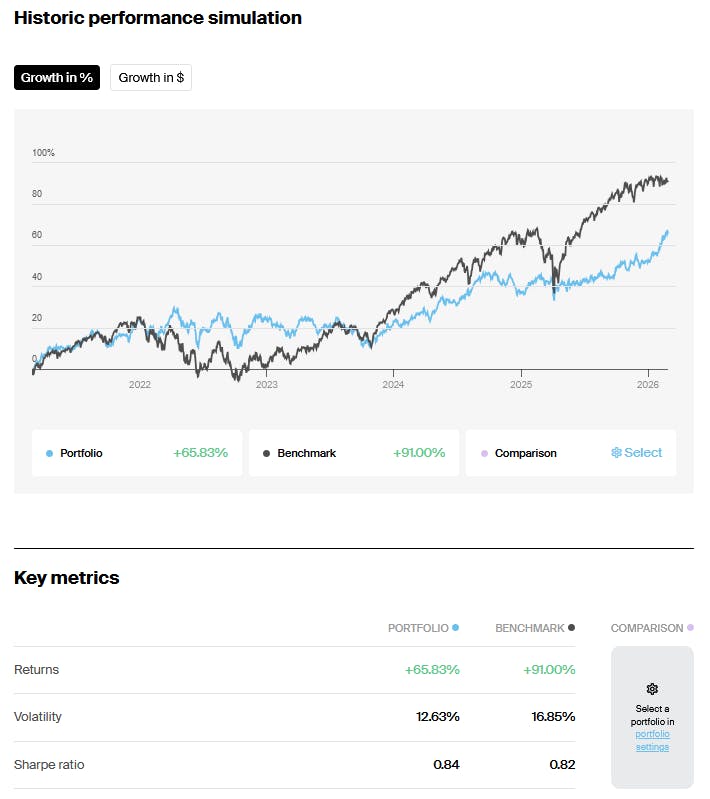
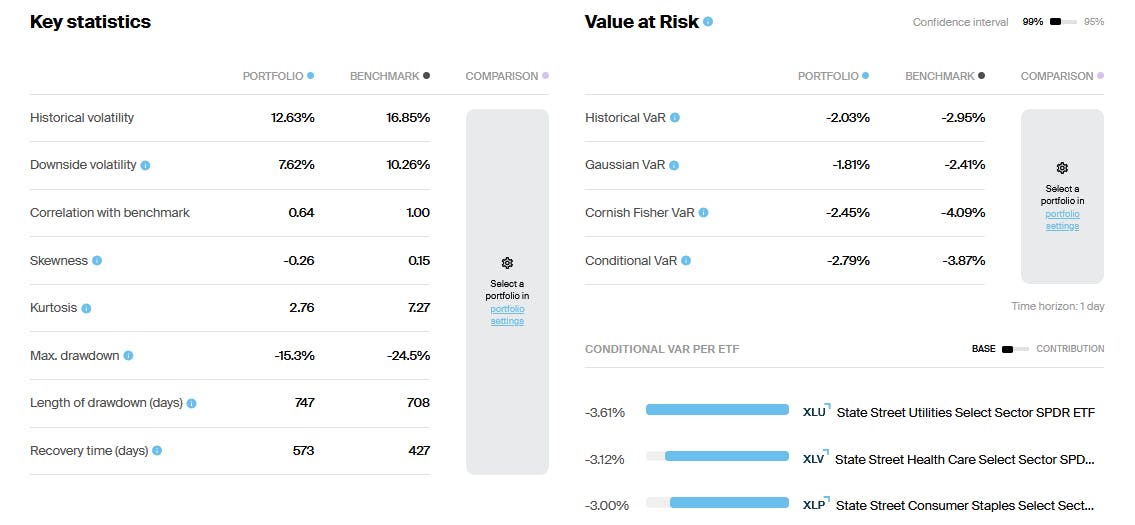
Where the defensive mix shines is on the risk side. Historical volatility was meaningfully lower. Downside volatility was reduced. Correlation with the S&P 500 was lower. Kurtosis, which measures the frequency and magnitude of extreme return events or “fat tails,” was also lower, suggesting fewer severe outliers. Value at risk was reduced across most measures as well.
Sector ETFs are not just tools for making aggressive macro bets. They can also be combined thoughtfully to shape the risk profile of an equity portfolio. Even for a relatively hands-off investor, an equally weighted, periodically rebalanced allocation to defensive sectors can serve as a simple way to dial down volatility while staying fully invested in stocks.
Please note that this article reflects the author’s personal views and does not represent the opinions of the publication or its affiliates. It is for informational purposes only and does not constitute investment advice. It is essential to seek guidance from a registered financial professional before making any investment decisions.
Mentioned ETFs
Further reading

Latest ETF News
See all ETF newsBeyond Big Tech: The Increasing Specialization of AI ETFs

There's an ETF for That? Humanoid Robotics and Physical AI

How Some ETF Issuers Use Their Own Funds for Cash Management

These Public-Private ETFs Invest in Polymarket and Anduril

There's an ETF for That? Frontier Markets



 Advantages of ETFs over Mutual Funds1/6
Lower Costs
In this guide, we'll explore the advantages of ETFs over mutual funds, giving you valuable insights into why ETFs have gained significant popularity among investors like yourself.
Leveraged ETFs: Unlocking the Potential for Amplified Returns1/6
Understanding Leveraged ETFs
Explore leveraged ETFs: potential for amplified returns & risks. 5 ETFs to consider across equities, commodities & fixed income.
What is a Leveraged ETF?1/6
Introducing Leveraged and Inverse ETFs
In this guide, we'll dive into the world of leveraged ETFs, exploring their definition, mechanics, potential risks, and rewards.
Recent educational content

First Look ETF
First Look ETF: Income, International, and Cash Flow ETFs
In this season 6 episode of First Look ETF, Stephanie Stanton @etfguide examines the latest ETF marketplace trends with NYSE and guests.


ETF Trends
ETF Industry KPIs October 5, 2026
This week’s KPI data overview highlights key metrics and trends shaping the ETF landscape.

ETF Trends
ETF Industry KPIs September 28, 2026
This week’s KPI data overview highlights key metrics and trends shaping the ETF landscape.
ETF Trends
ETF Industry KPIs September 22, 2026
This week’s KPI data overview highlights key metrics and trends shaping the ETF landscape.