Open Now: The Global ETF Survey Take the Survey →



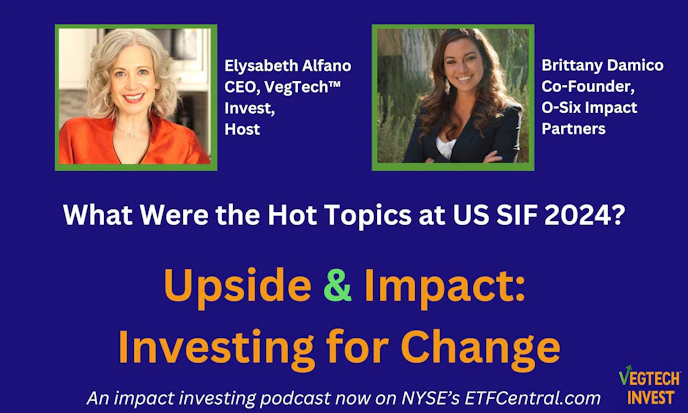
Elysabeth Alfano and Brittany Damico Recap US SIF 2024
Join CEO Elysabeth Alfano and Brittany Damico of O-Six Impact Partners as they delve into the world of sustainable investing at the June US SIF conference in Chicago.

Keep up with what matters in ETFs
Get timely ETF insights, market trends, and top ideas straight to your inbox.
Your newsletter subscriptions with us are subject to ETF Central's Privacy Policy and Terms and Conditions.
CEO of VegTech™ Invest and host Elysabeth Alfano is joined by Brittany Damico of O-Six Impact Partners to recap their take-aways at the June US SIF conference in Chicago.
Key Points Covered in the Episode: Specifically, they discussed
- the most engaging and concerning topics discussed at the conference,
- the interest in sustainable investing and how it has progressed and shifted, and
- important panels and speakers that provided thought leadership for a new era of investing.
The ETF Industry Is Evolving Fast
From AI infrastructure to active strategies, the ETF landscape is shifting. Share your perspective in the 7th Annual Global ETF Survey and get exclusive early access to the final report.
Listen here
Full Transcript
Elysabeth: Hey everyone, welcome to the VegTech Invest Upside & Impact podcast. I’m your host, Elysabeth Alfano, the CEO of VegTech Invest, Advisor to the Plant-based Innovation and Climate ETF, EATV. On Upside & Impact I chat with the leaders and movers who are shaping and growing impact investing for meaningful change. We “pull up as we go up” as the expression goes so this podcast is all about making meaningful and productive impact while also managing one’s portfolio for upside. Of course, always managing for upside.
If you’d like more information about VegTech Invest you can visit us at VegTechInvest.com and subscribe to our newsletter. You can also find us on LinkedIn and on Twitter @VegTechInvest. We record live every first and third Wednesday of the month on our LinkedIn page at 1:30pm eastern standard time. So, check us out live and be sure to bring your questions.
Now if you’re listening as part of a podcast, of course subscribe to this podcast right now so that you never miss an episode. And if you’re listening on iTunes, be sure to leave a 5-star review. It really does help.
So now let’s get down to today’s show and thanks for being with me on today’s episode of VegTech Invest’s Upside & Impact. And as always, a reminder, this podcast is for informational purposes only and is not meant to recommend any specific company or investment. Now, onto the show.
Hey everybody, welcome to another episode of Upside & Impact: Investing for Change, distributed by the New York Stock Exchange’s ETFCentral.com. Thank you, NYSE. I sure do appreciate that. Of course, it’s also on iTunes and Spotify. You can also find a link on the VegTechInvest.com website. If you go to iTunes and you have enjoyed this podcast, go ahead and share. Go ahead and share. It sure does make a difference.
If you hear some background noise or maybe even hear a big air conditioning vent or something, I am in Chicago for the US SIF Conference. That stands for Sustainable Investment Forum. We are at the very tail end of day two and I ran into a friend and colleague in the hall of the conference so we’re ducking away so that we can have a nice chat today to talk about what we’ve learned at the US SIF Conference. Brittany Damico, Founder of O-Six. Thank you for being with me today.
Brittany Damico: Thank you for having me. It’s great to be here.
Elysabeth: So, give everybody a rundown of O-Six and what you do.
Brittany Damico: O-Six Impact Partners, we are a third-party distributor which means that we work with small and scrappy, super sustainable firms such as VegTech Invest and we do sales, help with marketing, and just help elevate and tell the story for these firms that are doing really powerful, great work.
Elysabeth: Yeah, I just can’t sing your praises enough. I feel so lucky to be in the O-Six umbrella because I know what most distributor firms do in terms of being on the ground and it’s nothing compared to what you guys do and I also know what they charge, and I just feel so grateful and lucky to be under the O-Six umbrella.
So here we are on day two of the US SIF Conference which happens every other year. So, there’s a member meeting next year and so the next US SIF conference will be in 2026. I think the world will look quite different in 2026. So here as we get to the tail end, any major takeaways, or constant themes? I mean, we’ve had two days of panels that have been journalists and politicians and investment advisors and researchers, but they’ve all had some common threads. What have they been for you?
Brittany Damico: Yes, I think that’s a good point because a lot of the sessions that we’re in are kind of all over the map. We’re talking about every angle of sustainable investing and so for me I was making notes and I was reading through them. The one thing that really resonated was this idea of listening. I think it’s a good time in the industry for the sustainable investing space to just- I don’t want to say retreat because that’s not the right word but take a step back and listen to the field. Listen to what corporations are saying they need, and just kind of readjust our narrative in the way that we’re approaching the market to ensure that we are communicating in a way that is productive and helpful and really getting our point across in a meaningful way. So “listening” was my word for the conference.
Elysabeth: Yeah, and I’ll just take a little bit of a deeper dive. We were both sitting in the journalist lunch-and-listen panel and the journalists from Morningstar, US News and World Report, Reuters and I believe a PR firm. They were talking about how there’s been a slam on ESG, let’s just call it that, and has it been data-driven or has it been politics-driven? So, there are some questions about pushback on that and then there’s also the question of is it your editor pushing you to write for the clickbait?
There was another freelance journalist. So, the questions were, is your editor pushing you to go for that clickbait, or are you coming up with the sexy headlines yourself, or what’s driving some of this stuff that is more shock value than data? I thought Leslie from Morningstar had a good comment. She said we must balance this content for what people are willing to read and the data that makes sense but maybe we should be focusing more on the search terms in Google as to what people are really most interested in and it’s not the term “ESG” so maybe you can share what else she talked about.
Brittany Damico: Yes, I love Leslie Norton. She’s amazing. She’s a great writer. She was touching on the subject, and she had referenced an article and I don’t have the name of it but when we get it we should link it to the podcast. It was a group of subreddits. I don’t remember how many there were, but it was a large group of subreddits and when people were talking about sustainable investing, what terminology were they using? It wasn’t ESG and it wasn’t sustainable investing, it was more direct. There were things like climate change, it was things like nuclear and fossil fuels.
So, speaking more to what people want to hear, like what are they talking about? ESG might mean nothing to the end retail investor. So, you must communicate what it means for ESG. How do we talk about it in a way that’s more casual, more colloquial, in a way that people can connect to? I think that’s really an important takeaway.
Elysabeth: Yeah, I agree with that. So, for those of you listening on NYSE’s ETFCentral.com, I know that some of you are registered investment advisors and some of you are just retail investors. So, this is more for the investment advisors. This is really an opportunity to have conversational alpha. So, if ESG was in its hopeful days meant to be this one big umbrella that everything literally under the sun fell under, that really isn’t working anymore.
But what is working is that you can go sector level and there’s a lot of passion and that’s all brewing right there under the big ESG terminology. So, whether it’s climate change or oceans or food systems transformation or social justice issues. It’s all there and that gives you the opportunity to really get closer to your clients.
Brittany Damico: Yeah, totally, and I think just speaking on food quick. Another panel that we were in that was fascinating was on private markets and private investing.
Elysabeth: S2g?
Brittany Damico: Yes.
Elysabeth: Hi s2g. We love s2g.
Brittany Damico: Yes, they were talking about an ocean fund that they have and talking about looking at food differently and looking at aquaculture. How can we invest in that in a meaningful way and look at companies that really had a positive impact. They were just referencing how much of a trend that they see this becoming, that that’s where it’s going, and that they didn’t have a lot of competition. That was what the moderator was asking, “So you have an ocean fund? That’s something really kind of differentiating.”
When they started talking about the way that they’re going to produce food and what we’re looking at, it made a lot of sense and they said, “You don’t have a lot of competition, but this is the upcoming trend, so we’re going to see a lot more of that,” and I thought that was tangible and resonated with VegTech’s methodology and process.
Elysabeth: Yeah, s2g is very dedicated to food and agtech and now adding in blue oceans or the ocean economy, if you will, and they’ve been very forward about it and very aggressive in their investing. They’ve been aggressive about it and kind of leaders on the forefront. I enjoyed that panel as well. I also enjoyed what Aaron Rudberg was saying from s2g about how he doesn’t like to paint anything with a broad brush. He likes to really say, “I’m sector focused on climate, on food, and on oceans.” It’s great to see. Are there any other panels that stood out to you?
Brittany Damico: Oh, on the hotspot. You know, there was the congressman that came in from Florida and I’m drawing a blank on his name.
Elysabeth: He was great.
Brittany Damico: He was. I think one of the benefits of the Sustainable Investment Forum or US SIF, is that they do bring in all these policy experts. There was a congressman, there was a treasurer, and so getting these different perspectives that we don’t necessarily always hear in the echo chamber of just the financial sector, kind of broadening that out and hearing more from the policy realm, so any of those different conversations I thought were beneficial.
Elysabeth Alfano: Yeah, Michael Friedrich, the state of Illinois treasurer, in charge of $56 billion, he was saying that he does get push back about ESG and his responses and I think most people have the same response, “I want the data. If you don’t want the data, don’t read it, but I want it.” He was even more aggressive.
I do love it when they bring in the politicians because they’re so charismatic. They’re so used to really engaging the audience. He said, “I’m really happy to know that you won’t read the data because it makes me have a competitive advantage over you.” So, I think he used the term laziness. I’m not saying that. This is a quote. He said, “You know, if you want to be a lazy investor, that is just better for me.” So, I said, “Well, no holds barred here.”
Brittany Damico: Basically. Again, they are so good at engaging the audience, so it was fun to listen to. It’s engaging. It creates different perspectives, and I like that they just roped in some different elements this round.
Elysabeth: You know, when I came here, I was a little worried if everyone was going to feel down and out. We’re about four months out from an election, so of course that determines whether you are to the right or to the left, or whether you’re a sustainable investor or not. Elections tend to make people a bit nervous. This year might be even more extreme in that regard, and I wondered if people’s spirits were going to be down and out or if they were going to be down on sustainable investing or if there was going to be a small turnout, but that hasn’t been the case at all.
Brittany Damico: It hasn’t and it’s energizing because you come into these kinds of concerns like what is the pulse. What’s the energy going to feel like, but everybody here are optimistic people who are looking at the future. The interest levels are there so it’s not like you see these waning interests in sustainable investing. It’s how can we do it differently, how can we do it better, what is out there, what do we need to talk about, what do we need to address, what do we need to listen to?
So, I think coming to these events is always great. You meet wonderful people and you do leave a little bit more re-energized and feeling that there is a lot of enthusiasm around the space, and it isn’t draining.
Elysabeth: Yeah, I would agree with that. It’s very energizing but also there are some great takeaways again for the asset owners, I think, because what I’ve been seeing from the registered investment advisors is that they’ve been sort of hiding from their clients for lack of a better perspective. They’re just so afraid if they’re going to make the wrong move or say the wrong thing or if any conversation is going to be polarizing, that they’ve been staying away from conversations altogether.
In fact, here’s that opportunity to really create that deeper, longer-lasting relationship, particularly as younger generations get into having wealth, and you don’t want that younger generation to leave you. You want to establish that relationship like you did with the previous generation. So, I thought there was a lot of focus on developing that conversation and then it was even. I was happy to see this from a food systems transformation perspective, it was even about greenhouse gas emissions reduction, food systems transformation, diversity, equity, and inclusion, and maybe the least was really transportation. There hasn’t been that much content on transportation.
Brittany Damico: I think the conversational alpha is gold. I think that the more you can speak to these different elements, whether it is you want to focus on sector-specific, just maybe looking at energy or if you’re looking at food or whatever that might be but in terms of what the conference is offering, I think it’s reflective of that interconnectedness. If you’re talking about sustainability it’s all dependent on all of these different components sf it has to have equal representations so people begin to understand where the connections are and how if we’re working in one sector how that affects the others and what needs to happen to ensure that we’re elevating everything at once as opposed to just really targeting or having a micro-focused lens from the sustainable investing space as a whole.
So, I think the conversational alpha in terms of understanding each of the different elements is beneficial to do the deep dives. I think at these conferences, when you get a piece of everything, it helps tie it together in a thread that really illustrates that interconnectedness that is sustainability, that word that we say so much, but has so much meaning behind it.
Elysabeth: Yeah, I love that because I think it helps the registered investment advisor really build out a sustainability sleeve, so they have diversity within that sleeve. So, they’re not just hanging their hat on alternative energy, which all things have their ups and downs and that’s been going through a rough period, but there are other things you can invest in to have a well-balanced, diversified investment sleeve.
The panels did not address this, but at lunch and at cocktail hour, some of the interesting conversations I was having was about concentration risk. So many people either have cash on the sidelines or they’re in the Mag 7 and every ETF they invest in is basically a different wrapper for the Mag 7. So, there’s this potential bubble, but more importantly, this high concentration of everyone being in the same seven companies. So, there's this sort of, I wouldn’t call it a fear, but a rising element of concern of concentration risk. I wonder if you have had any of those side conversations.
Brittany Damico: Oh, totally. I feel like the Mag 7 has been in any allocation conversation that’s been happening. That’s a hot topic and diversification is key, right? It's a necessity. I mean, modern portfolio theory shows that we need diversification. It’s just part of building allocations and so coming to these kinds of conferences, learning about the different strategies, looking at it from different perspectives, I think that is the benefit.
People will have a broader pool of understanding to go about that so they can get out of the Mag 7. Look at these different opportunities for these up-and-coming sectors and industries like food. These are places that we can go to for investments that are going to create that diversification.
Elysabeth: Yeah, and I think that’s been helpful to educate people about other options beyond the Mag 7. So, when they feel that the time is right, there’s of course some tax restraints, it’s gone up so much that everyone’s a little bit afraid to get out, but then you’re stuck. It’s like golden handcuffs. You can’t get out but it’s great to know what you will move to when you’re ready when there’s a little dip or what have you when your tax bracket allows for such things. So, I think this has been great in that respect.
I’ve had some other fun cocktail conversations moving through the rooms with people. One registered investment advisor was telling me that he just moved to a new firm, and he is the only voice of sustainability at that firm. The firm didn’t really think of sustainability as an option for them to gain business, but he’s been bringing over clients for sustainability and the rest of the team is now realizing, “It’s not an either/or, it’s a yes/and. It’s an option on the menu that can bring us more business. So, we don’t have to put people in sustainable options if they don’t want them, but they can choose that tilt now in our company whereas they couldn’t before.”
So sometimes the cocktail conversations are as much fun as the panels, and I learned just as much, and that’s partly what’s so energizing is to be around so many with such a united vision and yet different ways of approaching sustainability for their clients. So, I’m wondering when O-Six, you, and your co-founder Dan Carreno, when you speak to investment advisors, small advisors, large advisors interested in sustainability, do you guide them on the portfolio construction for the sustainability arm of their investments?
Brittany Damico: We must be conscious with the term “guiding” because we are here as promoters. We tell stories. We essentially provide insight into what’s out there for their allocation, so these different elements that they can incorporate. I will say that a lot of the advisors that I’ve talked to have moved firms where they are creating the sustainable models, or the sustainable arm, kind of the same story that you were just telling. In that case, when a new client comes in, they’re able to gain different levels of business.
So, if a client comes in, they don’t have to lead with sustainability, but being able to say, “Are you looking for a traditional portfolio or would you like a portfolio that has a bit more of a sustainability tilt and we can kind of dig into what your values look like in that sleeve?” Often, every advisor that I work with that has that type of structure and procedure, they say that eight to nine out of ten of the clients will go towards that sustainable sleeve.
So more of the registered investment advisors that have an option, or they have advisors who are strictly working on the sustainability model building, portfolio development, analysis, due diligence of the funds and asset managers, they can say that they get more business and that’s been something that I’ve seen repeatedly when I’m going to market talking to different financial advisors.
Elysabeth: Yeah, it’s wonderful insight and I think it’s helpful for the advisors. I’ll tell you as we wrap up here, as happy as I was to see so much food systems transformation information being dropped at this conference, I ran a panel or a breakfast table I should say, on investing in food systems transformation. The former U.S. ambassador to the Food and Agriculture Organization of the United States, Ertharin Cousin, spoke about food systems transformation and investing in that.
There is a regenerative agriculture panel. There’s been food woven in and out of the sustainability discussions.
Brittany Damico: The food we ate.
Elysabeth: The food was all vegan here or mostly vegan. Everyone was full and everyone loved it. I heard great feedback on that, but I think one of the most engaging panels for me and that says a lot because I was so engaged in the food panels, was how to speak to retail clients or getting new clients.
Ally Morton, I believe is her last name from Align Impact, was saying it resonates particularly with women but also with men that she often starts the conversation by saying, “What trauma do you have around money?” because she wants to understand all the baggage that they bring. “I’m afraid I’ll never have money.” “I thought I’d be poor.” “I’m afraid of losing money now that I have it.” These insecurities that she puts under the umbrella of the term “trauma”, and I thought, “Wow, that’s really getting to the heart of it.”
We started this conversation and podcast by saying conversational alpha, getting to know your clients and what they’re passionate about. This takes getting to know your clients to a whole new level and I thought, “It’s money therapy.” I can’t tell you how many people I’ve talked to and they say, “Don’t even talk to me about investing. I hand it over to someone at XYZ firm and I never look at it.” It does seem like trauma. They’re unwilling to even look at their own finances which determines their future. So, I will have her on this podcast, but you were there in that panel?
Brittany Damico: Yes, she was amazing. I had the same thought the minute she said that. I thought, “Wow.” It was a wow moment. That was just impressive the way she delivered it and the way she communicated about it. People have so many personal identities, thoughts, and feelings around finance that to give them space to be able to share that at the beginning of a meeting is just going to do nothing but help her guide it in a way that she’s communicating that they feel safe. They feel empowered. Everything about that was a mic drop moment and Ally is just wonderful.
Elysabeth: Yes, she is wonderful. It also sets up early for the client like, “How much do you want me to check in with you? Can we get you over the hump of this fear? Should I be checking in kind of often with you or should I just stay away?” I think in the past when I think of my parents’ era of investing, it was very much the financial advisor never showed their face. They were like, “I take your money. I do with it what I do, and you just say yes.” Those days are over.
Brittany Damico: Yes, those days are over. Let’s move on.
Elysabeth: Yes, let’s move on. Speaking of which, it is about cocktail hour here, so we are moving on as well, but I just want to thank everyone for listening to the podcast. Please do share, please do share and I will be back right here in just about two weeks. Have a great day everybody.
Thanks for being with me everyone on today’s episode of VegTech Invest’s Upside & Impact. I hope that you’ve found this to be a knowledge drop and I’m always here to answer any questions so please feel free to reach out to me on LinkedIn. Elysabeth Alfano, you can find me there. I’m also on Twitter @ElysabethAlfano and you can find the VegTech Invest pages on both LinkedIn and Twitter.
Sign up for our newsletter at VegTechInvest.com and share this podcast with your colleagues, friends, and clients. And of course, be sure to subscribe to this podcast to never miss an episode. Remember we record live on the VegTech Invest LinkedIn page every first and third Wednesday of the month at 1:30pm eastern standard time. So come find us there to join the conversation live. Until then, thanks for leaving a 5-star review on this podcast app because it really does help.
If you’d like more information about VegTech Invest you can visit us at VegTechInvest.com and subscribe to our newsletter. Okay everyone, great show today. See you next time on VegTech Invest’s Upside & Impact.
VegTech Invest is a registered investment advisor focused on investing in sustainable food and materials. This podcast is for informational purposes only and should not be relied on as the basis for investment decisions. It does not constitute either explicitly or implicitly any provision of services or products by VegTech Invest. All statements made regarding companies and securities are strictly beliefs and points of view held by VegTech Invest or podcast guests and are not endorsements or recommendations to buy, sell, or hold any security. Clients of VegTech Invest may maintain positions in the securities discussed in this presentation. VegTech Invest believes that the information presented is accurate and was obtained from sources that VegTech Invest believes to be reliable. However, VegTech Invest does not guarantee the accuracy or completeness of any information and such information may be subject to change without notice from VegTech Invest.
Certain statements in this presentation may be statements of future expectations and other forward-looking statements that are based on VegTech Invest’s views and assumptions at the time of publication and involve risks that could cause actual results, performance or even events to differ materially from what is expressed or implied by such statements. VegTech Invest’s strategies are actively managed and not intended to replicate the performance of any cited index which may differ materially. You cannot invest directly in an index.
Segments
See all
No specific market segments were tagged
Mentioned ETFs
No specific ETFs were tagged
Further reading
Latest ETF News
See all ETF newsThis is How Calamos Turned Wall Street’s $100 Billion Secret Into an ETF


From Dot-Com to ETFs: How One Entrepreneur Helped Spark an Investment Revolution
How Blossom Social Is Revolutionizing Retail Investing and ETF Marketing
Is 2025 the Year for Financing Food Fast?

 Advantages of ETFs over Mutual Funds1/6
Lower Costs
In this guide, we'll explore the advantages of ETFs over mutual funds, giving you valuable insights into why ETFs have gained significant popularity among investors like yourself.
Leveraged ETFs: Unlocking the Potential for Amplified Returns1/6
Understanding Leveraged ETFs
Explore leveraged ETFs: potential for amplified returns & risks. 5 ETFs to consider across equities, commodities & fixed income.
What is a Leveraged ETF?1/6
Introducing Leveraged and Inverse ETFs
In this guide, we'll dive into the world of leveraged ETFs, exploring their definition, mechanics, potential risks, and rewards.
Recent educational content

ETF Trends
ETF Industry KPIs July 20, 2026
This week’s KPI data overview highlights key metrics and trends shaping the ETF landscape.

ETF Trends
ETF Industry KPIs July 13, 2026
This week’s KPI data overview highlights key metrics and trends shaping the ETF landscape.
First Look ETF
First Look ETF: Cash Deployment, Bond, and Hedged ETFs
In this season 6 episode of First Look ETF, Stephanie Stanton examines the latest ETF marketplace trends with NYSE and guests.

ETF Trends
ETF Industry KPIs July 6, 2026
This week’s KPI data overview highlights key metrics and trends shaping the ETF landscape.
Browse all educational columns



Active Trader Report: Use of Leveraged & Inverse ETFs Way Up
Direxion partnered with Compound Insights and Vanda to explore what’s driving the evolution of active trading — and how active traders are using leveraged and inverse funds across equities, single stocks, commodities, and volatility.