Explore professionally built ETF model portfolios. Discover now →



Diversify Your Portfolio with Agriculture Commodities
Commodity agriculture ETFs provide investors with distinct diversification benefits for their portfolios.

Keep up with what matters in ETFs
Get timely ETF insights, market trends, and top ideas straight to your inbox.
Your newsletter subscriptions with us are subject to ETF Central's Privacy Policy and Terms and Conditions.
One of the famous axioms attributed to Warren Buffet is, “Invest in what you know”, well…food is a necessity for all humans, which must surely make agriculture a great investment, right? While there is certainly truth in that surface-level assessment, in this article we’ll take a look at the benefits of investing in the agriculture sector and explore turnkey investment solutions from a specialist asset manager, that provides fulsome exposure to the sector’s most prominent goods.
Like what you're reading?
Stay in the loop — get the latest ETF insights: trends, analysis, and expert picks.
When investing in Agriculture, think Commodities
Though the natural association one makes when thinking of agriculture is food, when it comes to investing, it should really be commodities – the raw, unprocessed grains (i.e., wheat, corn, soybeans, etc.) that are essential in making the food (i.e., bread, rice, etc.) we eventually eat. When considering commodities as an asset class, there are two primary ways they benefit investors:
Commodities as a hedge against inflation
Inflation—which can erode the value of stocks and bonds—can often mean higher prices for commodities. This positive correlation between inflation and commodities has been observed over time and demonstrated particularly throughout the past year, as the agriculture price index has moved in tandem with the rise in inflation, consistently.
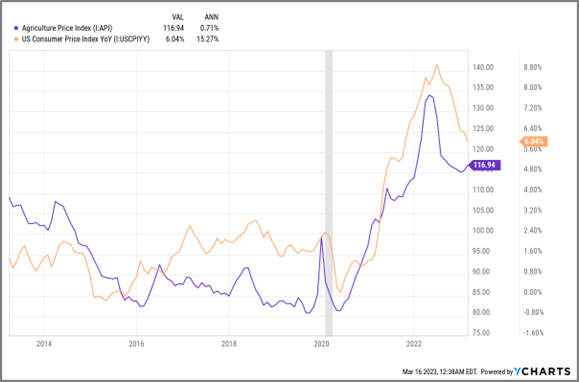
For businesses involved in commodities, as the cost of farming and producing grains increases, they are passed along the development value chain and ultimately reflected in the prices of the goods that are consumed. For investors that have exposure to commodities (or associated businesses) within their portfolio - the strong pricing power they possess allows them to mitigate the effects of rising inflation, relative to other asset classes or business entities in the economy.
Commodities as a portfolio diversifier
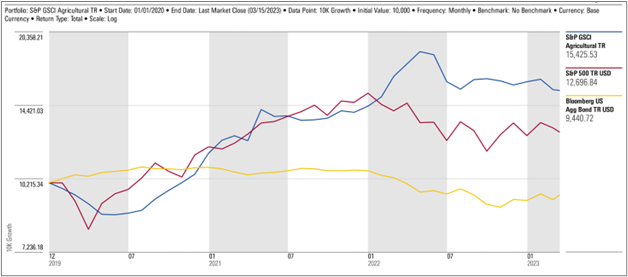
Investors looking for ways to diversify their portfolio outside of the more traditional asset classes, such as stocks and bonds, will at times turn to commodities. In looking at the 10-year correlation between the S&P GSCI Agricultural TR Index, the S&P 500 TR USD Index, and Bloomberg US Aggregate Bond TR Index, proxies for the agriculture commodity asset class, US equities and US bonds respectively, there is clearly a weak to negligible relationship between the agricultural index and other two indices.
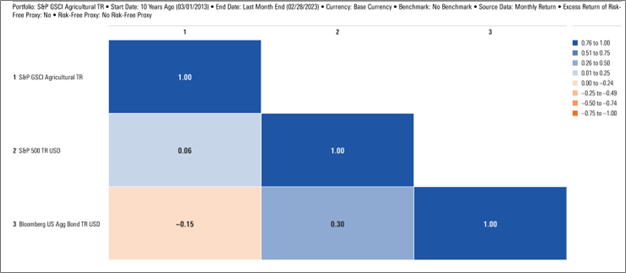
Though commodities have strong diversification capabilities, it is fair to note that they can be volatile, and their performance is highly driven by market dynamics. In recent years, agriculture as an investment segment has been impacted by global events, such as COVID and the Russia-Ukraine war. In the case of the latter, as reported by CNN Business, Ukraine normally supplies about 45 million metric tons of grain to the global market every year and is the world’s top exporter of sunflower oil. Together with Russia, it accounted for approximately a quarter of global wheat exports in 2019. The end of that market supply led to a price increase, which was ultimately reflected in the recent investment performance of the S&P GSCI Agricultural Index.
In looking at the performance of all three indices over the past three years, the agriculture index has been able to outperform both the S&P 500 Index and Bloomberg US Aggregate Bond Index, due to said market forces. Furthermore, as climate developments, such as extreme heat and flooding become more commonplace – this will impact the crop yields of all grains and be reflected not only in the pricing of food, but in the performance of commodity investments.
Why consider investing in Agricultural Commodities
As mentioned in an earlier article, here, the ability of the 60/40 portfolio to meet the full investment goals of investors in an ever-evolving and complex market environment is in question. To address this complexity, alternative assets, such as agriculture commodities, have proven to be additive components to bond and equity portfolios, given the attributes outlined earlier in this article – their ability to hedge inflation and their low/negligible correlation to traditional assets.
In looking at the trailing performance of each asset class, as of December 2022, using their respective indices as a proxy, an allocation to agriculture would have been additive to portfolio performance in most instances.

For investors looking to bolster performance and/or mitigate the risk elements specific to traditional assets within their portfolio – agriculture commodities as an alternative asset allocation could be a worthwhile consideration and solution.
Investing in agriculture commodities through ETFs
For investors interested in gaining exposure to agriculture commodities, Teucrium Trading is an ETF provider of commodity-based solutions focused on US Agriculture. Across the firm’s suite of solutions, investors can gain pure-play exposure to specific commodity types or benefit from diversified, single-ticket portfolio offerings.
Direct, pure-play commodity ETFs offer investors a convenient way to gain exposure to the price of specific commodity futures including:
- Teucrium Corn Fund (Ticker: CORN), provides investors an easy way to gain exposure to the price of corn futures.
- Teucrium Wheat Fund (Ticker: WEAT) provides investors an easy way to gain exposure to the price of wheat futures.
- Teucrium Soybean Fund (Ticker: SOYB) provides investors an easy way to gain exposure to the price of soybeans futures.
- Teucrium Sugar Fund (Ticker: CANE) provides investors an easy way to gain exposure to the price of sugar futures.
Alternatively, for investors seeking more diversified exposure within a single-ticket portfolio the following could be of interest:
- Teucrium Agricultural Fund (Ticker: TAGS) s a passively managed fund of funds, that holds Teucrium’s single-commodity ETFs (CORN, WEAT, SOYB, CANE), in equal weight.
- Teucrium Agricultural Strategy No K-1 ETF (Ticker: TILL) is an actively managed fund that provides investors an easy way to gain long only price exposure to corn, wheat, soybeans, and sugar futures. Though TILL and TAGS are similar in their objective, the key difference between them is the tax treatment of TILL.
- Teucrium AiLA Long-Short Agriculture Strategy ETF (Ticker: OAIA) delivers access to an agriculturally focused quantitative strategy that has the potential to achieve positive returns regardless of market direction. The ETF will track the performance of the AiLA-S033 Index, a sophisticated long-short investment strategy in the agriculture sector.
Please note this article is for information purposes only and does not in any way constitute investment advice. It is essential that you seek advice from a registered financial professional prior to making any investment decision.


Latest ETF News
See all ETF newsETF comparison: NEOS S&P 500 High Income ETF (SPYI) Versus Goldman Sachs S&P 500 Premium Income ETF (GPIX)


There’s an ETF for That? Investing Like University Endowments

Could Water ETFs Be the Next AI Bottleneck Trade?
What is a Boomer Candy ETF?




 Advantages of ETFs over Mutual Funds1/6
Lower Costs
In this guide, we'll explore the advantages of ETFs over mutual funds, giving you valuable insights into why ETFs have gained significant popularity among investors like yourself.
Leveraged ETFs: Unlocking the Potential for Amplified Returns1/6
Understanding Leveraged ETFs
Explore leveraged ETFs: potential for amplified returns & risks. 5 ETFs to consider across equities, commodities & fixed income.
What is a Leveraged ETF?1/6
Introducing Leveraged and Inverse ETFs
In this guide, we'll dive into the world of leveraged ETFs, exploring their definition, mechanics, potential risks, and rewards.
Recent educational content

ETF Trends
ETF Industry KPIs September 14, 2026
This week’s KPI data overview highlights key metrics and trends shaping the ETF landscape.

ETF Trends
ETF Industry KPIs September 8, 2026
This week’s KPI data overview highlights key metrics and trends shaping the ETF landscape.
ETF Trends
ETF Industry KPIs August 31, 2026
This week’s KPI data overview highlights key metrics and trends shaping the ETF landscape.
ETF Trends
ETF Industry KPIs August 24, 2026
This week’s KPI data overview highlights key metrics and trends shaping the ETF landscape.
Browse all educational columns



Expert-Built ETF Portfolios, All in One Place
Don’t start from scratch. Discover ready-made ETF portfolios built by professionals to match different goals, timelines, and market views. Use them as inspiration or as a starting point for your own allocation.