Ready-made ETF portfolios built for real investor needs. Explore now →



Diversify Your Diversifiers with the AGF U.S. Market Neutral Anti-Beta Fund (BTAL)
This alternative ETF can help allocators combat the challenging market conditions of 2022.

Keep up with what matters in ETFs
Get timely ETF insights, market trends, and top ideas straight to your inbox.
Your newsletter subscriptions with us are subject to ETF Central's Privacy Policy and Terms and Conditions.
Stocks are for growth. Bonds are for ballast. That’s the traditional idea behind a balanced portfolio. But what happens when both move together, and not up, but down? That’s what investors in classic 60/40 portfolios went through in 2022.
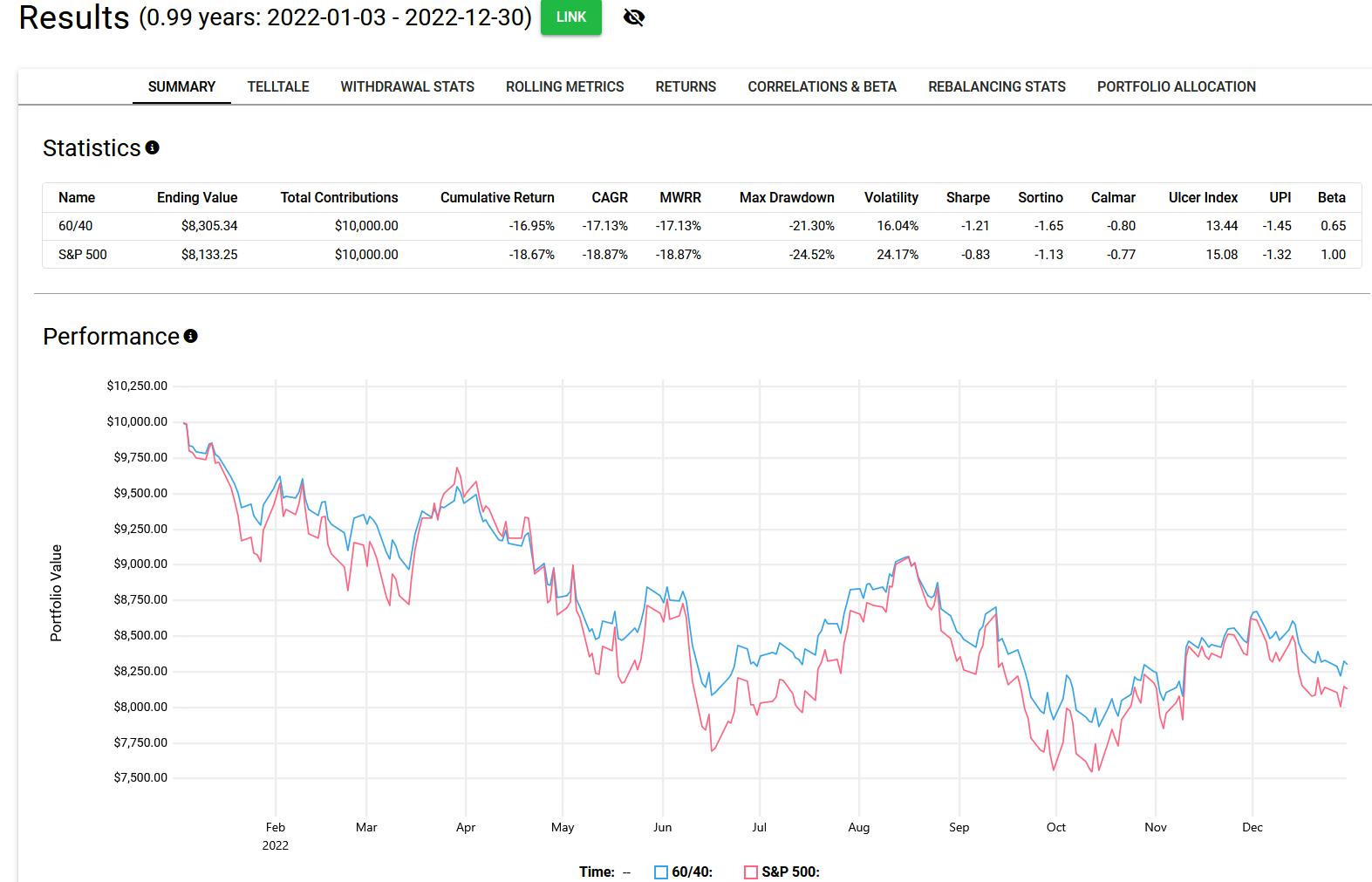
From January to December that year, a 60/40 split between U.S. stocks and aggregate bonds lost 16.95%, with a max drawdown of 21.30%. Going all-in on the S&P 500 didn’t help much either. That was down 18.67%, with a peak-to-trough drawdown of 24.52%. The problem was bonds didn’t cushion the blow.
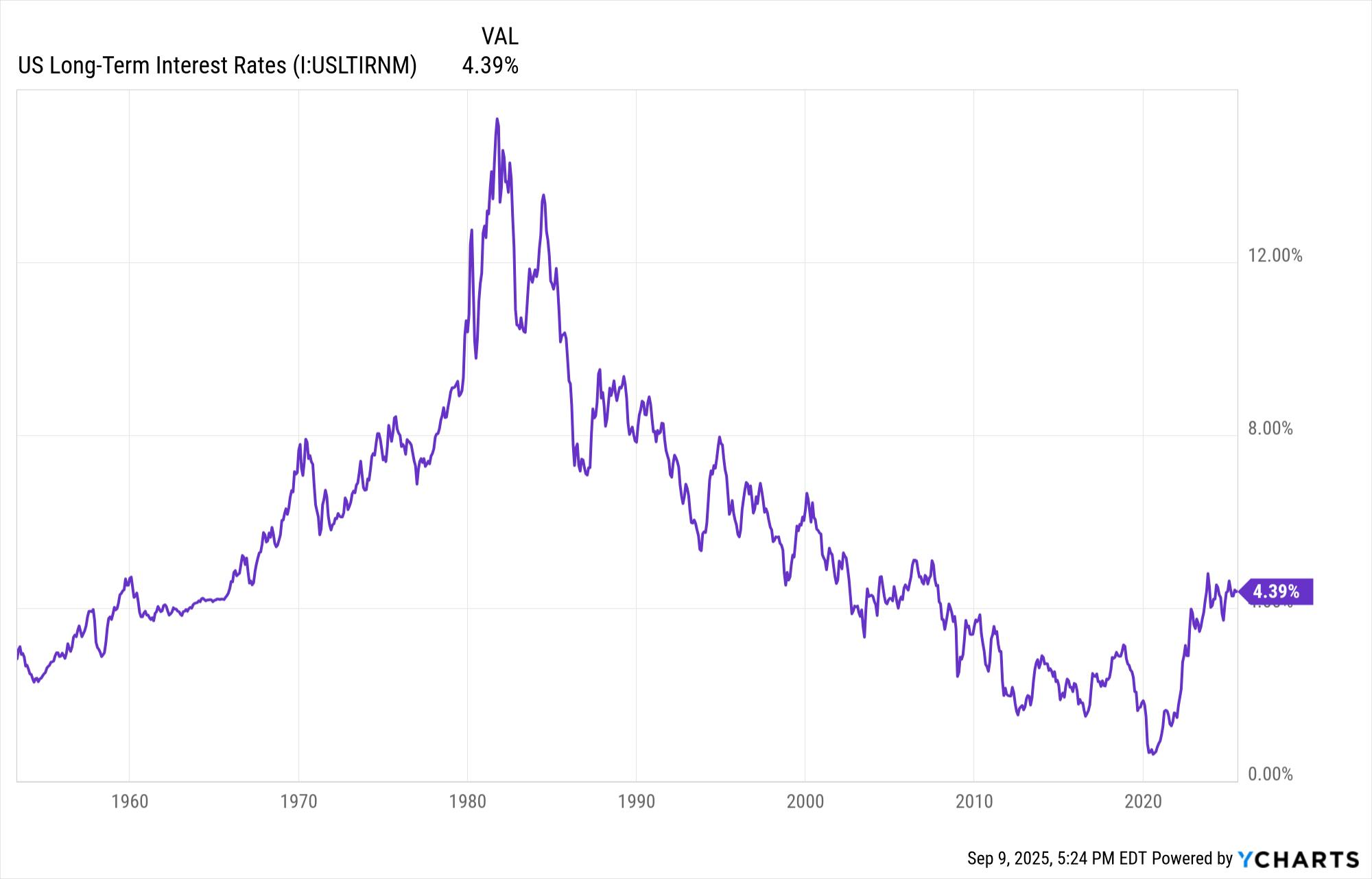
What played out was rare. It wasn’t just high inflation but also the end of a 40-year tailwind of falling long-term interest rates. The chart below tells the story. After decades of decline, rates surged.
The takeaway here isn’t to abandon the 60/40 model. It’s to complement it with a thoughtful allocation to alternatives that don’t depend on stocks and bonds moving in opposite directions.
One notable option for this is the AGF U.S. Market Neutral Anti-Beta ETF
Global ETF Survey 2026 is Live!
With 1,790 new products launched by July 2026, choosing is harder than ever. Our Global ETF Survey 2026, built on 620 professional investors and allocators, shows how active, fixed income, options-based and thematic ETFs are reshaping fund selection.
How does BTAL BTAL-0.08% work?
BTAL follows a market-neutral strategy. It focuses on the relative performance between two groups of stocks. Specifically, BTAL does two things:
- Goes long low beta U.S. equities
These are companies that tend to move less than the market. Think of them as more stable, less volatile stocks. - Goes short high beta U.S. equities
These stocks tend to swing more than the market. They rise more when markets are rallying but also fall harder during downturns.
The goal is to exploit the spread between these two groups. When low beta stocks outperform high beta stocks, BTAL makes money. This approach creates a new source of risk and return. That’s why BTAL can be an effective diversifier in a portfolio.
The strategy works well in defensive environments where investors pull back from speculative growth names and rotate into quality or value stocks. That’s exactly what happened in 2022. But it can underperform in momentum-driven bull markets like 2021 or even recently in 2025, when high beta names rip higher and low beta gets left behind.
As of August 31, 2025, BTAL holds 198 long and 198 short positions.
From a fundamentals perspective, the long portfolio has an average market cap of $72.3B with a beta of 0.65 and trades at a price-to-earnings ratio of 22.65. The short portfolio is slightly larger by market cap at $79.4B, but riskier, with a beta of 1.39 and a much higher P/E of 31.9. Price-to-book tells a similar story, with longs at 3.4 versus shorts at 5.62.
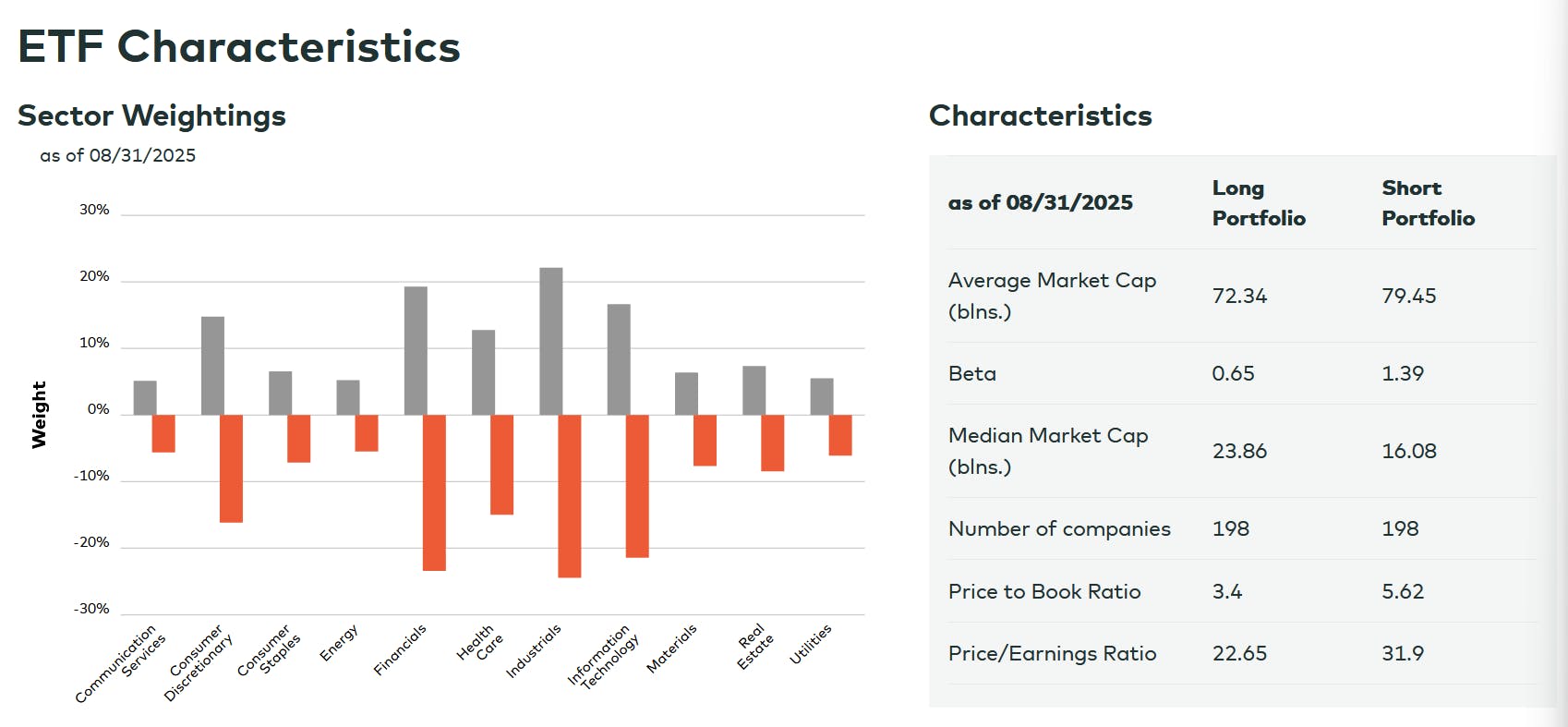
BTAL is positioned to benefit if defensives and quality stocks take leadership again while speculative growth falls out of favor.
How to incorporate BTAL into a portfolio
You can use BTAL
But a long-term strategic allocation is likely the more durable approach. The point isn’t to judge BTAL in isolation. What matters is how it contributes to the overall portfolio’s risk and return. Even a 10% allocation can move the needle.
For example, over the nearly 14-year period from September 2011 to September 2025, a portfolio with 90% in VBIAX (Vanguard’s 60/40 balanced mutual fund) and 10% in BTAL, rebalanced quarterly, delivered better risk-adjusted returns than VBIAX alone.
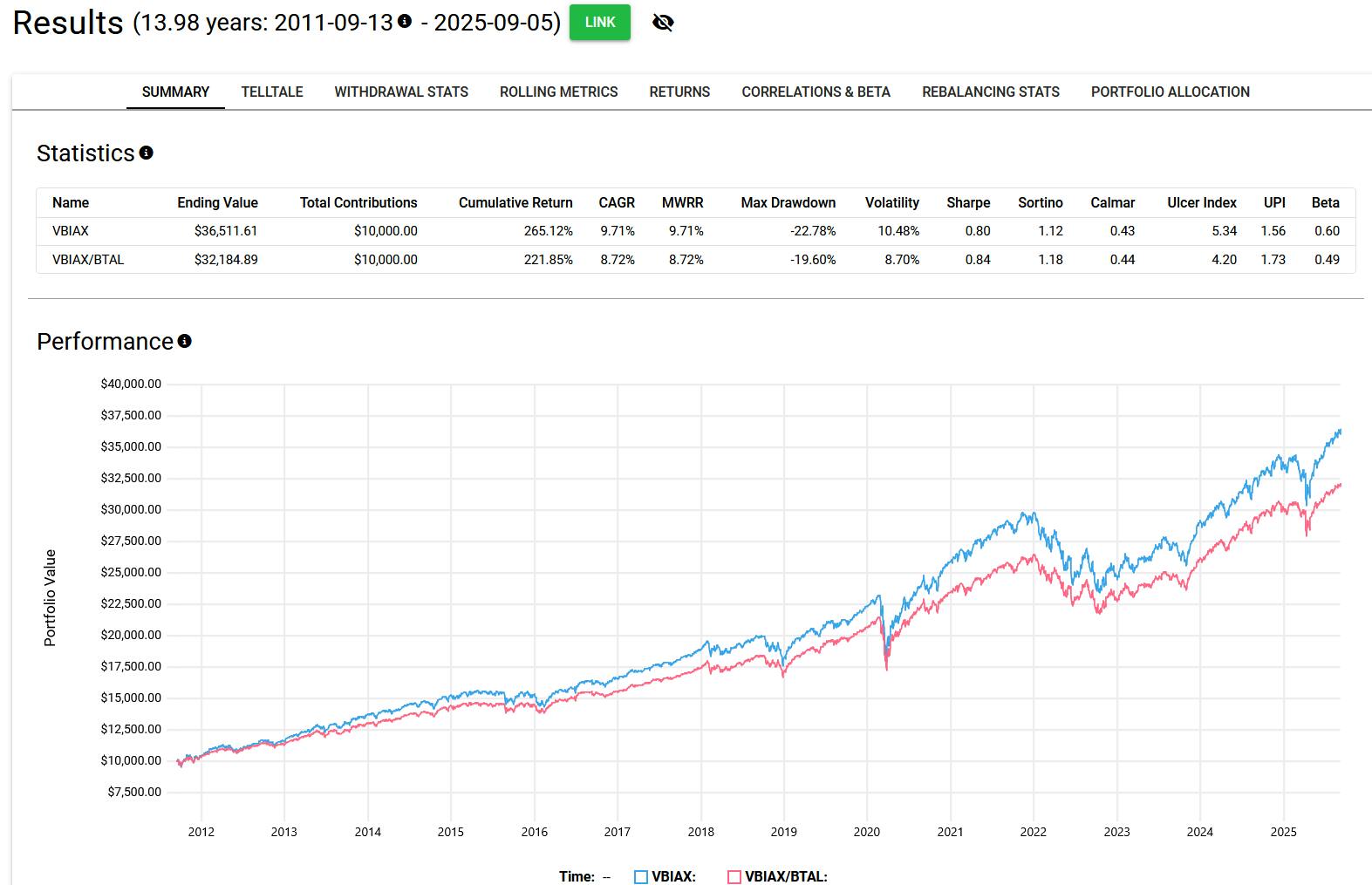
Returns were slightly lower in absolute terms, but the 90/10 blend had:
- Lower max drawdown (–19.60% vs –22.78%)
- Lower volatility (8.70% vs 10.48%)
- Higher Sharpe and Sortino ratios
- Lower beta and Ulcer Index
All that came from just a 10% allocation. You can also see how this helped during the 2022 bear market. BTAL softened the drawdown and shortened the time needed to recover:
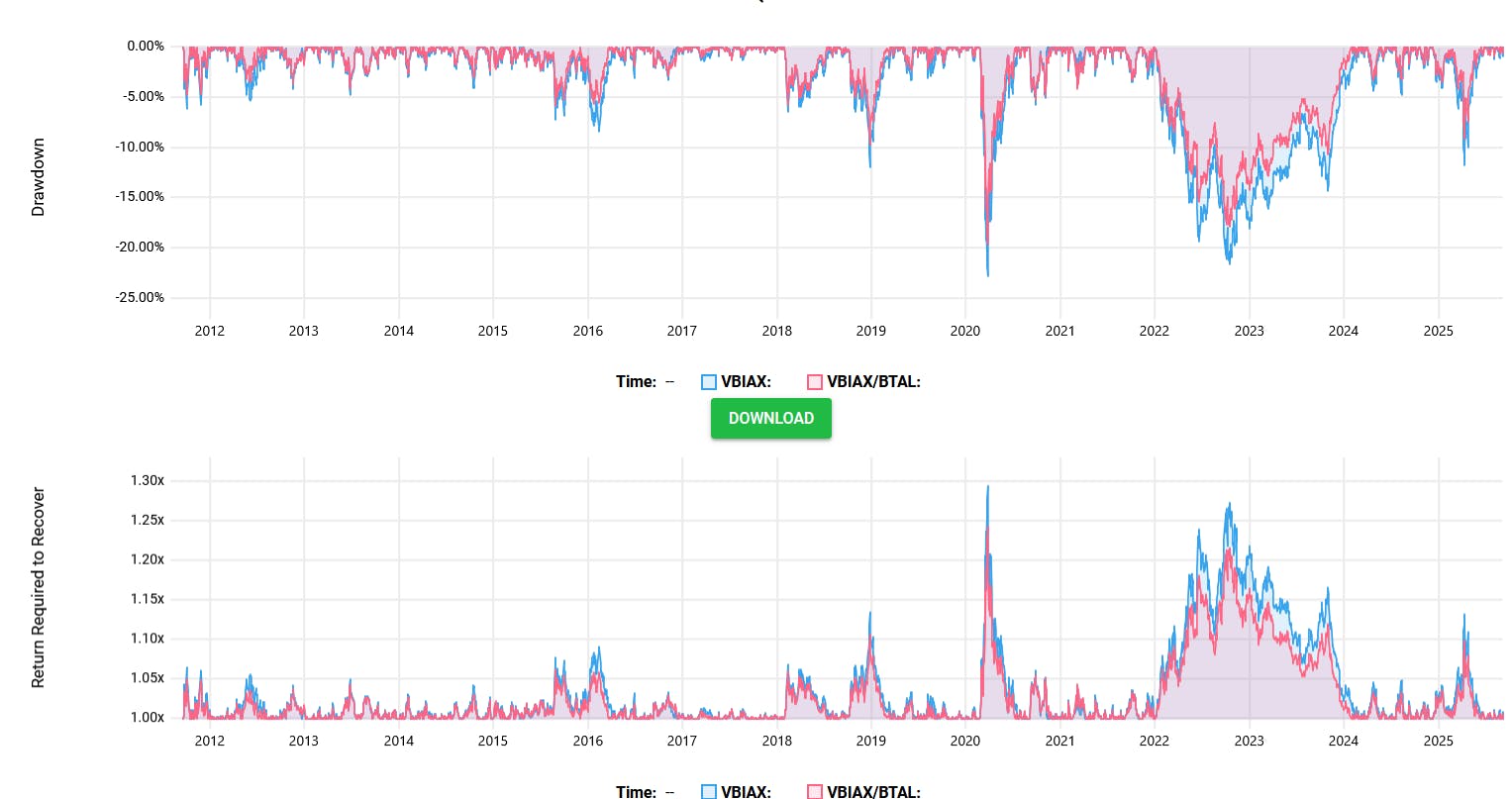
For allocators looking to hedge tail risk, lower volatility, or just get a return stream that behaves differently, BTAL
Please note that this article reflects the author’s personal views and does not represent the opinions of the publication or its affiliates. It is for informational purposes only and does not constitute investment advice. Past performance is not indicative of future results. It is essential to seek guidance from a registered financial professional before making any investment decisions.

Latest ETF News
See all ETF newsBeyond Big Tech: The Increasing Specialization of AI ETFs

There's an ETF for That? Humanoid Robotics and Physical AI

How Some ETF Issuers Use Their Own Funds for Cash Management

These Public-Private ETFs Invest in Polymarket and Anduril

There's an ETF for That? Frontier Markets



 Advantages of ETFs over Mutual Funds1/6
Lower Costs
In this guide, we'll explore the advantages of ETFs over mutual funds, giving you valuable insights into why ETFs have gained significant popularity among investors like yourself.
Leveraged ETFs: Unlocking the Potential for Amplified Returns1/6
Understanding Leveraged ETFs
Explore leveraged ETFs: potential for amplified returns & risks. 5 ETFs to consider across equities, commodities & fixed income.
What is a Leveraged ETF?1/6
Introducing Leveraged and Inverse ETFs
In this guide, we'll dive into the world of leveraged ETFs, exploring their definition, mechanics, potential risks, and rewards.
Recent educational content

First Look ETF
First Look ETF: Income, International, and Cash Flow ETFs
In this season 6 episode of First Look ETF, Stephanie Stanton @etfguide examines the latest ETF marketplace trends with NYSE and guests.


ETF Trends
ETF Industry KPIs October 5, 2026
This week’s KPI data overview highlights key metrics and trends shaping the ETF landscape.

ETF Trends
ETF Industry KPIs September 28, 2026
This week’s KPI data overview highlights key metrics and trends shaping the ETF landscape.
ETF Trends
ETF Industry KPIs September 22, 2026
This week’s KPI data overview highlights key metrics and trends shaping the ETF landscape.