Explore professionally built ETF model portfolios. Discover now →



Defensive investing: Utility and healthcare sector ETFs
Tilting a portfolio towards these two sectors can smooth out volatility.


Keep up with what matters in ETFs
Get timely ETF insights, market trends, and top ideas straight to your inbox.
Your newsletter subscriptions with us are subject to ETF Central's Privacy Policy and Terms and Conditions.
I think investors are coming back to their senses in 2022 and regretting the heavy technology sector overweight present in many popular market-capitalization weighted indexes.
While the technology sector was responsible for the outperformance of both the S&P 500 and NASDAQ 100 from 2010 – 2021, 2022 saw them falter, with many FANGMA stocks falling from grace.
In contrast, more traditional, "boring" sectors like healthcare and utilities have outperformed, drawing down less with a lower correlation to the overall market.
This effect didn't start in 2022. Historically, these two sectors have displayed defensive characteristics, with lower volatility and sensitivity to market movements.
A portfolio that overweights these defensive sectors, called a "tilt" can potentially protect the downside effectively while still ensuring attractive returns.
They've been increasingly popular this year, with State Street noting that their healthcare and utilities Select sector ETFs were the only ones with net inflows in Q3 2022 asides from consumer staples.
Like what you're reading?
Stay in the loop — get the latest ETF insights: trends, analysis, and expert picks.
Healthcare sector
The healthcare sector encompasses companies that are involved in medical care, from hospitals, pharmaceutical companies, and medical device manufacturers. These companies tend to hold up better during recessions due to the inelastic demand for their products and services.
While consumers might cut their discretionary spending (thus hurting retail and technology companies), healthcare companies tend to have evergreen demand. As a sector, healthcare stocks have historically delivered a lower correlation to the broad market and lower volatility.
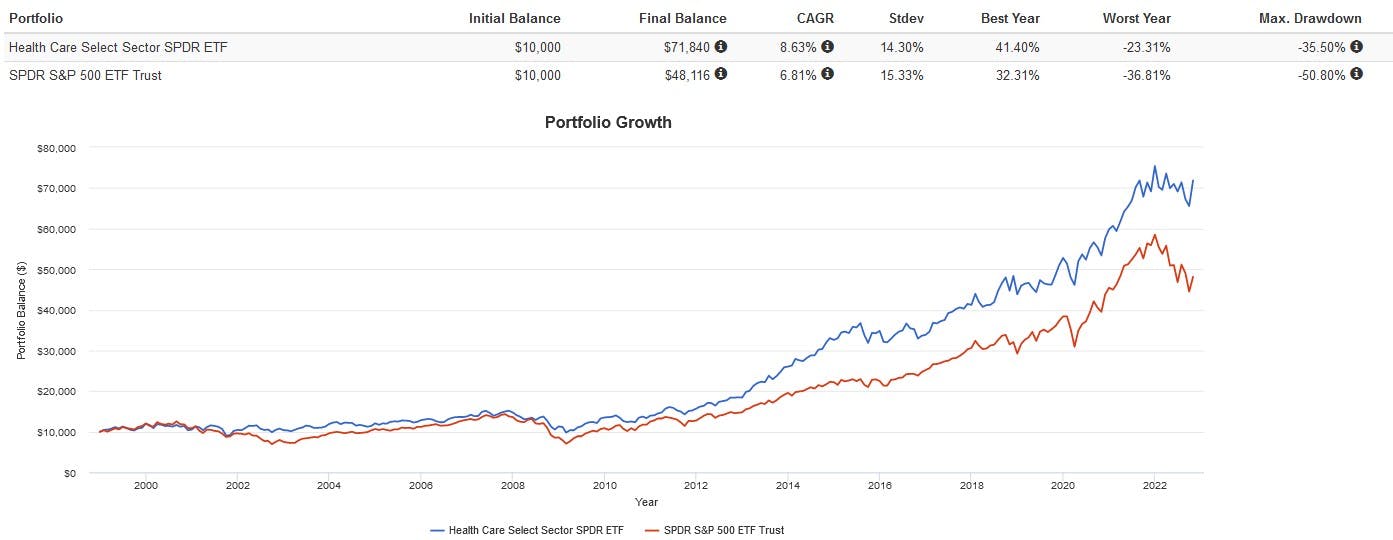
As seen below, the healthcare sector of the S&P 500 has historically outperformed the broader index, with lower max drawdowns during numerous bear markets such as 2001, 2002, 2008, 2018, and 2022.

Investors who wish to "tilt" their portfolios to the healthcare sector have two main options, one from Vanguard and one from State Street:
- The Health Care Select Sector SPDR Fund (XLV) tracks a market-cap weighted index of 64 healthcare stocks in the S&P 500. It's dominated by large-caps and costs an expense ratio of 0.10%.
- The Vanguard Health Care ETF (VHT) tracks a market-cap weighted index of 399 healthcare stocks from the broad U.S. market. It has more of an allocation to small and mid-caps and costs an expense ratio of 0.04%.
Utilities sector
Historically, the U.S. utilities sector has displayed a fairly consistent low correlation with the broader market (0.43 as of November 24th, 2022). That, coupled with its positive expected returns (largely due to consistent and growing dividends) makes utilities an attractive long-term hold.
As with healthcare stocks, utilities benefit from evergreen demand. When times are rough, people might cut discretionary spending, but the gas, electric, and hydro bills will still be paid. Demand is therefore less volatile, which translates to more consistent earnings and thus stable share prices.
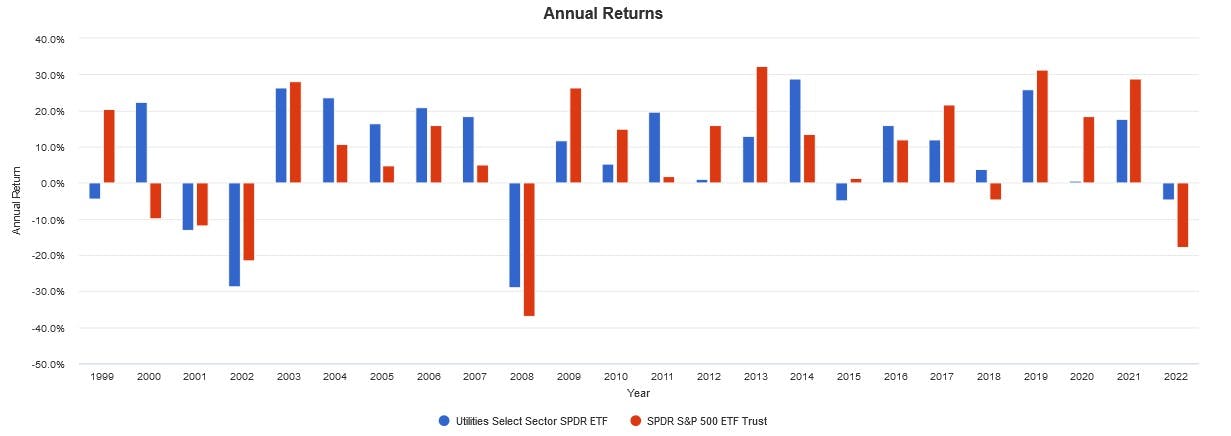
As seen below, the utilities sector of the S&P 500 has also historically outperformed the broader index, with lower max drawdowns during numerous bear markets such as 2000, 2008, 2018, and 2022.

As with healthcare stocks, investors who wish to "tilt" their portfolios to the utilities sector have two main options, again from Vanguard and State Street:
- The Utilities Select Sector SPDR Fund (XLU) tracks a market-cap weighted index of 30 utilities stocks in the S&P 500. It's dominated by large-caps and costs an expense ratio of 0.10%.
- The Vanguard Utilities ETF (VPU) tracks a market-cap weighted index of 65 utilities stocks from the broad U.S. market. It has more of an allocation to small and mid-caps and costs an expense ratio of 0.04%.
Vanguard or State Street?
The SPDR funds are more concentrated and focused on large-cap stocks found in the S&P 500. If you're a fan of the committee's selection process and want a concentrated play, the SPDR funds are better.
If you're looking for lower expense ratios and a "buy the haystack" mentality, the Vanguard ETFs might be more appealing. They're still market-cap weighted, so their largest holdings will have the most effect.
Personally? I think the ETFs of both providers make for excellent tax-loss harvesting pairs, given that they perform similarly yet track different indexes.
Please note this article is for information purposes only and does not constitute investment advice.

Latest ETF News
See all ETF newsBeyond Big Tech: The Increasing Specialization of AI ETFs

There's an ETF for That? Humanoid Robotics and Physical AI

How Some ETF Issuers Use Their Own Funds for Cash Management

These Public-Private ETFs Invest in Polymarket and Anduril

There's an ETF for That? Frontier Markets



 Advantages of ETFs over Mutual Funds1/6
Lower Costs
In this guide, we'll explore the advantages of ETFs over mutual funds, giving you valuable insights into why ETFs have gained significant popularity among investors like yourself.
Leveraged ETFs: Unlocking the Potential for Amplified Returns1/6
Understanding Leveraged ETFs
Explore leveraged ETFs: potential for amplified returns & risks. 5 ETFs to consider across equities, commodities & fixed income.
What is a Leveraged ETF?1/6
Introducing Leveraged and Inverse ETFs
In this guide, we'll dive into the world of leveraged ETFs, exploring their definition, mechanics, potential risks, and rewards.
Recent educational content

First Look ETF
First Look ETF: Income, International, and Cash Flow ETFs
In this season 6 episode of First Look ETF, Stephanie Stanton @etfguide examines the latest ETF marketplace trends with NYSE and guests.


ETF Trends
ETF Industry KPIs October 5, 2026
This week’s KPI data overview highlights key metrics and trends shaping the ETF landscape.

ETF Trends
ETF Industry KPIs September 28, 2026
This week’s KPI data overview highlights key metrics and trends shaping the ETF landscape.
ETF Trends
ETF Industry KPIs September 22, 2026
This week’s KPI data overview highlights key metrics and trends shaping the ETF landscape.