From idea to ETF portfolio in minutes. Build yours now →



DBMF: A top ETF outperformer in 2022
This ETF ranks among one of the best in its class so far this year. Let's break it down.


Keep up with what matters in ETFs
Get timely ETF insights, market trends, and top ideas straight to your inbox.
Your newsletter subscriptions with us are subject to ETF Central's Privacy Policy and Terms and Conditions.
After many years of underperformance, alternatives like managed futures and hedge funds made a resurgence in 2022. The high inflation, rising interest rate environment was exactly the sort of conditions that these funds thrive under.
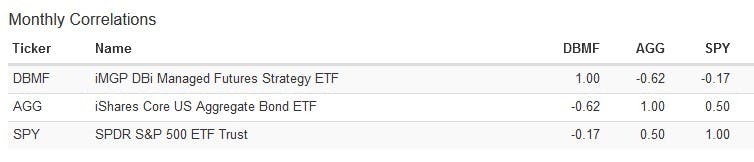
With stocks and bonds falling together, managed futures delivered not only positive absolute returns but also posted a low to negative correlation with most other asset classes. Despite the higher fees, an investor with an allocation to managed futures would have seen far lower losses year-to-date.
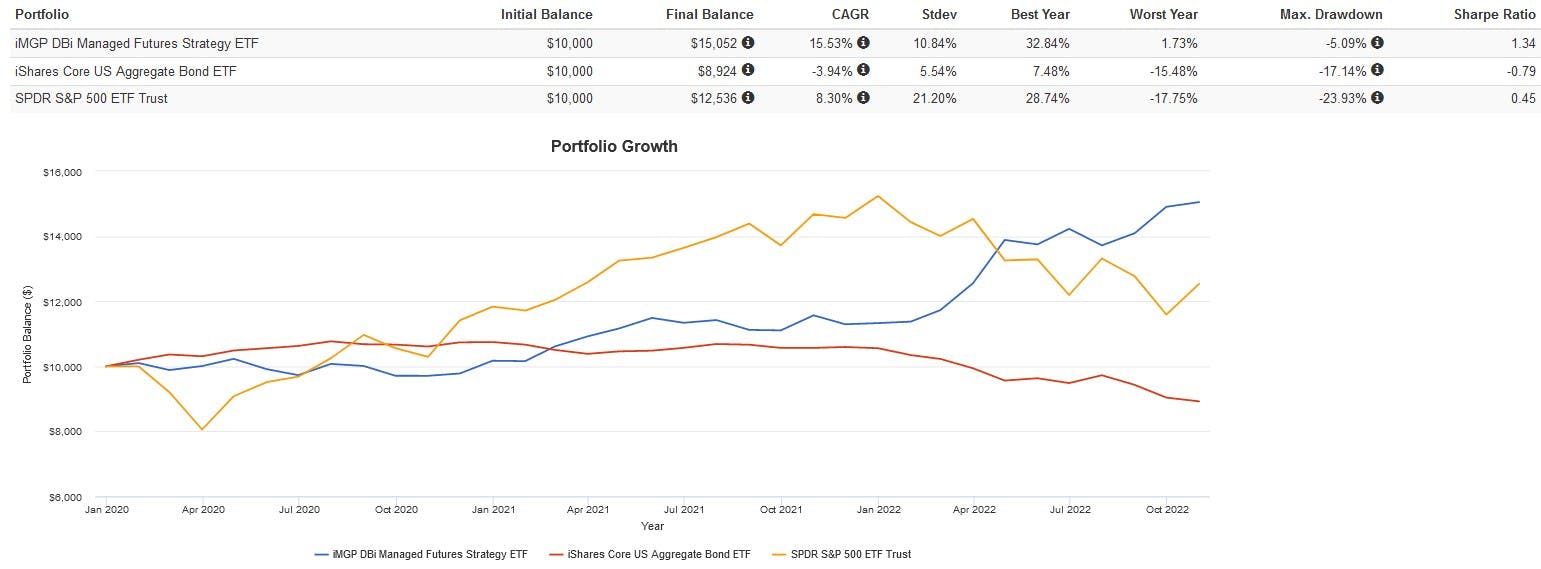
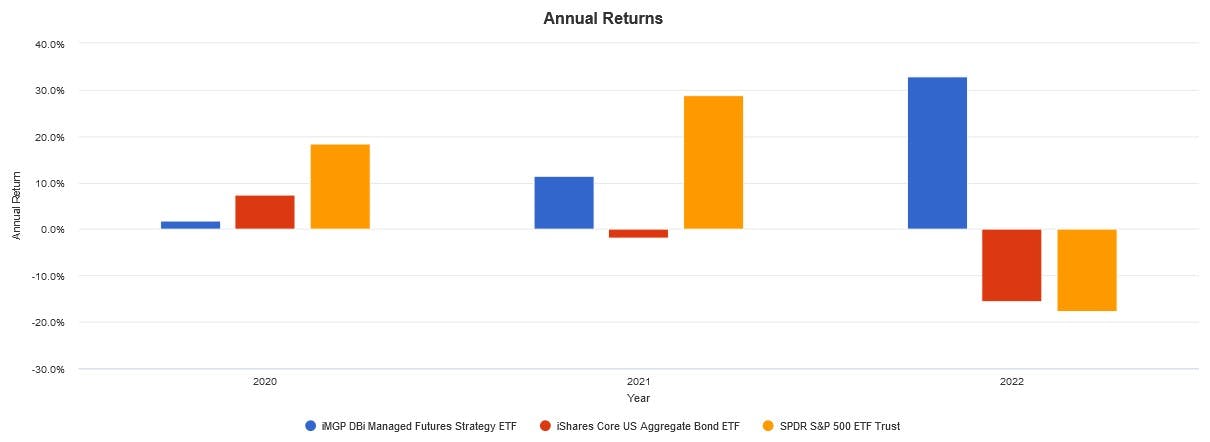
One of the top-performing managed futures ETFs this year was the iMGP DBi Managed Futures Strategy ETF (DBMF). After debuting in 2020 with a 1.73% annual return, the ETF returned 11.38% in 2021 and an incredible 32.84% in 2022. Recently, the ETF hit $1 billion in assets under management, a testament to its growing popularity. Let's look at what makes this ETF tick and why it’s so innovative.
Get data on 14,000+ ETFs
Access Trackinsight's reliable and comprehensive data with 500M+ points on 14,000+ ETFs.
A brief introduction to managed futures
Managed futures are a type of alternative investment managed by Commodity Trading Advisors (CTA's). As per their name, they offer exposure to multiple asset classes (equities, commodities, fixed-income, currency, etc.) using futures contracts. Like hedge funds, they're free to use leverage and employ strategies such as long/short, market neutral, global macro, and trend-following.
These funds can be quite costly. Some use a hedge-fund fee structure like the "2% and 20%", which means a flat percentage fee based on the assets under management and a percentage of any outperformance over a benchmark, subject to possible high-water marks.
They're also actively managed. Albeit, mostly rules-based, in that they use a quantitative methodology for making trading decisions. Still, it’s a bet on the quality and consistency of the CTA's knowledge, skills, and model. There is the risk of style drift over time if the team and their strategy change.
Finally, managed futures can perform inconsistently. Prior to 2022, many posted years of flat returns, exacerbated by their high fees. These funds tend to "melt up," meaning that outperformance tends to come in bursts. As such, it can be difficult for investors to justify holding them during bull markets.
Why DBMF is so unique
DBMF targets the gross (pre-fee) returns of the SG CTA Index, which tracks the performance of the top 20 CTA's and hedge funds. The ETF's quantitative "Dynamic Beta Engine" reverse-engineers the trailing 60-day performance of the SG CTA index to determine what its constituents are invested in.
Then, the ETF takes positions in futures contracts designed to mimic this allocation, which can include equities, fixed income, currencies, and commodities. Last quarter, DBMF was short the Euro and Yen, while remaining long in crude oil, which helped them outperform the SG CTA index by 2.9%.
DBMF's "replicator" strategy highly minimizes managed-specific risk. With DBMF, investors are no longer at the mercy of a single CTA team's strategy or model-specific risk. They can now target the average returns and risk of the top CTAs and hedge funds before all the high fees are factored in.
This approach is nothing short of revolutionary. For a flat 0.85% expense ratio, investors can basically invest in what amounts to a hedge fund for indexes. Much like how index ETFs mitigate the security-specific risk of stock-picking, DBMF minimizes much of the risk associated with hedge funds.
Much of the alpha captured by hedge funds gets eaten up by high fees. DBMF avoids this by targeting the gross returns of the SG CTA index and charging a flat, relatively low expense ratio. With DBMF, you're betting on the average gross performance of the hedge fund industry, and not a single manager.
As shown in the backtest below, since inception DBMF has met all of its goals: a positive absolute return, a low correlation with stocks and bonds, and a target annual volatility of between 8-10%.
Please note this article is for information purposes only and does not constitute investment advice.

Latest ETF News
See all ETF newsHow Some ETF Issuers Use Their Own Funds for Cash Management

These Public-Private ETFs Invest in Polymarket and Anduril

There's an ETF for That? Frontier Markets

10-Year Treasury Yield Hits 5%: Which Bond ETFs Offer the Most Direct Exposure?




 Advantages of ETFs over Mutual Funds1/6
Lower Costs
In this guide, we'll explore the advantages of ETFs over mutual funds, giving you valuable insights into why ETFs have gained significant popularity among investors like yourself.
Leveraged ETFs: Unlocking the Potential for Amplified Returns1/6
Understanding Leveraged ETFs
Explore leveraged ETFs: potential for amplified returns & risks. 5 ETFs to consider across equities, commodities & fixed income.
What is a Leveraged ETF?1/6
Introducing Leveraged and Inverse ETFs
In this guide, we'll dive into the world of leveraged ETFs, exploring their definition, mechanics, potential risks, and rewards.
Recent educational content

ETF Trends
ETF Industry KPIs October 5, 2026
This week’s KPI data overview highlights key metrics and trends shaping the ETF landscape.

ETF Trends
ETF Industry KPIs September 28, 2026
This week’s KPI data overview highlights key metrics and trends shaping the ETF landscape.
ETF Trends
ETF Industry KPIs September 22, 2026
This week’s KPI data overview highlights key metrics and trends shaping the ETF landscape.
First Look ETF
First Look ETF: Income, Corporate Arbitrage, and Growth and Value Investing
First Look ETF September 2026: iCapital, Mast Investments and North Square unpack new ETFs targeting monthly income, merger arbitrage and complementary growth and value exposure.

Browse all educational columns



Have you tried our ETF Compare tool?
Compare ETFs like a pro. Analyze fees, performance, exposure & holdings side-by-side.