Explore professionally built ETF model portfolios. Discover now →



Crypto Income ETFs: Futures, Options, or Staking?
Yield-focused investors looking for crypto exposure can select between futures, options, or staking-based ETFs in 2026. Here’s a breakdown of the pros and cons behind each approach.

Keep up with what matters in ETFs
Get timely ETF insights, market trends, and top ideas straight to your inbox.
Your newsletter subscriptions with us are subject to ETF Central's Privacy Policy and Terms and Conditions.
One of the enduring criticisms of cryptocurrencies is that they do not inherently generate income. Stocks can pay dividends. Bonds distribute coupon payments. Real estate can produce rental income. Cryptocurrencies, by contrast, have traditionally relied almost entirely on capital appreciation to generate returns. That distinction has become less clear in recent years.
Today, several ETF strategies seek to generate income from cryptocurrency exposure using a variety of mechanisms. Broadly speaking, these approaches fall into two categories: derivative-based and non-derivative strategies.
Derivative approaches can be further divided into those that generate income through futures contracts and those that rely on options strategies. Non-derivative approaches, meanwhile, typically earn income through blockchain-native mechanisms such as staking.
Some of these products were originally developed before spot cryptocurrency ETFs existed, using futures contracts as a regulatory workaround to provide crypto exposure. Others were launched after spot ETFs became available, taking advantage of new ways to generate income from directly holding digital assets.
The result is a growing menu of income-oriented crypto ETFs, each pursuing yield through a very different mechanism and exposing investors to a distinct set of risks and tradeoffs.
Today, we'll compare three examples from ProShares, Grayscale, and Roundhill, examining the advantages and drawbacks of futures-based, options-based, and staking-based approaches to crypto income, all using Ethereum as the underlying asset.
Like what you're reading?
Stay in the loop — get the latest ETF insights: trends, analysis, and expert picks.
ProShares Ether ETF EETH-4.51%
EETH holds an interesting place in ETF history because it was technically the first U.S. ETF to provide Ethereum exposure. The fund launched before the SEC approved spot Ethereum ETFs and instead gained exposure through regulated futures contracts.
Specifically, EETH holds cash collateral while investing in Chicago Mercantile Exchange (CME) Ethereum futures. These are standardized derivative contracts that obligate the buyer or seller to transact Ethereum at a predetermined price on a future date.
At the time of writing, essentially all of the fund's notional exposure comes from the front-month CME Ethereum futures contract expiring on July 31, 2026, backed by collateral via the ProShares Genius Money Market ETF
Front-month contracts, meaning those nearest to expiration, generally exhibit very high correlation with the spot price because relatively little time remains for pricing differences to emerge. Even so, futures prices are not identical to spot prices, meaning tracking differences can occur.
One feature that immediately catches investors' attention is the fund's exceptionally high distribution yield. As of May 31, 2026, EETH reported a trailing 12-month yield approaching 80%. As futures contracts approach expiration, EETH must sell its existing contracts and purchase new ones further out on the maturity curve to maintain continuous exposure. That rolling process can realize taxable gains.
Because EETH is a 1940 Act ETF, it is generally required to distribute substantially all of its taxable income to shareholders each year in order to avoid federal excise taxes. Those realized gains therefore flow through to investors as cash distributions, which the fund currently pays on a monthly basis.
Importantly, those distributions are neither fixed nor guaranteed. They can fluctuate significantly depending on realized gains or losses during the futures rolling process and whether previous payouts have already satisfied much of the fund's estimated annual distribution requirement.
The futures-based approach also comes with several drawbacks. The first is tax efficiency, because gains may be realized as contracts are rolled and are paid out monthly. For investors holding the fund in taxable accounts, this may reduce after-tax returns compared with spot Ethereum exposure.
Second, EETH remains considerably more expensive than today's spot Ethereum ETFs. The fund charges a 0.95% expense ratio, reflecting both active futures management and the higher operating costs associated with maintaining derivative positions.
Finally, investors must contend with contango, which occurs when longer-dated futures contracts trade above the current spot price. As existing contracts expire, the fund must repeatedly sell lower-priced contracts and purchase more expensive ones further out on the curve. Over time, this negative roll yield can act as a headwind versus spot Ethereum prices.
Roundhill Ether Covered Call Strategy ETF YETH-5.97%
The approval of spot Ethereum ETFs created an entirely new avenue for generating crypto income. Once investors could own spot Ethereum through an ETF, and once liquid options markets developed around the largest funds, covered call strategies became possible.
The basic idea is straightforward. By owning at least 100 shares of an ETF, an investor can sell call options against that position to collect option premiums. The amount of income generated depends on several factors, including the strike price selected, time to expiration, and the implied volatility of the underlying asset. Given Ethereum's historically high volatility, those premiums can be substantial.
Rather than managing the strategy manually, investors can outsource the entire process through products such as YETH. YETH is an actively managed fund that implements what is known as a synthetic covered call strategy using the options market on the iShares Ethereum Trust
Instead of purchasing ETHA outright, the portfolio begins by simultaneously buying a call option and selling a put option at the same strike price. Economically, the payoff from this combination closely resembles simply owning shares of ETHA, but it does so with greater capital efficiency.
The fund then sells call options against that synthetic position, effectively converting it into a covered call strategy. Those short calls generate option premium that is distributed to shareholders with fairly tax-efficient return-of-capital treatment, but they also place a ceiling on potential upside.
For example, according to Roundhill's portfolio holdings as of July 1, the notional value of the short calls closely matched the fund's AUM, meaning nearly all of the portfolio's Ethereum exposure was overwritten. The short calls had a slightly out-of-the-money strike price 4.46% above the current price of ETHA and only one day remaining until expiration.
If ETHA remains below the strike price, the options expire worthless and the fund retains the entire premium while continuing to hold its synthetic position. If ETHA rises sharply above the strike, the premium is still retained, but gains above the strike price are effectively surrendered.
Covered call strategies generally perform best in markets that move sideways or appreciate gradually. Strong rallies can leave the strategy lagging because upside becomes capped, while significant declines can still produce losses that exceed the option premiums collected. Based on YETH’s most recent weekly payout annualized relative to NAV, the distribution rate exceeded 65% at the end of June 2026.
Grayscale Ethereum Staking ETF ETHE-4.54%
Investors looking to avoid derivatives altogether and stay closer to Ethereum's native blockchain economics may prefer ETHE. Unlike the previous two strategies, ETHE does not use futures contracts or options. The fund simply holds spot Ethereum. Rather than generating income through financial engineering, it earns yield by staking its underlying assets on the Ethereum network.
Staking is a core component of Ethereum's proof-of-stake consensus mechanism. Instead of relying on energy-intensive mining to validate transactions, Ethereum relies on validators that lock, or "stake," their Ether to help secure the network. In return for performing this function honestly, validators receive newly issued Ether and a share of transaction fees as rewards.
Those rewards are compensation for providing security to the blockchain. At the same time, validators assume certain risks. Their assets remain locked for periods of time while staking, reducing liquidity, and validators that fail to meet network requirements or behave maliciously can face penalties, commonly referred to as slashing, that reduce a portion of their staked assets.
ETHE allows investors to participate in this process without needing to operate their own validator nodes or manage staking infrastructure, and Grayscale provides several useful metrics on its website for monitoring the strategy.
One is Total Net USD Rewards, which measures the cumulative staking rewards received by the fund after staking-related fees have been deducted. Since staking operations began on October 6, 2025, the fund has accumulated approximately $24.5 million in net staking rewards.
Another important statistic is the percentage of the portfolio currently staked. This figure includes Ether actively validating the network, Ether waiting in the activation queue before beginning validation, and Ether in the exit queue awaiting withdrawal after staking has been terminated. As of June 30, 80.39% of the fund's eligible Ethereum holdings were participating somewhere within this staking process.
ETHE reports a staking rewards yield. The first measure is the gross staking rewards yield, which reflects the rewards earned by the fund over the previous 60 calendar days and annualizes that experience using a 360-day convention. As of June 30, the gross staking rewards yield stood at 2.62%.
Generating those rewards is not free. Validators generally charge staking fees for operating the infrastructure necessary to participate in the Ethereum network. After accounting for those costs, the net staking rewards yield declined to approximately 2.01%.
Fund expenses also deserve attention. ETHE charges a 2.50% management fee, substantially higher than most traditional spot cryptocurrency ETFs. That fee represents an additional drag on investors' overall returns and reduces the amount of staking income ultimately passed through to shareholders.
From a tax perspective, investors should also recognize that these payments differ from many derivative-based ETF distributions. Rather than primarily consisting of capital gains or return of capital, staking distributions are generally characterized as ordinary income.
How Do These ETFs Compare to a Spot Ethereum ETF?
While the prospect of earning income from cryptocurrency is certainly appealing, investors should remember that total return should remain the primary objective. A strategy that produces a high distribution but significantly erodes capital may ultimately leave investors worse off.
Even for investors who require regular cash flow, there is another option. A portfolio with stronger capital appreciation can effectively create its own distribution by periodically selling shares and realizing gains as needed. In other words, distributions should not be evaluated in isolation.
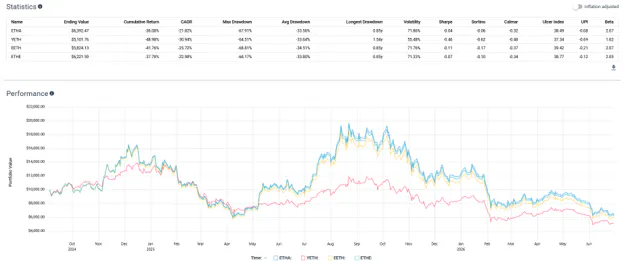
With that in mind, I compared all three income strategies against the iShares Ethereum Trust
Source: testfolio.io
It is worth noting that this was a difficult period for Ethereum itself. ETHA declined 36.08% on a cumulative total return basis. However, both derivative-based income strategies performed even worse. YETH lost 48.90%, while EETH declined 41.76%.
Importantly, these results already assume investors fully reinvested every distribution they received without paying any taxes. Even after accounting for those substantial payouts, the derivative-based approaches still lagged simply holding spot Ethereum.
The outlier was ETHE. Although it also underperformed ETHA, its cumulative loss of 37.78% was considerably closer to the spot benchmark. The relatively modest gap is likely explained primarily by ETHE's 2.50% management fee, which is more than ten times higher than ETHA's 0.25% expense ratio.
Remember, ETF distributions are not free money! Whether the cash comes from rolling futures contracts, selling covered calls, or staking Ethereum, every payout drops NAV on the ex-distribution date.
A high distribution rate may appear attractive on the surface, but investors should always evaluate where that income originates, what risks are being assumed to generate it, and whether the strategy is actually improving long-term wealth creation rather than simply converting portfolio value into cash.
Please note this article is for information purposes only and does not in any way constitute investment advice. It is essential that you seek advice from a registered financial professional prior to making any investment decision.


Latest ETF News
See all ETF newsThese Public-Private ETFs Invest in Polymarket and Anduril

There's an ETF for That? Frontier Markets

10-Year Treasury Yield Hits 5%: Which Bond ETFs Offer the Most Direct Exposure?

ETF comparison: NEOS S&P 500 High Income ETF (SPYI) Versus Goldman Sachs S&P 500 Premium Income ETF (GPIX)




 Advantages of ETFs over Mutual Funds1/6
Lower Costs
In this guide, we'll explore the advantages of ETFs over mutual funds, giving you valuable insights into why ETFs have gained significant popularity among investors like yourself.
Leveraged ETFs: Unlocking the Potential for Amplified Returns1/6
Understanding Leveraged ETFs
Explore leveraged ETFs: potential for amplified returns & risks. 5 ETFs to consider across equities, commodities & fixed income.
What is a Leveraged ETF?1/6
Introducing Leveraged and Inverse ETFs
In this guide, we'll dive into the world of leveraged ETFs, exploring their definition, mechanics, potential risks, and rewards.
Recent educational content

ETF Trends
ETF Industry KPIs October 5, 2026
This week’s KPI data overview highlights key metrics and trends shaping the ETF landscape.

ETF Trends
ETF Industry KPIs September 28, 2026
This week’s KPI data overview highlights key metrics and trends shaping the ETF landscape.
ETF Trends
ETF Industry KPIs September 22, 2026
This week’s KPI data overview highlights key metrics and trends shaping the ETF landscape.

First Look ETF
First Look ETF: Income, Corporate Arbitrage, and Growth and Value Investing
First Look ETF September 2026: iCapital, Mast Investments and North Square unpack new ETFs targeting monthly income, merger arbitrage and complementary growth and value exposure.

Browse all educational columns



Build and Analyze Your ETF Portfolio Like a Pro
Create your own ETF portfolio in minutes and instantly see allocations, exposures, performance, and risk. Visualize diversification across asset classes, regions, and sectors. Stress-test ideas, compare benchmarks, and refine your strategy with professional-grade analytics.