Global ETF Survey Is Live! 600+ ETF Professionals Weigh In. See Results →



The SpaceX IPO May Have Revealed a New ETF Loophole
The SpaceX IPO may have revealed a new ETF trade, one that lets temporary capital capture scarce IPO allocations at the expense of long-term shareholders.


Keep up with what matters in ETFs
Get timely ETF insights, market trends, and top ideas straight to your inbox.
Your newsletter subscriptions with us are subject to ETF Central's Privacy Policy and Terms and Conditions.
I'm Nicholas Phillips, President of ETF Capital Markets Advisors LLC, with 27 years of experience in ETF trading and capital markets. I provide fractional capital markets support to ETF issuers and asset managers, helping them navigate launches, liquidity, ETF market structure, market maker relationships, and sales and execution support. Through my contributions to ETF Central, I aim to provide practical insights for investors and issuers navigating the ETF landscape.
In this latest piece, I explore how the recent SpaceX IPO may have exposed a new ETF trading strategy, and why it raises important questions about who should ultimately benefit from scarce IPO allocations inside ETFs.
Global ETF Survey 2026 is Live!
With 1,790 new products launched by July 2026, choosing is harder than ever. Our Global ETF Survey 2026, built on 620 professional investors and allocators, shows how active, fixed income, options-based and thematic ETFs are reshaping fund selection.
A New Question for ETF Investors
The recent Bloomberg article highlighting billions of dollars flowing into and out of several ETFs surrounding the SpaceX IPO caught the attention of many ETF professionals.
While the headline focused on the extraordinary fund flows, the more interesting story may be what those flows represent.
According to Bloomberg, similar trading patterns were observed around the Bullish IPO last year, suggesting this may not have been an isolated event, but rather the emergence of a repeatable institutional trading strategy.
If that is the case, the ETF industry may soon need to ask a new question:
When an ETF receives access to a scarce primary-market allocation, who should ultimately benefit from that opportunity?
Understanding the Strategy
Actively managed ETFs regularly participate in initial public offerings. Portfolio managers perform due diligence, build relationships with underwriting syndicates, and, when appropriate, receive allocations in newly public companies.
Those allocations can be extremely valuable. Many highly anticipated IPOs begin trading well above their offering price, creating immediate gains for investors who receive shares at the IPO price.
The Bloomberg article suggests that some sophisticated investors may have identified a way to participate in those allocations without becoming long-term investors in the ETF.
Consider the following simplified example.
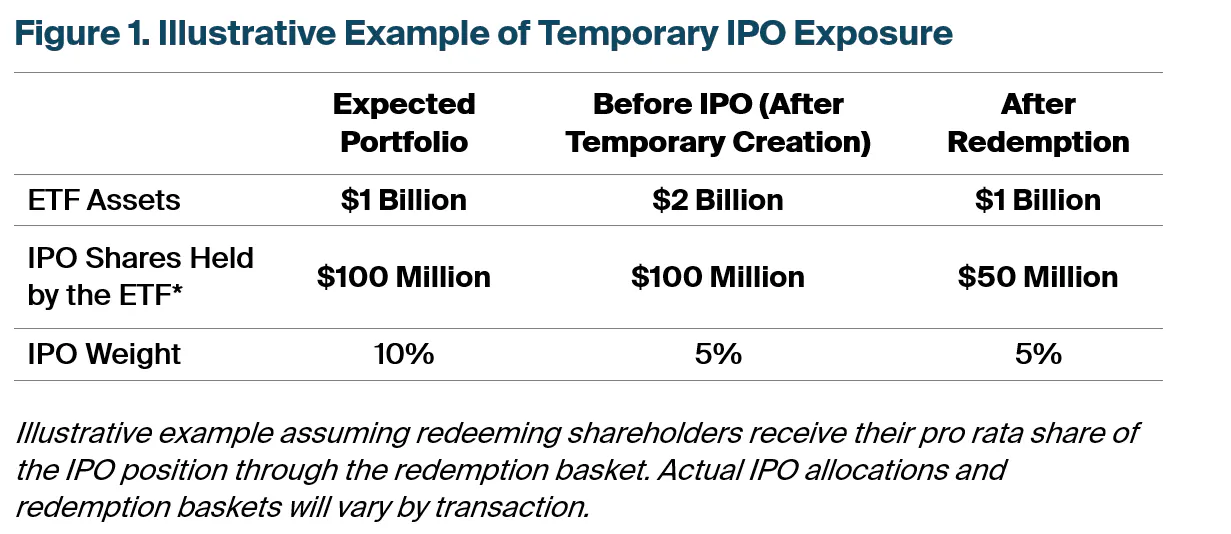
Assume an actively managed ETF has approximately $1 billion in assets and has already secured an IPO allocation that, once received, is expected to represent approximately 10% of the portfolio.
A few days before the IPO, a hedge fund creates another $1 billion of ETF shares.
The ETF temporarily grows to $2 billion in assets.
From the hedge fund's perspective, the objective is not to own the ETF. The objective is to temporarily gain access to an IPO allocation that may otherwise be unavailable.
Once the IPO is completed and the shares become part of the portfolio, the hedge fund redeems its ETF shares through the normal creation and redemption process, receiving its pro rata share of the redemption basket, including its proportionate share of the newly acquired IPO position.
After the redemption, the ETF returns to approximately $1 billion in assets.
The long-term shareholders, however, are left in a different position than they expected.
Instead of owning an ETF where the IPO represented approximately 10% of the portfolio, they are now left with roughly half of that exposure, while temporary capital captured the remaining economic benefit despite only participating in the fund for a matter of days.
Nothing about this strategy is improper.
In fact, every participant is acting exactly as the ETF ecosystem was designed to permit.
The Authorized Participant is performing its intended role.
The hedge fund is responding rationally to market incentives.
The ETF issuer is operating within the existing ETF framework.
The ETF ecosystem is functioning exactly as designed.
The question is whether the outcome is the one long-term shareholders reasonably expect.
A Market Structure Question
The ETF creation and redemption mechanism was designed to efficiently transfer market exposure and provide liquidity.
It was never specifically designed to determine who should benefit from scarce primary-market allocations.
If institutional investors can repeatedly use temporary creations to participate in IPO allocations before quickly redeeming their shares, perhaps the industry should consider whether ETF issuers ought to have additional tools available to better protect long-term shareholders.
This is not a call for additional regulation.
Nor is it a suggestion that anyone has done anything wrong.
It is simply a recognition that the ETF ecosystem continues to evolve, and as new institutional trading strategies emerge, the industry may need to evolve with it.
Possible Approaches
One approach is to temporarily restrict primary market creations before particularly significant IPOs.
At least one ETF issuer has already taken steps in this direction. Ahead of the SpaceX IPO, ERShares announced that it expected to exercise its authority to reject certain large Creation Unit orders that it believed could adversely affect existing shareholders. While such an approach may not be appropriate for every ETF, it demonstrates that issuers are already considering ways to address this issue.
Restricting creations, however, is not without tradeoffs.
During the period between an IPO allocation and the stock's first regular trading session, the ETF may own shares that have an established IPO price but have not yet entered normal price discovery on the exchange. From a market maker's perspective, that position shares characteristics with a temporarily unavailable security. Until the IPO begins trading and can be efficiently hedged, uncertainty remains.
If creations were temporarily restricted during this period, market makers would likely respond the same way they do whenever the arbitrage mechanism is constrained—they would widen quoted spreads to reflect the additional uncertainty and reduced hedging opportunities. Trading in the ETF would continue, and price discovery would still occur, but investors would likely pay wider bid-ask spreads until normal creation activity resumed.
The question then becomes whether a brief period of wider spreads is an acceptable tradeoff for preserving the economic benefit of a scarce primary-market allocation for investors who have remained committed to the fund.
Another possibility may involve the redemption basket itself.
One potential approach would be to temporarily exclude newly acquired IPO positions from redemption baskets for a defined period following the offering.
During that period, the ETF would continue to own the shares, and their full value would be reflected in the fund's NAV. Redeeming Authorized Participants would continue to receive full NAV through cash or substitute securities rather than the newly acquired IPO shares.
After the protection period expired, the IPO shares would once again become eligible for inclusion in normal redemption baskets.
Such an approach could preserve the liquidity and pricing efficiency of the ETF while making it significantly more difficult to use temporary creations solely to capture scarce primary-market allocations.
Whether such a mechanism is operationally, tax, or regulatorily feasible is a separate discussion.
The broader point is that, if this trading pattern continues to emerge around highly anticipated IPOs, the industry may benefit from considering whether ETF issuers should have additional tools available to better align scarce primary-market allocations with the interests of long-term shareholders.
Final Thoughts
The ETF creation and redemption process remains one of the greatest innovations in modern investing.
The recent SpaceX IPO does not suggest the ETF ecosystem is broken.
Rather, it demonstrates how sophisticated market participants continue to discover new ways to utilize one of the industry's most powerful features.
If the activity reported around SpaceX and previously around Bullish represents the beginning of a broader trend—and with several large IPOs expected in the coming months, similar situations may arise again—the ETF industry has an opportunity to proactively consider whether the current framework appropriately balances the interests of temporary capital and long-term shareholders.
As ETFs continue to participate in some of the world's largest IPOs, the industry has an opportunity to determine whether the existing framework appropriately rewards long-term shareholders—or whether issuers should have additional tools available when scarce primary-market allocations are involved.
That is a conversation worth having.
Disclaimer
Please note this article is for information purposes only and does not in any way constitute investment advice. It is essential that you seek advice from a registered financial professional prior to making any investment decision.
Latest ETF News
See all ETF newsWhat To Watch This REIT Earnings Season - Q3 2026



Your ETF Is a Tool. Investors Will Decide How to Use It.

How Much ETF Infrastructure Do You Really Need?





 Advantages of ETFs over Mutual Funds1/6
Lower Costs
In this guide, we'll explore the advantages of ETFs over mutual funds, giving you valuable insights into why ETFs have gained significant popularity among investors like yourself.
Leveraged ETFs: Unlocking the Potential for Amplified Returns1/6
Understanding Leveraged ETFs
Explore leveraged ETFs: potential for amplified returns & risks. 5 ETFs to consider across equities, commodities & fixed income.
What is a Leveraged ETF?1/6
Introducing Leveraged and Inverse ETFs
In this guide, we'll dive into the world of leveraged ETFs, exploring their definition, mechanics, potential risks, and rewards.
Recent educational content

First Look ETF
First Look ETF: Income, International, and Cash Flow ETFs
In this season 6 episode of First Look ETF, Stephanie Stanton @etfguide examines the latest ETF marketplace trends with NYSE and guests.


ETF Trends
ETF Industry KPIs October 5, 2026
This week’s KPI data overview highlights key metrics and trends shaping the ETF landscape.

ETF Trends
ETF Industry KPIs September 28, 2026
This week’s KPI data overview highlights key metrics and trends shaping the ETF landscape.
ETF Trends
ETF Industry KPIs September 22, 2026
This week’s KPI data overview highlights key metrics and trends shaping the ETF landscape.