Open Now: The Global ETF Survey Take the Survey →



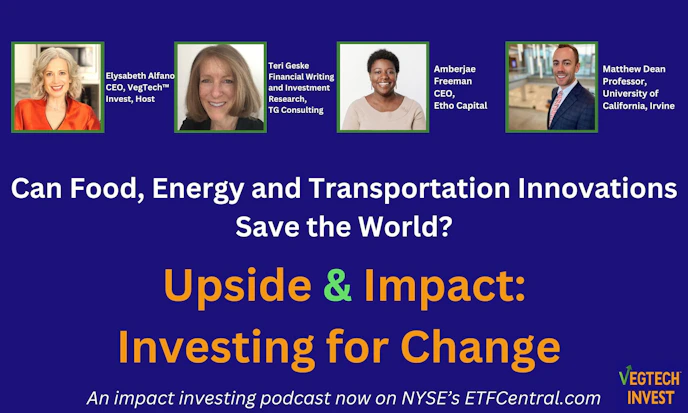
Can Food, Energy and Transportation Innovations Save the World? Three Sector Experts Come Clean
Learn from industry leaders about sustainability, new energy economy, and transportation disruptions. Gain insights on investment opportunities in the latest trends.

Keep up with what matters in ETFs
Get timely ETF insights, market trends, and top ideas straight to your inbox.
Your newsletter subscriptions with us are subject to ETF Central's Privacy Policy and Terms and Conditions.
Amberjae Freeman, CEO of Etho Capital, Engineering and Transportation Professor Matthew Dean of University of California, Irvine, and host and CEO of VegTech Invest, Elysabeth Alfano, spoke on a panel that was moderated by Teri Geske at a Women In ETFs SoCal Chapter sustainability event. They discussed the trends in the new energy economy, food systems transformation and disruptions in transportation, along with the accompanying investment opportunities therein.
Key Points Covered in the Episode: Specifically, they discussed
- How can one measure the impact of sustainability focused investments?
- What is driving the increased level of interest in investing in the new energy economy, electric vehicles, and food systems transformation?
- What areas are underinvested in as far as improving the way we live in our urban life?
- Where's the tipping point at which there's going to be capital directed toward technologies and at a scale that really makes a difference?
- What kind of catalyst will drive the adoption of new innovations in all three sectors?
The ETF Industry Is Evolving Fast
From AI infrastructure to active strategies, the ETF landscape is shifting. Share your perspective in the 7th Annual Global ETF Survey and get exclusive early access to the final report.
Listen here
Full transcript
Elysabeth Alfano: Hey everyone, welcome to the VegTech Invest Upside & Impact podcast. I’m your host, Elysabeth Alfano, the CEO of VegTech Invest, Advisor to the Plant-based Innovation and Climate ETF. On Upside & Impact I chat with the leaders and movers who are shaping and growing impact investing for meaningful change. We “pull up as we go up” as the expression goes so this podcast is all about making meaningful and productive impact while also managing one’s portfolio for upside. Of course, always managing for upside.
If you’d like more information about VegTech Invest you can visit us at VegTechInvest.com and subscribe to our newsletter. You can also find us on LinkedIn and on Twitter @VegTechInvest. We record live every first and third Wednesday of the month on our LinkedIn page at 1:30pm eastern standard time. So, check us out live and be sure to bring your questions.
Now if you’re listening as part of a podcast, of course subscribe to this podcast right now so that you never miss an episode. And if you’re listening on iTunes, be sure to leave a 5-star review. It really does help.
So now let’s get down to today’s show and thanks for being with me on today’s episode of VegTech Invest’s Upside & Impact.
Gwendolyn Brown: Hi all, I’m Gwen, the producer of the Upside & Impact: Investing for Change podcast. As always, thank you for listening. Today’s podcast is slightly different than usual. This is a live recording of the Women in ETFs SoCal chapter, Sustainability in SoCal panel. Enjoy this episode and be sure to share this podcast and give it a 5-star review on iTunes. As always, look for the Upside & Impact: Investing for Change podcast on the New York Stock Exchange website, etfcentral.com.
Elysabeth Alfano: And as always, a reminder, this podcast is for informational purposes only and is not meant to recommend any specific company or investment. Now onto the show.
Jane Edmonson: I just wanted to thank everybody for coming out today. We have a great turnout and it’s interesting because when Elysabeth proposed the idea of doing a sustainability event, us at Women in ETFs were like, “Well yeah, I think it’s a great idea. We’re going to go to a vegan place.” We didn’t think we would have a great turnout but I’m thankfully amazed that this is fantastic. So, it’s good to know that ESG is alive and well, and that there is an interest in this topic in our industry.
So, I’m Jane Edmonson. I’m the co-head of Women in ETFs in Southern California and today’s turnout is a testimony that I think there is a need for more events like this to support the financial industry. Part of Women in ETFs’ goal is to support people in the ETF industry and in finance to connect, which I think we’ve all connected today, thanks to this networking event and also support the idea of having more women in the industry, although it’s great to see a lot of male faces as well, because one of the things that we believe within Women in ETFs is that men have to be part of the solution to elevate women in the industry.
So, it’s great to see everybody here. Women in ETFs is about 10,000 members strong now around the world. We just launched a Madrid chapter. So here in Southern California we’re kind of spread out. We try to do events in San Diego, in Orange County, and in LA. Obviously today is an Orange County event. We do have some events coming up. Now that you’re WIE members from registering for this event, we have a pickleball event that we’re doing May 16th with Orange County CFA. Do we have any pickleball people out here? Alright, there you are.
Then we’re also doing an event I think on May 23rd as well in conjunction with CFA LA at the double line office and there’s going to be a woman speaker on women leaders. We try to mix it up and create content for everybody in the financial community. We’ll be heavily involved with an event in September called Future Proof. They say it’s kind of like the Coachella of finance. Who could turn that down?
We’ll be doing an event at the Hyatt that won’t require you to be the conference attendee, but it will be a great event to network. So, we’re excited to have you all here and I’m just going to hand it over to the panel. We’ve got a great panel here, so I’m going to hand it over to you.
Teri Geske: Hi everyone. Again, thanks for being here. I’m delighted to be here. My name is Teri Geske, and I am an investment writer. I write for mostly institutional investment firms both involved in ETFs and mutual funds as well as the private space and I’m really honored to be here. Before I started doing this, I spent twenty years in the investment analytics space, and I became interested in sustainability from sort of a perspective of how do you actually measure the impact of sustainable focus on investment returns?
I’m not sure we have any answer to that question yet, but maybe we’ll figure that out today. So that’s enough about me. I am going to have all the panelists introduce themselves, and why don’t we start with Elysabeth?
Elysabeth Alfano: Hi everybody, I’m so happy that you’re all here. Thank you for coming. I hope you’ve had lots of food and drinks. My name is Elysabeth Alfano. I’m the CEO of VegTech Invest. We put out the world’s only plant-based innovation and climate ETF. With my portfolio manager Dr. Sasha Goodman and I as sector experts, we really focus on food systems transformation. It’s something that we’ll talk about a lot today.
In addition, we are recording this. So, if all things are going well, this will be on my podcast for the New York Stock Exchange’s etfcentral.com podcast platform, the Upside & Impact: Investing for Change podcast. So, everyone, your questions, just so you know, will be recorded. I’m just happy that everyone’s here.
Matthew Dean: I am not in ETFs. I’m an assistant professor of civil and environmental engineering at UC Irvine and I should also introduce myself, Matt Dean. Broadly, my research interests are in sustainable travel and evolving energy research. So, some of the topics we’re looking into in my lab are the Airbnb of residential EV charging. You have an EV charger, but you hardly ever use it. Could you rent it out to others? And charging as a service, the ecosystem that provides for charging providers, utilities, and customers. I’ll hand it off to Amberjae.
Amberjae Freeman: Hello everyone. My name is Amberjae Freeman. I’m the CEO of Etho Capital. We are a financial technology company focused on supply chain tracing, particularly Scopes 1, Scope 2, and Scope 3 carbon emissions and Scope 4. We look at avoided emissions as well. We’re a team of research scientists of varying stripes and we have an ETF called the Etho US Climate Leadership ETF, and we also have a climate positive index.
Teri Geske: So, I do have some prepared questions and I’m going to direct each question to one of you specifically, but that just means you get to start and then everybody else will chime in and we’ll have time for Q&A at the end.
So, the first question is what is driving the increased level of interest in investing in new energy, in the new energy economy, electric vehicles, and food systems transformation? Is the driver mostly consumer demand, or is it government regulations, or is it the media? Is it just a belief that we can generate competitive investment returns in this space and help the planet, so you know, people profit from planet ideas? What is really generating this increased level of interest in sustainable investing?
Matt, even though you said you’re not in ETFs, you did say that you are looking at vehicles and transportation, so what do you think is driving the increased interest in funding that kind of effort?
Matthew Dean: I guess early on it would have been a little bit of those earlier adopters who had sustainability behind it and those who just wanted to have lower operational expenses. Right now, you’ve probably read the media EV sales are dropping. Should we focus from battery electric vehicles to plug-in hybrids or just hybrids in general? I think a lot of that negative attention is just due to that year-over-year growth is declining right now as we go from early adopters to majorities.
We have also had a slump right now or a lot of EV startups are at risk of bankruptcy. The issue there is it costs $2 billion to get a new vehicle out onto the road and it’s just capital intensive. So right now, for those ones that are those large Ford GMs and even Tesla, for example, they are trying to get the biggest market share that they can. Tesla was dominating right there. Ford GM is trying to do that right now, but they just don’t have the type of vehicles that the majorities want. That’s the hardest part right now. So, policy can help us move there, have increasing efficiency standards, and certainly incentives to help get the majorities to make that transition.
Teri Geske: So, I have a follow-up question, but I’ll hold off until the Q&A. I know Elysabeth that, you know, one of the things-
Elysabeth Alfano: Well, I was going to respond to that before we hop away. It’s interesting in food systems transformation because what you’re seeing is where with EVs you might see what the consumer wants. What’s happening in food you can’t really see yet. Yes, there’s the big media hype cycle, but I really encourage you to divorce what you see in the media as really a financial vector of any sort.
Really, I would peek behind the curtain and look at what governments are doing and what industry is doing. Cargill, JBS, the largest beef producer in the world, Maple Leaf, and Tyson. They’re all investing to various degrees in novel technologies because they know food systems shift is coming and they want to own food. Some of them have even changed their name from meat companies to protein companies. They don’t care what they sell. They’re looking to make money as they should.
So, when you combine governments and industry together, that’s where you’re really seeing the push and innovation and again, you’re not seeing it as a- I mean we’re here at this great restaurant but otherwise mostly except for maybe the coasts and millennials and Gen Z, you’re not really seeing it but the capex is being spent and it’s coming. So, we’re really anticipating that S curve and I can talk about that a little bit more later with the carrot and the stick and when that’s coming, but the seeds are being planted and the money is being spent.
Teri Geske: I guess I will ask a follow-up of yours, Elysabeth, because just before we got started, we were talking about Beyond Meat. Why was there this initial huge amount of interest in these plant-based meat products and then that really dropped off radically and we’re now talking about lab grown chicken and what it’s going to take to get these kinds of lab-grown proteins to take off. So, I’m curious from your point of view, is it the technology? Is it the marketing perception? Or is it the cost? What do you think is delaying that?
Elysabeth Alfano: I’m so happy you asked this. We had questions ahead of time, but we’re already off the rails. Yeah, things have gone awry. I’m so happy you asked this question because we do not live in a vacuum so many things are going on. So, I guess now I told you not to listen to the media hype cycle and now I’m going to have to bring it in. It’s there and it’s well funded and it’s funded by anyone who’s opposed because perhaps their innovation isn’t ready yet and they want to own food so they’re going to oppose anyone else who’s sneaking up. That’s one aspect.
I don’t know who to really point a finger at here except to just express it as what it is. Food tech is not big tech. It’s not consumer staples, but it’s not EVs. So, this is a novel technology and sector, and analysts kind of labeled it valuing Beyond Meat and Oatly like the dot.com bubble in the early 2000s. So the analyst’s kind of saw it in the wrong light if you will and then you’re up against supply chain issues, you’re up against Covid where restaurants and food service change. Beyond Meat being much smaller than obviously large food companies and then you also have wicked inflation.
So, you’re never going to have price parity on anything although maybe Matt would disagree with me, but I would say you’re not going to have price parity on anything until you have mass adoption and scale. So obviously this burgeoning sector doesn’t have scale so it’s more expensive in a time when you have probably sworn at your grocery store bill. People are backing away from anything that is 50% more expensive.
When you’re in venture you sell the dream. When you’re on Wall Street, you meet your numbers. Ethan Brown was selling the dream for a long time. I think that got very old for analysts. So, he’s finally taken expenses from I think $320 million down to $108 million a year, slicing it by two-thirds, showing that he can do math and that he’s trying to get to a path to profitability. Will they make it? I don’t know, but there’s lots of factors at play. There’s a long answer.
Teri Geske: No, there’s a lot more to say, I’m sure. Amber, I do want to ask this next question to you because I happen to know based on the amount of time now that we spend together that your experience is amazing and that you have some great insights about how to bring together places that need money and people who have money. So, if these technologies and new approaches are better, more efficient, and good for the planet, why is this change happening so slowly? Is it that we need more carrots or more sticks? What are your thoughts about that?
Amberjae Freeman: There are a variety of factors that contribute to or don’t contribute to the proliferation of these kinds of adoption of these technologies. A lot of it has to do with the fact that the vast majority of the most compelling and interesting and the most useful inputs for climate technology, whether it’s plant-based proteins or renewable energy, etc. are usually happening in private equity. Private equity tends to be a bit slower or rather they’re a bit more generous, right? They take a long time to proliferate before they’re ready for the public markets. You’re seeing some of that.
I think also what’s interesting though is it doesn’t mean that the public equity space doesn’t have that ability. What you’re seeing instead is sort of an acquisition. So, you have these smaller private companies that are being purchased by larger public equity companies and then they’re adopting those technologies to try to help them scale, but it’s not happening as rapidly as we would like, largely because of high cost and the ability to have proof of concept. Taking something from concept to its ability to be brought to the masses and to any degree. It’s viability.
It’s not an “either or.” It’s more of a “yes and” situation. Yes, these technologies do exist and there are these challenges that either make them attractive or not attractive to a variety of investors, but most of the growth or most of the interesting things that are happening in climate tech are happening in the private equity space. So, you’re seeing a lot of the investment happening there, rather than happening in the ETF space or another public equity kind of product.
Teri Geske: So, do you want to add onto that before I-
Amberjae Freeman: I’m happy to. Do you have follow-up to that already?
Teri Geske: Well, yes, and. So, I think you made a good point about the fact that some of these smaller companies that are still private are being acquired by bigger corporations and then those of you who have funds that invest in these public entities can benefit from that. But I’m wondering if you are Nestle or the cement company in Mexico who’s been doing some phenomenal stuff with green cement and Nestle’s been doing some phenomenal stuff but doesn’t move the needle. If you have billions and billions in revenue and you acquire one of these small companies that has 200 million in revenues, does that appeal to you as ETF investors? Are you going to find those companies?
Amberjae Freeman: So, with Nestle, the end. There are a lot of other companies. You mentioned Cemex, but I’ll mention Albomar which makes lithium batteries. You have a variety of other lithium miners and lithium producers that are trying to produce the inputs that go into the batteries that power these electric vehicles, etc. Of course, you have other technologies that are also being semi-rapidly scaled to try to reduce our dependence on cobalt and it’s almost like the more information you have about the inputs that go into these different products that we’re trying to use to create a more sustainable future, the more difficult it becomes to try to find those companies that are trying to do well and do good at the same time.
I think it depends on the company. So, to answer your question more directly, companies like Nestle and Cemex and others, when they acquire one of these smaller companies it depends on what they’re trying to do. Are they acquiring it because they want to proliferate or sort of scale or are they trying to acquire it so that way they can pick it for parts so that way they can continue business as usual. So that’s why ESG or Sustainable Investing is so difficult.
That’s why you really must dig into the weeds because you might read a headline that says “Cemex Purchased XYZ Green Mixer Company” or what have you and you’re really excited about that, but how is that going to contribute to their long-term profitability? How are they giving that company that they’ve acquired the resources it needs to grow and to scale. Sometimes they do and sometimes they don’t. So, it’s about understanding how well those companies actually are embedded and integrated and supported once they’re acquired.
Elysabeth Alfano: Can I riff on that? So, you need scale and you’re not going to have scale until you invest. So, when you look at greenhouse gas emissions, food is 30% of the world’s greenhouse gas emissions, specifically animal agriculture is 18%. In fact, in terms of methane, cows produce 32% of the world’s global methane emissions. You’re just not going to impact climate change unless you address a number like 32. So, it’s fossil fuels and it’s food.
Food tech gets 2.5-4% of all climate tech investing. So, coming out of COP28 where I was speaking and I think you were there too, right? Or Ian was there, that’s right. Ian was there, her partner. The World Bank is saying they want to see food tech regarded as climate tech and get the same kind of investment and they’re calling for $300 billion to $500 billion invested in food tech every year for the next ten to fifteen years.
Well, that’s how you scale and that’s how you bring down price. There’s an institute called the Good Food Institute and they say that you’re really going to see mass adoption when you see taste, price, and convenience. I’m convinced it’s price, price, and price. So, you don’t have price until you have scale, and you don’t have scale until you have real investment. So, I don’t know if we’re going to talk about carrots and sticks. We can talk about what’s going to bring that investment and I think the sticks are big and fat, but that’s coming our way.
Amberjae Freeman: I think taste, price, and convenience are the three. I know why you say price, price, and price, but taste, especially when you think about what percentage of the population consumes or purchases their food, because when we’re talking about these kinds of questions, we’re not talking about subsistence farmers because they eat what they grow and if they don’t grow anything, they don't eat.
So, we’re talking about populations of people that go out and consume food that they purchase and so taste matters. I think convenience absolutely matters. I haven’t churned butter ever. I don’t know if any of you have ever done that, and I don’t plan to, but I will buy butter because that’s convenient.
Elysabeth Alfano: They’re there. I would agree, yes, and this is why the Good Food Institute says taste, price, and convenience but if I were to weigh them like we do in our ETF, I would say price is 70% and the other two are 15% and 15%. If I could just take a step back, another reason that it doesn't happen super-fast is food is $9.4 trillion. So, it’s an enormous sector.
Anyone can take a guess. A little audience participation. How many people are on the planet? Okay, eight billion people, we heard it. How many animals are in factories? Somebody shouted out here.
Teri Geske: Including people? People are animals.
Matthew Dean: What’s the scale?
Elysabeth: But you’re not in factories.
Amberjae Freeman: You mean factory farming.
Elysabeth: Yes. How many animals are in factories? Okay, no one’s coming up with it. 80 billion. So, you’ve got ten times more animals in factories than you have people on the earth. It’s going to take a while to change. How many pounds of meat do you think people eat a year in America? How many pounds of meat do Americans eat a year on average? You said 200. You said 60. In 2020 it was 280. This is the average. Now it’s probably about 300. This takes a long time to change.
Teri Geske: Did you have a follow-up to that because I was going to switch gears and ask you a question, but if you had a follow-up to that.
Matthew Dean: Well, I was thinking about the price for electric vehicles and how that could drive a lot of these considerations. We’re at about 120-130 dollars per kilowatt hour. Mass market for battery packs needs to go down to 100 dollars per kilowatt hour to really get that price parity.
I asked my mom today on the phone. I said, “I really want some research ideas. What would it take for you to get an EV?” She said, “Well I must drive 300 miles to see my mom, but I only take that trip four or five times a year and I don’t want to get stranded. I don’t want to deal with that.” So, it’s range and it’s charging anxiety much more than price. She can afford to get an electric vehicle, but she can’t afford to get stranded when she needs to meet her mom. So that’s a convenience aspect and it’s an anxiety aspect.
So how do we do that? We change our batteries. We switch to a solid-state battery. It’s going to improve energy density, like it is with hydrogen or gas or ethanol and diesel. Lithium ions are just not there right now. We also incentivize public charging stations. Unfortunately, Tesla laid off all our supercharging team today, so that is going to impact the field. We’re figuring things out in the EV industry.
Teri Geske: So you kind of anticipated the question I was going to ask you but I’ll ask it anyway because your focus is on civil engineering and transportation, from an investment standpoint, can you think of some area that is underinvested as far as improving the way we live in our urban life and could we do that and still improve reducing carbon emissions?
Amberjae Freeman: That’s an easy question.
Matthew Dean: So easy. From an investment perspective, this is like a policy perspective.
Teri Geske: Yeah, and what can regulators do to push it?
Matthew Dean: Denser urban living standards, restricting growth the further out you go, that allows for more mixed-use developments, allows for innovative products like micro transit, micro mobility, even potentially robo-taxis in the future which I think is great for shared mobility and on-demand mobility. It really reduces the per capita emissions, per square foot emissions for housing and per transportation, per mile emissions that you go.
Teri Geske: So, does that mean from an investment standpoint that we should be investing in home builders, or should we be investing in innovative ways to charge our electric vehicles, or should we be finding some other ways? Is civil engineering just not the way that we should be looking at this from an investment standpoint?
Matthew Dean: Well, for policy like public charging it’s electric wires. All that is civil and environmental engineering infrastructure, right? So, invest in the aggregation or the aggregates, rocks, steel, wires, aluminum, right? All that needs to be is the market commodity. Invest in those. I don’t know if you could invest in the rental market or the real estate market right now. It’s widely dependent upon that location.
Amberjae Freeman: I think from a civil engineering perspective, not that I’m a civil engineer. I think a lot of times as investors we tend to think in public equities exclusively. Even though we diversify our portfolios, we have a variety of different kinds of investments, but one of the things that people never talk about when they think about impact investing are municipalities, right? So, if you’re thinking about infrastructure and you’re thinking about how you can improve and how you can create those kinds of systems where you have more robust transportation that is available, cheap, and viable for everyone, a lot of that’s not going to come from the public equity side. It’s going to come from municipalities, right? So that’s where you need to make those kinds of investments.
When you’re talking about power lines and infrastructure. A lot of that is municipalities and so it’s a much more long-term investment, obviously. Lower return in terms of how they’re structured depending, but that’s where you’re going to get that kind of value. Those are quite lucrative impact investments on the public equity side, even though you’re looking at municipalities.
When you’re thinking about aluminum right, or aluminum. I'll say it that way. No, no it’s a perfectly fine way to say it, you know? I think the challenge with that from a sustainable investment perspective must do a lot with the carbon intensity and the water and other risks from a sustainability perspective, right? So, it’s not an “either or.” That’s why I say it’s a “yes, and.” A lot of the components that go into electric vehicles come from requiring extractives and we know how damaging extractives are to the environment, to our society, to watersheds, etc.
So I am of a very unpopular opinion that I think we should be more focused on what you’re talking about in terms of creating more densely populated ecosystems where people can have walkable and reachable grocery stores and other amenities and things that they need. Of course, this is very much a U.S. problem, I think largely. You go to other countries and it’s very easy to get around and to be able to go to the grocery store, go pick up your kids, you know, all day-to-day things. You can do that walking distance, maybe a couple of stops on the tube. This is a very uniquely American problem.
So, I think there’s a lot that needs to happen here in the United States in terms of how we structure our lives. I’m from Los Angeles, born and raised, and one of the things people always say to me is, “Oh, in LA you must have to have a car.” I find that fascinating because I don’t drive. I live in Los Angeles. I live ten minutes away from the Expo Line. So, I just walk there, and I take the train. I designed my life that way and I grew up in Los Angeles taking the bus back when it was called RTD, just to give you a sense of how old I am.
But the thing that people do when they move to Los Angeles is they buy a car and then they move as far away from all the things they need to do as possible. Then they spend time complaining about traffic. Fascinating.
Elysabeth Alfano: I was going to jump in on the investing side. So, for food, we look at this and we call it blended capital. So, you have governments around the world concerned about food insecurity. So, China is investing heavily in diversified proteins. Singapore, you know places that can’t create their own food. So, we control China’s food which means it’s very hard for them to really take a strict trade stance with us because they only have 7% arable land. You’re not going to feed 1.4 billion people on 7% arable land.
So, they’re looking heavily into diversified proteins. Singapore is doing the same thing. Netherlands, Canada, Germany, UAE obviously they’re concerned about water, Saudi Arabia, and the U.S. as well. So, you see food security driving governments investing, then you see philanthropic endeavors. Bezos just decided to invest a billion dollars into food systems transformation. Then you have venture capital and then you have Wall Street capital.
You were talking about the supply chain and everything you can do to invest to support the outcome. So one of the reasons why we crafted our ETF the way we did is because we wanted to have the entire supply chain available so sort of like a solution ETF starting with the initial innovations in AgTech and going all the way up to ingredients, flavor texture companies and then CPG at the end of the line because ultimately like you’re saying, you’re going to have to build up that supply chain so that you can scale. You’re going to need all those nuts and bolts, otherwise it won’t work. It’s a big problem to scale for all of what we’re talking about. That’s many systems. So, we live in fascinating times. Many major systems change all at the same time.
Teri Geske: That is a beautiful lead into the next question, although I really feel like I should just rip this paper in half and throw it away. Matt, it looks like you had something you wanted to follow-up on.
Matthew Dean: Well, I had a couple comments. The U.S. is sprawling, but other regions are sprawling faster than the U.S. is. Just because they were so densely urbanized, the population is growing in Southeast Asia. Europe is sprawling faster than the U.S. at its current rate right now. To take a step back further, gas tax revenues are declining. What do we do? Are EVs to blame? Well, no, it’s just we haven’t raised gas taxes in years. So, we have suburban sprawl. It’s been there for fifty years. It’s now declining. We must replace all our lead pipes. All of this adds cost. We don’t want to raise gas taxes.
So, what do we do? We ask our citizens, “Oh, please vote on this ballot measure. We want to raise a bond.” So, I think there’s a lot of investment opportunities there. But then you brought up a great point, Elysabeth, about China versus the U.S. I’m thinking right now that China, back in January I think, imposed an export ban on graphite which is important for all our cathodes and our batteries, right? But last fall they also imposed a ban on extraction and processing of these crude boron materials. China dominates in that. South Africa could be great in manganese, but they don’t process it themselves.
Electricity is rare, I mean not rare, but full of issues with generating reliable electricity that is needed to grow that sort of processing market. So, what do you have to say about that, Amberjae?
Amberjae Freeman: I wrote a paper on this earlier this year about the mineral. I’ll just talk forever so let me just try to bullet point this quickly. You’re correct. China has dominated the rare earth metals market. We allowed that to happen.
Teri Geske: I see restraint.
Amberjae Freeman: We allowed that to happen. We’re trying to find ways to develop new partnerships with external organizations, other countries, like you mentioned like South Africa, etc. But that has presented challenges because of our long policy history. I don’t know how to talk about this.
Teri Geske: You think about it. I’m going to turn to Elysabeth. She’s talking about blending capital from different sources. So, the question to you and to others if you like is that we’re talking about getting capital from here and there and everywhere, but where is the tipping point of making a difference by directing capital to these technologies that really can make a difference?
Is it just a matter of having passionate people talk to investment people, or is it a regulatory thing? Or is there something that ETFs are uniquely structurally capable of doing to help direct that capital? And carrots and sticks.
Elysabeth Alfano: Certainly, ETFs are a great tool to direct that capital, and that’s why we do what we do. I think a big part of that answer is, I can only speak to food systems transformation, but there are many big sticks driving this shift. We’ve talked about national security issues due to food insecurity. We’ve talked about climate change. We haven’t really talked about pandemics and according to the UN, the top two reasons for the next pandemics are all related to the intensification of animal factories.
We haven’t talked about antibiotic resistance. The animals get antibiotics because of the conditions they live in and then people eat the meat and then antibiotics don’t work on them anymore. You can’t give birth in a hospital or have basic surgery if you don’t have antibiotics. So, there’s some societal issues like another pandemic, which could really push this transition to move very quickly.
So, to answer your question about tipping points, I think it can go with the traditional way which is usually considered when you have 10% of adoption. You’re kind of starting that S-curve and you have the pull from consumers, and you’ll get that pull from consumers when you have enough products on shelves because industry and government have been spending in R&D, this kind of blended capital, to get the innovation so that people have enough choice to pull from. Or you have a pandemic.
So, the choice is- that’s a stick, and then there’s other things we don’t even talk about, like labor issues, that most people don’t want to take those jobs. Those are bad jobs for the community, etc. So, then you’ve got some other societal issues too.
Amberjae Freeman: Can you repeat the question?
Teri Geske: Well, the question is really given that there are these various sources of capital. There’s private, there’s public, and there’s philanthropic. Where’s the tipping point at which there’s going to be capital directed toward technologies and at a scale that really makes a difference. Are we already seeing that? Are we already there? Maybe I asked the wrong question.
Amberjae Freeman: No, I don’t think that’s the wrong question. I think a lot of it has to do with the regulatory environment. So, as we’ve seen, the proliferation of ESG and sustainable investing has been both a gift and a curse. It’s been kind of a curse for those of us who have been doing it for a long time and are just like, “What are you guys calling ESG? It can’t all be ESG because if everything is ESG, then nothing is ESG. It’s all just investing.”
The regulatory environment, particularly with the changes in the EU with their principal adverse impacts and their metric-based sustainability measures. Then you’re also seeing with the SEC where they’re requiring investment products that are labeled “sustainable,” “ESG,” “climate,” etc., to prove it rather than just sort of say it. You have asset owners who have asset managers, and the asset managers are asking these companies to say that you’re making these claims about the sustainability, the viability, whether it’s a social metric or a governance metric or an environmental metric, you are saying that you do this so now you have to prove it.
For us to be able to invest in you because we need to do our fiduciary duty, and as a result you’re seeing more transparency. Hopefully that will increase over time. So, I think a lot of it is coming from the policy side in terms of sort of the proliferation of it and I think rather because people are being required to prove what they’re saying you’re going to see more adoption of this act and of this end as a result. It’s sort of kind of hitting the tipping point. If the SEC stays the course, and they don’t allow themselves to be watered down too much because that happens.
Elysabeth Alfano: Can I add to that? I think policy with AI could create rapid change. So, AI is going to render the supply chain very transparent. For food, which is protected by law that no one can see what goes on, well in thirteen states, no one can see what goes on in animal factories. I just don’t think that survives in an AI world. So, you’re going to see things like who are the farmers that grew this and how much water was used and how much land and how much emissions and all the conditions and I think AI, in addition to policy, could make- I’m curious what you guys think could make things move quickly.
Amberjae Freeman: When you say AI, because that means a lot of things, what aspects of it? Because actually- no, can you just answer that question?
Elysabeth Alfano: Sure, just the technologies that render the supply chain more transparent. So, some of the things that people are working on are walking down the grocery store aisle and you can scan the barcode and you can see that the grains came from India. It has this kind of footprint. So just more information, more data, more transparency to the consumer. I think younger consumers, growing up on phones, but also very concerned with the planet are asking for this kind of transparency as well.
Matthew Dean: Yeah, I see that for cars. You have that label there like here’s the MPG equivalent for electric vehicles. I think making that clear to the consumer, the operational capital that it takes to maintain and buy and use that vehicle for example, but even for recycling all these different cartons at the grocery store. Is it recyclable or not? There are those QR codes that you can scan that shows depending on where you live, how you recycle it. How do you reuse those packaging materials? I think consumer knowledge using AI or using AI tools is helpful.
Teri Geske: So, hold that thought because I’m going to come right back to you, Matt, if I may. Six months ago, I think, I wrote a guide to sustainability disclosure requirements around the world, and it was very educational because I got to look at sustainability disclosure requirements around the world and found that- I mean we all know that people are mostly familiar with what’s going on in the EU, but there’s different things going on in different countries.
So, I’m wondering from your perspective, Matt first but then all the panelists, are other countries early adopters compared to the U.S.? Are we more of an early adopter? Are some of these technologies, particularly in transportation but also in food, are they national security issues that if we develop something that is really a big deal that we need to safeguard it or only give it to our friends or help the planet? How does the international scene look in terms of what you’re seeing with transportation and what you guys are seeing in your area as a specialty?
Matthew Dean: Well, when you said national security, I thought of chips and stuff like that. But let’s talk about transportation for a second. I was also talking to my mom today and she was concerned about batteries and recycling them and where do you get those materials? So, I pointed out redwood materials. I think Nevada is having a site that has 90% or greater efficiency in inputs being reused and repurposed into new battery packs. But the U.S. lags in laws and regulations that say this is the type of battery pack, here’s how many cells are in it, here’s how it’s assembled, here’s the risk in how it should be transported. The EU is strong on that.
China is another good leader into the regulations and packaging of our battery packs for recycling and repurposing. I think that’s something the U.S. lags in and could be stronger in to allow for more sustainable and reuse of our materials. We don’t necessarily have to extract new ones if we could just reuse it almost indefinitely at a 10% loss, right?
Elysabeth Alfano: The U.S. is not leading, and I think they’re going to catch up because nobody wants to be in the back of the bus on food and water. That’s a very dangerous place to be, but adoption is much higher in the UK and Howland is very advanced. We’re doing things and we have a society that’s open to innovation so culturally it comes to us naturally but we’re just treading water. We’re not leading.
Teri Geske: Yeah, I certainly wouldn’t say we’re leading in terms of sustainability disclosure requirements, not by a long shot, but are we the most innovative? Or do we have sort of the DNA in our culture to be the most innovative? You’re shaking your head no.
Elysabeth Alfano: No, it comes to us naturally in our culture, but many other cultures see this as a larger priority than we do. I think that if we’ve learned anything from China and EVs and batteries, then we won’t make that mistake again. I think we’ll come from behind very quickly and throw money at food very quickly when we realize how far advanced everyone else is getting. Who’s going to own the IP of food? That’s probably a very upsetting sentence for people, the IP of food, they shouldn’t be in the same sentence.
You can ferment proteins and ABInBev is working on this right now. So, we ferment bread, tea and beer and kimchi. ABInBev, they are the largest fermenter in the world. They ferment beer. They’re now fermenting diversified proteins. So, you can create the same amount of meat that you would make in a cow which takes about a year and a half with lots of help from drugs and stuff. You can make that in three or four hours. So, these innovations can be very meaningful and owning this kind of technology can be very critically important.
Teri Geske: Amberjae, I just wanted to ask you because I know you have international experience, and do you have a perspective on this before we throw it open to the audience for Q&A? Do you have any thoughts to add?
Amberjae Freeman: I think they’ve covered it.
Teri Geske: Okay.
Amberjae Freeman: I want to hear from everyone else. I want to hear their questions.
Teri Geske: Well, that was to me like drinking out of a fire hose. I don’t know about you. These are some knowledgeable people. I’d love to hear what questions you have.
Audience Member: The aspect of non-technology barriers here strikes me particularly in food. You’ve had incredible consolidation in meat processors, most of whom are owned by foreign countries. You’ve had incredible consolidation in the retail grocery store space, and it’s getting worse if certain merges can happen. How do you fight and bring in new innovations when you’ve got completely consolidated systems that really don’t want to do it on your terms, they want to do it on theirs?
Elysabeth Alfano: And they really are the lobbies that are holding us back. They’re meaningful. So, they’re tied to the hype cycle. They really are the hype cycle. So, the negative press, they do own that as well. They pretty much own the government too. So, it’s very difficult. The silver lining here is that there’s a study by the Boston Consulting Group. They compared if you were to invest in diversified proteins or alternative building materials, electric vehicles, or an alternative energy, which would have the largest impact of reducing greenhouse gas emissions.
It turns out diversified proteins were three times to forty times more impactful, as let’s say electric vehicles, alternative transportation, etc. The reason is the capex spend is much less so you can change things faster and get results faster. I think those large industries, ultimately climate change is going to force them, and business is going to force them. So as a little bit of data here, 77% of our agricultural land that is used to grow crops and graze animals gives us 18% of our calories. 77% for 18%. It’s a bad conversion because animals are bad math. They’re bad at converting calories.
So that means you need a lot of land to get food, you need a lot of water to get food, you need a lot of deforestation to grow crops for animals. You could give that food to people but instead you give it to animals, and they need land, water, and time. It’s a very long cost of goods sold. This ultimately is a bad business equation. I think business is going to drive them to change because they want shorter cost of goods sold, less risk of pandemic, that’s a risk to the bottom line, less risk of being fined for methane.
These are all risks to their bottom line. So, I was just speaking to the Cattle Ranchers Association recently and they were talking about the EPA fining them for the eutrophication of water for all the manure. They don’t have indoor plumbing. 80 billion animals just go to the bathroom in your land and water and then those are fines to the bottom line, so I ultimately think that bad math is going to push them to do other things, but we are at their mercy and it’s on their timeline.
Audience Member: So, I have a question about the slowdown in EVs which has been kind of a little bit depressing because we had such a good trajectory there and I don’t know if it’s going on around the world but certainly in the U.S., we’ve seen a decline. So, what is going to be the catalyst to kind of turn things around? Is it going to be EV charging infrastructure? Is it going to be price parity? I’m interested in Professor Dean to know what is going to be the thing that turns things around?
Matthew Dean: Price parity for one, lower interest rates for two. Three, would be investments in public charging and that’s only for personal duty vehicles. We’re still seeing growth in electric bikes. We’re seeing electric motorcycles, electric buses. China is heavily promoting that. That’s what they want to export to the world. So, they’re going to find a way to do it. Whether those export bans or national security or tariffs, import tariffs are going to be effective is to be determined for growth outside of China, outside the U.S. and EU. But for light-duty vehicle markets, it’s purchase price parity, lower interest rates to go buy it for those who can’t buy it outright and public charging.
Teri Geske: Another question? Who wants to go first?
Audience Member: Hi, I had a question of if you find more small-scale farming would that help encourage consumers to purchase instead of going directly to vegan or Beyond Meat options? I know maybe convenience would be something that people would struggle with but in terms of pandemic then the disease would be only constrained within one small farm instead of a large-scale animal warehouse or something and help with carbon emissions as well. You’re not producing more than what your local community needs.
Elysabeth Alfano: I love this question and I get it every time I speak. It’s such a great question. I’m so happy for those communities that can do that and that is a wonderful position to be in. It’s not going to feed Mumbai and it’s not going to feed Nairobi. The reason we’re going from 8 billion people on the planet to 10 billion people is you have less population in the U.S. and Europe, but you have more in Africa. So that community farming, I think, is going to be hard as we feed the world, so 10 billion people.
It’s great for some communities and it’s great as an option so I think people think it's “either or” rather than “yes and.” Actually what you’re going to see because you’re never going to change a $9.4 trillion system like food overnight, you’re still going to see animal factories and you’re going to see definitely grass fed which is actually worse for the environment because you’re using more land and water but that’s better for the animals and one might argue better for the people but you’re also going to see Beyond Meat and you’re also going to see hybrid products of veggies and some meat and then you’re going to see novel innovations like fermented proteins of microbes and algae and then you’re going to see cultivated meat.
It’s going to be like the potato chip aisle. You walk down the potato chip aisle and you’re like, “Oh my god. It’s baked, it’s fried, it’s salted, it’s not, it’s gluten-free, it’s in a can, it’s in a bag, it’s blue, it’s yellow, right?” That’s what your meat choices are going to be. You’re going to have all of them at the same time. That’s why it’s called diversified proteins and not “either or.”
So yes, this regenerative farming, which really means regenerating the soil more than the animals, it’s about bringing nutrients back to that soil by not monocropping soy and wheat for 80 billion animals, but actually having cover crops of legumes and proteins for people so that’s going to be a wonderful part of it, but they have to think of the scale of the world. It can’t be the only solution.
Teri Geske: I have a question too, but I’ll have to wait.
Audience Member: I have a question about data so as we see AI technology is here but that said, what’s fueling a lot of this and I think AI technology systems help us drive policy as well as influence investments decisions, right? So, I guess the question really is around what data do we have? Where are the gaps? In terms of thinking of agriculture, right? There are significant gaps. So, I just wanted to see maybe from the whole panel, but where do we see the growth in data? Where are the gaps and where do we have good data?
Teri Geske: Amberjae, I know you have a lot of experience in research and working with data so I thought maybe you might want to kick that one off.
Amberjae Freeman: It depends on what data you’re looking for particularly. It’s a tough question. You’re talking about agriculture as an example. So, a lot of the data for developing countries has been improving over the last five or six years, but before that a lot of it was disappearance data where people were just sort of making estimates based on hectares and the crops that they were growing and which roots and tubers and that kind of thing.
Artificial intelligence, you throw up the term AI, but it means so many different things. So that’s why I sort of shy away from it. When you’re looking at big data sets and then trying to synthesize that or try to get signals from that data, through machine learning processes you must make sure that the information and the impetus that you’re taking in are as clean as possible and then try to get those signals to get the expertise. But you’re not always going to be able to do that and you need humans in the loop to sort of look at it.
I think data sets are improving. I’m thinking about it from a developing country perspective, just because that’s where my expertise is when it comes to agricultural data. I can’t speak for developed countries. So, I think that would probably be Elysabeth.
Elysabeth Alfano: I’m seeing more data come out of the FAO, the Food and Agriculture Organization, United Nations, the IPCC, the intergovernmental panel on climate change. But to Amberjae’s point, there’s not enough and big gaps.
Teri Geske: We may have time for one more question.
Elysabeth Alfano: Let’s take yours!
Audience Member: This is great, and I thought you all were amazing, and I’d love to spend an hour and a half with each one of you just dissecting everything. Earlier one of the first questions was on how the big have fallen like Beyond Meat and all that stuff. One of the big things was the science behind what it does to the body and the heavy sodium content like forty times or four hundred times. I don’t know the number and that might be even more powerful or negative than carcinogens for people. Have they captured that? Have they done a little bit more on that? I’d like to know more because I like that stuff. I think it’s great and I like meat too, but if I can get an alternative source, I also want to know that- I just had nine days’ worth of sodium with those amazing margaritas, by the way. So, I’m just asking.
Elysabeth Alfano: Yeah. That’s a great question, and I get this question all the time too. So first, I just want to level set. When did a hamburger become the benchmark of health? Hamburgers are not a health food. So, you’re comparing a non-health food to a non-health food. So, when you buy a Beyond Meat, it comes in a box. It has a scanner code. You probably know it’s not a carrot. You can really see that it’s not a carrot. But it is better than the animal version, even though it's processed food in a box with a barcode.
It’s not going to have trimethylamine n-oxide, which induces cardiovascular disease. It’s not going to have animal heme. It’s not going to have antibiotics. It’s not going to have hormones. It’s not going to have cholesterol. It’s going to have some fiber. Now, it’s in the very beginning stages of the innovation curve, since you probably last read an article and where that source came from is maybe dubious, but let’s just say that it’s accurate and you read that article a year ago.
Audience Member: Five years ago.
Elysabeth Alfano: Okay, five years ago. That burger has changed. It has dropped at least 30% to 40% in saturated fat. It’s dropped at least 20% in sodium. It’s now got a cleaner label for saturated fat like if you’ve tried their steak tips. So, this is just the beginning. This is all just beginning and so you’re getting healthier options and you’re getting non-healthy options. Like when you walk into a birthday party you probably eat birthday cake. When you walk into an open bar you probably have a margarita.
We always say we want to be healthy and sometimes we don’t and there’s a niche for that and that’s an okay niche to exist. So yeah, that’s it.
Amberjae Freeman: Beyond Meat also had a problem because of the health and safety of their factories, right, so we can’t overlook that. That was a huge issue. The processing that went into it. The risks of exposure to disease for the people that are processing and then of course also the end consumer. As she says, it is in its infancy I guess in a lot of ways, but we can’t overlook those things that are super important.
Elysabeth Alfano: Food has problems. So, you probably all saw the Bloomberg articles about underage children working in slaughterhouses and the meat industry or consumer reports article on 31% of chicken all having salmonella. So, food safety and food waste, we didn’t even touch on any of these things today.
Teri Geske: Well, we obviously need more time. Unfortunately, we don’t have it today. I feel so honored to be able to moderate this amazing panel, so I know you all want to give a little round of applause for our panelists. Thank you for letting me tear up the list of prepared questions.
Jane Edmonson: Yeah, I just wanted to say thank you everyone on behalf of Women In ETFs. I hope you enjoyed today’s panel. I think it was amazing. I learned a lot today and I guess we have the next hour where we can just network and talk to each other and talk about these things. So please enjoy yourselves and thank you so much for coming and let’s give a big round of applause to our panelists.
Thanks for being with me everyone on today’s episode of VegTech Invest’s Upside & Impact. I hope that you’ve found this to be a knowledge drop and I’m always here to answer any questions so please feel free to reach out to me on LinkedIn. Elysabeth Alfano, you can find me there. I’m also on Twitter @ElysabethAlfano and you can find the VegTech Invest pages on both LinkedIn and Twitter.
Sign up for our newsletter at VegTechInvest.com and share this podcast with your colleagues, friends, and clients. And of course, be sure to subscribe to this podcast to never miss an episode. Remember we record live on the VegTech Invest LinkedIn page every first and third Wednesday of the month at 1:30pm eastern standard time. So come find us there to join the conversation live. Until then, thanks for leaving a 5-star review on this podcast app because it really does help.
If you’d like more information about VegTech Invest you can visit us at VegTechInvest.com and subscribe to our newsletter. Okay everyone, great show today. See you next time on VegTech Invest’s Upside & Impact.
VegTech Invest is a registered investment advisor focused on investing in sustainable food and materials. This podcast is for informational purposes only and should not be relied on as the basis for investment decisions. It does not constitute either explicitly or implicitly any provision of services or products by VegTech Invest. All statements made regarding companies and securities are strictly beliefs and points of view held by VegTech Invest or podcast guests and are not endorsements or recommendations to buy, sell, or hold any security. Clients of VegTech Invest may maintain positions in the securities discussed in this presentation. VegTech Invest believes that the information presented is accurate and was obtained from sources that VegTech Invest believes to be reliable. However, VegTech Invest does not guarantee the accuracy or completeness of any information and such information may be subject to change without notice from VegTech Invest.
Certain statements in this presentation may be statements of future expectations and other forward-looking statements that are based on VegTech Invest’s views and assumptions at the time of publication and involve risks that could cause actual results, performance or even events to differ materially from what is expressed or implied by such statements. VegTech Invest’s strategies are actively managed and not intended to replicate the performance of any cited index which may differ materially. You cannot invest directly in an index.
Please note this article is for information purposes only and does not in any way constitute investment advice. It is essential that you seek advice from a registered financial professional prior to making any investment decision.
Segments
See all
No specific market segments were tagged
Mentioned ETFs
No specific ETFs were tagged
Further reading
Latest ETF News
See all ETF newsThis is How Calamos Turned Wall Street’s $100 Billion Secret Into an ETF




From Dot-Com to ETFs: How One Entrepreneur Helped Spark an Investment Revolution
How Blossom Social Is Revolutionizing Retail Investing and ETF Marketing

Is 2025 the Year for Financing Food Fast?

 Advantages of ETFs over Mutual Funds1/6
Lower Costs
In this guide, we'll explore the advantages of ETFs over mutual funds, giving you valuable insights into why ETFs have gained significant popularity among investors like yourself.
Leveraged ETFs: Unlocking the Potential for Amplified Returns1/6
Understanding Leveraged ETFs
Explore leveraged ETFs: potential for amplified returns & risks. 5 ETFs to consider across equities, commodities & fixed income.
What is a Leveraged ETF?1/6
Introducing Leveraged and Inverse ETFs
In this guide, we'll dive into the world of leveraged ETFs, exploring their definition, mechanics, potential risks, and rewards.
Recent educational content

ETF Trends
ETF Industry KPIs July 20, 2026
This week’s KPI data overview highlights key metrics and trends shaping the ETF landscape.

ETF Trends
ETF Industry KPIs July 13, 2026
This week’s KPI data overview highlights key metrics and trends shaping the ETF landscape.
First Look ETF
First Look ETF: Cash Deployment, Bond, and Hedged ETFs
In this season 6 episode of First Look ETF, Stephanie Stanton examines the latest ETF marketplace trends with NYSE and guests.

ETF Trends
ETF Industry KPIs July 6, 2026
This week’s KPI data overview highlights key metrics and trends shaping the ETF landscape.
Browse all educational columns



The ETF Industry Is Evolving Fast
From AI infrastructure to active strategies, the ETF landscape is shifting. Share your perspective in the 7th Annual Global ETF Survey and get exclusive early access to the final report.