Global ETF Survey Is Live! 600+ ETF Professionals Weigh In. See Results →



ETF Central Guide: How to Build Your First ETF Portfolio and Pick the Right ETF
Here's a step-by-step walkthrough with examples from ETF Central's tools to help you get an ETF portfolio going.


Keep up with what matters in ETFs
Get timely ETF insights, market trends, and top ideas straight to your inbox.
Your newsletter subscriptions with us are subject to ETF Central's Privacy Policy and Terms and Conditions.
Building an ETF portfolio is a personalized journey tailored to your objectives, risk tolerance, and time horizon. There's no one-size-fits-all approach, but there are steps you can follow to streamline the process and reduce complexity.
Today, I'll guide you through how I would construct a beginner-friendly ETF portfolio using the ETF Central screener. By following these five simple steps and customizing them to your own circumstances, you can create a well-rounded portfolio in less than 30 minutes.
Global ETF Survey 2026 is Live!
With 1,790 new products launched by July 2026, choosing is harder than ever. Our Global ETF Survey 2026, built on 620 professional investors and allocators, shows how active, fixed income, options-based and thematic ETFs are reshaping fund selection.
Step 1: pick your asset classes
The first step in building an ETF portfolio is deciding how to allocate your investments among different asset classes. While I can't choose the exact allocation for you, I can share my thought process to help guide you.
As a young working professional investing for capital appreciation within a tax-advantaged account, I have a high-risk tolerance and a long investment horizon, aiming for retirement. Given these factors, I'm inclined to allocate the bulk of my portfolio to asset classes known for high growth potential—primarily equities.
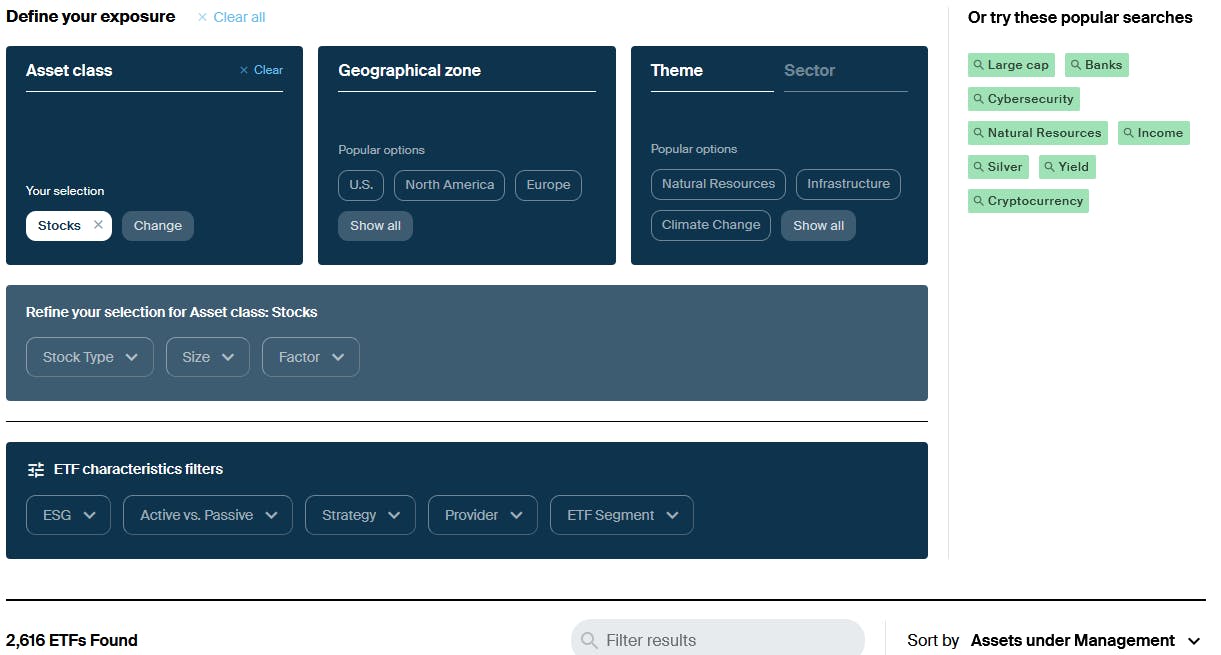
Using the ETF Central screener, I start by selecting "Stocks" as the asset class. This action filters my options down to a manageable list of 2,616 ETFs, focusing my search on those most likely to meet my growth objectives.
Step 2: pick your geographical exposure
Next, it's essential to decide where geographically you want your stocks to come from. Personally, I'm a strong proponent of global diversification. This means I aim to hold stocks from a mix of U.S., developed, and emerging markets.
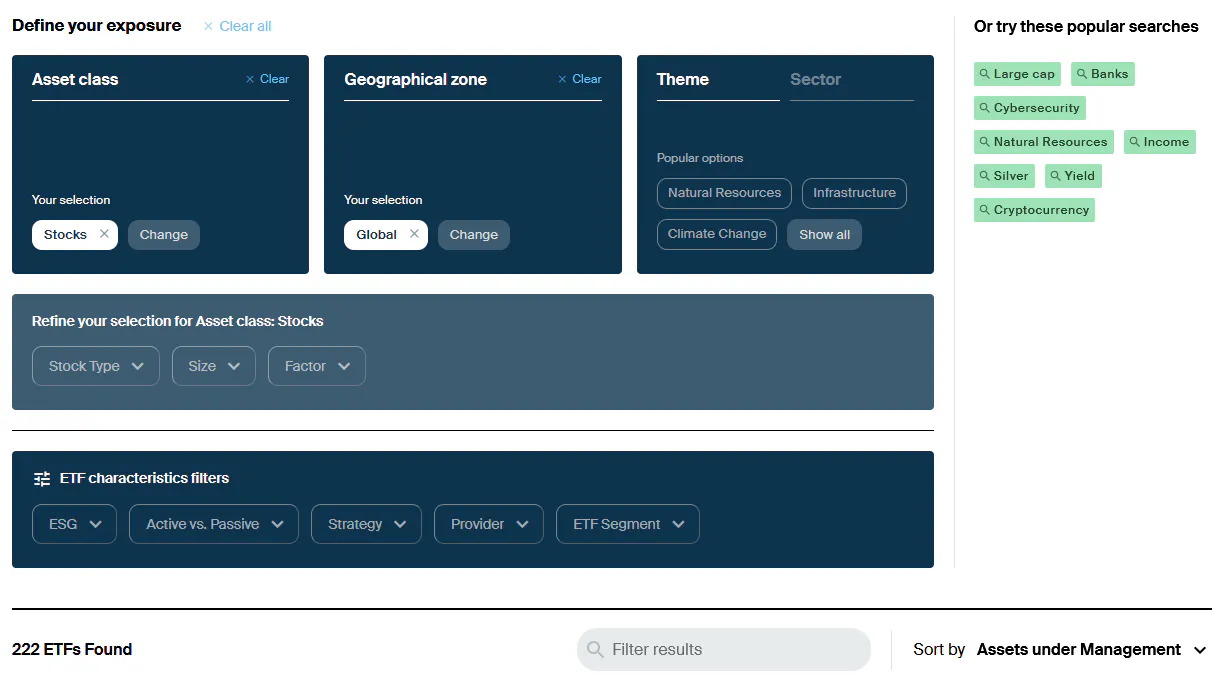
To align my portfolio with this strategy, I'll select "Global" in the ETF Central screener. This choice narrows my options down to 222 ETFs, making my selection process more manageable.
Step 3: refine your selection
This is the phase where you can truly tailor your portfolio to meet your specific investment goals by refining your selection of ETFs.
For equities, consider these primary asset class filters:
- Stock Type: Decide whether you want common stock or preferred shares.
- Size: Choose from small, mid, or large cap stocks. You may also opt for all cap or blended funds for broader exposure.
- Factor: These are essentially different styles of stocks. You might prefer ETFs that focus on low volatility, value, high quality, dividend yield, or multi-factor stocks.
Once you've narrowed down your equity type, you can apply additional filters for ETF characteristics:
- ESG: Environmental, Social, and Governance (ESG) considerations are increasingly important. Decide if you want your ETF to screen for ESG factors.
- Active or Passive: Choose between ETFs that passively track an index or those that are actively managed by professionals.
- Strategy: Determine if you want an ETF that holds long-only stocks, offers leveraged or inverse exposure, or generates options income.
- Provider: If you have a preference for certain ETF issuers, such as Vanguard, you can filter by provider.
- ETF Segment: Trackinsight and ETF Central categorize ETFs into various segments to help investors find key ETFs that match specific criteria.
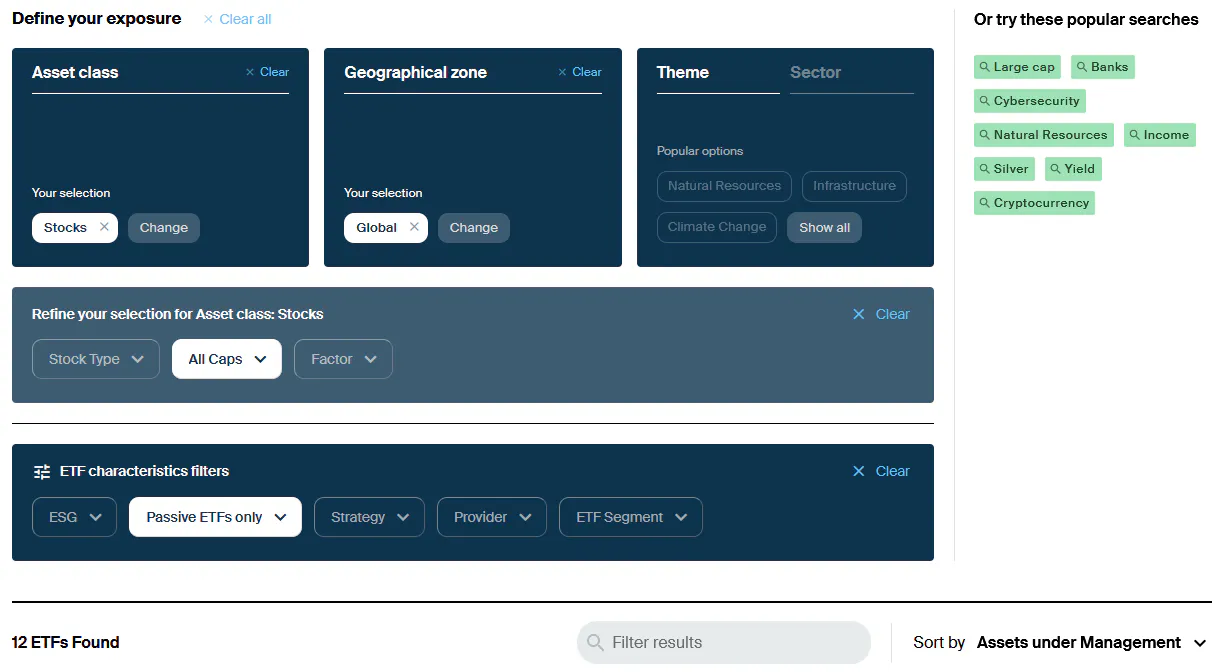
For my own portfolio, I'm selecting "All Caps" and "Passive" management while leaving other filters unchecked. My goal is to find the broadest ETF in terms of diversification, managed in a simple, cost-effective manner as the core of my portfolio. This leaves me with 12 ETFs up for grabs.
Step 4: sort the remaining ETFs
Once you've narrowed down your selection to a dozen or so eligible ETFs, it's time to sort them according to various criteria to find the one that best fits your needs:
- Assets Under Management (AUM): This is useful if you're looking to quickly identify the largest ETFs. However, don't overlook smaller ETFs, as they can sometimes offer unique opportunities or niches.
- Best Performance: Sorting by recent performance can give you an idea of which ETFs have outperformed. Keep in mind, though, that past performance is not necessarily indicative of future results.
- Largest Inflows and Outflows: This metric is helpful for understanding which ETFs are currently popular with investors or which ones are being moved away from.
- Lowest Expense Ratio: If cost is a major consideration, sorting by expense ratio can help you find the most cost-effective ETFs.
- Indicated TTM Yield: For those interested in income, sorting by the trailing twelve-month dividend yield can be beneficial.
For my own portfolio, I'm going to sort by AUM and then by the lowest expense ratio. My objective is to find the largest and most cost-effective globally diversified, passive, index-based all-cap ETF. The winner? The Vanguard Total World Stock ETF

Step 5: compare against other ETFs
Once you've identified a potential ETF for your portfolio using the screener tool, you'll have the opportunity to conduct a more detailed comparison against possible substitutes. Clicking on the ETF in the list will direct you to a comparison tool.
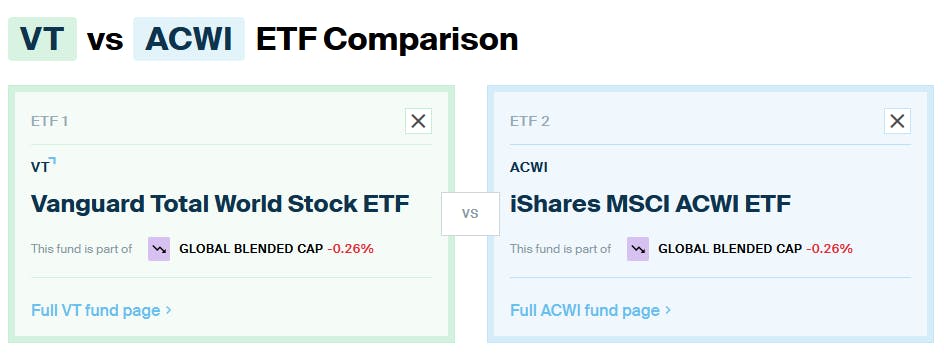
On this page, you can analyze key differences between the ETFs, including historical performance, volatility, liquidity, fees, yield, assets under management (AUM), the underlying index, top holdings, and sector allocations. This comprehensive view provides everything you need to make an informed decision.
For those interested in a deeper dive into how the ETF comparison tool works, I recommend checking out my previous analysis, where I compared the Vanguard Dividend Appreciation ETF versus the Vanguard High Dividend Yield ETF.
Please note this article is for information purposes only and does not in any way constitute investment advice. It is essential that you seek advice from a registered financial professional prior to making any investment decision.
Latest ETF News
See all ETF newsBeyond Big Tech: The Increasing Specialization of AI ETFs

There's an ETF for That? Humanoid Robotics and Physical AI

How Some ETF Issuers Use Their Own Funds for Cash Management

These Public-Private ETFs Invest in Polymarket and Anduril

There's an ETF for That? Frontier Markets



 Advantages of ETFs over Mutual Funds1/6
Lower Costs
In this guide, we'll explore the advantages of ETFs over mutual funds, giving you valuable insights into why ETFs have gained significant popularity among investors like yourself.
Leveraged ETFs: Unlocking the Potential for Amplified Returns1/6
Understanding Leveraged ETFs
Explore leveraged ETFs: potential for amplified returns & risks. 5 ETFs to consider across equities, commodities & fixed income.
What is a Leveraged ETF?1/6
Introducing Leveraged and Inverse ETFs
In this guide, we'll dive into the world of leveraged ETFs, exploring their definition, mechanics, potential risks, and rewards.
Recent educational content
First Look ETF
First Look ETF: Income, International, and Cash Flow ETFs
In this season 6 episode of First Look ETF, Stephanie Stanton @etfguide examines the latest ETF marketplace trends with NYSE and guests.


ETF Trends
ETF Industry KPIs October 5, 2026
This week’s KPI data overview highlights key metrics and trends shaping the ETF landscape.

ETF Trends
ETF Industry KPIs September 28, 2026
This week’s KPI data overview highlights key metrics and trends shaping the ETF landscape.
ETF Trends
ETF Industry KPIs September 22, 2026
This week’s KPI data overview highlights key metrics and trends shaping the ETF landscape.