Open Now: The Global ETF Survey Take the Survey →



How to Benchmark Your Investing Impact: Results of the Recent IEN Study with Georges Dyer
Explore the insights from Georges Dyer of the Intentional Endowments Network on impact investing and the Endowment Impact Benchmark in this engaging podcast episode.

Keep up with what matters in ETFs
Get timely ETF insights, market trends, and top ideas straight to your inbox.
Your newsletter subscriptions with us are subject to ETF Central's Privacy Policy and Terms and Conditions.
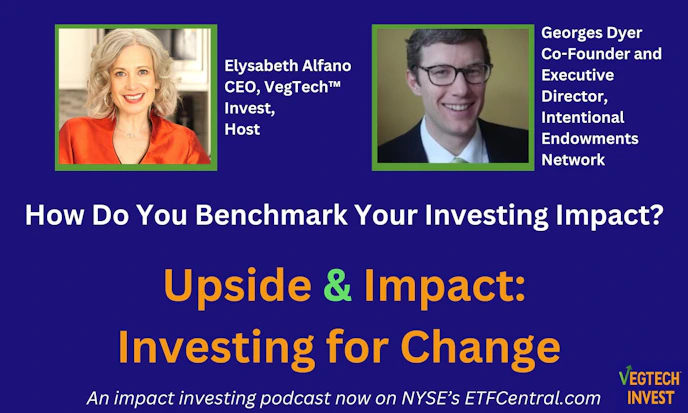
Executive Director of the Intentional Endowments Network (IEN), Georges Dyer, discusses the organization's recent pilot program for the Endowment Impact Benchmark. Joined by CEO of VegTech Invest and host, Elysabeth Alfano, the two discuss a resurgence for impact investing and the pressure for institutional organizations to lead on sustainable investing initiatives.
Summary of Podcast with key points covered in the episode: Specifically, they discussed
- What is the Intentional Endowments Network and what is the Endowment Impact Benchmark?
- What is the framework/construction of the Benchmark and which universities participated in the beta program?
- What were the results?
- What kind of interest are you seeing in impact investing vs. what the media is reporting?
- What kind of societal or internal organizational pressure is there for endowments to incorporate sustainability metrics?
The ETF Industry Is Evolving Fast
From AI infrastructure to active strategies, the ETF landscape is shifting. Share your perspective in the 7th Annual Global ETF Survey and get exclusive early access to the final report.
Listen here
Full Transcript
Elysabeth: Hey everyone, welcome to the VegTech Invest Upside & Impact podcast. I’m your host, Elysabeth Alfano, the CEO of VegTech Invest, Advisor to the Plant-based Innovation and Climate ETF, EATV. On Upside & Impact I chat with the leaders and movers who are shaping and growing impact investing for meaningful change. We “pull up as we go up” as the expression goes so this podcast is all about making meaningful and productive impact while also managing one’s portfolio for upside. Of course, always managing for upside.
If you’d like more information about VegTech Invest you can visit us at VegTechInvest.com and subscribe to our newsletter. You can also find us on LinkedIn and on Twitter @VegTechInvest. We record live every first and third Wednesday of the month on our LinkedIn page at 1:30pm eastern standard time. So, check us out live and be sure to bring your questions.
Now if you’re listening as part of a podcast, of course subscribe to this podcast right now so that you never miss an episode. And if you’re listening on iTunes, be sure to leave a 5-star review. It really does help.
So now let’s get down to today’s show and thanks for being with me on today’s episode of VegTech Invest’s Upside & Impact. And as always, a reminder, this podcast is for informational purposes only and is not meant to recommend any specific company or investment. Now, onto the show.
Hey everybody, I’m Elysabeth Alfano, CEO of VegTech Invest. We are live on Upside & Impact: Investing for Change podcast. Thank you to the New York Stock Exchange which distributes this podcast on its platform ETFCentral.com. They asked me to be their voice of sustainability so I bring that news about energy investing, electric vehicle investing, equity diversity investing, food systems investing, what is going on out there in the marketplace, and what things could transpire pre-election and post-election. It’s really anybody’s guess. Come on lucky seven.
Today I want to talk about something that I think is important in the sector that everyone is still trying to find their way amidst the rest of the craziness in life and that is how do you benchmark impact? Really how do you measure it? It’s one thing to say, “Oh these are my intentions and I’m going to have a goal for 2030, right around the corner by the way, or 2050.” But really, how indeed do you measure that?
So, I want to bring on my guest today. I want to say a colleague for whom I have so much respect, the Executive Director and Founder of the Intentional Endowments Network, Georges Dyer. Thank you for being with me today.
Georges Dyer: Hi Elysabeth. Thanks for having me. It’s good to see you.
Elysabeth: So, we have a study that you’ve just done how to measure and really have a benchmark for impact for endowments. But before we get into the study and before we get into the sort of configuration of those who are members in your organization, maybe you can tell me what your organization is for those who don’t know the Intentional Endowments Network. Maybe you can explain it.
Georges Dyer: Absolutely. So, the Intentional Endowments Network or IEN is a nonprofit peer learning network. We established it about ten years ago. We’ve got about 250 members of the network now and a broader network of folks that engage in various ways in our events and programming. The network is made up of a mix of endowments, largely college and university endowments, but also some foundations, some other types of endowed nonprofits as well as the investment consultants, outsourced CIO firms, and investment managers across asset classes and across strategies that work with endowments.
So, it’s really kind of a diverse mix of organizations and institutions in the ecosystem designed to help folks just learn about all these issues around sustainability and impact investing so they can sort of start their own topic.
Elysabeth: Yeah, I must, for better or worse, do a very shameless plug here. This is my favorite organization. I am a member of many organizations and I often find that I send in my membership dues and that’s all I hear from them. This is just not the case with the Intentional Endowments Network. I say that truly authentically. They are constantly putting out studies, constantly doing webinars, constantly having informative newsletters, constantly having meetings and group reunions I’ll say for lack of a better expression with the interest of distributing information and it has been a wonderful network for us at VegTech Invest. We’ve been members for quite a while.
So, a shameless plug. I love Intentional Endowments Network. Moving beyond that. You have this study called the Endowment Impact Benchmark and one of the criticisms I hear about ESG investing or impact investing- those are two different things folks. ESG being a screen out to make sure you’re not doing any harm. Impact investing is a screen in and making sure your dollars are being used for change as well as obviously growth opportunities and to grow that wealth but also to see that money do more than grow your own wealth. But many ask, is it really making a difference? So please explain the concept behind the Endowment Impact Benchmark and maybe the framework as well.
Georges Dyer: Absolutely. So, you know, it’s not going to solve all those issues, I don’t think, but it’s hopefully a big step in the right direction. It really stemmed from some of our asset owner members asking if they could get some sort of recognition for the progress that they’d made in their own investment policies and practices around sustainable or impact investing. We thought that was a great idea, but a little more nuanced and probably challenging than it seemed maybe at first blush.
So, we designed this framework. It’s a reporting framework where the endowments, the asset owners, fill out a questionnaire with questions about their strategy as it relates to social and environmental outcomes, as well as how they manage that strategy, how that strategy is governed and their transparency practices around it. Then their responses to that are verified by a third-party verifier called Blue Mark and we can go into a little more detail about their work. But that provides a rating for the endowment in terms of the progress that they’ve made.
We piloted this benchmark with five endowments to go through that process and we put out this summary report of those results. It’s a step in the direction of increasing the access to data and really what a lot of endowments want to see is how they’re comparing to best practices in the field and their peers. So as this grows and the universe of asset owners that are participating grows, we’ll have better data and be able to slice that data to show institutions where they are on the spectrum of progress around these issues.
Elysabeth: For those of you listening on audio I just want to give you a little run through of what I’m doing here on the screen. I’m scrolling through some of the universities. The first one is Arizona State University Foundation, a public university of Tempe, Arizona, they have an endowment size of $1.55 billion and got a rating of gold. We’ll go into the rating system in a second. California State University endowment size of $52.2 million. They have a rating of silver.
I was scrolling prior to that to go over the framework. So, in this, am I understanding correctly, self-executed questionnaire and self-scored questionnaire? Or no, there’s the third party that scores the results to this self-executed questionnaire?
Georges Dyer: That’s right. The questionnaire is filled out by the endowment, and then evidence around those responses is also provided to the third-party verifier. The third-party verifier then goes and looks at the responses and compares it to the evidence base. That evidence base can be things like investment policy statements, minutes from meetings, or just anything that sort of documents that what they’re responding to those questions is taking place.
Then the Blue Mark team- there’s a lot of expertise in this space and a lot of expertise around impact measurement frameworks and standards. The team goes through and sort of confirms or verifies that those responses are accurate, and they will adjust them and explain the results and how they got there. Then that provides a rating for the endowment that they can then use to better communicate with their stakeholders in the broader field.
Elysabeth: And the name of this organization again?
Georges Dyer: It’s called Blue Mark. They’ve been doing this work with other types of asset owners and large investment managers, and they have their own process for that. They helped us design this framework that’s really tailored towards endowments and foundations and asset owners specifically, but it takes a lot of that expertise that they have in terms of best practices in the field. We wanted to design something that was very much aligned with other reporting frameworks and standards in the field.
So, we didn’t want to just sort of introduce a new one, but design something that was explicitly for the unique circumstances of endowments and foundations and help get them on the path to reporting in a way that was also not too burdensome. You know how other institutions can have resource constraints or are in some cases short staffed, so we wanted something that was feasible but also comprehensive enough and meaningful to get them on that path to reporting with the expectation that increasingly this type of reporting will just become standard best practice, and this is a way for them to get those processes in place.
Elysabeth: So much to unpack there so I want to go over the last two points that you made, the first being I think one of the tricky things is once we start to measure or at least come up with some kind of framework, because this isn’t measurement per se, it’s more judging against the initiatives in place, but it’s not saying, “Okay, how many trees have you saved on biodiversity loss?” So, we’re not getting that granular. But it’s what mechanisms are in place. I’ll go through that framework in just a second in a little more detail, but generally what mechanisms are in place to ensure that you’re doing less damage or you’re on the path to making change.
But then if you have many of these third parties- and this is what happens, many third parties pop up so then you have different certifications. You’ve got a rating system of platinum, gold, and silver. Others might have gold stars or whatever and then you say, “Okay, how are these going to be unified so that we have one standardized measurement system?” What do you think about that?
Georges Dyer: I think it’s a great question. For new concepts, as markets evolve like this, they will mature towards more of that and converge around standards. But as I said, I think a lot of the existing ones weren’t geared for endowments and foundations specifically. There are so many types of investors that it’s hard to do something like that. So, like I said, we really tried to align this with those other existing frameworks.
So, for example, the Principles for Responsible Investing. You know, they have thousands of organizations that report to that. It’s been a tremendous driver of learning and progress in this space. But they’ve designed something that is applicable to asset owners of all kinds. Endowments, foundations, pension funds, as well as large managers and small managers. So, some of the questions just aren’t relevant to all those types of participants. This kind of really narrows in on this asset owner class, but at the same time aligns with those questions.
So, we’ve through and some of the questions that very closely align with PRI questions, we will identify that. So, if some of these endowments are also reporting to PRI, which some in the pilot are, that they sort of see the same language and say, “Okay, we know the answer to this one because we use it for PRI so we can plug it into this one.” It’s not sort of asking a similar thing in slightly different wording or whatever. We try to make it as easy as possible and align as possible in that way. But I agree. As I said, this is a step to help the entire field I think, move towards more consistency around this reporting as it matures.
Elysabeth: Yeah, and if you are a student let’s say at University of California, Long Beach and you’re concerned about how the university is investing- I know when I went to college, divestment from South Africa was an important student topic. So, if one were interested in how its own university was investing and they could go on the website and see a gold rating or platinum rating or even silver from their university and then also see what rating they get from UNPRI, the two together might give one a level of confidence.
So, if both ratings were good, then they might give one a level of confidence. So even if they’re not the same as standardized and as you say, PRI has a taskmaster to many, so it’s going to be broader. But still, there might be some level of comfortability. Before we go over the framework exactly because I want the folks to kind of get that sense of how detailed it is and how detailed maybe it isn’t, just kind of an off-the-cuff question.
So, when you see companies measure their carbon that they’re pulling from the air, they can then go ahead and sell those carbon credits on the market, do you foresee any kind of market brewing for the good that is being done here if we ever do get to the granular level of land saved, trees saved, animals saved, anything like this?
Georges Dyer: It’s an interesting question. I’m not sure at the asset owner level because they are sort of a couple steps removed typically to the ownership of the company and then the companies itself that might be doing those activities. We’re certainly seeing an emerging market around biodiversity and capital-based credits at the corporate level. It’s an interesting question at the asset owner level. I’m not sure.
I mean, we’ve had some endowments make net zero portfolio commitments around carbon and some of those strategies include carbon offsetting at the portfolio level. But it’s an interesting question if you can track the positive carbon reduction from your investments or your portfolio if you could then turn around and sell those. Maybe, but I think most of the investors probably wouldn’t necessarily look to do that. I think they would be looking more to address that systemic risk and ensure that those avoided emissions were accounted for and retired in that way.
Elysabeth: Yeah, I understand this. We have a financial product in the market that I won’t mention. I don’t want to be promotional, but let’s just say we worked hard at its construction and then sort of as a bonus, we didn’t even expect that we would get this, it’s carbon neutral without buying credits.
Often asset managers who look to invest say, “Well great, this is a way that I can bring down the carbon footprint of my own portfolio” as they start to be concerned with these kinds of ratings. So, the great thing about this system is as it catches on, and it will because there’s so much pressure. We’ll get to that question in a minute. There’s so much pressure to perform in this area beyond growing assets and wealth, but also to do no harm, if you will, and to be an agent for good, that I think these kinds of rating systems will become more and more important.
And transparency as we get out there with AI and more people can have transparency into the food supply chain, into the clothing supply chain, into their investments, I think these kinds of questions are going to be coming up. So again, for those listening to audio I have pulled up here the framework on the screen. There are four stages, if you will, of this questionnaire. Would you mind running through them, Georges?
Georges Dyer: Sure, yeah. We refer to them as pillars of the framework. The questionnaire is sort of split up into these four pillars and under each of them are a series of questions that kind of dive into what the practices are by the asset owner. The first one is strategy. Essentially the headline question there is do you have a strategy in terms of thinking about social and environmental impacts of your investments but from a risk and opportunity perspective. It goes into other elements of that through the various questions but it’s really the first stage of “Are you thinking about this? Do you have a view and a plan for it?”
The second pillar is management, and that focuses a little more on how your strategy is codified into policy. So, are these topics explicitly in your investment policy statements or do you have specific policies around environmental social factors? And how do you engage with your investment consultants and investment managers around these topics? So, it’s really sort of a little bit more about where the rubber hits the road.
The third pillar is around governance. So that’s questions about how this process is overseen. It ranges from education around how the fiduciaries and staff that are managing these investments are educated around these topics of environmental social risk and opportunity and questions around the diversity and sort of viewpoints that those governance groups bring to these issues.
Then finally, the fourth pillar is around transparency and that’s just questions around what the practices are reporting back on specific actions. So, the whole structure itself is really focused more on process and policy. In that way it’s quite high level, at least at this stage, and this might be something that changes, but we don’t dive into a whole lot of specifics around reporting on what specific managers you’re allocating to or what the underlying holdings are specifically, but more around what are your policies and practices about thinking about those processes.
Elysabeth: So, I’ll lump that into methodology. It’s primarily from my perspective, a methodology benchmark. Would you consider that fair?
Georges Dyer: Yeah.
Elysabeth: Okay, so I mentioned Arizona State University Foundation got a rating of gold. Well done you. Let me go over some of the things that they’re interested in. So, for them they’re looking at a holistic approach. Activities around climate change, commitment to justice, equity, diversity inclusion through investment measurement and engagement including investing with diverse managers. So just sort of telling you what they’re up to.
California State University Foundation out of Long Beach, $52.2 million, well done you. They have a rating of silver. They have a broad commitment to responsible investing and an investment philosophy and management of portfolio reflecting a commitment for responsible investing. All of these are members of the Intentional Endowments Network. Lewis and Clark College, I thought this was an interesting choice because I think of this as such a small private college, but it’s great to see that represented here.
So far, everybody is on the West Coast. $306.4 million is the endowment size and they are looking for diversity within its investment program through enhanced inclusive investment practices by fund managers, including hiring diverse investment managers, women, and people of color. They are looking to divest from fossil fuels. So, they were the most specific, them and one other university and of course a commitment to transparency.
The University of California, Oakland, they have an endowment size of $20.7 billion. I thought they were the most specific in that they look to invest around climate change, inequality, human rights, food security, water security, diversity, circular economy, demographics, and governance. I’m surprised I’m not seeing biodiversity in any of these universities.
University of Toronto, $3.8 billion endowment size, very focused on independent limit audit, assurance audit, and task force on climate-related financial disclosures. So, I loved that, really getting to the real numbers of it. I also support fossil fuel divestment and net zero targets. I’m going to stop sharing my screen now, but really it was a joy to read.
I’m going to put this in the chat. Not on the internal chat but the external comments so anyone can see this study. If my eyes are diverted folks, it’s because I’m the producer behind the scenes as well as here with you so I’ve now got the link in the live comments on LinkedIn and Twitter and YouTube so you can see that if you want to, but it was a great read.
Georges Dyer: Yeah, thank you. I thought it was great. We tried with that group of pilot participants to get a diversity of institution types. Obviously, an end of five is quite small but we had some very large institutions in terms of enrollment. ASU is one of the biggest in the country. As you said, Lewis and Clark, a relatively small school, but also a range of endowment size and AUM. So, I think the California State University Foundation was the smallest at $50 million, and as you said, the University of California system is over $20 billion.
So quite a range there and trying to structure something that was relevant to different size portfolios which have very different governance models and management structures. So, the University of California system has a large team, heads for every asset class working with external managers and then some of the other smaller ones really worked through their consultants or outsourced CIOs to implement their strategies so we wanted something that was applicable to all types of endowments that could look at these issues.
Elysabeth: Yeah, and no bronze results. Everybody was either platinum, gold, or silver. I think two platinum, two gold and one silver, something like this.
Georges Dyer: I think that was as expected. Some of the folks that were willing to be pioneers and pilot something like this is those that have been thinking about these issues for longer and quite well-versed in them. So, we certainly expected some of that sort of selection bias in the early participants to score more highly. That was really the idea behind this too, as we didn’t want to necessarily design something that was sort of a shaming mechanism, but more one that was celebrating progress.
So, we also see it as something that can be helpful to endowments and foundations that are early on in their journeys because just going through the process does provide a framework for how to think about these issues. Blue Mark, after doing their assessment and the rating, they provide their own customized feedback and recommendations so we hope that as we go through more iterations and more cohorts, those that maybe aren’t as far along will still participate in and find that value in it.
Elysabeth: I always think this is important because the universities compete like any business or institution competes. So, when you see five universities go forth and have silver or better, and most really being around gold and platinum, you know that it’s coming, and that people are going to ask you for this transparency and you’re going to have to perform at some kind of level. So, I think it just raises the standard for everyone in the sector, being universities’ endowments.
So, the results are quite good, but I’m wondering what kind of pulse you’re feeling from the participants and maybe others that you spoke to who didn’t participate, their pressure to execute these kinds of methodologies and within what time frame?
Georges Dyer: It’s a great question. A lot of our work in creating the Intentional Endowments Network was really sparked by the student pressure around fossil fuel divestment. So, we are actually working with colleges and universities around climate and other sustainability issues in their campus operations and their education and research activities. When that sort of movement hit the campuses, we got a lot of questions about what this meant, and what it was all about.
So that’s sort of what prompted us to create this network and have this venue for endowments to learn from each other and from experts in the field about the various options. So those types of stakeholder pressures, I think have been a big part of all of this for institutions, for sure. Then clearly over the last year with the Israeli-Palestinian conflict and all the protests on campus, an element of a lot of those protests were calling for divestment. I think that’s very different in many ways than the fossil fuel divestment, but still kind of shines a light in general on endowments and these calls for transparency.
We’ve tried to design something that helps with that, and that shows that endowments are being thoughtful, rigorous, open to this third-party verification, but at the same time designed in a way that’s really feasible and manageable just for the way endowments are managed. In some ways there are confidentiality concerns and privacy concerns around some of these policies and practices and this gives a way for endowments to show that they’re going through this process in ways that makes sense with just how their general practices and management work.
Elysabeth: So, I see this, remembering vividly my college days. So fun. Shout out to Northwestern University. Students usually don’t do the investing and how I invest today is maybe slightly different than how I would have invested as a 19-year-old at Northwestern University. My values haven’t shifted, but I’m just understanding the system better, how it works, how to have an investment strategy, the time frame involved, just adult measures, if you will.
I understand these internal pressures, but maybe we’ll talk about the external pressures to the universities, not just the alums, but if you look at the media, at least in the United States, I don’t believe this is true globally, sustainability investing is down. There’s been a pullback. There’s less interest in it. Basically, it had a blip on the screen as a fad. I’m not quoting any media organization when I use the word “fad.” That is my own easy, one-word consensus. They seem to indicate that this would be going away. Now, what I’m hearing from you is that this is only ramping up. Is that accurate?
Georges Dyer: That’s what we’re seeing. These issues aren’t going away, and climate risk isn’t. There’s social dynamics and all this, and there’s political dynamics and all of this. But when you think about climate change, there’s just the straight science of it too. As more greenhouse gas emissions are going to the atmosphere, the overall temperature rises, the climate changes, and that’s having real impacts on businesses, and that’s having real impact on the value of investments.
I think investors, particularly long-term investors like endowments, see that clearly and want to ensure that they’re doing everything they can to reduce that risk and look at opportunities as the market dynamics around renewables and some of these climate solutions change and they see a big wave of investment opportunity. So that’s sort of why I like working in the investment side on some of these issues is that while there have been very concerted, deliberate efforts to politicize some of these conversations and a media campaign to pull all this into the culture wars that we wrestle with here in the U.S., I think by and large, investors at the end of the day are more inclined to look at the data.
I guess everybody brings a little bit of their own personal bias and perspective to their decisions, but investors compared to most other types of people or other groups really do look at the data and again it’s not like this is going to be linear or it’s easy to identify where those risks are and where those opportunities are. It’s not like you can just go and pick any ESG label fund or impact fund and it’s automatically going to perform better than others. There’s still all that due diligence that needs to be done and manager selection. That’s so important.
But I do think investors are seeing that there are real risks and opportunities in these mega trends around climate change, around extreme inequality, and that their investments have a role in that.
Elysabeth: We just put out a newsletter as we do every week so if you would like to get that go to vegtechinvest.com. But we just put out a newsletter about concentration risk. So while maybe the new energy sector hasn’t been performing well of late, it’s so dirt cheap at this moment that one might consider it an opportunity, but either way, as one looks to avoid concentration risk and bring in diversification- no one’s saying everything has to be in new energy, but some kind of exposure to food systems, new energy, electric vehicles, women CEOs, however you have that makeup of impact and sustainable investing, it just leaves the door open for opportunities whereas Nvidia is pretty high at the moment, I’ll just say that.
Georges Dyer: Also, these dynamics are different in different asset classes and we’re not offering investment advice. We’re conveners of people to pull together conversations like this but I just saw a report the other day, I think MSCI put it out, looking at some of the exits from private investments. The last seven years of oil fossil fuel investments versus renewables and showing that outperformance there so as you say the timing and the dynamics around this, you still must be an expert investor to do it well.
Elysabeth: Sure, and to be fair, it’s tricky out there. It’s tumultuous. We’re about to head into an election. Interest rates still haven’t come down so it’s not like it’s a one and done, black and white, easy thing to wrap one’s mind around. If you’re enjoying this podcast, Upside & Impact: Investing for Change, go back to a couple episodes prior. I interviewed the Senior ESG Analyst from Bloomberg Intelligence, Rob Du Boff, and the Senior Energy Analyst of Bloomberg Intelligence, Rob Barnett, and Rob Barnett was saying that the investment in fossil fuels was $1 billion and the investment in novel energy solutions was $2 billion and that it really needs to be 3 to 1 but that it’s already on its way to that.
So, more investment is in novel innovations than the previous way. So just a data point for some, and you can listen to that interview if you’d like to get his take on that. It’s a deep dive. So let me ask you again, the kind of universities that were in this pool, but also maybe those that weren’t and hoped to be in it in 2024. I understand that you’re taking new entrants for 2024, yes?
Georges Dyer: Indeed, yeah. We’re right in the middle of that process right now and we’re expecting to have fifteen in the second cohort.
Elysabeth: That’s fantastic. Can universities still get in, or is that door closed?
Georges Dyer: Yep, we are looking to confirm all those participants by the end of this month, so July 31st. We’re talking to lots of folks, but we’ve only got about half of the spots confirmed right now. So, there are opportunities. In this cohort, as you saw from the report, the first five were all college and university endowments, but in this cohort, we’ve already got some foundations, some other types of endowed nonprofits, environmental groups, and the like that are going through the process too. So, we’ll have some different looks this time around.
Elysabeth: Wonderful. So how would people reach out to you if they wanted to apply before July 31st?
Georges Dyer: Yeah, they can go directly to our website, intentionalendowments.org and all our contact info is on there. My name is Georges Dyer. My email address is georges@intentionalendowments.org. So, you can reach out directly to me too and we can send more information. Then that link you shared in the chat as a dedicated website for the endowment impact benchmark as well. There’s lots of information about the process on there.
Elysabeth: That’s wonderful. It’s Intentional Endowments with an “s.” It’s Georges with an “s”. So, everyone gets your S’s in there. A couple of last questions before we wrap up. So, these were 2023 results so maybe that’s why and maybe universities didn’t feel the need to be so specific or maybe they were specific but in the executive summary I didn’t see it. I would have thought biodiversity would have popped up a lot more.
I was seeing, at least in those five universities, divesting from fossil fuels, food security and new energy and diversity, but I wasn’t seeing so much on biodiversity, which is inherently linked, obviously to food as food is the largest driver of biodiversity loss. But I wondered if biodiversity came up as a topic.
Georges Dyer: It’s increasingly coming up in conversations in the network in general, in the field in general. I agree. I think it’s more nascent for a lot of endowments and in that summary, you’ll see those sorts of more specific points that are just highlights and kind of illustrative selections and not comprehensive overviews of everything that they’re doing and really just the ones that are publicly available too. So, they are reporting aspects through this and not all of it is publicly available so that’s part of the confidentiality and the process too.
But that’s a great point. I think it’s something we’re going to be doing a lot more programming on in the network, just as there’s more investment managers that I think are being thoughtful about it and offering products and ways to engage companies around those topics and so interrelated to food systems. It’s also so interrelated to the climate challenge that it’s clearly a risk that I think more investors need to wrap their heads around.
Elysabeth: I love that you say that because we talk about the political football that has become of impact or ESG investing, but for those data focused asset managers, risk really is also driving them, not just perception or demands of students or societal perception as driven through the media, but material risk and mitigating that material risk through stranded assets as the food system changes or environmental fines from the EPA for old systems in energy or food, maybe polluting and other things. Then that just directly impacts the bottom line. So really, they’re looking at this not just from societal pressure but for real investing.
Georges Dyer: Absolutely. I would say the endowments in our network are very much looking for market rate or better returns, kind of a risk return first approach to this. A lot of times, as I mentioned, their students or stakeholders are prompting the issue or sort of forcing the conversation a bit. Unlike some foundations that may be willing to look at concessionary returns because they align with their mission or some of their grant making in the like, most universities rely heavily on their endowments for their operations, to support scholarships, to support all the good things that colleges and universities do.
For better or for worse the CIOs and the investment teams that are managing those endowments are incentivized around the financial performance so it’s certainly looking at it from that perspective. Again, it’s encouraging, and I think fits with where we see things going, that they are seeing that there are ways to do this that not only fit within those risk return parameters, but also really can help them over the long run.
Elysabeth: Of course, as I zoom out and take a broader approach with the next questions. No one has a crystal ball, but the media really has had a field day and so has politics. Where do you think we’re going in terms of ESG screening out, doing no harm and impact screening in and investing for change? Where do you think this is going? Let me bifurcate that question a little bit. Do you think we’ll continue to even use those terms? Do you think we’ll see a resurgence in investing, but it will be called something different, so they’ll get around the political scapegoat by saying it’s something else? How do you see this all shaking out?
Georges Dyer: They’re great questions. I remember when we were starting this network and we were wrestling with the terminology. We were putting together initial publications that were sort of primers on what this was all about to help educate endowments and investment committees that were getting the student pressure to understand the different dynamics and approaches from SRI, socially responsible investing, to ESG to impact to mission-aligned investing, and kind of defining and laying out all those terms.
Sometimes the definitions are clearer than others and sometimes they overlap and sometimes people have different definitions. We would always just say that it’s going to be great when we get to the day where this is just investing. We don’t have the terminology. It’s just good investing. I think a lot of ESG proponents would say that’s what it is, right? Investors have looked at environmental and social risks and opportunities in the investment process for a long time.
I think the sort of “ESG movement” or some of these tools that help do that, just make it more explicit and systematic to help investors maybe do it better than they have in the past. Again, these are material risks that all investors are, and I think will continue to look at or if they ignore or don’t do them for political reasons, I think they’re putting themselves in the risk of sacrificing performance or violating their fiduciary duties. I do think some of that politicization is really a shame. At the same time, I’ve said from the start when these sorts of campaigns started kicking off, never underestimate the power of propaganda and we are seeing it have a real impact.
Elysabeth: My god, I wonder if that will be a college major one day. Propaganda. “I majored in propaganda. I got straight As.” We’ll see. I just have another quick question. Do you foresee that the election will change much?
Georges Dyer: Another great question. I think the election is probably going to change a lot, depending on how it goes, but in some ways with these dynamics I think there might be some specific regulations or guidance from the Department of Labor or SEC and some of those things that might accelerate progress and help investors get access to better data that depending on the results of the election might continue on and progress or might be stalled or reversed.
Again, I think that would be detrimental to investors. But I don’t think it’s going to change the broad trend or trajectory of all of this because again, that’s sort of out of the hands of politicians in a lot of ways. So obviously, elections do have big impacts, but I think in general, a lot of investors will keep moving in this direction regardless.
Elysabeth: I would agree. I would say quite lovingly, I’m a capitalist and I don’t think the desire to make money is going away. Ultimately, this drives that. So, if you are concerned about the bottom line, then you are looking at everything. I always liken it to a real estate investor. So of course, they look at the rent roll and the revenue coming in, but they would be completely remiss if they didn’t get on a ladder and look at the roof and see if they were going to have to put on a new roof in three years and that was going to cost them upwards of $50,000. And the water heater and the heating system. What kind of shape are those in? That’s exactly what I think of here.
If you’re not looking just beyond the numbers, but how management is set up or what other external risks they have that could take those profits by many ways like lawsuits, societal shift and moving down the ladder for your competitors, not being as relevant because you’re not up to date, these kinds of things. I liken it just to real estate.
Georges Dyer: Yeah, absolutely. I think again like you said, where the opportunities are, investors will go, and there’s the risk side and there’s the opportunity side. There’s lots of solutions and exciting new opportunities coming out that are going to drive sustainable solutions so I think we’ll see continued interest there and I think one other topic and maybe this is too big a can of worms to open at this point, but some of these risks are also systematic and can’t just be invested around and I think climate change is a good example of that.
That’s an interesting conversation that I think a lot in the sustainable investing field are still wrestling with is what is the role of investors to speak up and share their mind and make the case for smart climate policy, for example. Again, not to politicize it and not to punish certain companies or sectors, but just to recognize that real estate, again coming back to real estate, all real estate investments are going to be at risk from extreme weather and rising seas and other factors depending on where it is.
So, we need more climate policy at the end of the day to help mitigate some of that risk and that’s going to be in the interest of all investors and particularly universal owners that kind of own the whole economy.
Elysabeth: Yeah, I would say real estate already is at risk as insurance becomes nearly impossible to get in California and Florida. Most people have the most amount of their wealth in their real estate where they live so that’s an incredible risk to one’s global portfolio so I would say real estate is already very much at risk. Governments from my perspective, when they invest in novel innovations and they help jumpstart R&D and innovation, then the private sector and private business can take over and do more R&D and ultimately, they become publicly traded companies and grow from there for real innovations that can be adopted at mass scale because they bring down the price.
That often starts with government investment in R&D, sometimes coming from the military and trickling down to these private corporations before they come publicly traded or sometimes just through something straight like the IRA or something.
Georges Dyer: Or the university research.
Elysabeth: Yes, you’re seeing a lot of that in the food systems. I’d be so interested to know if universities like UC Davis or U of I or Tufts or University of Virginia or University of North Carolina, if any of those are going to be in 2024. You probably can’t tell me at this point but all of those are investing heavily in food systems transformation and getting grants from the government for that R&D which is so interesting. Maybe on a data point on the way out you could tell me- and this is off the cuff, and I didn’t prepare you for this, so if you don’t have it at the tip of your fingers, it’s okay. I can include it in the show notes. I’m curious, and I should know the answer to this. Of the investment dollars out there in the publicly traded markets, and if you don’t have that we can just do investing, what’s the percentage that is attributable to endowments and foundations?
Georges Dyer: I don’t know what the percentage is, but endowments, roughly speaking in the U.S. and obviously it fluctuates, but it’s pushing about a trillion so $850 to $900 billion in assets under management in the U.S. higher education endowments and over a trillion at private foundations. $1.1 is sort of the figure we use for those foundations that are over $50 million because there’s so many smaller ones. But yeah, a couple trillion in assets at foundations in the U.S., roughly speaking.
Elysabeth: So not trivial. To give people a reference folks, the entire worldwide meat market is $1.4 trillion, and you can kind of do the math in your head. The average American eats three hundred pounds of meat a year. That’s the average American, so some are eating four hundred pounds of meat a year. Somebody’s making up for me. That’s a lot of meat so that $1.4 trillion, the entire meat market, so here we’re talking about more than that or about on par from foundations and again combined foundations and university endowments are much more, $2.4 trillion or $2.3 trillion, something like that.
So, as we wrap up, I would be remiss if I didn’t ask this. You’re having a busy day. You’re working very hard on this pilot program for 2024. You don’t have time for lunch. What is your go-to-snack?
Georges Dyer: My go-to snack is typically trail mix. If it’s a busy day it’s oftentimes working from home running by the pantry, pouring out a handful of trail mix to keep the energy.
Elysabeth: It’s so handy. It’s so great. I love trail mix. I always take it on the plane. That’s my go-to because I’m not a big fan of plane food. But trail mix never disappoints and it’s always so filling, and it reminds me of happy camping days as a kid, so it’s got a happy factor for me.
If anyone is interested in reading the pilot results from the Intentional Endowments Network Benchmarking Report, you can get that right now in the comments on LinkedIn at the VegTech Invest LinkedIn page. It will be in the show notes from the podcast, which is about to come out in ten days. It will be in the transcript that’s going to come out on the New York Stock Exchange platform, etfcentral.com. When it comes out, it will also be in the show notes at the VegTechInvest.com episode, the same episode as iTunes and Spotify.
So, you can get that just by going to intentionalendowments.org or any of the places I just mentioned. I want to thank you, Georges, for really doing the study that I want to thank you for and of course, for being a guest today. I think this study is a big leap forward and as I said in the beginning, folks, really, I am a fan of IEN. They’re always putting out great information, never sitting on their laurels, never sitting back, so I really want to thank you for that.
Georges Dyer: Well, thank you, Elysabeth. This has been fun and thanks for all your leadership in this space. It’s always a pleasure.
Elysabeth: It is always a pleasure. Thank you for being with me. Georges, you don’t go anywhere. Everybody on Facebook, LinkedIn, YouTube, and Twitter, I will see you in about two weeks with another great guest so be sure to tune in to Upside & Impact: Investing for Change distributed by the New York Stock Exchange. Bye everybody.
Thanks for being with me everyone on today’s episode of VegTech Invest’s Upside & Impact. I hope that you’ve found this to be a knowledge drop and I’m always here to answer any questions so please feel free to reach out to me on LinkedIn. Elysabeth Alfano, you can find me there. I’m also on Twitter @ElysabethAlfano and you can find the VegTech Invest pages on both LinkedIn and Twitter.
Sign up for our newsletter at VegTechInvest.com and share this podcast with your colleagues, friends, and clients. And of course, be sure to subscribe to this podcast to never miss an episode. Remember we record live on the VegTech Invest LinkedIn page every first and third Wednesday of the month at 1:30pm eastern standard time. So come find us there to join the conversation live. Until then, thanks for leaving a 5-star review on this podcast app because it really does help.
If you’d like more information about VegTech Invest you can visit us at VegTechInvest.com and subscribe to our newsletter. Okay everyone, great show today. See you next time on VegTech Invest’s Upside & Impact.
VegTech Invest is a registered investment advisor focused on investing in sustainable food and materials. This podcast is for informational purposes only and should not be relied on as the basis for investment decisions. It does not constitute either explicitly or implicitly any provision of services or products by VegTech Invest. All statements made regarding companies and securities are strictly beliefs and points of view held by VegTech Invest or podcast guests and are not endorsements or recommendations to buy, sell, or hold any security. Clients of VegTech Invest may maintain positions in the securities discussed in this presentation. VegTech Invest believes that the information presented is accurate and was obtained from sources that VegTech Invest believes to be reliable. However, VegTech Invest does not guarantee the accuracy or completeness of any information and such information may be subject to change without notice from VegTech Invest.
Certain statements in this presentation may be statements of future expectations and other forward-looking statements that are based on VegTech Invest’s views and assumptions at the time of publication and involve risks that could cause actual results, performance or even events to differ materially from what is expressed or implied by such statements. VegTech Invest’s strategies are actively managed and not intended to replicate the performance of any cited index which may differ materially. You cannot invest directly in an index.
Segments
See all
No specific market segments were tagged
Mentioned ETFs
No specific ETFs were tagged
Further reading
Latest ETF News
See all ETF newsThis is How Calamos Turned Wall Street’s $100 Billion Secret Into an ETF



From Dot-Com to ETFs: How One Entrepreneur Helped Spark an Investment Revolution
How Blossom Social Is Revolutionizing Retail Investing and ETF Marketing
Is 2025 the Year for Financing Food Fast?

 Advantages of ETFs over Mutual Funds1/6
Lower Costs
In this guide, we'll explore the advantages of ETFs over mutual funds, giving you valuable insights into why ETFs have gained significant popularity among investors like yourself.
Leveraged ETFs: Unlocking the Potential for Amplified Returns1/6
Understanding Leveraged ETFs
Explore leveraged ETFs: potential for amplified returns & risks. 5 ETFs to consider across equities, commodities & fixed income.
What is a Leveraged ETF?1/6
Introducing Leveraged and Inverse ETFs
In this guide, we'll dive into the world of leveraged ETFs, exploring their definition, mechanics, potential risks, and rewards.
Recent educational content

ETF Trends
ETF Industry KPIs July 20, 2026
This week’s KPI data overview highlights key metrics and trends shaping the ETF landscape.

ETF Trends
ETF Industry KPIs July 13, 2026
This week’s KPI data overview highlights key metrics and trends shaping the ETF landscape.
First Look ETF
First Look ETF: Cash Deployment, Bond, and Hedged ETFs
In this season 6 episode of First Look ETF, Stephanie Stanton examines the latest ETF marketplace trends with NYSE and guests.

ETF Trends
ETF Industry KPIs July 6, 2026
This week’s KPI data overview highlights key metrics and trends shaping the ETF landscape.
Browse all educational columns



Have you tried our ETF Compare tool?
Compare ETFs like a pro. Analyze fees, performance, exposure & holdings side-by-side.