Open Now: The Global ETF Survey Take the Survey →



Behind the Curtain: What AUM Really Tells You (and What It Doesn’t)
ETF flows can lie. Here’s how to read between the lines.


Keep up with what matters in ETFs
Get timely ETF insights, market trends, and top ideas straight to your inbox.
Your newsletter subscriptions with us are subject to ETF Central's Privacy Policy and Terms and Conditions.
In the earlier days of ETFs, it wasn’t uncommon to see opening seed sizes exceed 200,000 shares, with creation baskets typically ranging anywhere from 50,000 to 200,000 shares.
This was driven largely by trading demand and fewer available ETF options at the time. Lead Market Makers (LMMs) controlled more of the order flow, and best practices for primary and secondary market interactions were still in the learning phase.
LMMs often competed for the opportunity to provide early liquidity, manage broad creation baskets, and even commit substantial seed capital—in part because wider spreads made these roles more economically rewarding.
Taking on these responsibilities was a strategic advantage—it helped them build a presence in a product and potentially capture significant trading flow.
It’s important to remember that LMMs and market makers don’t make markets for fun—this is a business. In the earlier years, wider spreads, fewer exchanges, and a less fragmented market structure provided stronger incentives. There were fewer competitors, fewer dark pools, and far less payment for order flow diverting traffic.
Many of the orders that would have gone directly to an exchange—where LMMs traditionally operated—are now routed elsewhere. This erosion of visible order flow reduces the economic rationale for firms to take on LMM responsibilities, particularly for new or niche ETFs.
However, as the ETF industry has grown and matured, the dynamics have changed. In some areas, the market has become saturated; in others, it's still expanding. The role of the LMM has evolved too. Today, depending on the product, the issuer, and anticipated demand, new ETFs can sometimes present more risk than reward to LMMs. What was once an asset has, in some cases, become a liability.
Issuers must recognize this shift. It's no longer enough to assume a single LMM will step in to manage all aspects of liquidity. Instead, issuers need to be actively involved in designing thoughtful capital markets strategies—selecting the right partners, offering competitive fee structures, and understanding the demands placed on APs and market makers.
Most of these decisions are carefully considered in close collaboration with a capital markets expert, who helps guide the issuer through structural complexities, partner selection, and ecosystem development.
The ETF Industry Is Evolving Fast
From AI infrastructure to active strategies, the ETF landscape is shifting. Share your perspective in the 7th Annual Global ETF Survey and get exclusive early access to the final report.
Shares Outstanding and AUM – More Than Meets the Eye
During my time as Director of Capital Markets, I helped manage approximately 60 different ETFs—ranging from fixed income to equity strategies, including some of the first active ETFs to hit the market.
While we had our share of thematics, the platform was broad and diverse, serving a wide variety of investor needs. One ETF in particular stands out: it had a unique mix of long-term holders and tactical users. Hedge funds frequently used it as a tool for expressing short-term views—sometimes taking directional bets, other times using it as a hedge. Meanwhile, retail and institutional investors held it for core exposure.
There were periods when this ETF’s assets under management (AUM) would spike dramatically—doubling in size over a few months—driven by specific hedge fund trades. Just as quickly, AUM would fall when those trades were closed.
To an outside observer, this might seem like a sign of weakness or volatility in investor sentiment. But to me, it showed something else entirely: that the ETF was working exactly as intended. It was a functional tool for expressing exposure, and one that institutions would likely come back to.
This example underscores the importance of interpreting AUM and shares outstanding with context. Fluctuations don’t always signal retail interest or disinterest. Sometimes, they reflect the ebb and flow of institutional strategies.
Create to Lend: Behind-the-Scenes Liquidity
In cases where hedge funds are involved in large trades, the process often starts well before anything hits the tape. Typically, a fund will reach out to the stock loan desk to negotiate borrow rates.
Once the economics make sense, the trade proceeds—and it often prompts a create to lend process. In these instances, ETF shares are created not for long-term investment, but specifically for lending purposes. The demand for borrow drives the creation, and those newly minted shares enter the securities lending market, often enabling hedge funds to initiate or maintain short positions.
Understanding this dynamic is key to interpreting ETF flow data. What might appear as a surge in new investor interest may actually be driven by short-side demand—and vice versa.
Rebalance Timing and the Flow Illusion
Another area of misinterpretation arises around rebalance periods. It’s not unusual to see large creations and redemptions just days apart, particularly in thematic, fixed income, or rules-based ETFs. At a glance, it may appear as though investors are rapidly entering and exiting the fund. But this isn’t always the case.
Often, these flows are tied to in-kind transfers of securities using custom baskets, facilitating tax-efficient rebalancing rather than reflecting investor sentiment. For example, in a fixed income ETF, bonds may mature or no longer align with the fund’s investment criteria.
The portfolio manager may work with trading partners—such as banks or dealers—to compare inventories, identify bonds that need to be offloaded, and assess what their counterparties want to part with.
If both parties can agree on baskets of equal value, they'll coordinate a creation of one custom basket and a redemption of another, allowing both to adjust their holdings in a tax-efficient, operationally smooth way.
This process typically unfolds within a two- to three-day window, with trades often structured to settle on the same day to optimize capital efficiency. These are not directional inflows or outflows—they’re strategic moves that maintain alignment with the ETF’s mandate while enhancing tax and trading efficiency.
Conclusion
In today’s ETF landscape, surface-level flow data can be more misleading than informative if you don’t understand the mechanics underneath. Whether it’s a large rebalance, a create-to-lend trade, or temporary inflows from hedge fund positioning, the numbers rarely tell the full story. As spreads have tightened, incentives have shifted, and market structure has evolved, so too must our interpretation of ETF activity.
For issuers, this means engaging early and often with APs, LMMs, and market makers to build sustainable trading ecosystems. It also means leaning heavily on the relationships cultivated by capital markets experts and the portfolio managers they work alongside—from trading desks and custodians to stock loan desks and authorized participants. These relationships are essential to navigating complexity and ensuring the fund operates smoothly from day one.
For investors, it means looking beyond AUM and recognizing that volatility in shares outstanding isn’t necessarily a sign of instability—it can be a reflection of utility.
Understanding ETF liquidity means going beyond the ticker—toward strategy, structure, and timing. That’s where the real story begins.
About the Author
Nicholas Phillips | President of ETF Capital Markets Advisors LLC
With over 25 years of experience in ETF market making and capital markets, Nicholas Phillips is recognized as a subject matter expert in the ETF industry. He started his career spending the first ten years as a lead market maker for SIG and Goldman Sachs.
At the helm of MCAP LLC's ETF Desk, Nicholas built and scaled the division, enhancing its operations through innovative pricing and risk models, and robust relationships with market makers and issuers. His tenure at Van Eck Associates as Director of ETF Capital Markets further solidified his expertise, managing critical facets of operations and deepening connections within the trading community.
Beyond market making, Nicholas is an avid content creator, sharing insights that demystify complex market dynamics. He is keen on exploring board member roles that benefit from his extensive background and forward-thinking approach to ETF strategies. His dual US/Ireland citizenship complements his global perspective, enriching his professional endeavors in diverse markets.
Disclaimer
Please note that this article reflects the author's personal views and does not represent the opinions of the publication or its affiliates. It is for informational purposes only and does not constitute investment advice. It is essential to seek guidance from a registered financial professional before making any investment decisions.


Latest ETF News
See all ETF news








 Advantages of ETFs over Mutual Funds1/6
Lower Costs
In this guide, we'll explore the advantages of ETFs over mutual funds, giving you valuable insights into why ETFs have gained significant popularity among investors like yourself.
Leveraged ETFs: Unlocking the Potential for Amplified Returns1/6
Understanding Leveraged ETFs
Explore leveraged ETFs: potential for amplified returns & risks. 5 ETFs to consider across equities, commodities & fixed income.
What is a Leveraged ETF?1/6
Introducing Leveraged and Inverse ETFs
In this guide, we'll dive into the world of leveraged ETFs, exploring their definition, mechanics, potential risks, and rewards.
Recent educational content

ETF Trends
ETF Industry KPIs July 20, 2026
This week’s KPI data overview highlights key metrics and trends shaping the ETF landscape.

ETF Trends
ETF Industry KPIs July 13, 2026
This week’s KPI data overview highlights key metrics and trends shaping the ETF landscape.
First Look ETF
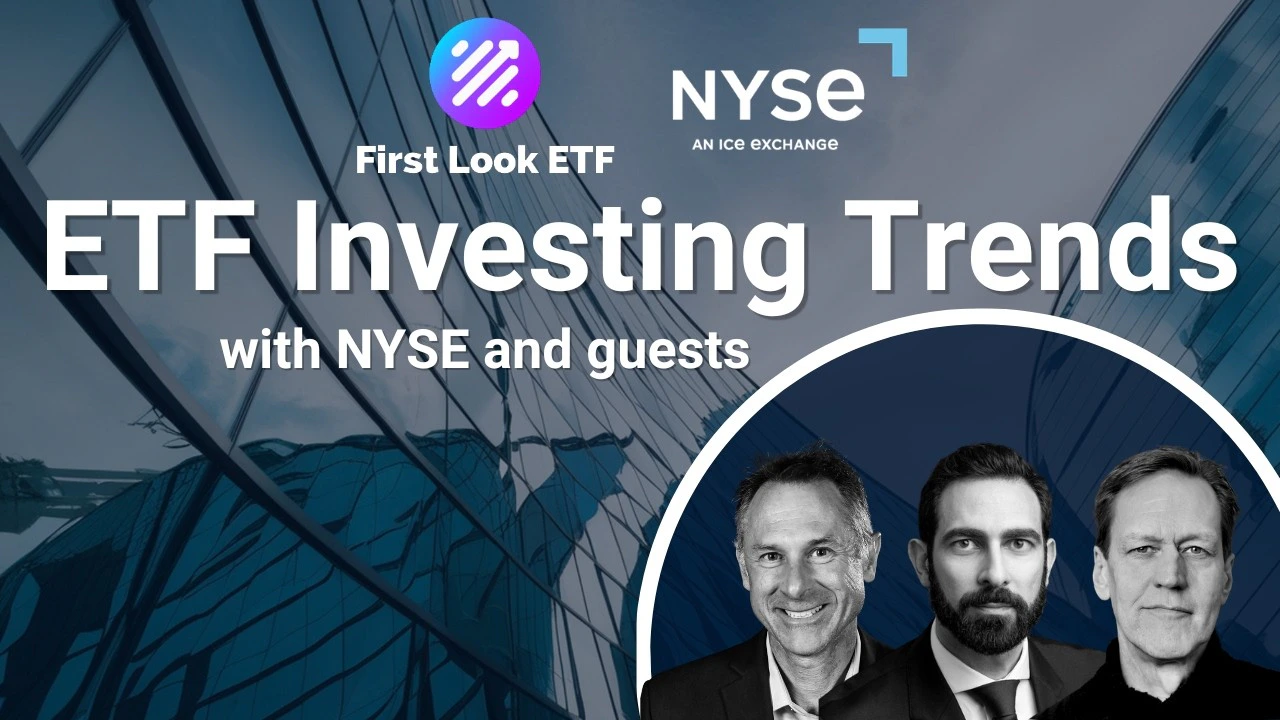
First Look ETF: Cash Deployment, Bond, and Hedged ETFs
In this season 6 episode of First Look ETF, Stephanie Stanton examines the latest ETF marketplace trends with NYSE and guests.

ETF Trends
ETF Industry KPIs July 6, 2026
This week’s KPI data overview highlights key metrics and trends shaping the ETF landscape.
Browse all educational columns



Expert-Built ETF Portfolios, All in One Place
Don’t start from scratch. Discover ready-made ETF portfolios built by professionals to match different goals, timelines, and market views. Use them as inspiration or as a starting point for your own allocation.