Open Now: The Global ETF Survey Take the Survey →



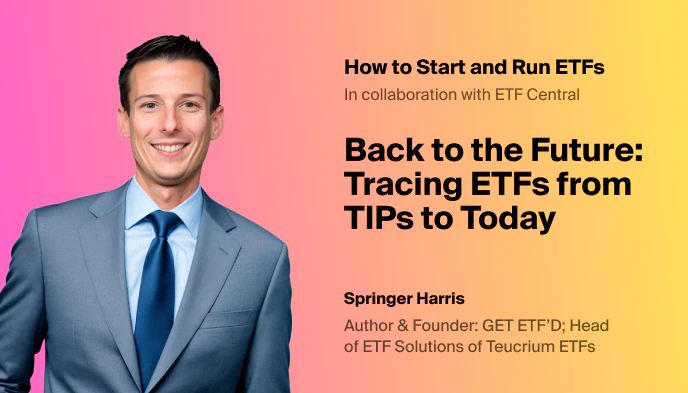
Back to the Future: Tracing ETFs from TIPs to Today
Unlock the evolution of ETFs from inception to innovation. Learn about their roots, stages, technological advances, and regulatory reforms.

Keep up with what matters in ETFs
Get timely ETF insights, market trends, and top ideas straight to your inbox.
Your newsletter subscriptions with us are subject to ETF Central's Privacy Policy and Terms and Conditions.
Understanding the Roots of ETFs
"Study the past if you would define the future." – Confucius
Get data on 14,000+ ETFs
Access Trackinsight's reliable and comprehensive data with 500M+ points on 14,000+ ETFs.
I know what you're thinking—kicking off an ETF article with an ancient Chinese philosopher might seem out of left field or even a tad cliché. But stick with me here; ETFs haven't been around nearly as long as Confucius's ideas, but they've made a significant mark in a short time.
The journey began in 1990 with the Toronto 35 Index Participation Units (TIPs). Yet, the real game-changer was the launch of the SPDR S&P 500 ETF Trust (SPY) in 1993. This ETF was designed to mirror the S&P 500 Index, offering investors a straightforward and cost-effective way to tap into the U.S. stock market. It quickly became a hit due to its novel tax-efficient structure and on-demand trading directly on the stock exchange. This set off rapid growth across the ETF sector. SPY is the most actively traded ETF in the world, with over $500 billion in AUM.
The Stages of ETF Evolution
The ETF landscape has come a long way from its early days, growing from about 300 in 2003 to nearly 12,000 ETFs, with almost $12 trillion managed globally by the end of 2023. This expansion happened in waves:
- ETF 1.0: Started in 1993 with ETFs that focused on broad-market indexes like the S&P 500.
- ETF 2.0: Came along in the early 2000s, expanding into various sectors, countries, and asset classes for better diversification.
- ETF 3.0: Introduced in the late 2000s, smart-beta and factor-based ETFs mixed with passive and active management strategies.
- ETF 4.0: Since the mid-2010s, this phase has centered on actively managed and thematic ETFs, targeting niche sectors and new ideas.
- ETF 5.0: Now in the 2020s, this phase uses blockchain for transparency and AI for dynamic management and explores new asset classes to meet evolving investor needs.
- ??? ETF 6.0: Should You Launch Your Own ETF? – Yes! Because you have the power to define the next stage of ETF development.
The Influence of Small and Independent ETF Issuers
Small and independent issuers have been the driving force behind the evolution of the ETF industry. While big institutions often stick to broad market indices and classic strategies, these smaller players are the real innovators, continually pushing what ETFs can do. Their efforts ensure the steady introduction of new ETF strategies and structures, broadening investment options even further.
Technological Advances Driving ETF Growth
Technology continues to make ETFs more popular and practical. Advanced trading algorithms and enhanced back-office operations have reduced trading costs and operational burdens, making ETFs a more attractive and affordable option for investors. Moreover, the surge of digital platforms and robo-advisors has made it easier for investors to integrate ETFs into their portfolios at a lower cost than traditional mutual funds. This tech integration appeals to younger, tech-savvy investors, pushing ETF adoption further.
The Impact of White-Label ETF Platforms
White-label ETF platforms have drastically reduced entry barriers for new issuers by offering infrastructure, regulatory expertise, and distribution capabilities. These platforms provide all-in-one solutions that cover the operational, regulatory, and distribution aspects of launching an ETF, keeping the industry innovative and competitive. They've also enabled many niche ETFs to emerge, letting smaller issuers concentrate on strategy and product differentiation.
Regulatory Reforms: What is The ETF Rule?
The introduction of the SEC’s ETF Rule in 2019 was a significant industry milestone. It created a standardized framework for most ETFs and leveled the playing field for issuers, both new and established. This rule removed the need for issuers to seek exemptive relief from the SEC, a previously long and expensive process. The ETF Rule has significantly eased the launch of a diverse range of funds, meeting various investor needs and preferences, and has been a key driver of growth and innovation in the ETF market.
Gearing Up for the Future
Launching an ETF isn't just a smart move—it's your entry ticket into one of the most progressive areas in finance. The ETF industry is unique; competitors often collaborate, sharing what’s next and working together to innovate. Starting your ETF is entirely feasible with lower costs and more support available than ever.
The benefits? You're at the cutting edge, driving the evolution of finance, expanding your reach, and potentially increasing your earnings. Are you thinking of joining the ETF revolution? I bet you have the idea within you to start your own ETF 6.0.
My articles are here to help you do exactly that. Together, we will unlock the potential of ETFs to transform your financial strategies into a successful ETF business. My mission is to equip you with the knowledge and confidence to successfully enter the ETF market.
About the Author
Springer Harris, author of "GET ETF’D: An Insider's Guide to Starting and Running an ETF," focuses on simplifying the complexities of launching and managing ETFs to empower entrepreneurs. He discusses the detailed processes and challenges of successfully introducing ETFs to the market in his writings. As Chief Operating Officer and Head of ETF Solutions at Teucrium ETFs, Springer has helped a broad spectrum of clients, from individuals to large asset managers, launch their ETFs efficiently. Connect with Springer on LinkedIn for more insights or help starting your ETF.
Please note this article is for information purposes only and does not in any way constitute investment advice. It is essential that you seek advice from a registered financial professional prior to making any investment decision.


Latest ETF News
See all ETF newsETF Creation Windows Matter More Than You Think


Why the Time of Day Matters When Trading an ETF

The Leveraged ETF Question Nobody Is Asking





 Advantages of ETFs over Mutual Funds1/6
Lower Costs
In this guide, we'll explore the advantages of ETFs over mutual funds, giving you valuable insights into why ETFs have gained significant popularity among investors like yourself.
Leveraged ETFs: Unlocking the Potential for Amplified Returns1/6
Understanding Leveraged ETFs
Explore leveraged ETFs: potential for amplified returns & risks. 5 ETFs to consider across equities, commodities & fixed income.
What is a Leveraged ETF?1/6
Introducing Leveraged and Inverse ETFs
In this guide, we'll dive into the world of leveraged ETFs, exploring their definition, mechanics, potential risks, and rewards.
Recent educational content
First Look ETF
First Look ETF: Cycle Aware Investing & Next-Gen Nicotine Shifts
In this season 6 episode of First Look ETF, Stephanie Stanton examines the latest ETF marketplace trends with NYSE and guests.


ETF Trends
ETF Industry KPIs August 10, 2026
This week’s KPI data overview highlights key metrics and trends shaping the ETF landscape.

ETF Trends
ETF Industry KPIs July 20, 2026
This week’s KPI data overview highlights key metrics and trends shaping the ETF landscape.
ETF Trends
ETF Industry KPIs July 13, 2026
This week’s KPI data overview highlights key metrics and trends shaping the ETF landscape.
Browse all educational columns



The ETF Industry Is Evolving Fast
From AI infrastructure to active strategies, the ETF landscape is shifting. Share your perspective in the 7th Annual Global ETF Survey and get exclusive early access to the final report.