Keep tabs on your favorite ETFs with a personalized weekly tracker. Create a Watchlist now →



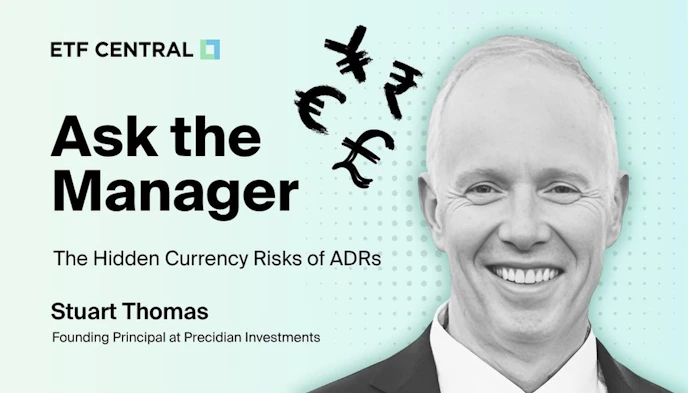
Ask the Manager: Stuart Thomas on the Hidden Currency Risks of ADRs
Stuart shares how this overlooked risk in ADRs could be dragging your returns.

Keep up with what matters in ETFs
Get timely ETF insights, market trends, and top ideas straight to your inbox.
Your newsletter subscriptions with us are subject to ETF Central's Privacy Policy and Terms and Conditions.
Welcome to Ask the Manager, ETF Central's series where we interview top experts, analysts and portfolio managers to dive into the latest investment trends, market updates, and economic insights.
We recently chatted with Stuart Thomas, Founding Principal at Precidian Investments, about the $1 trillion in hidden currency risk facing U.S. investors holding international stocks.
His team’s fix? ADRhedged™ ETFs — a first-of-its-kind solution that pairs foreign ADRs with built-in currency protection.
What risk are investors overlooking when they buy international stocks like ADRs?
With more than 50% of the global market capitalization residing outside the United States, investors realize that a well-diversified portfolio needs to include international securities.
What many investors may not be aware of, is that investing in securities of foreign companies through American Depositary Receipts (ADRs) or foreign ordinary shares doesn’t just give you exposure to the underlying company but also gives you dollar for dollar exposure to the underlying foreign currency.
As an example, when an investor purchases $10,000 dollars of Toyota Motor (TM) on the NYSE, embedded in that transaction is a corresponding $10,000 dollar exposure to the Yen. With volatility in the global currency markets heating up, this can have a profound impact on returns, something all investors need to be aware of.
If I’m buying ADRs in U.S. Dollars on regulated U.S. stock exchanges, why do I have currency exposure?
It’s important to remember that while you are buying an ADR in U.S. dollars on a U.S. exchange, the underlying company is domiciled in a country outside the U.S. and the valuation of that company is always expressed in local currency terms. It is as if you are converting your dollars to the local currency to purchase the security on the foreign market.
Therefore, when calculating the investment return of a transaction, any divergence between the exchange rate of the local currency and the U.S. dollar will greatly impact the returns of American investors.
How does the foreign currency exposure impact the returns of U.S. listed ADRs?
Since ADRs are backed by the local shares of the issuing company, the local returns of those shares must be translated back into U.S. dollar. Therefore, in times of U.S. dollar outperformance relative to the local currency of the issuing company, you can expect your ADRs to underperform the local shares.
Why has this risk not been highlighted in the past?
Up until the last decade or so, currency volatility was usually not as extreme as we are witnessing now. Therefore, there was a belief that the impact of currency on the underlying company would equalize over some period, so it was common practice to ignore it.
More importantly, for most investors (even certain institutional investors like those running SMA accounts) there wasn’t an efficient way to hedge the volatility associated with the currency exposure of foreign investments.
In fact, up until October 2024, most investors were generally only able to hedge that risk for an entire index through currency-hedged ETFs. For investors looking to hedge the currency exposure of individual foreign companies or a portion of a portfolio, most had no access to the tools that would enable them to do so.
What is the solution for someone looking to hedge the currency of individual foreign securities?
In October 2024, Precidian Investments subsidiary, Precidian Funds, an industry leader of innovate solution-based products, rolled out the first in a growing series of currency hedged ADRs.
Known as ADRhedged ETFs, each security consists of shares of an ADR plus a hedging instrument designed to mitigate the volatility between the local currency and the U.S. dollar. For the first time, investors can purchase individual foreign ADRs with a built-in currency hedge. Currently there are 11 ADRhedged ETFs listed on NYSE ARCA.
- AstraZeneca PLC ADRhedged™ (AZNH)
- HSBC Holdings plc ADRhedged™ (HSBH)
- Shell plc ADRhedged™ (SHEH)
- BP p.l.c. ADRhedged™ (BPH)
- GSK plc ADRhedged™ (GSKH)
- Novo Nordisk A/S (B Shares) ADRhedged™ (NVOH)
- SAP SE ADRhedged™ (SAPH)
- Arm Holdings PLC ADRhedged™ (ARMH)
- ASML Holding NV ADRhedged™ (ASMH)
- STMicroelectronics NV ADRhedged™ (STHH)
- Toyota Motor Corporation ADRhedged™ (TMH)
Are there any plans to bring more ADRhedged ETFs to market?
Yes, Precidian Funds has SEC approval to bring an additional 37 securities to market as demand warrants.
Where can I find more information on ADRhedged ETFs?
Go to, https://adrhedged.com/ or contact your broker.
Global ETF Survey 2026 is Live!
With 1,790 new products launched by July 2026, choosing is harder than ever. Our Global ETF Survey 2026, built on 620 professional investors and allocators, shows how active, fixed income, options-based and thematic ETFs are reshaping fund selection.
About Stuart Thomas
Mr. Thomas began his career at Merrill Lynch, where he spent more than 10 years working as a U.S. International Equity Salesman, Senior Deal Manager on the Equity Syndicate Desk, and Manager of the Convertible Sales & Marketing Desk before moving to Morgan Stanley. While at Morgan Stanley, Mr. Thomas is widely credited with creating their retail exchange-traded fund business. He served as Manager of the ETF Sales and Trading Department until his promotion to First Vice President, Director of Equity Capital Markets Sales. On behalf of the World Gold Council, he started World Gold Trust Services in August 2002 to create, manage, and market the first U.S. commodity-backed equity traded on an exchange, SPDR Gold Shares (GLD). In 2005 Mr. Thomas co-founded M7 Ventures (now Precidian Investments) with his partners to create innovative IP in the ETF space. In 2006, Precidian developed the first “physically-backed” currency ETFs and, along with Rydex Investments, launched, CurrencyShares® on the NYSE. Since 2006, Precidian Investments has created a number of unique patent-protected ETF structures including ADRhedged®, Managed Distribution ETFs, and the industry changing ActiveShares® ETF which was approved in May 2019.
Please note this article is for information purposes only and does not in any way constitute investment advice. It is essential that you seek advice from a registered financial professional prior to making any investment decision.
Segments
See all
Mentioned ETFs
Further reading


Latest ETF News
See all ETF newsAsk the Manager: Pieter Vorster on the NICO ETF and the Nicotine Transition
Ask the Manager: Tian Yang on Capital Cycle Investing and the VPX ETF

Ask the Manager: Kenneth Wong on Building the Next Wave of ETF Innovation, from Options to Korea's AI Semiconductor Opportunity



 Advantages of ETFs over Mutual Funds1/6
Lower Costs
In this guide, we'll explore the advantages of ETFs over mutual funds, giving you valuable insights into why ETFs have gained significant popularity among investors like yourself.
Leveraged ETFs: Unlocking the Potential for Amplified Returns1/6
Understanding Leveraged ETFs
Explore leveraged ETFs: potential for amplified returns & risks. 5 ETFs to consider across equities, commodities & fixed income.
What is a Leveraged ETF?1/6
Introducing Leveraged and Inverse ETFs
In this guide, we'll dive into the world of leveraged ETFs, exploring their definition, mechanics, potential risks, and rewards.
Recent educational content

ETF Trends
ETF Industry KPIs October 5, 2026
This week’s KPI data overview highlights key metrics and trends shaping the ETF landscape.

ETF Trends
ETF Industry KPIs September 28, 2026
This week’s KPI data overview highlights key metrics and trends shaping the ETF landscape.
ETF Trends
ETF Industry KPIs September 22, 2026
This week’s KPI data overview highlights key metrics and trends shaping the ETF landscape.
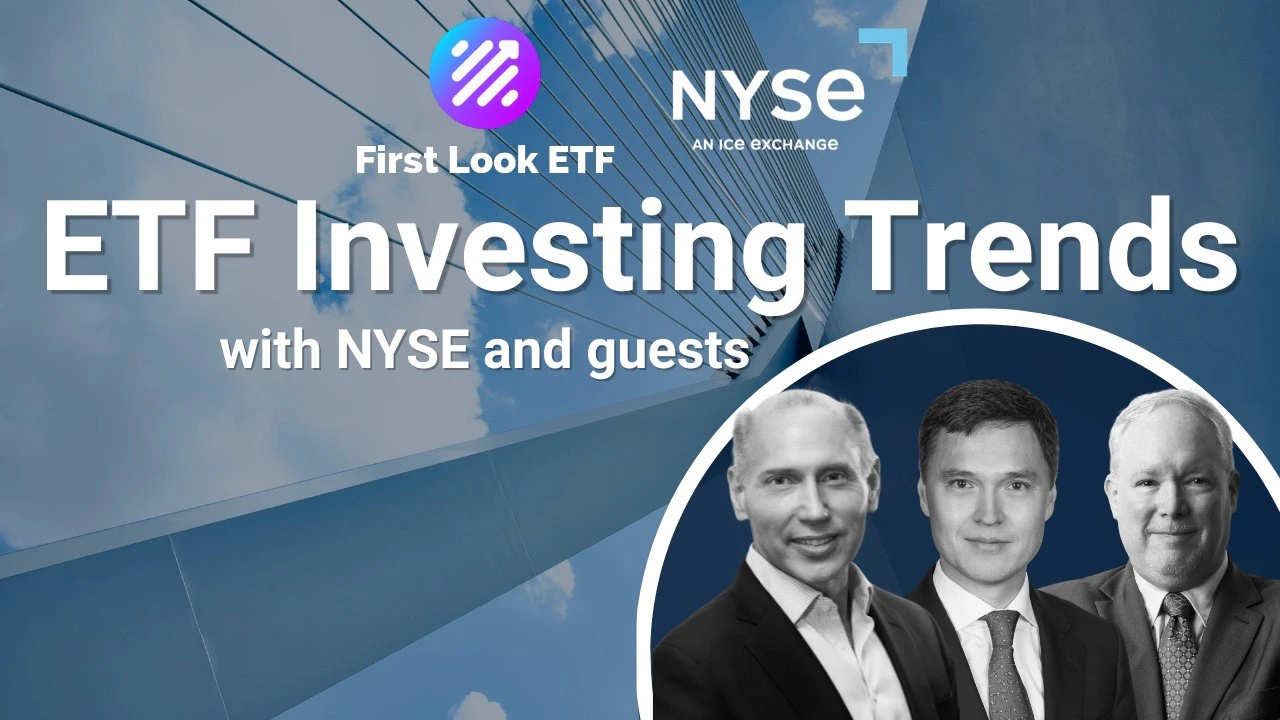
First Look ETF
First Look ETF: Income, Corporate Arbitrage, and Growth and Value Investing
First Look ETF September 2026: iCapital, Mast Investments and North Square unpack new ETFs targeting monthly income, merger arbitrage and complementary growth and value exposure.

Browse all educational columns



ETFs’ Next Act: From Access to Selection
With 1,790 new products launched by July 2026, choosing is harder than ever. Our Global ETF Survey 2026, built on 620 professional investors and allocators, shows how active, fixed income, options-based and thematic ETFs are reshaping fund selection.