From idea to ETF portfolio in minutes. Build yours now →



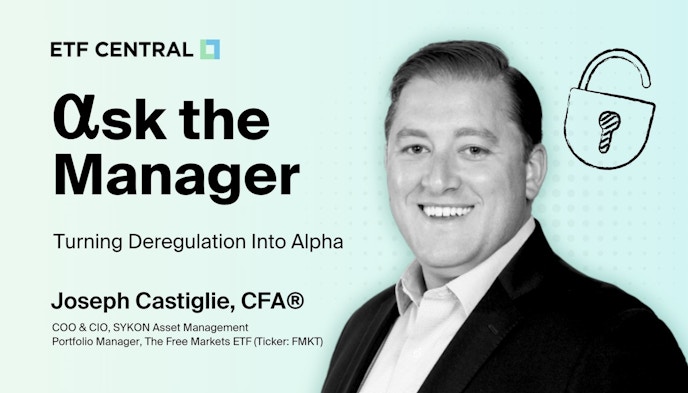
Ask the Manager: Joseph Castiglie on Turning Deregulation Into Alpha
Can deregulation drive alpha? Joseph Castiglie thinks so—and he’s betting on it

Keep up with what matters in ETFs
Get timely ETF insights, market trends, and top ideas straight to your inbox.
Your newsletter subscriptions with us are subject to ETF Central's Privacy Policy and Terms and Conditions.
In this edition of Ask the Manager, we caught up with Joseph Castiglie, COO and CIO of SYKON Asset Management, to unpack the strategy behind The Free Markets ETF (FMKT).
How do you turn deregulation into alpha?
Castiglie walks us through SYKON’s approach, focusing on sectors like energy, financials, and healthcare, where policy shifts can have a material impact.
By combining active management with tools that track regulatory momentum, the team aims to identify companies best positioned to benefit from a changing policy landscape.
What is your role, and your firm’s role, within the FMKT ETF?
SYKON Asset Management is one of the three sub-advisers of The Free Markets ETF (Ticker: FMKT), where we work with the fund adviser to maintain an actively managed portfolio that capitalizes on free markets and deregulation.
As one of the portfolio managers, I aim to identify investment opportunities from changes in the regulatory environment, while maintaining an active, risk managed portfolio construction process.
What are the levers that the Trump administration can use to promote economic growth in his second term?
There are several sectors that can have an outsized effect in promoting economic growth throughout this term.
Easing capital requirements for banks would allow them to deploy more capital for business investment, while potentially lowering capital costs due to increased liquidity in the system.
Additionally, several executive orders aim to reshape the nuclear landscape in the US, which can enhance the stability and availability of our energy grid, lowering costs for consumers and companies alike, as the expectations for increased demand rise in the face of the growing use of AI and data centers.
What is the impact of regulation on the American economy?
The amount of Federal regulation has steadily grown for decades, regardless of the political party in the White House. This regulation costs an estimated $2.1 trillion annually or roughly $15,000 per household.
A hidden cost of this increasing burden is the missed opportunity cost stemming from fewer people choosing an entrepreneurial path as a small business owner.
Why would the impact of regulation be different now versus prior attempts to reduce the regulatory burden in the American economy? What is the specific difference today?
In July of last year, the Supreme Court overturned the Chevron Doctrine, in which Federal agencies were given some degree of deference by the courts in their ability to interpret and enforce Federal regulations, a ruling Chief Justice Roberts said was incompatible with the courts’ fundamental duty to interpret the law.
This change could effectively undermine Federal regulators in their efforts to enforce vague or unclear laws, while systematically opening the door to numerous legal challenges to prior court cases that relied on the Chevron Doctrine since its establishment in 1984.
How can you quantify a company’s ability to benefit from changes in regulatory policy?
We start by targeting industries with high regulatory cost burdens and then score companies based on a range of financial metrics, such as operating margin and SG&A efficiency, to better understand their potential to benefit from reduced regulation.
The logic behind this is that companies that can efficiently manage operations despite higher regulatory expense will likely achieve even greater efficiency when those costs decline.
Are there specific sectors you expect to benefit from deregulation more than others?
In an earlier question, I addressed the potential for benefits in both the financial and energy sectors, both of which I believe are particularly leveraged to lower regulation.
Health care would be another sector that could experience significant gains from deregulation, as many executive orders have been issued that will bring changes that streamline FDA approvals, revise Medicare Drug Price Negotiation rules, and provide incentives for domestic manufacturing.
What tools are you using to measure a company’s momentum with respect to policy changes?
We’ve developed an AI screening tool, our R2Q system, to cross-check corporate filings, earnings calls, and policy databases for direct regulatory tailwinds and policy momentum.
As the pace of deregulation has increased, this has allowed us to analyze an increasing number of data points to specifically target and rank companies that exhibit a higher propensity to benefit from deregulation.
What are a few of your top holdings in the fund?
Well, three of our top holdings reflect the sectors that I had highlighted in the prior questions – financials, energy, and healthcare.
In the financial space, we have RobinHood (Ticker: HOOD), which we believe is uniquely positioned to benefit from recent executive orders that affect crypto currencies and digital assets, as well as AI deployment in the fintech space.
In the energy sector, we have Uranium Energy Corp (Ticker: UEC), which stands to benefit from faster reactor approvals and advances in the deployment of small modular reactors.
Lastly, we have McKesson (Ticker: MCK) in the healthcare sector, which could see tremendous benefits from streamlined FDA approvals and domestic manufacturing incentives.
Get data on 14,000+ ETFs
Access Trackinsight's reliable and comprehensive data with 500M+ points on 14,000+ ETFs.
About Joseph P. Castiglie III, CFA®
Joseph Castiglie is the COO and CIO of SYKON, where he leads investment strategy and operations, focusing on portfolio optimization and risk management using disciplined portfolio management techniques that integrate traditional financial theory and the principles of behavioral finance.
In his role as Portfolio Manager of the Free Markets ETF (FMKT), Joe uses financial and market data to identify investment opportunities that may arise from regulatory changes and macroeconomic trend shifts.
Joe maintains a focus on delivering clear and actionable insights that are guided by disciplined, process-oriented risk management, whether he is managing an investment mandate for a public ETFs or managing private client assets.
Please note this article is for information purposes only and does not in any way constitute investment advice. It is essential that you seek advice from a registered financial professional prior to making any investment decision.
Segments
See all
No specific market segments were tagged
Mentioned ETFs
Further reading

Latest ETF News
See all ETF news
Ask the Manager: Kenneth Wong on Building the Next Wave of ETF Innovation, from Options to Korea's AI Semiconductor Opportunity
Ask the Manager: Kristof Gleich on Why AI Is Becoming an Asset Class
Ask the Manager: Vince Lorusso on Active Equity in an AI-Driven Market





 Advantages of ETFs over Mutual Funds1/6
Lower Costs
In this guide, we'll explore the advantages of ETFs over mutual funds, giving you valuable insights into why ETFs have gained significant popularity among investors like yourself.
Leveraged ETFs: Unlocking the Potential for Amplified Returns1/6
Understanding Leveraged ETFs
Explore leveraged ETFs: potential for amplified returns & risks. 5 ETFs to consider across equities, commodities & fixed income.
What is a Leveraged ETF?1/6
Introducing Leveraged and Inverse ETFs
In this guide, we'll dive into the world of leveraged ETFs, exploring their definition, mechanics, potential risks, and rewards.
Recent educational content

ETF Trends
ETF Industry KPIs September 14, 2026
This week’s KPI data overview highlights key metrics and trends shaping the ETF landscape.

ETF Trends
ETF Industry KPIs September 8, 2026
This week’s KPI data overview highlights key metrics and trends shaping the ETF landscape.
ETF Trends
ETF Industry KPIs August 31, 2026
This week’s KPI data overview highlights key metrics and trends shaping the ETF landscape.
ETF Trends
ETF Industry KPIs August 24, 2026
This week’s KPI data overview highlights key metrics and trends shaping the ETF landscape.
Browse all educational columns



Build and Analyze Your ETF Portfolio Like a Pro
Create your own ETF portfolio in minutes and instantly see allocations, exposures, performance, and risk. Visualize diversification across asset classes, regions, and sectors. Stress-test ideas, compare benchmarks, and refine your strategy with professional-grade analytics.